I used to think I was healthy. I exercised regularly. I ate reasonably well. I got enough sleep. But something was off. I felt drained, unmotivated, and disconnected from the people around me. It took me a long time to realize that physical health alone was not enough.
That is when I started learning about the dimensions of wellness. And I realized that true well-being is not about one area. It is about balance across multiple dimensions. Understanding the dimensions of wellness completely changed how I think about health and helped me build a more sustainable approach to feeling good.
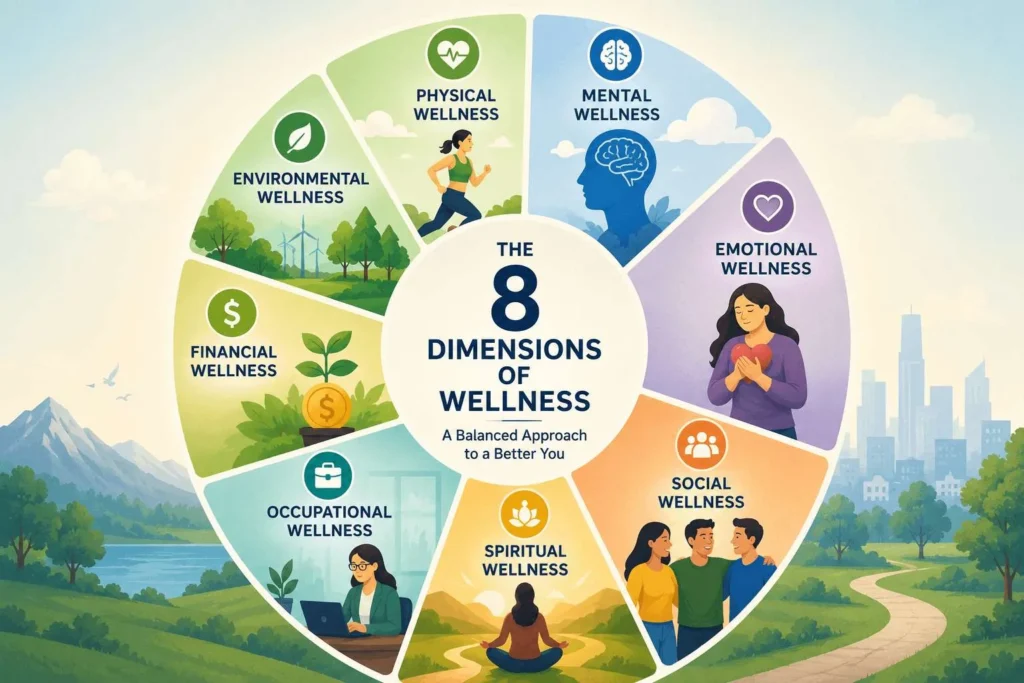
The 8 dimensions of wellness are physical, mental, emotional, social, spiritual, occupational, financial, and environmental areas that together determine overall well-being.
Wellness is not just physical health. It is mental health, emotional health, social connection, finding meaning in work, managing finances, and even the spaces where you live and work. Each area affects the others. Neglect one, and the rest eventually suffer.
The dimensions of wellness are the interconnected areas of life that contribute to overall well-being. Most wellness frameworks identify 6 to 8 dimensions, including physical, mental, emotional, social, spiritual, occupational, financial, and environmental wellness. Understanding each dimension helps you create a more balanced and fulfilling life.
Many universities, workplace wellness programs, and public health organizations use wellness dimension frameworks to promote long-term health and well-being. These frameworks help people understand that health is not just about physical fitness but about creating balance across multiple areas of life. Research from institutions like Harvard Health and the National Institutes of Health consistently shows that well-being requires attention to multiple dimensions, not just physical health.
According to the World Health Organization’s well-being framework, health is “a state of complete physical, mental, and social well-being and not merely the absence of disease or infirmity.” Similarly, a Harvard Health article on social connection highlights that strong relationships are associated with better physical health and greater longevity. The National Institutes of Health also emphasizes that mental health is an essential component of overall well-being and requires active attention
What Are the Dimensions of Wellness?
The dimensions of wellness are the different areas of life that contribute to your overall well-being. They are interconnected. Each dimension influences the others. When one area is neglected, it creates a ripple effect that can disrupt other areas.
Most wellness frameworks identify six to eight dimensions. The number varies depending on the model, but the core areas remain consistent. The National Wellness Institute identifies six dimensions: physical, mental, emotional, social, spiritual, and occupational. Other models add financial and environmental wellness, bringing the total to eight
Understanding these dimensions helps you recognize that well-being is not just about one thing. It is about balance. You can be physically fit but still feel unwell if your emotional or social needs are not being met. You can be financially stable but struggle if your work lacks meaning.
The dimensions of wellness are not separate boxes. They overlap constantly. Improving one often helps another. Neglecting one drags down the rest.
Wellness Wheel: Understanding the 8 Dimensions of Wellness
Many wellness organizations use a wellness wheel to illustrate how the dimensions of wellness connect. Instead of existing separately, each dimension influences the others. When one area becomes neglected, it can affect overall well-being.
Imagine the dimensions as spokes on a wheel:
- Physical Wellness
- Mental Wellness
- Emotional Wellness
- Social Wellness
- Spiritual Wellness
- Occupational Wellness
- Financial Wellness
- Environmental Wellness
A balanced wheel rolls smoothly. When one spoke is significantly weaker than the others, maintaining overall wellness becomes more difficult. This visual model helps explain why focusing on only one dimension often fails to improve overall well-being.
I spent years focusing almost entirely on physical wellness while ignoring social and emotional dimensions. My wheel was unbalanced. I was exercising regularly and eating well, but I was isolated and stressed. The wheel wobbled constantly.
Why the Dimensions of Wellness Matter
The dimensions of wellness matter because they provide a framework for understanding what contributes to your overall well-being. Instead of vague goals like “be healthier,” you can identify specific areas to work on.
Why understanding wellness dimensions is useful:
- It helps you identify which areas of your life need attention
- It prevents you from focusing too much on one area while neglecting others
- It shows you how different areas of your life are connected
- It gives you a clearer path to improving your overall well-being
For a long time, I focused almost entirely on physical wellness. I exercised. I tried to eat well. But I ignored my social and emotional needs. I spent years working long hours without real connection. I assumed that being healthy meant being physically fit. Then I burned out.
Eventually I realized that wellness is not about being perfect in every dimension. It is about being aware of each dimension and making small, consistent improvements. You do not need to fix everything at once. But you do need to understand what you are working toward.
This is where people often get stuck. They try to improve everything at once and end up overwhelmed. Or they focus on one area and ignore the rest, only to find that their overall well-being does not improve.
Physical Wellness
Physical wellness is the dimension that gets the most attention. It is the easiest to measure and the most visible. Steps, pounds, hours of sleep, minutes of exercise. But physical wellness is about more than numbers.
Physical wellness involves taking care of your body through regular movement, proper nutrition, adequate sleep, and avoiding harmful habits. It means listening to your body’s signals and responding to what it needs.
Key aspects of physical wellness:
- Regular physical activity, even if it is just walking
- Balanced nutrition with plenty of vegetables and protein
- Consistent sleep schedule and adequate rest
- Staying hydrated throughout the day
- Limiting alcohol and avoiding smoking
- Taking breaks from sitting during the day
What I learned the hard way was that extreme approaches do not work. I went through phases of intense exercise followed by months of doing nothing. I tried restrictive diets that left me tired and craving everything. Eventually I realized that consistency matters more than intensity. A twenty-minute walk I actually do is more valuable than an hour-long workout I quit after two weeks.
Physical wellness is the foundation for other dimensions. When your body feels good, you have more energy and capacity to focus on mental, emotional, and social wellness.
Practical steps for physical wellness:
- Move your body daily, even if it is just a short walk
- Eat a balanced diet with plenty of whole foods
- Prioritize sleep by going to bed at a consistent time
- Drink water throughout the day
- Schedule regular checkups with healthcare providers
Mental Wellness
Mental wellness is about how you process information, handle challenges, and maintain focus. It includes cognitive flexibility, problem-solving ability, and the capacity to manage the demands of daily life.
For me, mental wellness was the area I neglected most. I assumed that as long as I was not anxious or depressed, my mental health was fine. But mental wellness is not just about avoiding mental illness. It is about actively building the mental capacity to handle whatever life throws at you.
Key aspects of mental wellness:
- Cognitive flexibility and adaptability
- Problem-solving skills
- Ability to maintain focus and attention
- Curiosity and willingness to learn
- Awareness of thinking patterns
Digital overload has made mental wellness harder. Constant notifications, short-form videos, and endless scrolling have rewired attention spans. Mental wellness today means deliberately protecting your attention and creating space for deeper thinking.
Practical steps for mental wellness:
- Read regularly, even if it is just a few pages a day
- Limit digital distraction and screen time
- Practice focusing on one task at a time
- Learn something new that challenges your brain
- Take breaks throughout the day to clear your mind
Emotional Wellness
Emotional wellness is often confused with being happy all the time. That is not what it means. Emotional wellness is about understanding and managing your emotions, not avoiding negative ones.
I used to think that emotional wellness meant staying calm and composed no matter what. I would suppress frustration, swallow anger, and pretend I was not stressed. That approach worked for a while. Then it did not.
Key aspects of emotional wellness:
- Recognizing and naming your emotions
- Understanding why you feel what you feel
- Expressing emotions in healthy ways
- Building resilience and recovering from setbacks
- Managing stress effectively
What I eventually realized is that emotions are information. They tell you something about what is happening in your life and what you need. Suppressing them does not make them disappear. It just stores them up for later.
Practical steps for emotional wellness:
- Practice naming your emotions without judgment
- Develop healthy ways to manage stress, like deep breathing or journaling
- Build a vocabulary for your feelings beyond “good” and “bad”
- Allow yourself to feel difficult emotions without trying to fix them immediately
- Seek support when you need it, whether from friends, family, or professionals
Social Wellness
Social wellness is about the quality of your relationships and your sense of belonging. It includes your ability to build and maintain meaningful connections with others.
Social wellness is often overlooked, partly because it can feel less urgent than physical or mental health. But research from Harvard Health and other institutions consistently shows that strong social relationships are associated with better physical health, lower stress levels, and greater longevity. According to a Harvard Health article, social connection is one of the strongest predictors of overall well-being.
Key aspects of social wellness:
- Quality of relationships, not just quantity
- Communication and listening skills
- Sense of belonging and community
- Ability to give and receive support
- Healthy boundaries in relationships
Looking back, most of my friendships survived on proximity rather than intention. If someone moved away or changed jobs, we slowly stopped talking. When I started being more deliberate about who I spent time with and how I showed up in relationships, everything shifted.
Practical steps for social wellness:
- Prioritize time with people who genuinely support you
- Practice active listening when others speak
- Reach out to friends and family regularly, even just to check in
- Join groups or activities that connect you with people who share your interests
- Set boundaries with people who drain your energy
Spiritual Wellness
Spiritual wellness is the most misunderstood dimension. Many people assume it means being religious, and if they are not religious, they disregard it entirely.
But spiritual wellness is not necessarily about religion. It is about finding meaning, purpose, and a sense of connection to something larger than yourself. This might be through organized religion, but it could also be through nature, art, community service, or personal values.
Key aspects of spiritual wellness:
- Sense of meaning and purpose
- Connection to something larger than yourself
- Alignment with personal values
- Openness to questions about life and purpose
For me, spiritual wellness meant figuring out what I actually believe and what matters to me. It is not about having all the answers. It is about asking the questions and being open to what you find.
Practical steps for spiritual wellness:
- Reflect on what gives your life meaning and purpose
- Spend time in nature
- Practice mindfulness or meditation
- Identify your core values and use them to guide decisions
- Engage in activities that make you feel connected to something greater
Occupational Wellness
Occupational wellness is about finding satisfaction and purpose in your work. It does not mean you have to love every second of your job, but it does mean finding some sense of meaning and engagement in what you do.
I spent years in jobs that paid the bills but left me feeling drained. I assumed that work was just something you endured to earn money. It took me a long time to realize that occupational wellness matters for overall well-being.
Key aspects of occupational wellness:
- Finding meaning and purpose in your work
- Work-life balance and boundaries
- Positive relationships with colleagues
- Opportunities for growth and learning
- Work that aligns with your values
Practical steps for occupational wellness:
- Find work that aligns with your values and interests
- Set boundaries between work and personal time
- Take regular breaks during the workday
- Seek growth and learning opportunities at work
- Build positive relationships with colleagues
Financial Wellness
Financial wellness is often excluded from older wellness models, but it is increasingly recognized as essential to overall well-being. Financial wellness involves managing your financial resources in a way that reduces stress and supports your goals.
I used to think financial wellness only mattered when money was tight. What surprised me was how much mental energy even small financial worries consumed. A bill I forgot about could distract me for days and affect my focus, sleep, and mood.
Key aspects of financial wellness:
- Managing expenses within your means
- Reducing financial stress and anxiety
- Planning for short-term and long-term goals
- Building financial literacy and confidence
- Creating financial habits that support well-being
Practical steps for financial wellness:
- Track your spending to understand where your money goes
- Create a budget that aligns with your values and goals
- Build an emergency fund for unexpected expenses
- Seek financial education and resources
- Address financial stress with practical strategies
Environmental Wellness
Environmental wellness involves creating spaces that support your health and well-being. Your home, your workspace, your community. It also includes awareness of the broader environment and your impact on it.
I did not realize how much my physical environment affected my mood until I spent months working in a dark, cluttered room during remote work. Creating a space that actually felt good to be in made a surprising difference.
Key aspects of environmental wellness:
- Creating comfortable, calming physical spaces
- Reducing clutter and noise
- Spending time outdoors
- Awareness of environmental impact
- Access to safe and supportive communities
Practical steps for environmental wellness:
- Create spaces that feel comfortable and calming
- Declutter your physical surroundings regularly
- Spend time outdoors when possible
- Reduce exposure to noise and digital clutter
- Support sustainable practices in your daily life
How the Dimensions of Wellness Connect
The dimensions of wellness are not separate. They overlap constantly. Improving one often helps another. Neglecting one drags down the rest.
Examples of how dimensions connect:
- Regular exercise (physical) improves mood (emotional) and reduces stress (emotional)
- Strong relationships (social) provide support during difficult times (emotional)
- Meaningful work (occupational) contributes to sense of purpose (spiritual)
- Financial stability (financial) reduces stress (emotional) and improves sleep (physical)
- A calm environment (environmental) supports focus (mental) and relaxation (emotional)
This interconnectedness is why a holistic approach matters. You cannot fix one dimension in isolation and expect overall well-being to improve. The dimensions of wellness work together. When you improve one, the others benefit.
The most significant improvements came from working on multiple dimensions at once, even if the changes in each area were small. A morning walk improved my physical health and cleared my mind. Spending time with friends improved my social wellness and lifted my mood. Creating a comfortable workspace reduced stress and improved my focus.
Modern Challenges Across the Dimensions of Wellness
The dimensions of wellness have always existed, but modern life has created new challenges that affect nearly every area of well-being.
Digital overload affects mental wellness by reducing attention spans and increasing distraction. Constant notifications, short-form videos, and endless scrolling make it harder to focus on meaningful tasks and engage deeply with anything.
Remote work has changed occupational wellness, making it harder for many people to separate work from personal life. The blurring of professional and personal boundaries means many people now work longer hours with fewer clear breaks.
Social media can influence emotional and social wellness by encouraging comparison and creating unrealistic expectations. It is easy to mistake curated online content for reality and feel inadequate by comparison.
Financial wellness has become more complex as rising living costs affect long-term planning and financial security. Many people feel constant financial pressure that affects their mental health, relationships, and overall well-being.
Technology and wellness tools are changing how people monitor and improve their health. Wellness apps, fitness trackers, and AI-powered productivity tools can be helpful, but they can also create pressure to optimize every aspect of life. Sometimes wellness means stepping away from the data and paying attention to how you actually feel.
Understanding the dimensions of wellness today means recognizing how technology, work, finances, and digital habits influence overall well-being.
How to Assess Your Wellness Across Dimensions
Assessing your wellness across dimensions can help you identify which areas need attention. It is not about judging yourself. It is about understanding where you are and where you want to go.
Simple self-assessment questions:
- Physical: Am I moving my body regularly? Am I sleeping enough?
- Mental: Am I learning new things? Am I able to focus?
- Emotional: Am I managing stress effectively? Can I name my emotions?
- Social: Do I have meaningful relationships? Do I feel connected?
- Spiritual: Do I have a sense of purpose? Am I living in alignment with my values?
- Occupational: Do I find meaning in my work? Do I have work-life balance?
- Financial: Am I managing my finances without constant stress?
- Environmental: Is my physical space supporting my well-being?
You do not need to score yourself. Just notice which areas feel strong and which feel neglected. Then pick one area to work on.
Common Mistakes When Working on Wellness
Most people make the same mistakes when trying to improve their wellness. I have made all of them.
Mistake 1: Focusing Only on Physical Wellness
It is tempting to think wellness is just about eating well and exercising. But the other dimensions matter just as much. You can be physically fit and still feel miserable if your emotional or social needs are not being met.
Mistake 2: Trying to Improve Everything at Once
This is the most common mistake. People try to overhaul every dimension of wellness simultaneously. New diet, new workout routine, new sleep schedule, meditation, journaling, financial planning. It is unsustainable. You burn out and give up.
Mistake 3: Ignoring the Connections Between Dimensions
The dimensions of wellness are interconnected. Improving one helps others. Neglecting one drags down the rest. Trying to fix one dimension in isolation often does not work.
Mistake 4: Thinking Wellness Is the Same for Everyone
Wellness looks different for different people. What works for someone else might not work for you. Pay attention to your own needs and preferences rather than following generic advice.
Mistake 5: Waiting for Motivation
Motivation comes and goes. Wellness is not about waiting to feel like it. It is about creating systems that work even when you do not feel motivated.
Mistake 6: Ignoring Financial and Environmental Wellness
These dimensions are often overlooked but they matter significantly. Financial stress affects every other dimension. Your environment affects your mood and behavior.
Frequently Asked Questions
What are the dimensions of wellness?
The dimensions of wellness are the interconnected areas of life that contribute to overall well-being. Most wellness frameworks include physical, mental, emotional, social, spiritual, occupational, financial, and environmental wellness. Understanding the dimensions of wellness helps you create a more balanced and fulfilling life.
How many dimensions of wellness are there?
The number varies depending on the framework. The National Wellness Institute identifies six dimensions: physical, mental, emotional, social, spiritual, and occupational. Many modern frameworks include two additional dimensions: financial and environmental wellness, bringing the total to eight.
Why are the dimensions of wellness important?
The dimensions of wellness are important because they provide a framework for understanding what contributes to your overall well-being. They help you identify which areas of your life need attention and prevent you from focusing too much on one area while neglecting others.
What is the most important dimension of wellness?
No single dimension is most important. All dimensions are interconnected and contribute to overall well-being. Neglecting one dimension can affect the others. A balanced approach across multiple dimensions is more sustainable than focusing on one area.
How do the dimensions of wellness connect?
The dimensions of wellness are interconnected. Improving one often helps another. For example, regular exercise (physical) improves mood (emotional), strong relationships (social) provide support during difficult times (emotional), and financial stability reduces stress (emotional) and improves sleep (physical).
How can I improve my wellness across all dimensions?
Start with one area that needs attention. Make small, consistent changes rather than trying to overhaul everything at once. Pay attention to how different dimensions affect each other. Build sustainable habits over time rather than seeking quick fixes.
What is holistic wellness?
Holistic wellness means considering all dimensions of wellness rather than focusing on one area in isolation. It recognizes that well-being is multidimensional and that all aspects of life are interconnected.
What are the 8 dimensions of wellness?
The eight dimensions typically include physical wellness, mental wellness, emotional wellness, social wellness, spiritual wellness, occupational wellness, financial wellness, and environmental wellness. Each dimension contributes to overall well-being and affects the others.
Final Thoughts
If you are wondering where to start, pick one dimension that feels neglected. Not the one that feels most urgent. The one that feels most neglected. Maybe it is social connection. Maybe it is sleep. Maybe it is finding meaning in your work.
Start with one small change in that dimension. Call a friend. Go to bed thirty minutes earlier. Take a walk during your lunch break. Create a space that feels good to be in.
The dimensions of wellness are not about perfection. They are about awareness and progress. You do not need to be balanced in every dimension all the time. You just need to pay attention and make small adjustments when something feels off.
The goal is not to become someone different. It is to create a life that supports the things that actually matter to you. The more you understand the dimensions of wellness, the easier it becomes to build a life that feels good to live.
Written by Hussnain Ali — a wellness and healthy habits writer who focuses on behavior change, sustainable routines, and evidence-informed lifestyle practices. His work explores practical ways to improve physical, mental, and emotional well-being through everyday habits.