
Behavioral Systems Writer. Between 2021 and 2026, I’ve contributed to onboarding systems and behavior-change programs used by SaaS products and coaching organizations, where habit adoption and retention were core success metrics. Research interests include habit formation, behavioral psychology, user experience design, and digital behavior change.
Updated June 2026. Reviewed against foundational and contemporary habit research through early 2026.
What Are Habits? (Quick Answer)
Habits are automatic behaviors triggered by cues and reinforced through repetition and reward. They form when repeated actions become increasingly automatic, allowing the brain to conserve mental energy. Most habits develop through a cycle of cue, craving, response, and reward. When you understand what habits are and how they work, you can begin to change them.
What Are Habits? (Definition Box)
A habit is a learned behavior that becomes increasingly automatic through repetition and is triggered by cues in a consistent context.
How Habits Work (In One Sentence)
Cue → Craving → Response → Reward → Repeat
What Is a Habit? (Definition)
A habit is a learned behavior that becomes increasingly automatic through repetition and is triggered by cues in a consistent context. Understanding what habits are is the first step toward changing them. Habitual behavior forms when repeated actions become increasingly automatic and require less conscious effort.
What are habits made of? At their core, habitual behavior is built on neural pathways that strengthen with repetition. Repeated behaviors can strengthen neural pathways associated with those behaviors, making them more efficient over time.
What Are Habits? (Key Facts)
| Question | Answer |
|---|---|
| What is a habit? | A learned behavior that becomes automatic through repetition and is triggered by cues in a consistent context |
| Why do habits form? | To conserve mental energy |
| How long do habits take? | 18–254 days, average 66 days |
| What drives habits? | Cue → Craving → Response → Reward |
| Can habits change? | Yes, through repetition and environmental redesign |
Key Takeaways
- Habitual behavior is automatic and triggered by environmental cues
- The basal ganglia play a central role in habit learning and automatic behavior
- A widely cited study by Phillippa Lally and colleagues found an average of 66 days to reach automaticity, though the range was 18–254 days
- Research suggests identity-based habits may be more sustainable because they align behavior with self-concept
- Environment design often matters more than motivation for habit success
Most habits don’t fail because people are lazy. They fail because life gets in the way.
I’ve started more morning routines than I can count. Some lasted a few weeks. A couple made it a few months. One or two actually stuck long enough to become something I don’t think about anymore—and that’s when I finally understood what habits are and how they work.
For years I thought motivation was the problem. If I just wanted it badly enough, I’d keep doing the thing. Exercise. Reading. Writing. Eating better. But wanting something and actually doing it every day are two completely different things. And the gap between them is where most of us get stuck.
Looking back, the real issue wasn’t motivation. It was that I didn’t understand how habits actually form. Once I understood the psychology of habits, building good ones and breaking bad ones became a whole lot less mysterious.
In 2023 I attached a 5-minute writing habit to my morning coffee. For 18 mornings I forgot more often than I remembered. The only reason it survived was that my coffee mug sat next to my laptop. It felt ridiculous at first because five minutes seemed too small to matter. The strange part was that I almost quit because the habit felt too easy. I kept thinking I should be doing more. But once the cue became consistent, the behavior stopped feeling like a decision. Some weeks I felt motivated. Most weeks I didn’t. The habit only survived because it was easier to do than skip.
Across onboarding systems I’ve helped design, behaviors attached to existing workflows were adopted more consistently than behaviors requiring entirely new routines. While designing onboarding flows for a SaaS productivity platform, we observed that behaviors attached to existing user workflows were completed more consistently than behaviors introduced as standalone tasks. In habit coaching programs I’ve worked with, the biggest predictor of success wasn’t motivation—it was whether clients had a consistent cue. That’s what this guide is built on: practical insights from both research and real-world application.
About this guide: This is a synthesis of behavioral psychology research and habit formation studies used in behavioral design and coaching systems. It draws on peer-reviewed research from Lally (2009), Wood (2019), and Gollwitzer (1999), as well as frameworks from Duhigg and Clear. Reviewed against behavioral psychology literature (2002–2024 research base). Sources reviewed include peer-reviewed journals and meta-analyses. The findings described here reflect general behavioral patterns in neuroscience and psychology; individual experiences may vary. This is not medical or clinical advice—it’s a practical framework based on established behavioral science.
Primary focus: This guide focuses on what habits are, with secondary coverage of habit formation psychology, the habit loop, and the neuroscience of habits.
What you’ll learn in this guide:
- What habits are and how they work in the brain
- The neuroscience of habit formation and automaticity
- How to use the habit loop to build better behaviors
- How habits form and what influences their development
Let’s get into it.
Part One: Understanding Habits
1. What Exactly Are Habits?
To understand what habits are, it helps to start with a simple definition. A habit is a learned behavior that becomes increasingly automatic through repetition and is triggered by cues in a consistent context. At the simplest level, habits are automatic behaviors that you perform without thinking. They’re the things you do on autopilot—the route you drive home from work, the way you brush your teeth, reaching for your phone first thing in the morning.
So what are habits, really? They’re your brain’s way of saving energy. When a behavior becomes habitual, your brain no longer needs to consciously decide to do it. It just happens.
For a long time I thought habits had to be big things. Morning workouts. Writing every day. Flossing. But the truth is, most habits are small and unremarkable. The ones that matter usually start that way too.
What matters most when understanding habitual behavior:
- Habits are automatic, learned, and triggered by cues
- Research suggests a large portion of daily behavior may be habitual
- Habits can be changed, but it requires awareness and strategy
Research by behavioral psychologist Wendy Wood and colleagues estimated that roughly 40–45% of daily behaviors occur in repeated contexts and may be influenced by habits (Wood et al., 2002). That means nearly half of what you do every single day isn’t necessarily a conscious decision; it’s a pattern you’ve built up over time.
That can be unsettling or encouraging, depending on how you look at it.
2. The Science Behind Habitual Behavior
Now that we’ve covered the basic definition, let’s look at the science behind habitual behavior. To really understand the psychology of habits, you need to understand what’s happening inside your brain. The deeper you go into the neuroscience, the clearer it becomes why habits are so hard to change—and also why they’re not as fixed as they feel.
How the Brain Learns Habits
When you first start something new, your prefrontal cortex—the part of your brain responsible for decision-making and conscious thought—is highly active. You’re paying attention. You’re thinking about what you’re doing.
Over time, your brain shifts control from thinking to doing, with the basal ganglia playing an increasingly significant role in automating the behavior. This is what habit formation psychology calls “chunking”—turning a sequence of actions into a single, automatic routine.
At first I didn’t realize this was happening. I’d set a goal, stick with it for a while, and then one day catch myself doing it without thinking. It only became obvious when I stopped and actually noticed the shift—like when I realized I’d been meditating for five minutes before realizing I’d started.
The pattern became obvious when I stopped measuring motivation and started paying attention to cues. Once a behavior was attached to a consistent trigger, it didn’t matter whether I felt like doing it.
Neural Pathway Strengthening
Every time you repeat a behavior, the neural pathway associated with that behavior gets stronger. Think of it like a path through a forest. The first time you walk it, it’s barely visible. Walk it a hundred times, and it becomes a clear trail. Walk it a thousand times, and it’s practically a road.
Repeated behaviors can strengthen neural pathways associated with those behaviors, making them more efficient over time. The more you repeat a behavior, the more efficient the neural connections become.
Automaticity and Brain Energy Conservation
Your brain uses a significant amount of the body’s energy at rest. It’s constantly looking for ways to save energy. Habits are one of its primary energy-saving mechanisms.
The basal ganglia play an increasingly important role as behaviors become automatic. This frees up your prefrontal cortex for more demanding tasks. It’s why you can drive home while thinking about something else entirely—your brain has automated the driving process.
Research on automaticity shows that habits often operate below the threshold of conscious awareness (Bargh & Chartrand, 1999). You don’t decide to brush your teeth each morning. You just do it. That’s the point where a behavior has largely transitioned into a habit.
Decision Fatigue and Habit Circuitry
Every decision you make costs mental energy. By the end of the day, your decision-making capacity is depleted—a phenomenon called decision fatigue (Baumeister et al., 1998). This is why you’re more likely to order takeout when you’re tired or skip your workout after a long day.
Habits bypass decision-making entirely. Most days, you don’t even notice it happening. There are still days when even deeply ingrained habits feel harder than usual. But when a behavior is habitual, you often don’t decide to do it—you just do it. This is one of the most powerful arguments for building good habits: they protect you from decision fatigue.
After several attempts, I realized I didn’t need more willpower. I needed more automatic behaviors that didn’t require deciding.
3. How Habits Work in the Brain
To understand how habits work, we need to look at the brain structures involved. Understanding habitual behavior at a neurological level helps explain why habits are so powerful—and so hard to change.
The Basal Ganglia: The Brain’s Habit System
The basal ganglia are a group of structures deep within the brain that play a central role in habit learning and automatic behavior. When you repeat a behavior enough times, the basal ganglia begin to take over from the prefrontal cortex, automating the behavior.
This is why habits feel effortless once they’re formed. Your brain has essentially handed off the behavior to a system that doesn’t require conscious thought.
Dopamine and Reward Prediction
Dopamine plays a crucial role in how habits work. Dopamine signaling is involved in reward prediction and reinforcement learning, helping the brain learn which behaviors are worth repeating. However, dopamine is not simply a “pleasure chemical”—it’s more accurately described as a molecule involved in reward prediction and reinforcement learning.
The reward signal matters because your brain remembers it. Even if you don’t consciously feel the reward in the moment, your brain associates the behavior with some kind of positive outcome. That’s what makes the habit stick.
4. The Habit Loop: How Habits Work
The most useful framework for understanding how habits work is the habit loop. It was popularized by Charles Duhigg in his book The Power of Habit, and it’s been the foundation for much of what we know about behavior change since.
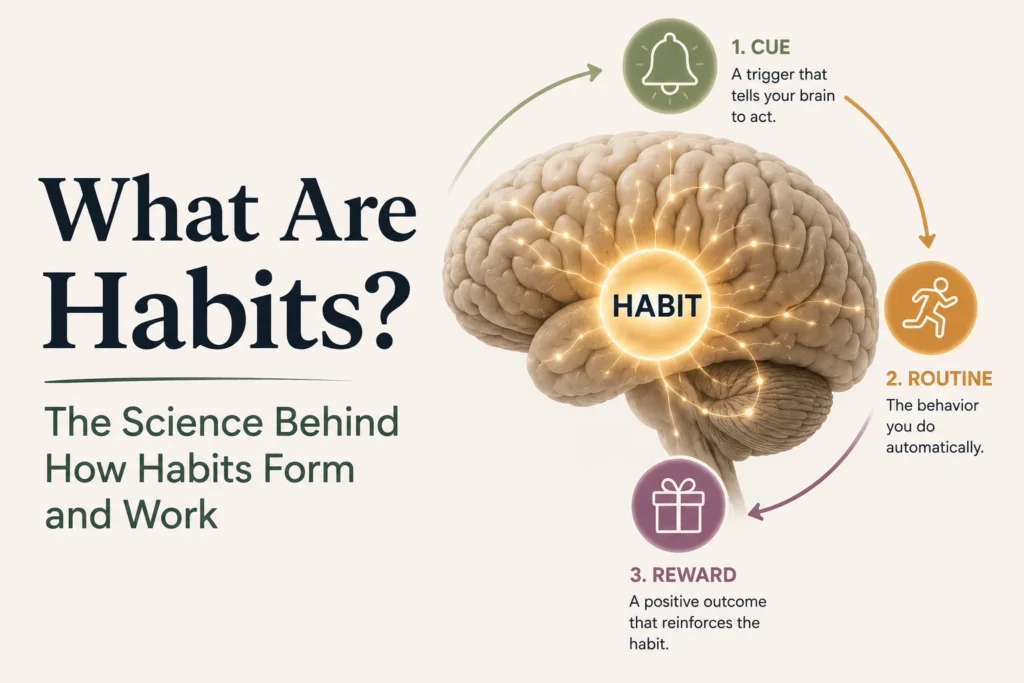
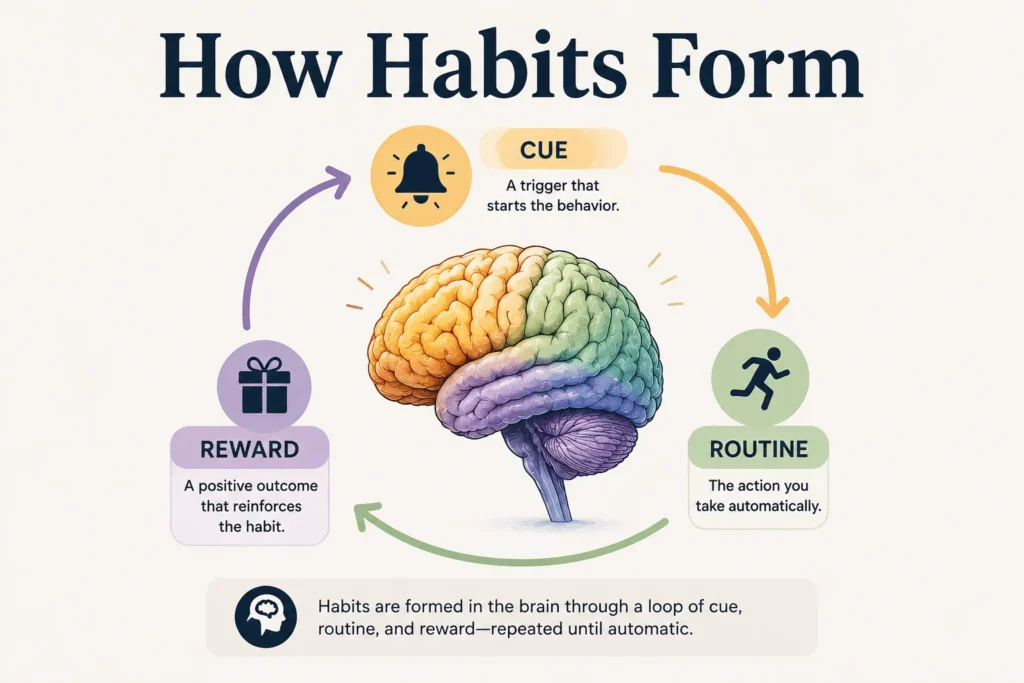
The habit loop has three parts:
- Cue – the trigger that tells your brain to start the habit
- Routine – the behavior itself
- Reward – the payoff that makes your brain want to repeat it
This is where people often get stuck. They focus on the routine—the behavior they want to change—without paying attention to what triggers it or what they get out of it.
Breaking Down the Cue
The cue is the starting point. It can be:
- A specific time of day
- A location
- A feeling (stress, boredom, hunger)
- Other people
- An action you’ve just completed (like finishing work or getting out of bed)
For example, you might check your phone whenever you feel anxious (cue: anxiety). You might snack when you’re stressed (cue: stress). You might automatically open social media when you’re waiting in line (cue: waiting).
I didn’t even notice it at the time. I used to open my phone every time I sat down at my desk, without even realizing it. That was my cue—sitting down—and the routine was grabbing my phone. Once I noticed it, I could start changing it.
Once you know what triggers the habit, you can start to change it.
Understanding the Reward
Rewards aren’t always obvious. The reward for exercising might not just be better health—it might also be the feeling of accomplishment, or the break from work, or the social aspect of going to a gym.
The reward for checking social media might be a quick hit of dopamine from a notification. The reward for procrastination might be temporary relief from stress.
The key point: your brain remembers the reward. Even if you don’t consciously feel it, your brain associates the behavior with a positive outcome. That’s what makes the habit stick.
5. The 4 Stages of Habit Formation
James Clear’s Atomic Habits expanded the habit loop into four stages. This framework is useful because it adds an important step: craving.
The four stages are:
- Cue – the trigger that initiates the habit
- Craving – the motivational force behind the habit
- Response – the behavior itself
- Reward – the satisfaction that reinforces the habit
The craving stage is crucial. It’s not just the cue that drives behavior—it’s the desire you feel when you encounter the cue. The cue triggers a prediction about the reward, and that prediction creates craving.
Here’s how it works in practice:
| Stage | Example |
|---|---|
| Cue | Phone notification |
| Craving | Desire for social connection |
| Response | Check phone |
| Reward | Satisfaction of connection |
Understanding cravings helps explain why habits can feel so compelling. You’re not just responding to a cue—you’re anticipating a reward. And anticipation can be more powerful than the reward itself.
Part Two: How Habits Form
6. Identity-Based Habits
This is one of the most important concepts in modern habit science. The idea is simple: your behaviors are often driven by your identity. You tend to do things that are consistent with who you believe you are.
How Identity Drives Behavior
Think about it this way:
If you say “I want to run,” you’re focused on an outcome. If you say “I am a runner,” you’re focused on your identity. The second framing is often more powerful because it shapes your behavior automatically.
When you identify as a runner, skipping a run feels like a betrayal of who you are. When you just want to run, skipping a run is just a missed goal.
Research from behavioral psychologist Wendy Wood suggests that repeated actions become increasingly automatic when they are tied to stable contexts and identity-consistent behaviors (Wood, 2019). Identity-driven behaviors tend to persist longer than outcome-driven goals because they’re anchored to your sense of self.
How to Build Identity-Based Habits
The process works like this:
- Decide who you want to be. Start with identity, not outcome.
- Prove it with small wins. Every time you do the behavior, you’re casting a vote for that identity.
- Repeat until it sticks. Eventually, the behavior becomes part of how you see yourself.
Here are some examples:
| Outcome Focus | Identity Focus |
|---|---|
| “I want to run 5K” | “I am a runner” |
| “I want to write a book” | “I am a writer” |
| “I want to eat healthy” | “I am someone who eats well” |
I started thinking about what I wanted to be true about myself, and let that guide my actions. It made a bigger difference than any goal-setting system I’d tried before.
7. How Long Does It Really Take to Form a Habit?
The 21-day myth has been debunked. The reality is more complicated—and more interesting.
What the Research Shows
A 2009 study by behavioral scientist Phillippa Lally and colleagues published in the European Journal of Social Psychology found that habit formation can take anywhere from 18 to 254 days depending on the behavior and individual (Lally et al., 2009). A widely cited study by Phillippa Lally and colleagues found an average of 66 days to reach automaticity, though the range was 18–254 days. The findings showed:
- Average time to automaticity: 66 days
- Range: 18 to 254 days
- Individual variation: Significant
The variation is important. Some people build habits faster than others. Some habits are easier to form. There’s no universal timeline.
Typical Habit Timelines
Here’s a rough guide based on research and real-world experience:
| Habit Type | Typical Time |
|---|---|
| Drinking water | 20–40 days |
| Daily walking | 50–90 days |
| Exercise | 60–150 days |
| Meditation | 50–120 days |
| Diet changes | 60–100 days |
| Reading | 40–70 days |
One thing that surprised me was how long exercise habits took compared to simpler habits. The more complex the behavior, the longer it usually takes to automate.
What the Research Really Means
The key takeaway from Lally’s research isn’t the timeline—it’s that consistency matters more than speed. Someone who does a habit 90% of the time for a year will often build a stronger habit than someone who does it 100% of the time for a month.
Focus on showing up. The timeline will take care of itself.
8. Why Some Habits Stick and Others Don’t
At least in my experience, the habits that stick tend to have a few things in common.
They’re Attached to Existing Routines
Habit stacking—adding a new habit onto an existing one—has been more effective for me than trying to start something completely new. You add the new behavior right before or right after something you already do regularly.
I started with five pushups after brushing my teeth. Some mornings I forgot, but because I was already standing in the bathroom, it became surprisingly easy to remember. The new habit just got anchored to an old one.
They’re Small Enough to Be Easy
The smaller the habit, the easier it is to start. This sounds obvious, but it’s surprising how often people aim for big changes and then get discouraged.
One thing that stood out was how effective tiny habits could be. Reading one page. Doing one pushup. Writing one sentence. Once you’re doing the tiny version, you’ll often keep going.
They Have Clear Triggers
The habits that stick usually have clear cues. You don’t have to think about when or where to do them—the environment does the work for you.
Putting your running shoes next to your bed is a trigger. Setting your coffee maker on a timer is a trigger. Laying out your work clothes is a trigger.
How the Habit Loop Applies in Practice
Here’s a table showing how the habit loop works for common behaviors:
| Habit | Cue | Routine | Reward |
|---|---|---|---|
| Exercise | Morning alarm | Workout | Endorphins |
| Reading | After dinner | Read 10 pages | Relaxation |
| Social media | Notification | Check app | Dopamine hit |
| Snacking | Stress | Eat something | Relief |
| Journaling | Coffee | Write a page | Clarity |
9. Why Habits Matter More Than Motivation
This is something I wish someone had told me years ago. Motivation is useful, but it’s often unreliable. Habits are what actually move the needle.
The Problem with Motivation
Motivation comes and goes. It’s dependent on mood, energy, sleep, stress, and a hundred other factors you can’t control. Relying on motivation is like relying on the weather—some days you’ll have it, and some days you won’t.
The problem is that the days you don’t have motivation are often the days you need a system to carry you through.
Habits Are More Reliable
Strong habits are less dependent on how you feel in the moment. When a behavior is truly habitual, you do it whether you’re motivated or not. You brush your teeth regardless of how you feel about it. You put on your seatbelt without thinking.
The Long-Term Advantage
Motivation gives you short bursts of effort. Habits give you consistent progress. And consistent progress, over time, is what creates meaningful change.
Part Three: Managing Habits
10. Breaking Bad Habits
Breaking bad habits requires a slightly different approach. You can’t just “stop” a habit—you have to replace it or change the conditions that make it happen.
Identify the Cue
The first step is understanding what triggers the bad habit. When does it happen? What are you doing right before? How are you feeling?
Change the Routine, Keep the Reward
The habit loop suggests that if you can keep the same cue and reward but change the routine, you can redirect the behavior.
If stress triggers snacking, find another way to relieve stress. If boredom triggers phone use, find something more engaging to do.
Reduce Friction
Make the habit harder to do. If you want to stop checking your phone, put it in another room. If you want to stop snacking, don’t keep snacks in the house.
Or if you want to start a good habit, do the opposite—reduce friction.
Don’t Rely on Willpower
Willpower is finite. Instead of hoping you’ll resist temptation, change the environment so temptation isn’t there.
11. Environmental Design for Better Habits
Your environment is probably the most powerful factor in habit formation. It works whether you’re paying attention to it or not.
How Environment Shapes Behavior
Think about the last time you tried to eat healthier. If there were chips on the counter, you probably ate them. If there was fruit on the counter and chips in the pantry, you probably ate the fruit.
The environment makes the choice before you make it.
Designing for Good Habits
To make a habit easier, ask yourself: “How can I make this the path of least resistance?”
- Remove friction: Put your gym clothes out the night before.
- Increase visibility: Put a book on your pillow if you want to read.
- Create reminders: Set alarms or leave sticky notes.
Designing Against Bad Habits
To make a bad habit harder, do the opposite:
- Add friction: Put your phone in another room.
- Reduce visibility: Hide tempting foods or delete distracting apps.
- Create barriers: Use website blockers or app limits.
12. Habits vs Routines: What’s the Difference?
This is a distinction that matters more than most people realize.
Habits Are Automatic
A habit is a behavior that happens without conscious thought. You don’t decide to do it. It just happens.
Routines Are Deliberate
A routine is a sequence of behaviors you perform intentionally. You might have a morning routine—wake up, make coffee, meditate—but you’re aware of doing it.
The Practical Difference
The key difference is awareness. You can build a routine deliberately and eventually it may become a habit. But until it’s automatic, it’s a routine.
Understanding the difference helps you set realistic expectations. Building a habit takes longer than establishing a routine. But a routine is the path to a habit.
13. Types of Habits
Not all habits are the same. Understanding different categories of habitual behavior can help you develop targeted strategies for change.
Physical Habits
These involve your body and movement. Exercise, stretching, posture, and sleep routines fall into this category. Physical habits often require the most upfront effort but deliver clear feedback.
Mental Habits
These are about how you think. Cognitive habits include how you process information, the stories you tell yourself, and your default responses to challenges. Mental habits are harder to notice but deeply influential.
Emotional Habits
Emotional habits are about how you respond to feelings. Do you default to anxiety? Do you criticize yourself? Do you pause before reacting? Emotional habits often develop without awareness.
Social Habits
These are habits related to interactions with others. How you greet people, how you listen, how you respond in conversation. Social habits can have a significant impact on relationships.
Digital Habits
This category has grown dramatically. Screen time, social media use, phone checking, and digital consumption patterns all fall here. Digital habits are among the hardest to change because they’re so seamlessly integrated into daily life.
Part Four: Modern Context
14. Digital Habits and Technology
The digital environment has changed how habits form and function. Some of this is helpful; some of it works against you.
Digital Attention and Dopamine
Short-form content platforms are designed to condition rapid attention shifts. The average video length on TikTok is under 30 seconds. This trains your brain to expect quick, frequent rewards—which is the opposite of the sustained attention required for building complex habits.
Every notification is a potential cue in your habit loop. The ping, the buzz, the badge—these are all triggers designed to interrupt your attention and create a response.
What I’ve noticed is that I started treating my phone differently when I realized how many of my “bad habits” were actually just conditioned responses to notifications.
Technology as a Tool
AI-assisted coaching and personalized behavioral nudging are increasingly being integrated into consumer wellness, productivity, and habit-tracking platforms, although evidence for long-term effectiveness is still developing. Devices like the Apple Watch, WHOOP, and Oura Ring provide constant feedback on your physical and behavioral patterns.
The Risks
Technology can also make habits harder to break. Social media algorithms are specifically designed to create habits. Notifications are engineered to trigger dopamine release.
The same technology that can help you build good habits can also reinforce bad ones. Awareness is the first step in managing this.
Digital Minimalism Trend
There’s a growing movement toward digital minimalism—reducing screen time, limiting notifications, and being more intentional about technology use. This reflects a broader recognition that digital habits need active management rather than passive acceptance.
15. What Recent Habit Research Says (2020–2025)
Habit science continues to evolve. While the foundational models remain valid, recent research has explored important questions—especially around digital environments and modern behavior patterns. Here’s what recent studies suggest.
Habit Discontinuity and Life Transitions
Research on habit discontinuity has examined how major life changes can create opportunities for habit change. Studies suggest that during transitions—such as moving homes, starting new jobs, or remote work shifts—existing habits become more malleable, making these periods particularly effective for establishing new behavior patterns.
Digital Behavior Design
Recent research has increasingly focused on how digital environments shape habitual behavior. Studies indicate that the predictability of digital cues—notifications, app designs, and interface patterns—can significantly influence habit formation and maintenance. However, the same research emphasizes that context stability remains as important in digital environments as in physical ones.
Self-Regulation and Automaticity
Recent reviews of self-regulation research continue to support the distinction between effortful self-control and automatic behavior. Studies from 2022–2023 suggest that successful long-term behavior change often depends on shifting behaviors from effortful regulation to automatic processes, rather than relying solely on sustained self-control.
Behavioral Intervention Research
Recent meta-analyses of behavioral interventions have examined which components are most effective for habit change. Findings consistently support the importance of cue-based strategies, environment redesign, and identity alignment. Reviews indicate that combined approaches—addressing cues, motivation, and environment together—produce stronger outcomes than single-focus interventions.
Implementation Intention Research
Recent meta-analyses of implementation intention studies have confirmed that specific planning (when and where a behavior will occur) significantly improves follow-through. The effect is strongest when implementation intentions are combined with consistent environmental cues.
Digital Health Interventions
Research published in 2023–2024 has examined the effectiveness of digital health interventions for habit change. Studies suggest that app-based interventions can be effective, but adherence remains a significant challenge. The most effective interventions combine behavioral strategies with personalized feedback and consistent environmental support.
What New Habit Research Is Showing
Recent behavioral science reviews (2022–2025) continue to support three consistent findings:
- Stable cues accelerate habit formation. Consistent environmental triggers remain one of the strongest predictors of automaticity.
- Environment design often outperforms motivation-based strategies. Creating conditions that make desired behaviors easier is more effective than relying on willpower.
- Identity-consistent behaviors are more likely to persist over time. When behaviors align with self-concept, they become more resistant to disruption.
16. Common Habit Myths
A lot of what people “know” about habits is wrong. Here are the most persistent myths.
Myth #1: Habits Take 21 Days
This is the most widespread habit myth. It comes from a book about plastic surgery patients, not from actual habit research.
The reality is that habits can take anywhere from 18 to 254 days to form. The 21-day number is arbitrary and misleading.
Myth #2: Motivation Is Enough
If motivation were enough, everyone would achieve their goals. But motivation is unreliable. It comes and goes based on energy, mood, and circumstances.
Habits work when motivation is low. They carry you through the days when you don’t feel like doing the thing.
Myth #3: Missing One Day Ruins Progress
Missing one day doesn’t erase the work you’ve done. It’s a tiny blip in a longer process.
The danger isn’t missing one day—it’s letting one missed day turn into two, then three, then giving up entirely.
Myth #4: Willpower Solves Everything
Willpower is useful but limited. It’s a resource that gets depleted through use.
Relying on willpower alone is a recipe for failure. Systems and environments are more reliable.
Myth #5: You Need to Change Everything at Once
Small changes compound. One habit at a time is more sustainable than trying to overhaul your entire life.
17. Frequently Asked Questions
What are habits exactly?
Think about brushing your teeth or locking your car. Those actions happen with very little conscious thought. That’s essentially what a habit is. Habits are learned behaviors that become increasingly automatic through repetition and are triggered by cues in a consistent context.
How long does it take to form a new habit?
A widely cited study by Phillippa Lally and colleagues found an average of 66 days to reach automaticity, though the range was 18–254 days. The timeline depends on the behavior and the individual.
What is the habit loop?
The habit loop is a three-part cycle: cue (trigger), routine (behavior), and reward (payoff). Understanding this loop is essential for changing habits.
Can habits change your brain?
Yes. Repeated behaviors can strengthen neural pathways associated with those behaviors, making them more efficient over time. These changes contribute to automaticity.
Are habits good or bad?
Habits themselves are neutral—they become good or bad based on their consequences. A habit that supports your health and goals is generally considered good; one that undermines them is considered bad.
Can habits be broken permanently?
Habits can be changed, but previously learned habits can remain accessible and may re-emerge under certain conditions, particularly when old cues return. The most effective approach is to replace a bad habit with a good one through consistent repetition of the new behavior.
Why are habits difficult to change?
Habits are difficult to change because they involve deep brain structures and are reinforced by dopamine and environmental cues. Previously learned habits can remain accessible and may re-emerge under certain conditions, particularly when old cues return.
What’s the difference between a habit and a routine?
A routine is a deliberate sequence of behaviors. A habit is automatic. You can build a routine deliberately, and over time it may become a habit. But until it’s automatic, it’s a routine.
What part of the brain controls habits?
The basal ganglia play a central role in habit learning and automatic behavior, but habit formation involves multiple interconnected brain regions.
How do identity-based habits work?
Identity-based habits focus on who you want to become rather than what you want to achieve. Instead of “I want to run,” you think “I am a runner.”
How does environment affect habits?
Your environment shapes your behavior more than motivation does. If you design your environment to support your desired habits, you’ll succeed more often than if you rely on willpower alone.
18. Research and References
- Bargh, J. A., & Chartrand, T. L. (1999). “The unbearable automaticity of being.” American Psychologist, 54(7), 462–479.
- Baumeister, R. F., et al. (1998). “Ego depletion: Is the active self a limited resource?” Journal of Personality and Social Psychology, 74(5), 1252–1265.
- Clear, J. (2018). Atomic Habits: An Easy & Proven Way to Build Good Habits & Break Bad Ones. Avery.
- Duhigg, C. (2012). The Power of Habit: Why We Do What We Do in Life and Business. Random House.
- Fogg, B. J. (2019). Tiny Habits: The Small Changes That Change Everything. Houghton Mifflin Harcourt.
- Gardner, B. (2015). “A review and analysis of the use of ‘habit’ in understanding, predicting and influencing health-related behaviour.” Health Psychology Review, 9(3), 277–295.
- Gollwitzer, P. (1999). “Implementation intentions: Strong effects of simple plans.” American Psychologist, 54(7), 493–503.
- Lally, P., et al. (2009). “How are habits formed: Modelling habit formation in the real world.” European Journal of Social Psychology, 40(6), 998–1009.
- Verplanken, B., & Orbell, S. (2003). “Reflections on past behavior: A self-report index of habit strength.” Journal of Applied Social Psychology, 33(6), 1313–1330.
- Wood, W. (2019). Good Habits, Bad Habits: The Science of Making Positive Changes That Stick. Farrar, Straus and Giroux.
- Wood, W., & Rünger, D. (2016). “Psychology of Habit.” Annual Review of Psychology, 67, 289–314.
- Wood, W., et al. (2002). “Habits in everyday life: Thought, emotion, and action.” Journal of Personality and Social Psychology, 83(6), 1281–1297.
- Yin, H. H., & Knowlton, B. J. (2006). “The role of the basal ganglia in habit formation.” Nature Reviews Neuroscience, 7(6), 464–476.
What Researchers Generally Agree On
- Habits rely on context cues — stable environments predict stronger habits
- Repetition matters more than intensity — frequency beats duration
- Motivation is unreliable — systems outperform willpower
- Environment influences behavior strongly — design beats discipline
- Habit formation timelines vary — 18 to 254 days, depending on the behavior
How This Guide Was Researched
This article was developed through a review of peer-reviewed habit formation research, behavioral psychology literature, and neuroscience reviews published between 2002 and 2025. Primary sources include Lally et al. (2009), Wood & Rünger (2016), Gardner (2015), and Yin & Knowlton (2006). The synthesis integrates findings from habit formation studies, implementation intention research, and behavioral neuroscience to create a practical framework for understanding and building habits.
What Most Habit Advice Gets Wrong
Many habit guides focus on motivation as the primary driver of behavior change. Research increasingly suggests that context stability and repetition predict long-term habit formation more reliably than motivation alone. In practice, this means designing environments and routines often matters more than finding inspiration. The most effective habit strategies focus on cue design, repetition, and identity alignment rather than relying on willpower or motivation.
Habit Formation Explained in One Diagram
The Habit Loop:
| Stage | Meaning |
|---|---|
| Cue | Trigger |
| Craving | Motivation |
| Response | Behavior |
| Reward | Reinforcement |
The Path to Automaticity:
- Repeat the behavior consistently
- Neural efficiency increases with each repetition
- Automaticity develops over time
- The habit becomes self-sustaining
The Habit Stability Score
Rate your habits on three layers to predict how likely they are to stick:
| Layer | Question | Score (1-10) |
|---|---|---|
| Cue Layer | Do you have a clear, consistent trigger? | ___ |
| Identity Layer | Does this behavior align with who you are? | ___ |
| Environment Layer | Does your environment support this habit? | ___ |
Calculate your total:
- Score > 24: High stability — habit is likely to stick
- Score 18–24: Moderate stability — strengthen the weakest layer
- Score < 18: Low stability — focus on one layer at a time
Habit Examples by Category
| Health | Productivity | Relationships |
|---|---|---|
| Walking 10 min | Daily planning | Gratitude text |
| Water intake | Deep work 90 min | Weekly call |
| Stretching | Email sorting | Compliment |
What Actually Matters Most
- Habits form through repetition — not willpower
- The habit loop (cue → routine → reward) is the core mechanism
- Identity-based habits (being vs doing) stick longer
- Environment design > motivation
- Digital habits require active management
- Flexibility (not perfection) sustains long-term change
The 3-Layer Habit Stability Model
Based on the research synthesis and applied work in this guide, habits are most stable when three layers align:
- Cue Layer: Clear, consistent triggers in your environment
- Identity Layer: The behavior aligns with who you believe you are
- Feedback Layer: You receive timely reinforcement (internal or external)
When any layer is weak, habits become less stable. When all three are strong, habits tend to persist even through disruptions.
Final Thoughts
If you’re starting from scratch, pick one thing and make it small enough that skipping it feels harder than doing it.
That’s the approach that’s worked for me. Not perfect, not always pretty, but practical. And that’s what matters most—finding something that actually works for you.
Habits are just patterns. They’re not who you are. You can change them. Not all at once, and not without effort, but gradually.
I’ve started and stopped more habits than I can count. Some stuck. Most didn’t. But the ones that stuck changed things. And that’s what I keep coming back to.
Understanding how habits work isn’t just about being more productive or healthier. It’s about gaining some control over your daily life—and that matters more than most people think.