

For years I thought changing your mindset was just a matter of wanting it badly enough.
I was wrong.
Wanting to think differently and actually thinking differently are two separate things. The first is a wish. The second is a practice. I’d read a book about growth mindset, feel inspired for a few days, and then slip right back into my old patterns the moment something went wrong. The inspiration never lasted. The old thoughts were faster.
I noticed something surprising after about three weeks of deliberately tracking my thoughts. The old patterns hadn’t disappeared, but I caught them much faster than before. Instead of spiraling for hours after a setback, I’d notice within minutes. That was the first sign something was actually changing.
What I didn’t understand at the time is that mindset isn’t just a set of opinions you hold. It’s a collection of mental habits that have been reinforced over years. Changing them isn’t a one-time decision. It’s a process of building new patterns while the old ones slowly fade.
Learning how to change your mindset is possible. There’s solid research behind it. But it doesn’t happen the way most people expect.
How to Change Your Mindset
- Notice your current thinking.
- Challenge limiting beliefs.
- Replace unhelpful thoughts.
- Build new mental habits.
- Practice consistently.
- Learn from setbacks.
- Repeat until automatic.
What Mindset Actually Is (And Why It Matters)
Mindset is a set of beliefs about yourself and your abilities. It’s the lens you use to interpret what happens to you. The term comes from Carol Dweck’s research, which we cover in more detail in our guide to what mindset is, but the concept is older than her work.
Your mindset determines how you interpret setbacks, whether you try again, and what you believe is possible for you. It’s not just about attitude. It’s about the core assumptions you operate from, often without realizing it.
Someone with a fixed mindset believes their abilities are mostly static. They interpret failure as evidence of permanent limitation. Someone with a growth mindset believes abilities can be developed. They interpret failure as information about what to try next.
The same event can produce completely different responses depending on which lens you’re using. That’s why mindset matters so much. It doesn’t just affect how you feel. It affects what you attempt and how long you persist.
Understanding mindset is one thing. Actually changing your mindset is another. More on that throughout this guide. If you want the full comparison between fixed and growth mindsets, we have a detailed breakdown here.
Research Snapshot
Repeated thoughts strengthen neural pathways through neuroplasticity, which is why consistent mindset practice matters more than occasional bursts of motivation.
Fixed Mindset vs Growth Mindset: A Quick Refresher
The distinction between fixed and growth mindsets is the foundation of most mindset work. I won’t spend too long here since we have a complete guide on the topic, but a quick summary helps.
A fixed mindset is the belief that your abilities, intelligence, and talents are largely set in stone. You have what you have. Effort might help at the margins, but the ceiling is already determined. This leads to avoiding challenges, giving up quickly when things get hard, and treating feedback as a personal attack.
A growth mindset is the belief that abilities can be developed through effort, learning, and persistence. People with this mindset don’t deny that starting points differ. They just believe those starting points aren’t endpoints. They embrace challenges, persist through obstacles, and learn from criticism.
Neither mindset is something you have or don’t have. Everyone operates from both at different times and in different areas of life. You might have a growth mindset about learning languages but a fixed mindset about your ability to become more organized.
I used to believe I was permanently disorganized. Not “I haven’t built organizational systems yet.” Just “I’m a messy person. That’s who I am.” That belief stayed intact for years because I never questioned it. It felt true, so I treated it as true. The goal of mindset change isn’t to become a pure growth mindset person that probably doesn’t exist. The goal is to expand the areas where a growth mindset operates and to recognize when a fixed mindset is showing up.
For a deeper look at the most powerful mindset for success, we have a separate guide that combines growth mindset with ownership, resilience, and action.
Growth Mindset Myths
Before we get into how to change your mindset, it’s worth clearing up a few misconceptions. These myths often cause people to misunderstand what they’re working toward.
Myth: A growth mindset means always being positive.
Reality: A growth mindset means believing improvement is possible. It doesn’t require feeling good about every situation. You can acknowledge difficulty and still believe your efforts matter. That’s not negativity. That’s accuracy.
Myth: People with a growth mindset never experience failure.
Reality: They experience failure constantly. The difference is in the interpretation. Failure is information, not identity. It tells you something about your approach, not something about your worth.
Myth: A growth mindset means trying harder forever.
Reality: A growth mindset involves trying different strategies, not just the same strategy with more effort. If something isn’t working, the growth minded response is to adjust the approach, not to simply push harder.
Myth: You either have a growth mindset or you don’t.
Reality: Everyone has both. The question is which one shows up more often and in which areas of life. The goal is expansion, not perfection.
Why Changing Your Mindset Is Harder Than Expected
Here’s something most articles skip: how to change your mindset is genuinely difficult. Not because you’re doing it wrong. Because you’re working against patterns that have been reinforcing themselves for years.
Every time you’ve had a thought, you’ve strengthened a neural pathway. The thought feels automatic because the pathway is well-established. When you try to think differently, the new thought feels forced. Awkward. Like it doesn’t quite fit. That’s not a sign you’re failing. It’s a sign you’re building something new.
The old thoughts don’t disappear just because you’ve decided to change. They show up anyway. Especially when you’re tired, stressed, or facing something difficult. The goal isn’t to never have the old thought. It’s to notice it faster and choose the new one more often.
Another thing that makes this hard: your environment often reinforces your old mindset. If the people around you think in fixed ways, their reactions to your growth can feel discouraging. They might not mean to undermine you. They’re just operating from their own patterns. But it helps to recognize that environment matters. Changing your thinking is easier when you’re around people who model the thinking you’re trying to adopt.
The common limiting beliefs that hold people back I’m not smart enough, it’s too late, I’m not the type are just specific expressions of a fixed mindset. Identifying them is part of the work.
Signs You Need a Mindset Change
Sometimes you don’t realize your mindset needs attention until you notice the symptoms. Here are patterns that often signal fixed thinking is running the show.
- You feel stuck in at least one area of life and can’t see a way forward.
- Fear of failure prevents you from starting things you genuinely want to do.
- Negative self-talk runs on a loop, especially after setbacks.
- You constantly compare yourself to others and come up short.
- You give up easily when things get difficult.
- You avoid challenges because trying and failing feels worse than not trying.
- Criticism feels like a personal attack rather than useful information.
- You find yourself saying “I’m just not that kind of person” about things you wish you could do.
One or two of these might be situational. But when several show up consistently, it’s worth examining the underlying beliefs.
The Science Behind Mindset Change
Mindset change isn’t just motivational talk. There’s actual biology behind it, and understanding the basics makes the process less mysterious.
Neuroplasticity and Brain Rewiring
Neuroplasticity is the brain’s ability to reorganize itself by forming new neural connections throughout life. This is the mechanism that makes mindset change possible. Every thought you think strengthens certain pathways and weakens others. When you repeatedly think a new thought, you’re literally building new neural infrastructure.
The old pathways don’t disappear completely. They just get weaker with disuse while the new ones get stronger with practice. This is why consistency matters more than intensity. A single powerful insight won’t rewire your brain. Repeated small shifts over time will.
“Neuroplasticity is the ability of the nervous system to change in response to experience.” — Dr. Andrew Huberman, Stanford School of Medicine neuroscientist
We cover this in more detail in our article on how habits are formed, but the short version is that the brain changes through repetition, not through one-time decisions.
Cognitive Restructuring
Cognitive restructuring is a technique from Cognitive Behavioral Therapy (CBT) that involves identifying and challenging unhelpful thought patterns. It’s one of the most researched methods for changing thinking patterns.
The process is straightforward: notice a thought, examine whether it’s accurate, and replace it with something more balanced if it’s not. Sounds simple. It is simple. That doesn’t mean it’s easy to do consistently, especially when emotions are running high.
Psychological Flexibility
Psychological flexibility is the ability to stay present and adapt your behavior based on what the situation requires, rather than reacting automatically. It’s a core concept in Acceptance and Commitment Therapy (ACT), developed by psychologist Steven Hayes.
People with high psychological flexibility can notice difficult thoughts without being controlled by them. They don’t have to change every negative thought. They just have to stop letting those thoughts dictate their actions. This is a more realistic goal than eliminating all negative thinking. It connects closely to building mental resilience.
Self-Awareness
You can’t change what you don’t notice. Self-awareness is the foundation of mindset change because it creates the gap between having a thought and believing the thought. That gap is where choice lives. Without it, you’re just running on automatic.
Building self-awareness is a skill in itself. It starts with paying attention to your internal reactions especially the ones that feel automatic and getting curious about what beliefs might be driving them.
Can You Rewire Your Brain at Any Age?
Yes. Neuroplasticity continues throughout life.
There was a time when scientists believed the adult brain was mostly fixed that after a certain age, you were stuck with the neural connections you had. That’s been thoroughly disproven. The brain remains adaptable throughout adulthood, though the rate of change can vary.
Older adults can still form new neural pathways. People in their fifties, sixties, and beyond learn new languages, pick up musical instruments, and shift long-held thinking patterns. The process might be slower than it is for children, but it still works.
The practical implication: you’re never too old to change your mindset. The belief that “it’s too late for me” is itself a fixed-mindset thought one that can be examined and challenged like any other. The biology supports change at any age.
Research Snapshot
A 2024 neuroscience review continued to support evidence that repeated thoughts strengthen neural pathways through neuroplasticity, reinforcing the importance of daily practice rather than one-time motivation.
15 Steps to Change Your Mindset
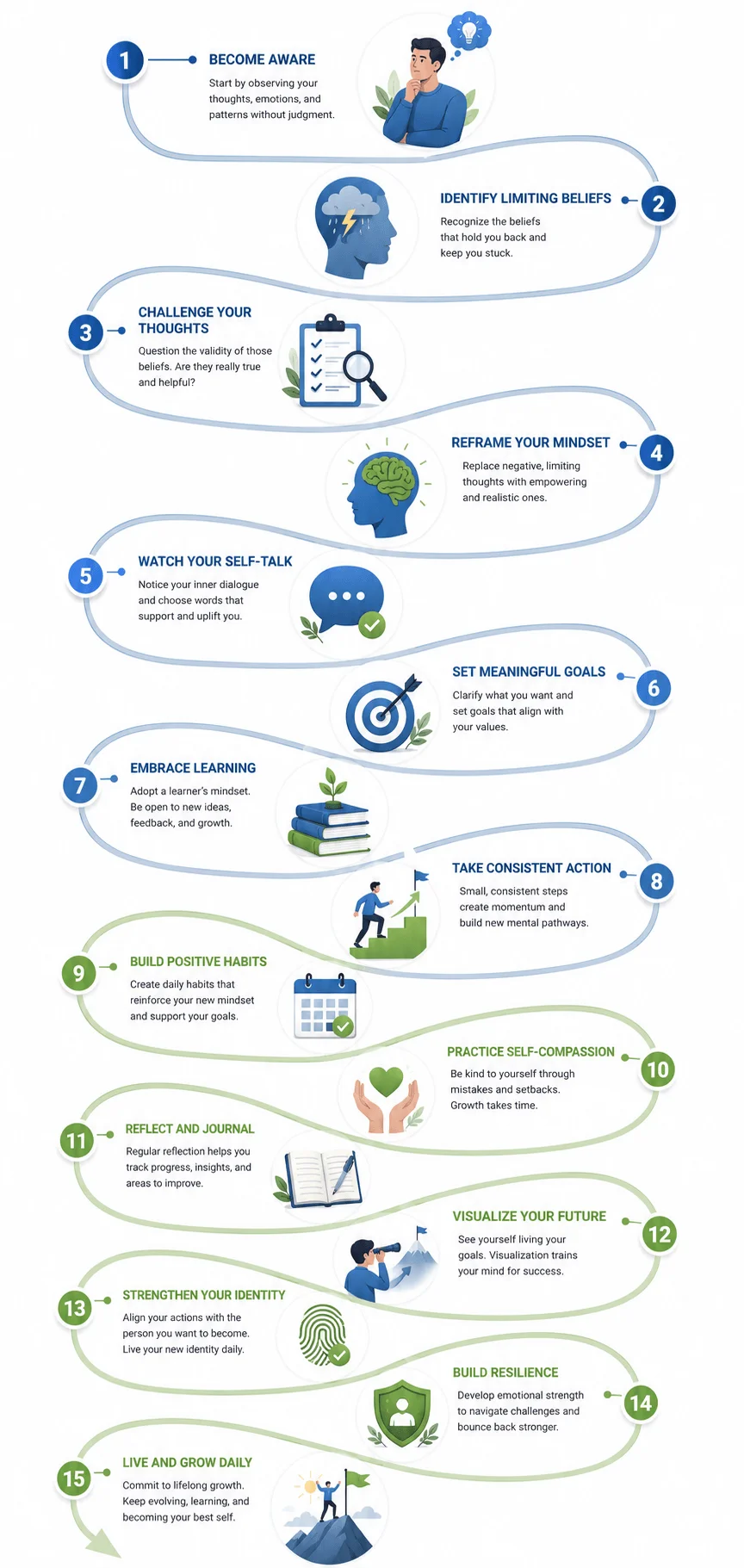
These steps aren’t sequential. You don’t master one and move to the next. They’re more like practices that overlap and reinforce each other. Pick one or two to start with. Add more as those become more natural.
Step 1: Identify Your Current Mindset Patterns
Before you can change anything, you need to know what you’re working with. Start paying attention to your automatic thoughts, especially in challenging situations.
What do you tell yourself when something goes wrong? What’s your first reaction when you see someone succeeding in an area where you struggle? Do you feel inspired or threatened? Do you think “I could learn to do that” or “I could never do that”?
Don’t judge what you find. Just notice. The goal at this stage is awareness, not correction.
Writing things down helps. I kept a notes file on my phone for a while where I’d jot down the automatic thoughts I noticed during the day. Reading them back later was uncomfortable turns out I had a lot of fixed-mindset thoughts I’d never examined but it was also clarifying. You can’t change what you can’t see.
Step 2: Understand Where Your Beliefs Come From
Most of your beliefs about yourself weren’t chosen. They were absorbed. A comment from a teacher, a comparison to a sibling, a failure that felt definitive at the time. These experiences formed the foundation of beliefs you’ve been carrying for years.
Understanding the origin of a belief doesn’t automatically change it. But it helps you see the belief as something that happened to you rather than something that is you. That distinction creates distance. And distance creates room for choice.
Ask yourself: when did I first start believing this about myself? Whose voice does it sound like? Was there a specific experience that locked it in place? These questions don’t require years of therapy to be useful. Even a rough answer helps loosen the belief’s grip.
Step 3: Catch Your Automatic Self-Talk
Self-talk is the running commentary in your head. For most people, it’s more negative than they realize. The commentary is so constant and so familiar that it fades into the background. You don’t notice it. You just feel its effects.
Pay attention to the specific words you use with yourself. Would you talk to a friend that way? If a friend made a mistake, would you tell them they’re incompetent and should give up? Probably not. But that’s often the tone of internal self-talk.
The goal isn’t to replace every negative thought with a positive one. That’s exhausting and usually doesn’t stick. The goal is to notice the thought and question it rather than accepting it automatically. “I always mess things up” is that actually true? Always? Every single time? Probably not.
Step 4: Reframe Limiting Beliefs
Limiting beliefs are the specific thoughts that constrain your behavior. Common ones include “I’m not smart enough,” “It’s too late for me,” “I’m not the type of person who succeeds at this.” We have a comprehensive guide on limiting beliefs that walks through how to identify and reframe them.
The reframe doesn’t have to be extreme. If the old belief is “I’m terrible at public speaking,” the reframe isn’t “I’m amazing at public speaking.” Your brain won’t believe that. A more useful reframe is “I’m not good at public speaking yet, and I can improve with practice.” Accurate enough to be believable. Hopeful enough to motivate action.
Step 5: Learn to Separate Facts from Interpretations
This is one of the most practical skills in mindset work. When something happens, distinguish between what actually occurred and the story you’re telling yourself about what it means.
“I didn’t get the promotion.” That’s a fact.
“I’ll never advance in my career.” That’s an interpretation.
“My presentation had a mistake in it.” Fact.
“Everyone thinks I’m incompetent.” Interpretation.
Facts are useful. Interpretations are often just fear in disguise. Practice stating the facts of a situation without adding the interpretation. You’ll be surprised how much calmer the facts feel compared to the stories you usually attach to them.
Step 6: Change Your Explanatory Style
Explanatory style is the term Martin Seligman uses for how people explain good and bad events to themselves. It’s one of the central concepts from the optimism vs realism research.
People with a pessimistic explanatory style explain bad events as permanent (“this will last forever”), pervasive (“this ruins everything”), and personal (“this is all my fault”). People with an optimistic explanatory style explain bad events as temporary, specific, and external.
The optimistic style isn’t about avoiding responsibility. It’s about being accurate. Most setbacks genuinely are temporary, specific, and influenced by multiple factors. The pessimistic style isn’t more truthful. It’s just more punishing.
Practice explaining setbacks in temporary, specific terms. “This project didn’t work out” instead of “I can never make anything work.” The first is a description. The second is a life sentence.
Step 7: Set Learning Goals, Not Just Performance Goals
Performance goals are about outcomes: get the promotion, hit the revenue target, lose the weight. Learning goals are about growth: develop a new skill, understand a topic deeply, become better at the process regardless of the outcome.
Performance goals aren’t bad. But if they’re the only kind you set, every setback becomes a verdict. Learning goals give you something to work toward even when the outcome isn’t what you wanted.
This connects to the research on building good habits. The people who sustain progress over long periods tend to focus on the process showing up, doing the work, trying different approaches rather than fixating on results they can’t fully control.
Step 8: Practice Self-Compassion
This might seem unrelated to mindset change, but it’s actually central. If you beat yourself up every time you have a fixed-mindset thought, you’re reinforcing the very pattern you’re trying to change. Now you’re not just having the old thought. You’re having the old thought and feeling like a failure for having it.
“Self-compassion involves treating yourself with the same kindness you’d offer a good friend.” — Dr. Kristin Neff, University of Texas at Austin
Self-compassion means treating yourself with the same understanding you’d offer a friend who was struggling. You made a mistake? That’s human. You had an old thought pattern show up? That’s expected. You’re not back at square one. You’re in the middle of a long process, and setbacks are part of it.
Neff’s research has shown that self-compassion actually increases motivation and resilience more than self-criticism does. Being kind to yourself isn’t soft. It’s practical.
Step 9: Surround Yourself with Growth-Minded People
Mindsets are contagious. The people you spend time with shape your sense of what’s normal. If everyone around you talks about abilities as fixed and complains about circumstances without doing anything to change them, that becomes your baseline.
Seek out people who challenge themselves, who talk about what they’re learning, who respond to setbacks with curiosity rather than defeat. You don’t need to cut people out of your life. Just be intentional about adding voices that model the thinking you’re trying to adopt.
This is one of the principles behind wellness habits. The people you surround yourself with shape your defaults in ways you don’t always notice until you change your environment.
Step 10: Create an Environment That Supports Your New Mindset
Environment matters more than willpower. If you’re trying to think differently while everything around you triggers your old patterns, you’re making the work harder than it needs to be.
This might mean putting reminders where you’ll see them. It might mean rearranging your space to support new habits. It might mean changing the media you consume fewer voices that reinforce a fixed view of ability, more voices that model growth.
The psychology of habit formation shows that environment is often a stronger predictor of behavior than intention. Design your surroundings to make your new thinking easier to maintain.
Step 11: Develop a Daily Reflection Practice
You don’t need a complicated journaling routine. Five minutes at the end of the day is enough. Ask yourself: what went well today? What was difficult? What did I learn? Where did I notice old thought patterns showing up?
The value of reflection isn’t in the writing itself. It’s in the pause. Most people go through their days reacting. Reflection creates a moment of stepping back and noticing what actually happened, including what happened in your own mind.
I kept a simple journal for a few months. Nothing elaborate. Just a few sentences each evening. Looking back, I can see patterns I was completely blind to at the time recurring thoughts, predictable reactions to certain situations. The awareness built slowly, but it built.
Step 12: Learn New Skills Intentionally
There’s no better way to reinforce a growth mindset than to actually grow. Pick something you’re not good at and practice it. Not with the goal of becoming an expert. With the goal of experiencing the process of improvement.
Learning a new skill gives you direct evidence that abilities can be developed. You can read about growth mindset all day, but experiencing it struggling with something, practicing, and slowly getting better is more convincing than any book.
Choose something small. A language app. A musical instrument. A cooking technique. The skill itself matters less than the experience of being a beginner and watching yourself improve through practice.
Step 13: Pay Attention to Your Physical State
Your physical state affects your thinking more than most people realize. When you’re tired, hungry, or stressed, your brain defaults to its most well-worn pathways. Old thought patterns show up more forcefully. Your capacity to notice them and choose differently diminishes.
This connects to the broader benefits of wellness. Sleep, exercise, nutrition, and stress management aren’t separate from mindset work. They’re part of the foundation that makes mindset work possible.
If you’re trying to change deeply ingrained thought patterns while chronically underslept and stressed, you’re doing it on hard mode. Address the physical foundation first. Your brain will cooperate more.
Step 14: Measure Progress by Effort, Not Perfection
The old mindset will still show up. You’ll still have fixed-mindset thoughts. You’ll still catch yourself slipping into old patterns. That’s not failure. That’s being human.
Measure progress by how quickly you notice the old thought and how often you choose the new one. Not by whether the old thought ever appears. The goal isn’t to never have a limiting belief again. It’s to stop letting those beliefs control your decisions.
This is one of the most important shifts in how you approach mindset transformation. If your standard is perfection, you’ll always feel like you’re failing. If your standard is gradual improvement, you’ll see progress that’s actually happening.
Step 15: Be Patient with the Process
Real mindset change takes time. Not days or weeks. Months and years. The patterns you’re working to change were built over decades. They won’t be replaced by a few weeks of practice.
That’s not discouraging. It’s just realistic. If you know the timeline is long, you don’t panic when you’re not transformed after a month. You keep practicing. You notice small shifts. Over time, the small shifts accumulate.
Changing a habit takes consistency. Changing a mindset which is really a collection of mental habits takes even longer. But the work compounds. Each time you notice an old thought and choose a new one, you’re strengthening a pathway. Each time feels small. The sum, over years, is significant.
The Mindset Change Formula
If the 15 steps feel like a lot to remember, here’s the simplified version. Most mindset change follows a basic pattern:
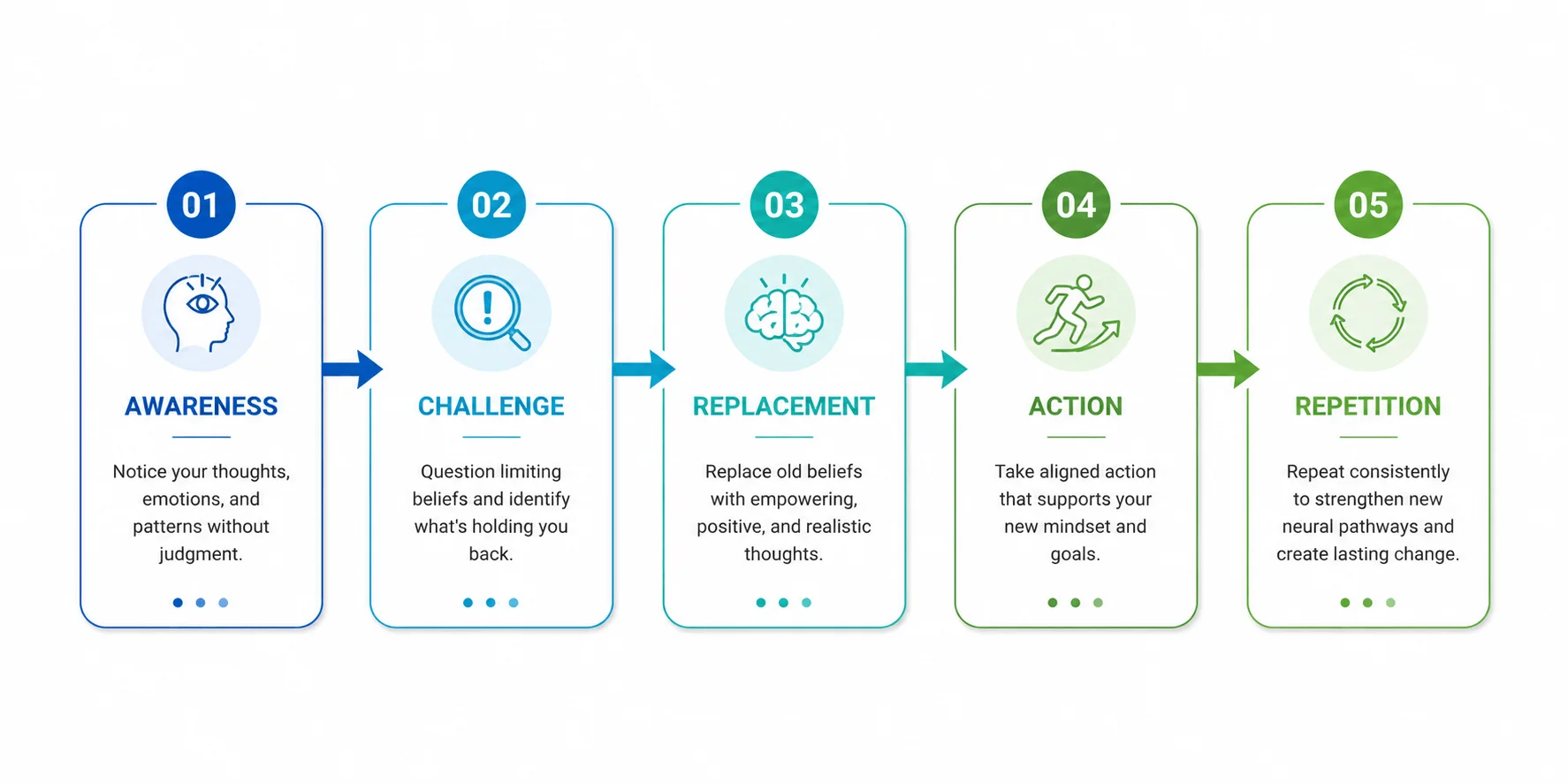
Awareness → Challenge → Replacement → Action → Repetition
Awareness: Notice the current thought pattern. You can’t change what you don’t see.
Challenge: Examine whether the thought is accurate. Is it a fact or an interpretation? What evidence supports it? What evidence contradicts it?
Replacement: Construct a more balanced, growth-oriented alternative. Not forced positivity. Something accurate that leaves room for possibility.
Action: Take a small step that the new belief would make possible. Behavior generates evidence. Evidence strengthens belief.
Repetition: Do it again. And again. Each repetition builds the neural pathway. Over time, the new thinking becomes more automatic.
That’s the formula. Simple. Not easy. But it works.
Identity-Based Mindset Change
One of the most effective ways to shift your thinking is to shift your sense of who you are. This is identity-based change, and it’s more powerful than relying on motivation alone.
“Every action you take is a vote for the type of person you wish to become.” — James Clear, author of Atomic Habits
James Clear, in his work on habit formation, emphasizes that lasting behavior change starts with identity. Instead of setting a goal like “I want to exercise,” you adopt the identity of “I am someone who exercises.” The behavior follows from the belief about who you are, not from willpower.
The same principle applies to mindset. Instead of trying to think more positively through effort alone, ask: who is the person I’m becoming? What does someone with a growth mindset believe about themselves? What would they do in this situation?
You can practice this by stating the identity you’re building: “I’m someone who learns from feedback.” “I’m someone who keeps going when things get hard.” “I’m someone who believes improvement is possible.”
At first, these statements might feel unnatural. That’s fine. Identity doesn’t change overnight. But repeated over time, backed by small actions, the new identity gradually replaces the old one. You stop being someone who’s “trying to change their mindset” and start being someone who thinks differently as a matter of course.
This connects to the work on changing limiting beliefs. Most limiting beliefs are identity statements: “I’m not smart enough,” “I’m not a creative person.” Changing the belief often means changing the identity statement underneath it.
Daily Mindset Reset Routine
A simple daily practice can reinforce new thinking patterns. Here’s a routine that takes about ten minutes total.
Morning (5 minutes):
- Gratitude: Write down one thing you’re grateful for. This primes your brain to notice positives rather than fixating on negatives.
- Intention: Set one learning goal for the day. Not a performance goal. Something you want to understand better or get better at.
- Identity reminder: State the identity you’re building. “I am someone who learns from challenges.” Keep it specific to the mindset shift you’re working on.
Evening (5 minutes):
- Reflection: What went well today? What was difficult? What did I learn?
- Lesson extraction: Identify one insight from the day’s experiences, especially from things that didn’t go as planned.
- Tomorrow’s action: Identify one small step you’ll take tomorrow that aligns with your new mindset.
You don’t need to do every element perfectly. Some days you’ll forget. Some days you’ll only do one part. That’s fine. The value is in the practice, not the perfection.
30-Day Mindset Challenge
A structured challenge can help build momentum when you’re starting out. Here’s a day-by-day plan for the first month.
Week 1: Awareness
- Day 1: Notice your self-talk throughout the day. Don’t change anything. Just notice.
- Day 2: Write down three automatic thoughts you had today.
- Day 3: Identify which of those thoughts might be limiting beliefs.
- Day 4: Pick one limiting belief. Ask: where did it come from?
- Day 5: Notice when this belief shows up. What triggers it?
- Day 6: Separate facts from interpretations in one situation today.
- Day 7: Reflect on what you’ve noticed this week.
Week 2: Challenging
- Day 8: Pick one limiting belief. List evidence for and against it.
- Day 9: Practice adding “yet” to fixed-mindset statements. “I can’t do this yet.”
- Day 10: Catch yourself catastrophizing. Ask: what’s the most likely outcome, really?
- Day 11: When you receive feedback today, listen without defending. Just say “thank you.”
- Day 12: Notice your explanatory style. Are you explaining setbacks as permanent or temporary?
- Day 13: Replace one negative self-talk statement with a more balanced version.
- Day 14: Reflect on what was hardest to challenge this week.
Week 3: Building New Patterns
- Day 15: Set one learning goal for the week. Not a performance goal.
- Day 16: Practice self-compassion. Talk to yourself the way you’d talk to a friend.
- Day 17: Do something you’re not good at. Pay attention to how it feels to be a beginner.
- Day 18: State your identity intention out loud: “I am someone who…”
- Day 19: Notice how your physical state affects your thinking. Tired? Stressed? How did your thoughts shift?
- Day 20: Surround yourself with growth-minded content today. A podcast, article, or conversation.
- Day 21: Reflect on which new patterns are starting to feel more natural.
Week 4: Consolidating
- Day 22: Review your original limiting belief from Day 4. Has your relationship to it shifted?
- Day 23: Teach someone else what you’ve learned about mindset this month.
- Day 24: Identify an area where your environment triggers old thinking. Make one change.
- Day 25: Set a learning goal for next month. What skill or mindset area do you want to develop?
- Day 26: Practice the full cycle: notice, challenge, reframe, act.
- Day 27: Write down three pieces of evidence that you can change and grow.
- Day 28: Notice how you respond to a setback today compared to Day 1.
- Day 29: Plan your mindset practice for next month. What will you continue? What will you add?
- Day 30: Reflect on the month. What’s different? What still needs work? Celebrate the progress.
You don’t have to follow this perfectly. Skip days if needed. Adjust the order. The value is in the daily practice, not in completing every task exactly as written.
How to Change Your Mindset When You Can’t Change Your Situation
Most mindset advice assumes you can change your circumstances. But sometimes you can’t. You’re in a job you can’t leave right now. You’re dealing with a health condition that isn’t going away. You’re caring for family members and the demands aren’t optional. You’re waiting on something outside your control.
Learning how to change your mindset about life when your life can’t change is a different kind of work.
The first thing to acknowledge is that some situations genuinely limit your options. Pretending otherwise isn’t growth mindset it’s denial. The goal isn’t to convince yourself that everything is fine when it’s not. The goal is to find the space within constraints where your thinking can shift.
Start by identifying what is actually in your control. Even in highly constrained situations, there’s usually something. How you interpret events. How you talk to yourself. What you pay attention to. Small choices about how you spend whatever free time you have.
Focus your mindset work on those areas. You might not be able to change your circumstances right now, but you can change your relationship to them. You can practice noticing when you’re catastrophizing. You can challenge the belief that the current situation is permanent. You can look for small opportunities to learn or grow within the constraints.
This isn’t toxic positivity. Toxic positivity would tell you to ignore the difficulty and just think happy thoughts. Realistic mindset work acknowledges the difficulty and still looks for what’s possible within it.
What Mindset Change Looks Like in Real Life
Mindset transformation isn’t dramatic. It’s not a breakthrough moment where everything suddenly feels different. It’s quieter than that.
It looks like catching yourself in the middle of a familiar negative spiral and pausing instead of continuing. It looks like trying something you would have avoided a year ago, not because you’re suddenly confident, but because you’re willing to be bad at it for a while. It looks like hearing criticism and feeling curious instead of defensive not every time, but more often than before.
The change is gradual enough that you might not notice it day to day. But if you look back over months, you’ll see differences. The things that used to derail you don’t hit as hard. The thoughts that used to feel like facts now feel like thoughts. You have more space between what happens and how you respond.
I downloaded a habit tracker a while ago and forgot about it after two weeks. That’s it. That’s the whole observation. Sometimes things just don’t stick, and it doesn’t have to mean anything deeper than that.
Brain Rewiring Timeline
People often ask how long it takes to rewire thinking patterns. While individual timelines vary, here’s a general sense of what the process looks like.
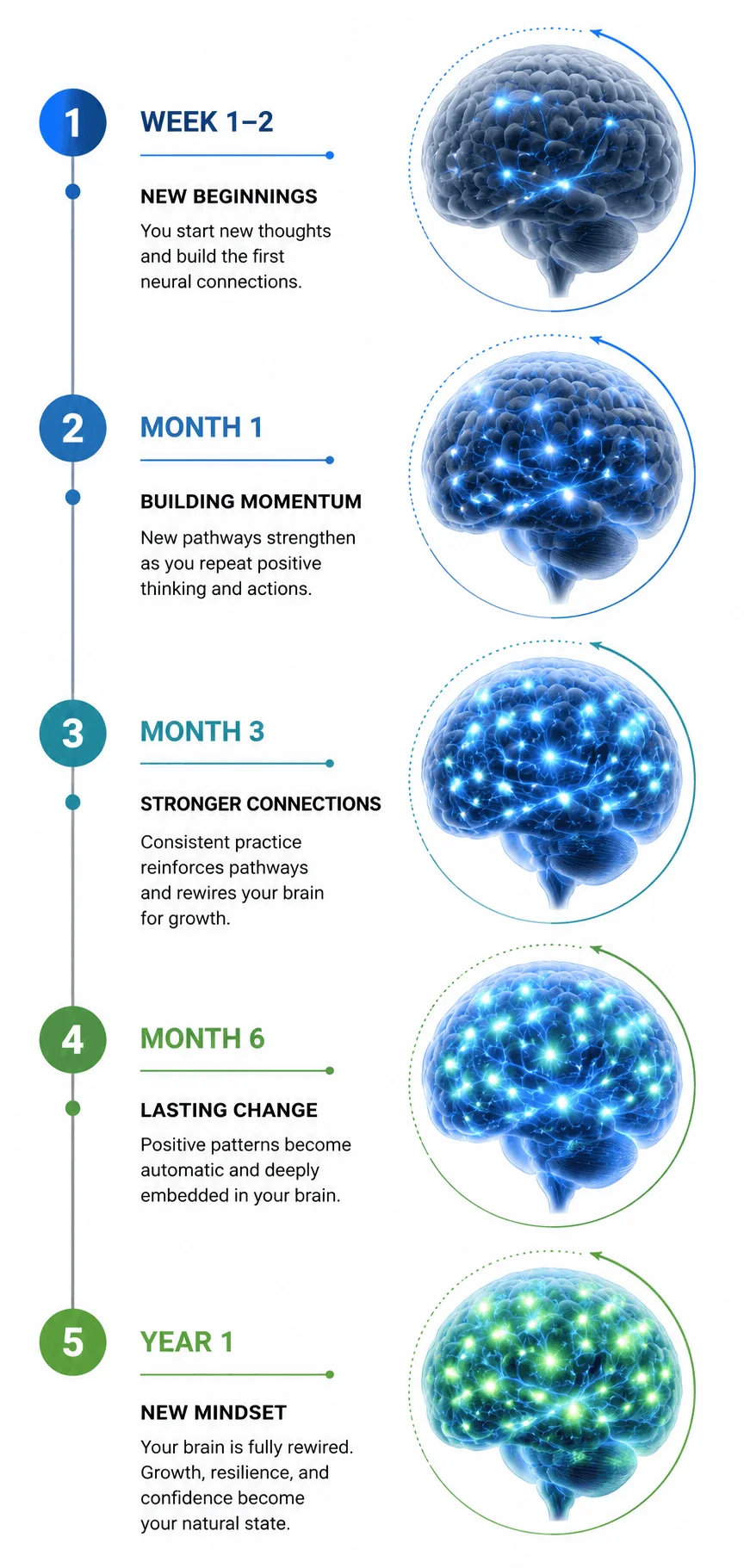
Week 1–2: You start noticing your automatic thoughts more frequently. The noticing itself feels new. You might feel frustrated by how often the old patterns show up. That’s normal. Awareness is progress.
Month 1: The new thoughts still feel deliberate and awkward. You have to consciously choose them. The old thoughts still appear regularly. Some days feel like you’re making progress. Other days feel like you’re back at the beginning. Both are part of the process.
Month 3: The new thoughts start to feel more natural in some situations. You catch the old thoughts faster. The gap between the old thought and the new response is shrinking. People close to you might notice changes in how you react to things.
Month 6: The new thinking patterns are becoming more automatic in certain areas of your life. The old thoughts still appear, especially during stress, but they don’t have the same weight. You recover faster from setbacks.
Year 1 and beyond: The new mindset feels more like your default than something you’re practicing. Fixed-mindset thoughts still appear they probably always will but they’re easier to recognize and dismiss. The work shifts from building new patterns to maintaining them.
This timeline isn’t exact. Some people move faster. Some move slower. The key variable is consistency of practice, not intensity. Small daily repetitions beat occasional marathon efforts.
Mindset Change by Life Area
Mindset change looks different depending on where you’re applying it. The principles are the same, but the specific beliefs and behaviors vary.
Career
Old mindset: “I’m not qualified enough for that role. I should wait until I’m ready.”
New mindset: “I can learn what I need to learn. I’ll apply and see what happens.”
Career mindset shifts often involve challenging beliefs about readiness and competence. The fixed mindset says you need to be fully qualified before trying. The growth mindset says trying is how you become qualified.
Health
Old mindset: “I’ve tried to get in shape before and it never sticks. I’m just not a fitness person.”
New mindset: “Past attempts didn’t work because of my approach, not because of who I am. I can try a different strategy.”
Health mindset shifts often involve separating past outcomes from identity. Failed attempts don’t define your capacity. They’re data about what didn’t work.
Relationships
Old mindset: “If this relationship has problems, it means we’re wrong for each other.”
New mindset: “All relationships have challenges. Working through them can make us stronger.”
Relationship mindset shifts often involve changing beliefs about conflict and compatibility. The fixed mindset treats difficulty as a sign of fundamental mismatch. The growth mindset treats it as an opportunity to deepen connection.
Money
Old mindset: “I’m just not good with money. Some people are and some aren’t.”
New mindset: “Managing money is a skill. I can learn it like any other skill.”
Money mindset shifts often involve challenging beliefs about innate ability. Financial literacy isn’t a personality trait. It’s a set of learnable behaviors.
Business
Old mindset: “Most businesses fail. Mine probably will too.”
New mindset: “Many businesses fail, so I’ll start small, test assumptions early, and adapt based on what I learn.”
Business mindset shifts often involve balancing realism with possibility. The fixed mindset sees statistics as destiny. The growth mindset sees them as information to inform strategy.
Parenting
Old mindset: “I need to be a perfect parent or I’ll mess up my kids.”
New mindset: “I’ll make mistakes. What matters is how I learn from them and how I model growth for my children.”
Parenting mindset shifts often involve releasing perfectionism. Children learn more from watching how you handle imperfection than from watching you pretend it doesn’t exist.
Before vs After: Old Thinking vs New Thinking
| Old Thinking | New Thinking |
|---|---|
| I can’t do this. | I can’t do this yet. |
| Failure defines me. | Failure teaches me. |
| I’m bad at this. | I’m still improving. |
| This is too hard. | This is an opportunity to grow. |
| I’m not a math person. | I haven’t learned this type of math yet. |
| They’re naturally talented. | They’ve practiced more than I have. What can I learn from their approach? |
| Criticism means I’m not good enough. | What’s useful in this feedback? |
| I’ll never change. | I’ve changed before. I can do it again. |
| It’s too late for me. | Starting now is better than never starting. |
| I need to be perfect before I start. | Progress requires imperfection. I’ll improve as I go. |
Self-Assessment: What’s Your Current Mindset?
Answer each question honestly. There are no right answers. This is a snapshot of where you are right now, not a permanent verdict.
- When you face a challenge, do you feel excited to learn or anxious about failing?
- After a setback, do you look for what you can learn or do you feel like giving up?
- When someone criticizes your work, do you get defensive or curious?
- When you see someone more successful than you, do you feel inspired or threatened?
- Do you believe your abilities can improve with effort, or are they mostly fixed?
- When something doesn’t work, do you try a different approach or conclude you’re not capable?
- Do you seek out challenges or stick to what you know you can do well?
- When you’re learning something new, do you expect to struggle at first or expect to pick it up quickly?
- How do you talk to yourself after a mistake with understanding or with harsh judgment?
- Do you believe most successful people got there through talent or through effort and learning?
Interpreting Your Results:
- If you answered mostly with the growth-oriented option, you likely operate from a growth mindset in many areas. The work is about maintaining and expanding that.
- If your answers were mixed, you probably have a growth mindset in some areas and a fixed mindset in others. That’s normal. Identify where the fixed mindset shows up most.
- If you answered mostly with the fixed-oriented option, you’re in good company. Most people start here. Awareness is the first step toward change.
The score isn’t a judgment. It’s information. Use it to identify where to focus your practice.
What Recent Research Says (2024–2026)
The understanding of mindset change continues to evolve. Several findings from recent years add useful nuance.
A 2025 review published in Nature Reviews Psychology found psychological flexibility to be one of the strongest predictors of long-term wellbeing and resilience, outperforming simple optimism alone. People who could adapt their thinking style to fit circumstances fared better than those stuck in either optimistic or realistic thinking.
A 2024 neuroscience review continued to support evidence that repeated thoughts strengthen neural pathways through neuroplasticity, reinforcing the importance of daily practice rather than one-time motivation. The brain changes through repetition, not through sudden insight.
Recent behavioral psychology research has also shown that identity-based habit formation produces more sustainable behavior change than relying solely on motivation. Starting with “who am I becoming” consistently outperforms starting with “what should I do.”
Research on self-compassion published in leading psychology journals continues to find that treating yourself with kindness during setbacks improves resilience and persistence more than harsh self-criticism. This challenges the old assumption that being hard on yourself drives improvement.
The overall direction of recent research supports what this guide describes: mindset change is real, possible at any age, and most effective when it combines new thinking with new behavior, self-compassion with accountability, and awareness with consistent practice.
Common Mistakes When Trying to Shift Your Mindset
Trying to change everything at once. Mindset change is not a weekend project. Pick one or two of the steps above and practice them for a few weeks before adding more. Trying to overhaul your entire thinking style simultaneously is a recipe for burnout.
Expecting to never have old thoughts again. The old patterns will still show up. They’re well-worn neural pathways. The goal isn’t elimination. It’s catching them faster and choosing differently more often.
Treating mindset work as purely mental. Your physical state, your environment, and the people around you all affect your thinking. If you’re only working on your thoughts and ignoring everything else, you’re making the work harder than it needs to be.
Confusing a growth mindset with blind positivity. Believing you can improve doesn’t mean ignoring problems or pretending everything is fine. The balanced thinking approach acknowledges difficulty while believing effort matters. It’s not about forced positivity. It’s about accurate assessment paired with hope.
Trying to change without understanding your starting point. You can’t map a route if you don’t know where you are. The identification phase noticing your current patterns is essential. Skipping it is like trying to fix something without first understanding what’s broken.
How Long It Actually Takes
There’s no precise timeline for mindset change. Anyone who gives you a specific number of days is guessing.
What the research on habit formation suggests is that new patterns take weeks to months to become more automatic, and deeply ingrained patterns can take much longer. The science of how habits are formed shows that consistency matters more than intensity. Small daily practices beat occasional big efforts.
Some shifts happen quickly. You might notice yourself catching an old thought within a few weeks of practice. Other shifts take longer. The belief that’s been with you since childhood won’t be rewritten in a month.
The encouraging part is that progress compounds. Each time you practice the new thinking, you’re building infrastructure. The early repetitions feel like they’re not doing anything. They are. You just can’t feel the results yet. Trust the process and keep going.
Frequently Asked Questions
How long does it take to change your mindset?
There’s no fixed timeline. Some shifts become noticeable within weeks of consistent practice. Deeply ingrained patterns can take months or years to rewire. The key variable is consistency small daily efforts compound more effectively than occasional intense efforts.
Can you really change your mindset?
Yes. Research on neuroplasticity, cognitive restructuring, and mindset psychology consistently shows that thinking patterns can be changed through deliberate practice. The brain remains adaptable throughout life. Change is possible at any age.
What is the first step to changing your mindset?
The first step is awareness. Before you can change a thought pattern, you need to notice it. Start paying attention to your automatic thoughts, especially in challenging situations. Writing them down helps reveal patterns you might otherwise miss.
How do I change a negative mindset?
Start by identifying the specific negative thoughts that show up most often. Examine whether they’re factually accurate or if they’re interpretations rather than facts. Practice reframing them into more balanced statements. Take small actions that challenge the old beliefs and generate new evidence.
Can mindset change improve mental health?
Mindset change can support mental health, particularly when combined with other evidence-based approaches. Cognitive restructuring and psychological flexibility both central to mindset work are core components of effective therapies like CBT and ACT. However, mindset work is not a substitute for professional mental health treatment when that’s needed.
What’s the difference between changing your mindset and positive thinking?
Positive thinking focuses on replacing negative thoughts with positive ones. Mindset change is broader. It involves understanding where your beliefs come from, examining whether they’re accurate, developing new thinking habits, and taking actions that generate new evidence. Realistic assessment matters as much as hope.
Can you change your mindset at any age?
Yes. Neuroplasticity continues throughout adulthood. The brain remains capable of forming new neural connections at any age. While the rate of change may vary, older adults can and do shift long-held thinking patterns through consistent practice.
What’s the difference between mindset and personality?
Mindset refers to your beliefs about your abilities and potential. Personality refers to broader, more stable patterns of thinking, feeling, and behaving. Mindset is more malleable than personality. You can shift your beliefs about what you’re capable of without fundamentally changing who you are.
How do I know if I need a mindset change?
Common signs include feeling stuck, persistent fear of failure, harsh self-criticism after mistakes, avoiding challenges, comparing yourself excessively to others, and interpreting setbacks as evidence of permanent inadequacy. One or two signs might be situational. Several together suggest underlying mindset patterns worth examining.
Can mindset change help with anxiety?
Mindset work can help with anxiety by teaching you to recognize and challenge catastrophic thinking patterns. Cognitive restructuring, a key component of mindset change, is also a central technique in anxiety treatment. However, clinical anxiety often benefits from professional support alongside self-directed mindset work.
If you’re starting from scratch, pick one step from the list. Not the one that seems most important. The one that seems most doable. Practice it for two weeks. Notice what happens. Then add another.
The people who successfully change their mindset aren’t the ones who read the most books about it. They’re the ones who practice the small daily repetitions that build new neural pathways over time. The work is simple. It’s just not easy. But it works if you keep showing up.
Written by Bilal Shah — a mindset and personal development writer at Grow Daily Life who focuses on growth mindset, limiting beliefs, confidence, resilience, and behavior change. His work combines psychological research with practical, evidence-informed strategies to help readers develop healthier thinking patterns, overcome mental barriers, and create lasting personal growth.