
I used to think I was just bad at certain things. Public speaking? Not for me. Math? Definitely not my strength. I’d avoid these situations entirely, and when I couldn’t, I’d feel that familiar knot in my stomach. If something didn’t come easily, I assumed it meant I wasn’t cut out for it.
For a long time, I thought this was just how I was wired.
Then I came across Carol Dweck’s research on fixed mindset vs growth mindset, and it changed how I think about pretty much everything. The basic idea is simple: you can believe your abilities are fixed traits, or you can believe they can be developed. But the implications of that belief are enormous.
This is where people usually get stuck. They hear about the growth mindset, they agree with it intellectually, and then nothing changes. Because understanding the difference between fixed vs growth mindset isn’t the same as actually shifting how you think.
What Is a Fixed Mindset?
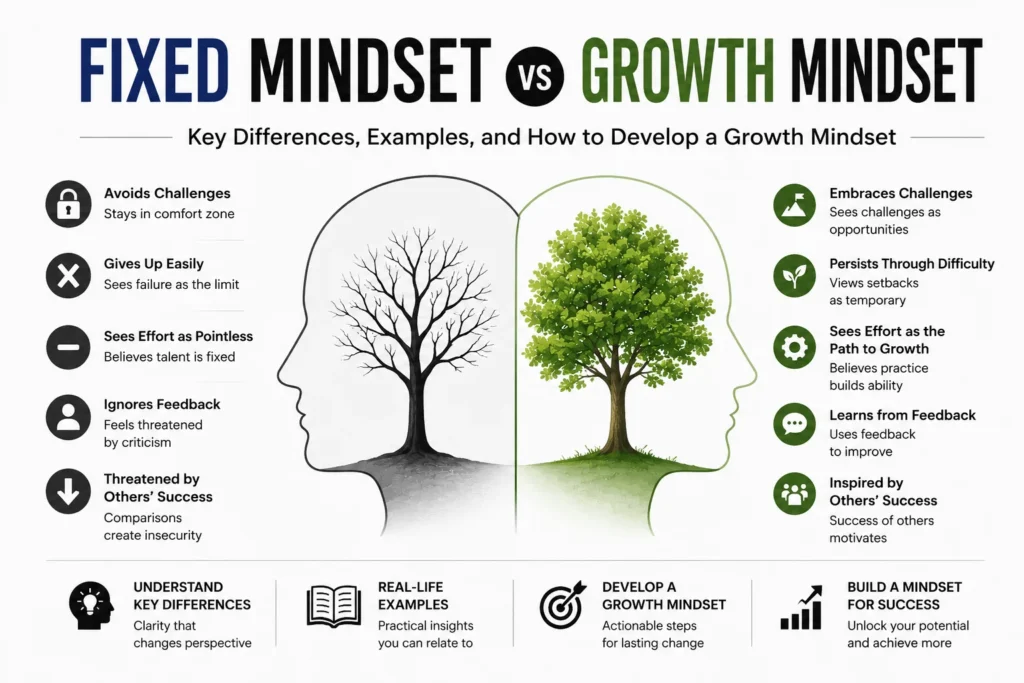
A fixed mindset is the belief that your intelligence, talents, and abilities are basically set in stone. You’re born with a certain amount, and that’s that. You can learn new things, but you can’t fundamentally change your core capabilities. Dweck describes this as the belief that your qualities are “fixed traits”.
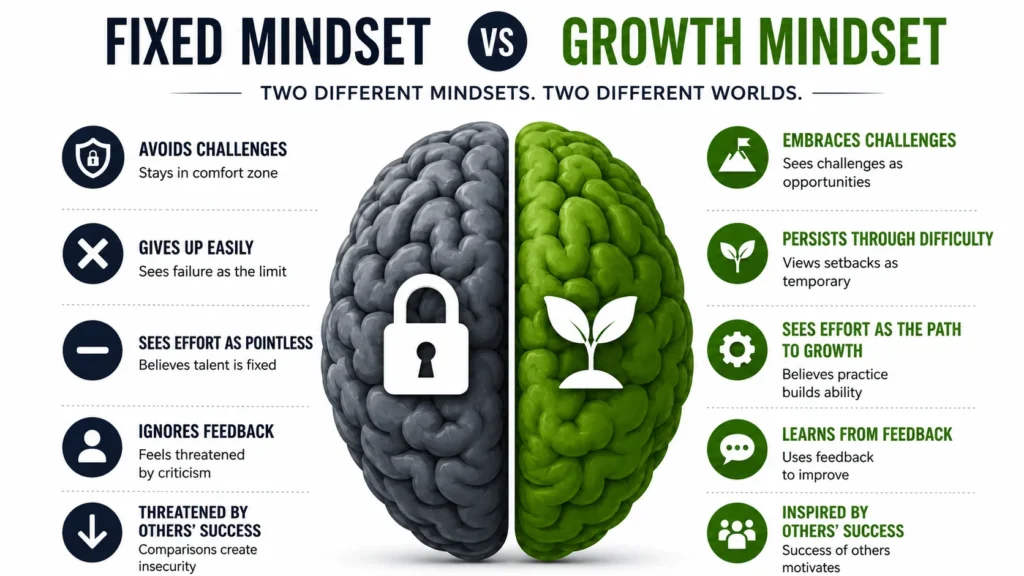
Here’s how this plays out in real life. People with a fixed mindset tend to:
- Avoid challenges that might expose their weaknesses
- Give up quickly when things get hard
- See effort as a bad sign. If you have to try, you must lack natural talent
- Ignore useful feedback or take it personally
- Feel threatened by other people’s success
The tricky part is that these responses feel completely natural. If you genuinely believe you’re not good at something, why would you keep trying? Why would you put yourself in situations where you might fail and look foolish?
I’ve seen this pattern so many times. Someone avoids a difficult project at work, sticks to what they already know, and then wonders why their career stalls. A student decides they’re “not a math person” and stops paying attention in class, which confirms their belief when they fail the test.
What is a fixed mindset at its core? It’s a belief system that prioritizes looking capable over actually becoming capable. It’s the voice that says “I can’t” instead of “I can’t yet.”
What Is a Growth Mindset?
A growth mindset is the belief that your abilities can be developed through effort, good strategies, and input from others. You might not be good at something now, but you can get better. Dweck defines it as the understanding that talents and abilities can be developed through “effort, good teaching and persistence”.
People with a growth mindset tend to:
- Embrace challenges as opportunities to learn
- Persist when things get difficult
- See effort as the path to mastery
- Learn from criticism and feedback
- Find inspiration in other people’s success
At least in my experience, this doesn’t mean you wake up every day feeling confident and motivated. It means you’ve internalized the belief that your effort actually matters. When you fail, you don’t interpret it as proof of your limitations. You interpret it as data.
Dweck and her team found that students with a growth mindset performed better academically, even when they started at the same level as their peers. In one study, students who learned growth mindset strategies showed a clear increase in math grades over time, while students in the control group saw their grades decline.
One thing that surprised me when I first looked into this research was the brain activity part. Dweck’s team examined people’s brains while they reviewed mistakes. Those with a fixed mindset showed no brain activity during this review. They weren’t learning from their errors. Those with a growth mindset, however, showed significant brain activity. Their brains were processing the mistakes and figuring out what to do differently next time.
Fixed Mindset vs Growth Mindset: The Core Differences
Let’s break down the fixed mindset and growth mindset side by side.
How You See Intelligence
| Aspect | Fixed Mindset | Growth Mindset |
|---|---|---|
| Belief about intelligence | Intelligence is fixed and unchangeable. You’re born with what you have. | Intelligence can be developed through effort and learning. Brains grow and change. |
| Goal | Look smart at all costs. Avoid looking foolish. | Learn and improve, regardless of how it looks. |
| Response to challenges | Avoid them if possible. Failure would expose your limitations. | Embrace them. This is how you grow. |
How You Handle Setbacks
When something goes wrong, the difference between fixed vs growth mindset becomes very clear. Students with a fixed mindset “will give up because they think their setback means they’re not smart”. Students with a growth mindset see setbacks as a natural part of the learning process.
This is where people often get stuck. A fixed mindset makes failure feel permanent. You think “I failed” and translate that into “I’m a failure.” A growth mindset makes failure feel temporary. You think “I failed” and translate that into “I’m learning.”
How You View Effort
Fixed mindset thinking says: if you have to work hard, you must not be very talented. Growth mindset thinking says: effort is what turns potential into skill.
I’ve seen this play out in my own work. Whenever I try something new and struggle, that old fixed mindset voice still shows up. “Maybe you’re just not good at this.” The difference is I now recognize that voice for what it is: a habit, not the truth.
How Neuroplasticity Supports a Growth Mindset
One of the most important discoveries in modern neuroscience is neuroplasticity. This is the brain’s ability to change throughout your life. For a long time, scientists thought the brain stopped developing after childhood. We now know this isn’t true.
Neuroplasticity means that when you practice a skill, your brain physically changes. New neural pathways form. Connections strengthen. Areas of the brain associated with that skill grow. This happens whether you’re learning a language, playing an instrument, or developing professional expertise.
This is what makes the growth mindset possible. If your brain couldn’t change, the growth mindset wouldn’t work. But because your brain can form new connections throughout life, your abilities aren’t fixed. They can improve with practice.
Here’s what this means in practice:
- Skills improve through repetition. When you practice something, you strengthen the neural pathways associated with that skill. This is why consistent effort works.
- You can learn new things at any age. Neuroplasticity continues throughout life. It might be harder than when you were younger, but it’s still possible.
- The brain adapts to what you do with it. If you stop using a skill, those neural pathways weaken. If you practice consistently, they strengthen.
The phrase “I’m just born this way” is outdated. Research shows that what we’re born with is just a starting point. The brain is constantly changing based on experience, effort, and learning.
Why the Distinction Matters More Than You Think
Understanding the difference between a fixed mindset and growth mindset isn’t just academic. It affects pretty much everything.
In Education and Learning
Students with a growth mindset consistently outperform students with a fixed mindset. They’re more likely to take on challenging work, persist through difficult material, and recover from setbacks.
Students with a fixed mindset will avoid asking questions because they don’t want to appear dumb. They’ll stick to subjects they already know, limiting their potential. Students with a growth mindset ask questions because they genuinely want to learn.
Research shows that when students learn about the growth mindset, they become “more likely to challenge themselves, believe that they can achieve more, and become stronger, more resilient and creative problem solvers”.
In the Workplace
A fixed mindset leads to stagnation. People stick to what they know, avoid challenges that might expose weaknesses, and get defensive about feedback. A growth mindset, on the other hand, encourages people to seek out new challenges, ask for honest feedback, and persist through difficult projects.
Harvard Business School Professor William Sahlman puts it simply: “Every person can find opportunities, attract necessary resources, and build teams to bring successful products and services to customers”.
In Personal Development
The growth mindset isn’t just for school or work. It applies to relationships, hobbies, health habits, everything.
If you believe you’re “not good at relationships,” you won’t have the difficult conversations that might actually improve them. If you believe you’re “bad at saving money,” you won’t even look at your bank account. The belief comes first, and the behavior follows.
Dweck found that when people with a fixed mindset review mistakes, “their brains showed zero brain activity.” They were processing nothing. “You could almost say they were running from the information.”
That’s what a fixed mindset does. It makes you run from the very information that could help you grow.
Signs You May Have a Fixed Mindset
Many people don’t realize they have a fixed mindset. Here are some common signs to watch for.
You avoid challenges.
When something seems difficult, you find reasons not to try. You stick to what you already know. You stay in your comfort zone.
You give up quickly.
When things get hard, you lose motivation. You tell yourself it’s not worth the effort. You move on to something easier.
You fear criticism.
Feedback feels personal. When someone offers suggestions, you feel attacked. You’d rather not hear it at all.
You compare yourself constantly.
You measure your success against others. When they succeed, you feel threatened. You worry about falling behind.
You believe talent is everything.
You think some people are just born with it. You explain success as luck or natural ability. You downplay the role of effort.
You feel like a fraud.
When you achieve something, you think it’s luck. You worry people will find out you’re not as capable as they think.
If these sound familiar, you’re not alone. Most people have some fixed mindset tendencies in certain areas of their lives. The key is recognizing them.
Signs You Already Have a Growth Mindset
On the flip side, here are signs that you already have a growth mindset in certain areas.
You learn from mistakes.
When you fail, you don’t just move on. You think about what went wrong and what you could do differently next time.
You ask questions.
You’re not afraid to admit you don’t know something. You ask for help when you need it.
You seek feedback.
You want to know how you can improve. You don’t take criticism personally. You see it as useful information.
You enjoy learning.
You don’t just want to be good at things. You actually enjoy the process of getting better. You’re curious about new subjects.
You persist through difficulty.
When things get hard, you stick with it. You try different strategies. You don’t give up easily.
You find inspiration in others’ success.
When someone else succeeds, you want to learn from them. You don’t feel threatened. You see it as proof that success is possible.
Everyone has a mix of fixed and growth mindset depending on the situation. The goal isn’t to be perfect. It’s to notice where you’re defaulting to a fixed mindset and choose a different response.
Benefits of a Growth Mindset
A growth mindset isn’t just a nice idea. It has measurable benefits across many areas of life.
Better Learning
When you believe you can improve, you put in the effort to actually improve. You practice more. You ask more questions. You seek out feedback. All of this leads to better learning outcomes.
Greater Resilience
A growth mindset helps you bounce back from setbacks. When you fail, you don’t see it as permanent. You see it as temporary. You keep going.
Improved Confidence
When you know you can improve, you’re not as afraid of failure. You’re willing to try new things because you know you’ll get better with practice. Your confidence doesn’t depend on being perfect right away.
Better Career Growth
People with a growth mindset advance faster in their careers. They take on challenging projects, learn from feedback, and persist through difficulties. They build skills over time.
Stronger Relationships
The growth mindset applies to relationships too. When you believe people can change and grow, you’re more willing to work through conflicts. You communicate better. You give people space to improve.
More Adaptability
In a world that changes constantly, a growth mindset is an advantage. When things shift, you’re willing to learn new skills. You adapt rather than resisting change.
Research consistently shows that a growth mindset supports persistence and resilience. These two qualities are essential for long-term success in just about any field.
Fixed Mindset vs Growth Mindset Examples
Seeing the difference in action helps clarify the concept. Here are concrete examples of fixed mindset and growth mindset in everyday situations.
Exam Failure
| Situation | Fixed Mindset | Growth Mindset |
|---|---|---|
| Failing a test | “I’m just not good at this subject.” | “I need a better study strategy.” |
| Response to a low grade | “Why bother trying?” | “What can I learn from this?” |
| Next action | Give up on the subject | Ask for help, try new methods |
Job Interview
| Situation | Fixed Mindset | Growth Mindset |
|---|---|---|
| After being rejected | “I’m not qualified for these roles.” | “I need to build specific skills.” |
| Before the interview | “I’ll probably fail anyway.” | “This is good practice regardless.” |
| During the interview | Focus on proving yourself | Focus on learning and connecting |
Public Speaking
| Situation | Fixed Mindset | Growth Mindset |
|---|---|---|
| When nervous | “I’m terrible at public speaking.” | “I’ll get better with practice.” |
| After a bad presentation | “I should avoid doing this again.” | “What can I work on for next time?” |
| Overall approach | Avoid speaking opportunities | Seek out more practice |
Fitness
| Situation | Fixed Mindset | Growth Mindset |
|---|---|---|
| Starting out | “I’ll never get fit.” | “Progress takes time.” |
| Missing a workout | “I’ve ruined my progress.” | “I’ll get back on track tomorrow.” |
| Seeing others in better shape | “I’ll never look like them.” | “What can I learn from them?” |
Learning a New Skill
| Situation | Fixed Mindset | Growth Mindset |
|---|---|---|
| First attempt | “I’m just not good at this.” | “This is challenging, but I’m learning.” |
| Hitting a plateau | “I’ve reached my limit.” | “I need a different approach.” |
| Comparing to others | “They’re naturally talented.” | “They probably practice a lot.” |
Entrepreneurial Mindset
| Situation | Fixed Mindset | Growth Mindset |
|---|---|---|
| Business failure | “I’m not cut out for this.” | “I learned what doesn’t work.” |
| Challenging competition | “I can never beat them.” | “What can I learn from them?” |
| Dealing with setbacks | “This business will never work.” | “What can I adjust and try again?” |
How to Develop a Growth Mindset
Developing a growth mindset isn’t about positive thinking. It’s about changing how you interpret challenges, setbacks, and feedback.
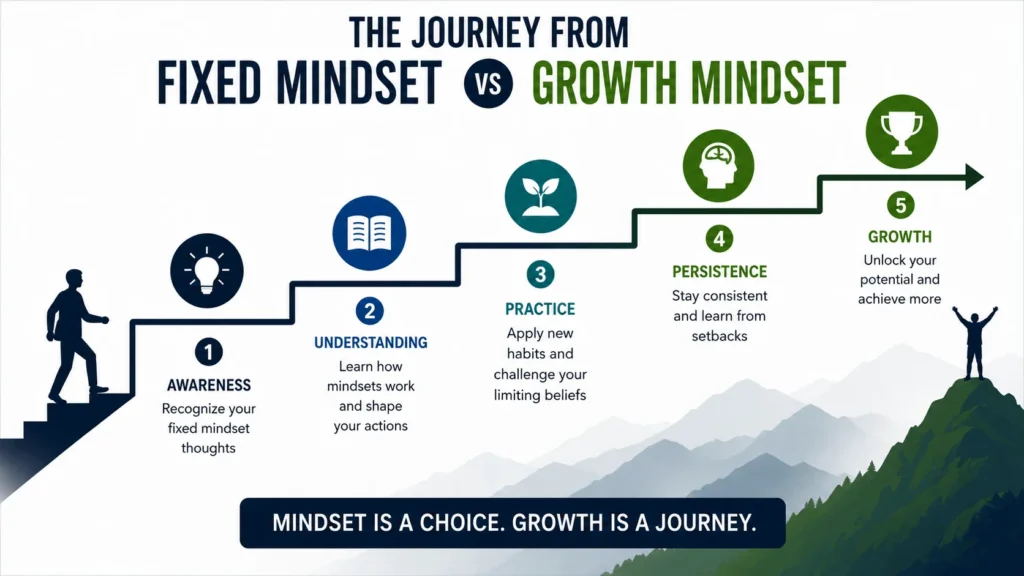
Step 1: Listen to Your Fixed Mindset Voice
The first step is noticing when the fixed mindset voice shows up. For me, it usually sounds like: “I’m not sure I can do this. What if I fail and people notice?”
Dweck calls this the fixed mindset voice. It’s the part of you that wants to play it safe. The key is recognizing that this voice is a habit, not the truth.
Step 2: Recognize That You Have a Choice
Once you notice the fixed mindset voice, you have a choice. You don’t have to obey it. You can decide how to interpret the situation.
This is where a lot of people get stuck. We’re so used to listening to that inner critic that we don’t even realize we could do something else.
Step 3: Respond With Your Growth Mindset Voice
When the fixed mindset voice says “You can’t do this,” counter it. “I can’t do this yet, but I can learn.”
When it says “You’ll probably fail,” try “What if I succeed? Or what if I learn something valuable even if I don’t?”
The language shift matters. “I’m bad at this” becomes “I’m not good at this yet.” That single word changes the whole direction of thought.
Step 4: Act in Alignment With Your Growth Mindset
The final step is action. You have to actually try the thing you’re afraid of. You have to ask for feedback. You have to persist through obstacles.
This is often where lasting change begins. You can tell yourself you have a growth mindset all day long, but until you actually try something hard and keep going, you haven’t really shifted anything.
Another thing worth mentioning: developing a growth mindset takes time. It’s not a quick fix. James Marcille, director of talent development at SNHU, says the most influential feedback he ever received was four words: “You’re trying to win.” When he felt he was right about something, his mindset became fixed. He recognized the pattern and realized he had a choice. “Take the feedback, learn from it and adjust my approach, or continue to get the same results I was getting”.
Common Misconceptions About the Growth Mindset
As the concept has spread, a few misunderstandings have taken hold.
Misconception 1: Growth Mindset Means Believing You Can Do Anything
The growth mindset doesn’t mean you can become Einstein just by trying hard. It means your potential is unknown. It means you can improve. Dweck herself clarifies that “they don’t necessarily think everyone’s the same or anyone can be Einstein, but they believe everyone can get smarter if they work at it”.
Misconception 2: It’s All About Effort
Dweck has pushed back on this herself. It’s not just about trying harder. It’s about using effective strategies, seeking feedback, and learning from others. Effort alone isn’t enough. Effective effort is what matters.
Misconception 3: You Either Have It or You Don’t
Everyone is a mix of fixed and growth mindsets depending on the situation. You might have a growth mindset about your career but a fixed one about your relationships. The goal isn’t to become perfect. It’s to notice when you’re defaulting to a fixed mindset and choose a different response.
Misconception 4: Growth Mindset Is Just Positive Thinking
This is one of the biggest misconceptions today. Growth mindset is NOT about pretending everything is fine or practicing blind optimism. It’s not about motivational quotes or forcing yourself to smile through difficulty.
Growth mindset IS about learning, adapting, improving, and using better strategies. It’s about acknowledging real challenges and believing you can work through them. It’s honest about the difficulty while still believing improvement is possible.
Dweck herself has clarified this distinction. The growth mindset isn’t just being open-minded or optimistic. It’s the specific belief that your abilities can be developed. It’s about engaging with problems and learning from them, not ignoring negative emotions.
What Recent Research Says About Growth Mindset
Recent studies have added important nuance to the growth mindset theory.
The research shows that growth mindset matters. It’s not a magic solution. Results improve when combined with deliberate practice, quality instruction, coaching, and supportive environments.
A 2024 study in Social Psychology of Education found that fixed and growth mindset items “are only moderately correlated”. This suggests that growth and fixed mindsets might be related but distinct dimensions rather than perfect opposites.
This matters because it means you can hold both fixed and growth beliefs about different aspects of yourself. You might have a growth mindset about your professional skills but a fixed mindset about your athletic abilities.
Another 2024 study published in the British Journal of Educational Psychology found four distinct mindset profiles among students: one fixed mindset profile and three growth mindset profiles that differed in their performance goal levels. Growth mindset students with low to moderate performance goals had the best outcomes, including higher grades and lower school burnout.
This suggests that developing a growth mindset isn’t just about believing you can improve. It’s also about what you’re trying to achieve and how you measure success.
Recent 2026 research continues to show that the growth mindset is effective, but it’s not the whole story. Other factors matter too: persistence, strategy, feedback quality, and support systems. The growth mindset opens the door, but you still need to walk through it.
Growth Mindset in Everyday Life
The growth mindset applies far beyond school and work. It touches almost every part of daily life.
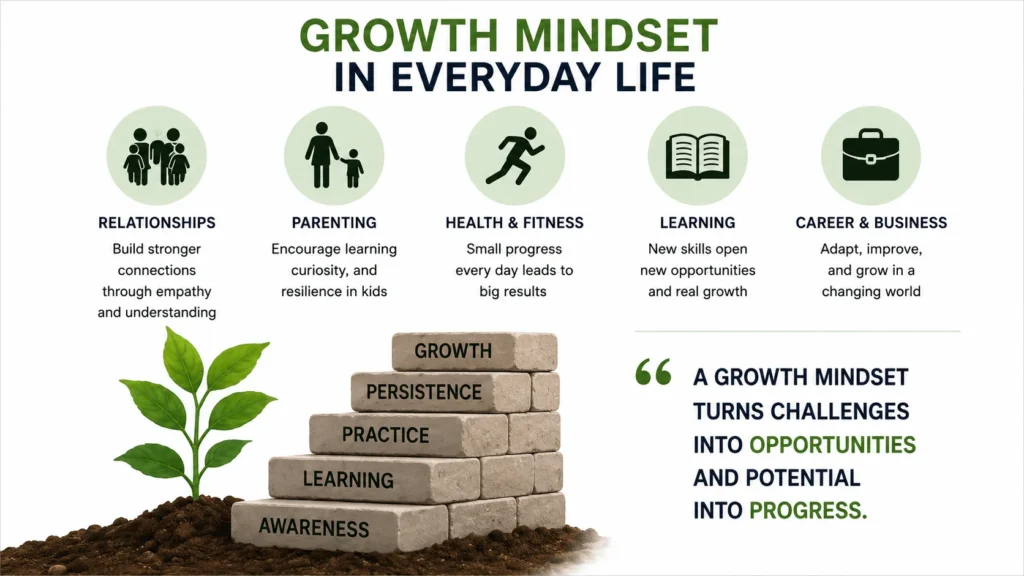
Relationships
If you believe people can’t change, you’ll give up on relationships when conflicts arise. The growth mindset says people can grow and improve. This leads to better communication, more patience, and stronger connections over time.
Parenting
Parents with a growth mindset focus on effort and learning rather than natural ability. They praise the process, not just the outcome. This helps children develop resilience and a love of learning.
Fitness
A growth mindset approach to fitness means accepting that progress takes time. You don’t give up when you miss a workout. You don’t compare yourself to others. You focus on your own improvement.
Learning New Skills
Whether you’re learning a language, an instrument, or a new hobby, the growth mindset is essential. You accept that you’ll be bad at first. You keep going anyway. You trust that you’ll get better with practice.
Business and Entrepreneurship
Entrepreneurs with a growth mindset treat failures as learning opportunities. They adapt quickly. They seek feedback from customers. They iterate. This is why a growth mindset is often associated with successful entrepreneurs.
What Changed When I Started Adopting a Growth Mindset
I remember the first time I really noticed the shift. I had to give a presentation at work, and I was terrified. In the past, I would have found a way to avoid it. I would have told myself I’m just not a good public speaker, and that’s that.
But this time I tried something different. I acknowledged I wasn’t great at it yet. Then I practiced. I recorded myself. I asked for feedback. I made changes.
The presentation wasn’t perfect. I still felt nervous. But it was better than before. And more importantly, I no longer believed that my public speaking ability was fixed. I believed I could improve. And I did.
This didn’t happen overnight. It took years of catching myself in that fixed mindset pattern and consciously choosing a different response. I still mess up. I still get nervous. But the belief that I can improve changes everything. It makes me willing to try things I would have avoided before.
FAQs
What is the difference between fixed mindset and growth mindset?
The main difference is how you view ability. A fixed mindset sees intelligence and talent as static traits you’re born with. A growth mindset sees them as qualities that can be developed through effort, good strategies, and learning from others.
Why is a growth mindset better than a fixed mindset?
Research shows that students with a growth mindset consistently outperform students with a fixed mindset. They’re more resilient, more willing to take on challenges, and better at learning from mistakes. A growth mindset leads to greater achievement and personal development across many areas of life.
Can you have both a fixed and growth mindset?
Yes. Everyone is a mix of both. You might have a growth mindset about your career but a fixed mindset about creative projects, or vice versa. Recognizing these patterns is the first step toward shifting them.
How can I develop a growth mindset?
Listen for your fixed mindset voice, recognize you have a choice in how you interpret situations, respond with a growth mindset perspective, and act in alignment with that perspective. It takes consistent practice over time.
What are examples of a fixed mindset?
A fixed mindset sounds like: “I’m just not good at math,” “I could never do public speaking,” or “If I have to try hard, I must not be talented.” Fixed mindset thinking avoids challenges, gives up easily, and sees effort as a sign of inadequacy.
What are examples of a growth mindset?
A growth mindset sounds like: “I’m not good at this yet, but I can learn,” “This challenge will help me grow,” and “Feedback will help me improve.” Growth mindset thinking embraces challenges, persists through setbacks, and sees effort as the path to mastery.
Final Thoughts
I still catch myself falling into fixed mindset thinking. When I try something new and struggle, that old voice still pipes up. The difference is I can see it for what it is now. A habit. Not the truth.
The shift from a fixed to a growth mindset doesn’t happen overnight. It’s not a quick fix. But the evidence is clear: how you think about your abilities affects what you try, what you persist through, and what you ultimately achieve.
If you’re starting from scratch, pick one area where you’ve been stuck. Listen to that fixed mindset voice when it shows up. Recognize you have a choice in how you respond. Then act differently than you would have before. Not perfectly, just differently.
That’s where the real change starts.