

Most mindset advice sounds good and does nothing.
At least that’s been the experience for many people. Reading about the power of positive thinking creates a brief surge of inspiration, and then within a few days the old patterns return. The inspiration evaporates. The old thoughts come back. Nothing actually changes.
What’s easy to miss is that mindset isn’t shaped by insights. It’s shaped by repetition. The thoughts you think every day, the behaviors you repeat, the small choices that seem insignificant in the moment those are what form your default way of seeing yourself and the world.
Daily habits that improve your mindset work differently than motivation. They don’t rely on feeling inspired. They rely on showing up and doing something small, consistently, until the new pattern becomes stronger than the old one.
Start Today
Choose ONE habit to begin:
- Gratitude writing (2 min)
- Walk for 20 minutes
- Quiet reflection (5 min)
- Read for 10 minutes
- Brief mindfulness (5 min)
Time Required: 20–35 minutes
Difficulty: Easy
Expected Results: 2–8 weeks of consistent practice
Mindset Habit Statistics
- Habit automaticity averages around 66 days, though it varies widely by person and behavior.
- Regular physical activity is consistently associated with better mental wellbeing.
- Gratitude interventions have repeatedly shown improvements in wellbeing across multiple studies.
- Self-compassion is associated with greater resilience and lower self-criticism.
- Approximately 40–45% of daily behaviors are habitual rather than conscious decisions.
Key Insight
Research from psychology, neuroscience, and behavioral science consistently shows that mindset changes through repeated behavior not occasional motivation. Small daily habits create lasting neural changes because repetition strengthens brain pathways over time.
Daily Habits at a Glance
If you only remember one thing: Your mindset isn’t shaped by insights or motivation. It’s shaped by the small behaviors you repeat every day. Pick one habit. Practice it consistently. The changes will follow.
If you only choose one habit: Start with gratitude. It has the strongest research support, takes two minutes, and requires no special equipment or conditions. The practice of writing down three things you’re grateful for each day consistently shows benefits for optimism and wellbeing across multiple studies.
Before You Start
Do I need all 17 habits?
No. The list is a menu, not a prescription. The goal is consistency with a few practices, not overwhelm from trying to do everything.
How many should I start with?
One. Build it until it feels relatively automatic, then add another.
What if I miss a day?
Continue tomorrow. Missing one day has almost no effect on long-term outcomes. The danger is psychological letting the miss convince you to quit.
How long before I notice changes?
Some effects are noticeable within 2–4 weeks. Significant shifts typically take 2–3 months of consistent practice.
Do I need special equipment or apps?
No. A notebook and pen work for most of these habits. Apps can help with tracking but aren’t required.
How to Choose the Best Mindset Habit
Different habits address different challenges. Here’s a guide to help you choose based on what you’re currently struggling with.
If you struggle with stress: Start with mindfulness or quiet reflection. These practices directly target the stress response and help build emotional regulation over time.
If you struggle with negative thinking: Start with cognitive reframing. Catching and challenging one negative thought per day addresses the root pattern.
If you struggle with low confidence: Start with comfort zone challenges. Small daily acts of courage build self-efficacy through direct experience.
If you struggle with burnout: Start with sleep and movement. Address the physical foundation before adding mental practices.
If you struggle with motivation: Start with Tiny Habits. Make the behavior so small that motivation becomes irrelevant.
If you struggle with overwhelm: Start with limiting information intake and saying no to one non-essential thing. Reduce the input before adding new practices.
The best habit is the one that addresses your most pressing challenge and fits into your existing life. Start there. Add more as the first one becomes automatic.
Who Benefits Most from Daily Mindset Habits
Daily mindset habits aren’t just for one type of person. The principles work across different life contexts, though the specific practices may vary.
Students benefit from learning goals, reflection, and self-compassion practices that support academic persistence and reduce the impact of setbacks on motivation.
Professionals benefit from reframing negative thoughts, separating facts from interpretations, and limiting information intake practices that improve decision-making and reduce stress.
Entrepreneurs benefit from comfort zone challenges, process visualization, and connecting with people who challenge their thinking practices that build resilience and adaptability.
Parents benefit from self-compassion, mindfulness, and end-of-day reflection practices that support emotional regulation and intentional parenting.
Athletes benefit from process visualization, consistency tracking, and learning goals practices that improve performance and persistence.
Retirees benefit from gratitude, reading, and connecting with others practices that support cognitive health and social connection.
The specific habits that work best depend on your circumstances, but the underlying mechanisms neuroplasticity, identity formation, and the habit loop apply universally.
Why Habits Change Your Mindset (The Science)
Most people think mindset change works like this: have an insight, feel inspired, and then think differently from that point forward.
It doesn’t work that way.
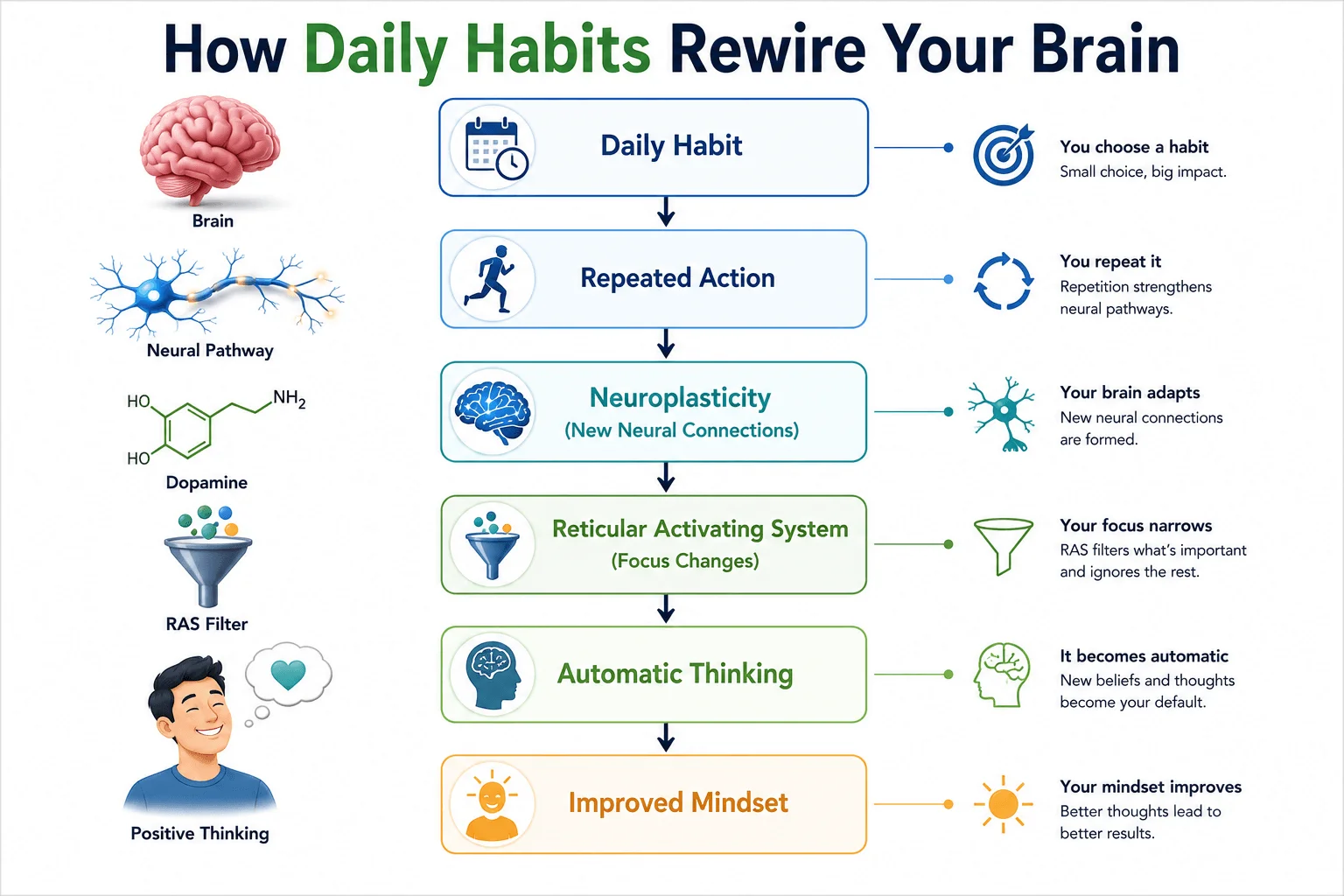
Insights fade. Inspiration is temporary. The reason daily mindset habits work is that they operate through a completely different mechanism. They change your brain physically over time.
Neuroplasticity: Your Brain’s Ability to Rewire Itself
Neuroplasticity is the brain’s capacity to reorganize itself by forming new neural connections throughout life. Every thought you think strengthens certain pathways and weakens others. When you repeat a new thought pattern daily, you’re not just practicing a skill. You’re building physical infrastructure.
Multiple systematic reviews (2018–2025) have confirmed that repeated thoughts and behaviors strengthen neural pathways through neuroplasticity across the lifespan. The brain changes through repetition, not through one-time insights.
The old pathways don’t disappear completely. They just get weaker with disuse while the new ones get stronger with practice. This is why consistency matters more than intensity. A single profound insight won’t rewire your brain. Daily repetition over weeks and months will.
The Reticular Activating System (RAS)
The RAS is a bundle of nerves at your brainstem that filters incoming information. It determines what you notice and what you ignore. Your RAS is programmed by what you repeatedly focus on.
When you practice gratitude daily, your RAS starts noticing more things to be grateful for. When you constantly scan for threats, your RAS serves up evidence of danger. The filter itself gets tuned by your habits.
This is why mindset practices create self-reinforcing cycles. The habit changes what you notice. What you notice changes what you experience. What you experience reinforces the habit.
Dopamine and Reward Pathways
Dopamine isn’t just about pleasure. It’s central to motivation, learning, and habit formation. When you complete a behavior and experience even a small reward, dopamine helps encode that behavior for repetition.
This is why making new habits satisfying even in small ways matters. The dopamine release strengthens the neural pathway. Over time, the behavior becomes increasingly automatic as the basal ganglia takes over from the prefrontal cortex.
Psychologist Insight
Research consistently suggests that small behaviors repeated over time have a greater impact on long-term change than occasional bursts of motivation. Sustainable habits are built through repetition, environmental support, and gradual identity change.
Scientific Consensus
Although different researchers study habits from different perspectives, there is broad agreement that consistent repetition, supportive environments, and identity-based behavior change produce more sustainable results than relying on motivation alone. The research converges on a central point: habits change mindsets through repeated practice, not through sudden insight.
Important Note
Mindset habits can improve wellbeing, but they are not a replacement for professional treatment if you’re experiencing clinical anxiety, depression, trauma, or other mental health conditions. If you’re struggling, consider reaching out to a qualified therapist or healthcare provider.
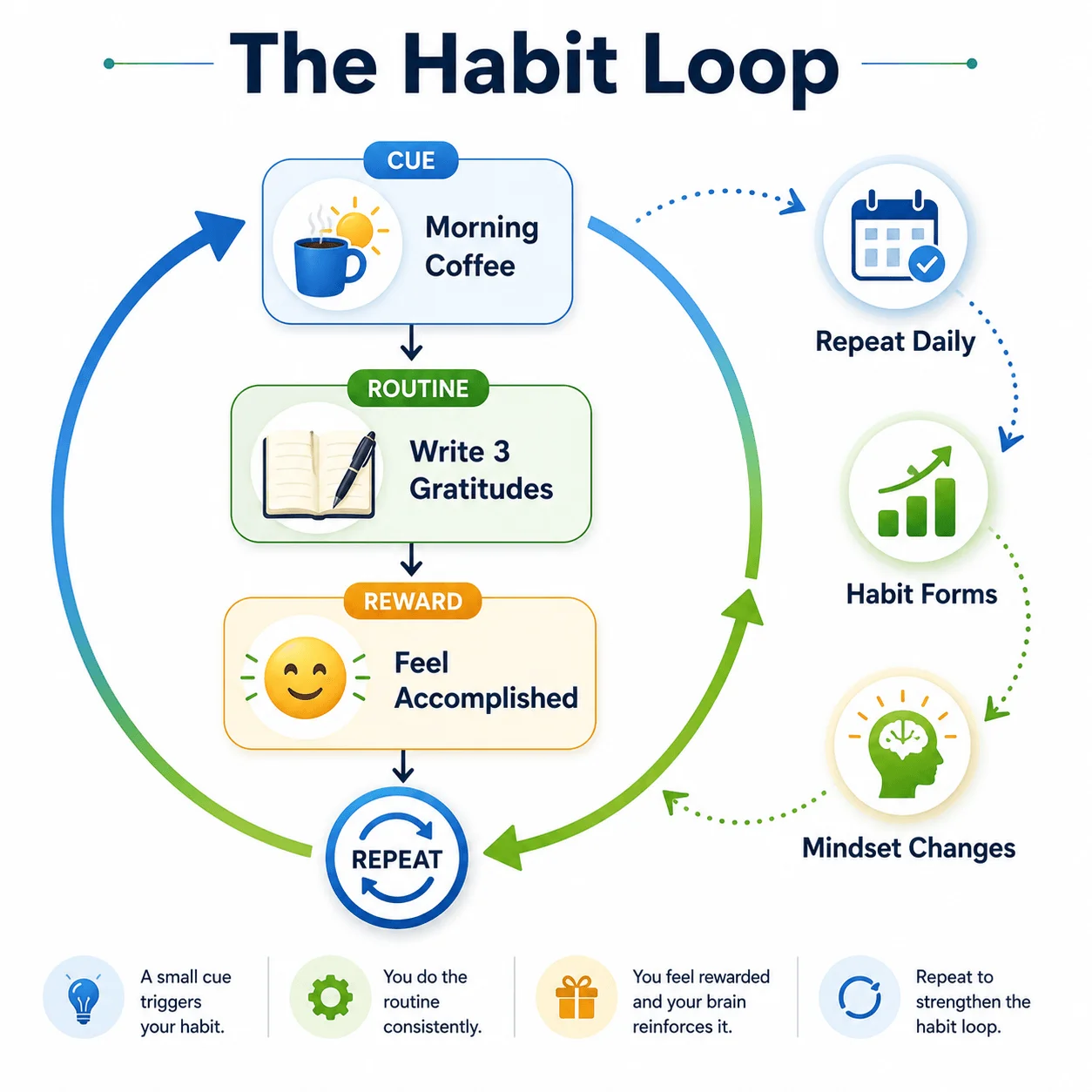
The Habit Loop: How Small Actions Rewire Your Brain
Charles Duhigg, in his research on habit formation, identified a three-part neurological loop that governs every habit: cue, routine, reward.
The cue is the trigger that initiates the behavior. It could be a time of day, a location, an emotional state, or an action you just completed. The cue tells your brain to go into automatic mode.
The routine is the behavior itself. This is what you actually do the physical, mental, or emotional action.
The reward is what your brain gets from completing the routine. It could be a feeling of accomplishment, a dopamine hit, or relief from discomfort. The reward is what makes the brain want to repeat the behavior next time.
When you’re building new habits for a better mindset, you can use this loop intentionally:
- Cue: Choose a trigger that’s already part of your day (pouring morning coffee, brushing teeth, getting into bed).
- Routine: Attach a small mindset practice to that cue.
- Reward: Make it satisfying. A moment of acknowledgment. A checkmark on a calendar. A brief positive feeling.
This loop is why habit tracking works. The act of marking a habit as complete provides a small reward that reinforces the behavior.
Tiny Habits: Why Starting Small Works
BJ Fogg, a behavior scientist at Stanford and author of Tiny Habits, developed a method that challenges the common approach to behavior change. Instead of trying to build big habits through willpower, Fogg argues that the most reliable way to create lasting change is to start absurdly small.
Expert Insight — BJ Fogg
“To create a habit, make the behavior tiny. Do it immediately after an existing habit. Celebrate immediately.”
The Tiny Habits Method has three components:
- Make it tiny. Floss one tooth. Do one pushup. Write one sentence. The behavior should be so small that it feels almost ridiculous.
- Find an anchor. Attach the tiny behavior to something you already do. “After I brush my teeth, I will floss one tooth.”
- Celebrate immediately. Create a positive emotional response right after doing the behavior. Say “I did it!” or do a small physical celebration. The positive emotion releases dopamine and helps encode the behavior.
The reason this works is that tiny behaviors bypass the resistance that kills most new habits. When the behavior is small enough, your brain doesn’t mobilize against it. There’s no activation energy barrier. You just do it.
In practice, many people find that trying to change five habits at once leads to giving up within a week. Starting with one small habit proves much more sustainable. Once the tiny habit is established which happens faster because it’s so small you can gradually expand it. One pushup becomes five. One sentence becomes a paragraph. But the foundation is the tiny version that you do consistently.
Identity-Based Habits: Becoming the Person Who Thinks Differently
James Clear’s work on identity-based habits shows that the most sustainable behavior change comes from shifting your sense of who you are. Instead of setting a goal like “I want to think more positively,” you adopt the identity of “I am someone who manages their thinking intentionally.”
Expert Insight — James Clear
“Every action you take is a vote for the type of person you wish to become.”
This is the identity-habit-mindset connection that most articles miss. Your daily practices become evidence for the identity. Each time you do the habit, you’re casting a vote for the person you’re becoming.
The sequence looks like this:
Identity → Habit → Evidence → Stronger Identity → Changed Mindset
Someone who identifies as “a writer” writes daily. The daily writing provides evidence that they are, in fact, a writer. The evidence strengthens the identity. The identity makes the writing feel natural.
This connects directly to the growth mindset research. The growth mindset the belief that abilities can be developed is itself an identity statement. “I am someone who grows through effort.” When that identity is in place, the daily mindset building habits feel like expressions of who you are rather than obligations you’re forcing on yourself.
Keystone Habits That Improve Everything Else
Some habits have ripple effects. They don’t just improve one area of your life. They create conditions that make other positive changes easier. These are called keystone habits.
Sleep is a keystone habit. When you’re well-rested, your emotional regulation improves, your decision-making sharpens, and your willpower strengthens. Sleep affects literally every other habit on this list. Current research consistently confirms that sleep quality directly impacts cognitive performance and emotional resilience.
Exercise is a keystone habit. People who start exercising regularly often report improvements in eating habits, productivity, and mood even though they didn’t set out to change those things. The exercise creates a foundation of energy and self-efficacy that spills into other areas. Multiple meta-analyses (2018–2025) have reinforced the connection between regular physical activity and improved mental wellbeing.
Journaling or reflection is a keystone habit. The practice of stepping back and observing your own thinking creates self-awareness that feeds into everything else. You start noticing patterns you were previously blind to.
If you’re starting from scratch, a keystone habit is often the best place to begin. One change that makes other changes easier.
17 Daily Habits That Improve Your Mindset
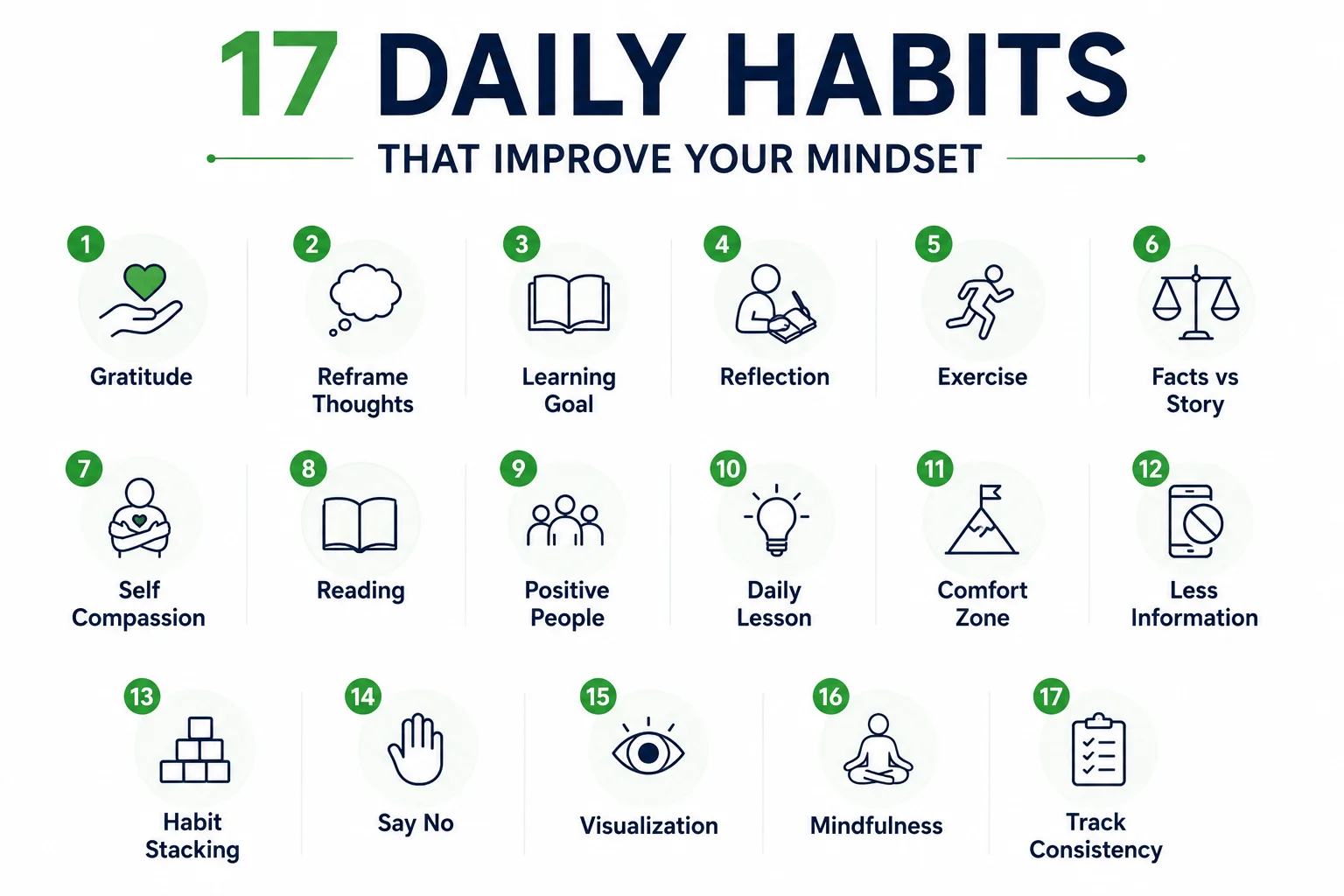
These aren’t in order of importance. Pick one or two to start. Add more as the first ones become automatic.
1. Practice Gratitude in Writing
Gratitude is one of the most researched interventions in positive psychology. Multiple studies and systematic reviews (2018–2025) have found that people who regularly practice gratitude report greater wellbeing and optimism.
The practice is simple: write down three things you’re grateful for each day. They don’t need to be profound. A good cup of coffee. A conversation that went well. The fact that your car started this morning.
Many people initially find gratitude repetitive before the benefits become noticeable. After several weeks, however, they often begin noticing positive events more naturally. The brain learns that it will be recording good things later, so it starts looking for them in real time. That shift in attention driven by the RAS is the mechanism.
2. Reframe One Negative Thought
Cognitive restructuring is a technique from Cognitive Behavioral Therapy (CBT) that involves identifying and challenging unhelpful thought patterns. The daily version: catch one negative thought and reframe it.
“I always mess things up” becomes “I made a mistake on this specific thing, and I can learn from it.”
“I’m terrible at this” becomes “I’m not good at this yet.”
The reframe doesn’t have to be wildly positive. It just has to be more accurate than the original thought. The original thought is usually distorted overly negative, overly general, overly permanent. The reframe brings it closer to reality.
This connects to the work of changing limiting beliefs. Most limiting beliefs are just negative thoughts repeated so often they feel like facts.
3. Set One Learning Goal for the Day
Performance goals are about outcomes. Learning goals are about growth. This is one of the core growth mindset habits identified in Carol Dweck’s research.
A performance goal: “Finish the report by noon.” A learning goal: “Understand the data well enough to explain it to someone else.”
Expert Insight — Carol Dweck
“Becoming is better than being.” Growth begins when you believe your abilities can improve.
Learning goals shift your focus from proving yourself to improving yourself. Set one each morning. Write it down. At the end of the day, reflect on what you learned.
4. Spend Five Minutes in Quiet Reflection
Most people go through their days without ever pausing to notice what’s happening in their own minds. Five minutes of quiet reflection creates that pause.
Sit somewhere without distractions. Don’t try to think about anything in particular. Just notice what comes up. What thoughts are circulating? What emotions are present?
This isn’t formal meditation. It’s checking in with yourself. The value is in the noticing. You can’t change patterns you don’t see. Building self-awareness starts with practices like this.
5. Move Your Body
Physical movement affects mental state directly. Exercise releases dopamine, norepinephrine, and serotonin neurochemicals involved in mood regulation, motivation, and focus. Multiple meta-analyses (2018–2025) have confirmed that regular physical activity is consistently associated with improved mental wellbeing across age groups.
This doesn’t require an intense workout. A twenty-minute walk. Ten minutes of stretching. The goal is physical activation, not athletic performance.
The connection between morning movement and sharper thinking is consistent enough that many people begin treating exercise as a mindset practice rather than just a health practice.
6. Separate Facts from Interpretations
When something difficult happens, distinguish between what actually occurred and the story you’re telling yourself about what it means.
“My boss didn’t respond to my email.” Fact. “My boss is unhappy with my work.” Interpretation.
“The presentation had a mistake in it.” Fact. “Everyone thinks I’m incompetent.” Interpretation.
Facts are usually manageable. Interpretations are where the suffering lives. This is one of the most practical positive mindset habits you can build.
7. Practice Self-Compassion
Most people treat themselves more harshly than they’d ever treat a friend. The assumption is that being hard on yourself motivates improvement.
The research says otherwise. Kristin Neff’s work has consistently shown that treating yourself with kindness during setbacks improves motivation and resilience more than self-criticism. Multiple systematic reviews (2018–2025) have confirmed that self-compassion interventions produce meaningful improvements in psychological wellbeing.
The daily practice: when you notice you’re being hard on yourself, pause and ask what you’d say to a friend in the same situation. Then say that to yourself instead. This is one of the healthy mindset habits that supports all the others.
8. Read for Fifteen Minutes
Reading exposes your brain to new ways of thinking. It’s fifteen minutes away from the noise of notifications and scrolling. The sustained attention itself is a form of mindset training.
What you read matters less than the consistency. Psychology, biography, fiction, history the genre matters less than the practice of focused attention.
9. Connect with Someone Who Challenges Your Thinking
Mindsets are shaped socially. The people you spend time with influence what you believe is normal, possible, and worth pursuing. This is one of the principles behind building wellness habits.
A daily check-in with someone who thinks differently or who models a mindset you’re trying to develop can shift your thinking in ways solitary practice can’t.
10. End the Day with One Lesson Learned
Before you go to bed, ask: what did I learn today? It doesn’t need to be profound. A small insight about how you work best. Something you noticed about another person.
The question trains your brain to scan for learning opportunities throughout the day. Over time, this shifts your orientation from performance to growth.
11. Do Something Outside Your Comfort Zone
Growth happens at the edge of discomfort, where things feel slightly unfamiliar. This connects to the work of building self-efficacy.
Speak up in a meeting when you’d normally stay quiet. Try a new skill. Have a conversation you’ve been avoiding. Each experience of doing something difficult and surviving it strengthens your belief in your ability to handle challenges.
12. Limit Information Intake
Most people consume more information in a day than their grandparents consumed in a month. The volume fragments attention, increases anxiety, and fills mental space that could be used for reflection.
A daily habit of limiting intake: check the news once instead of constantly. Turn off notifications for set periods. Put your phone in another room during focused work. Current research on digital wellbeing (2020–2025) confirms that intentional limits on information consumption are associated with reduced stress and improved attention.
13. Use Habit Stacking
Habit stacking, a technique from BJ Fogg’s Tiny Habits method and popularized by James Clear, means attaching a new habit to an existing one.
After pouring morning coffee, write down one thing you’re grateful for.
After brushing teeth at night, identify one lesson learned today.
The existing habit becomes the cue for the new one. You don’t have to remember. It’s attached to something you already do automatically. We cover this in our guide on building good habits.
14. Practice Saying No to One Non-Essential Thing
A cluttered life produces a cluttered mind. When you’re overcommitted, your mental bandwidth is consumed by obligations that don’t align with your priorities.
The daily practice: identify one thing you could say no to. Then say no to it. Each time you do this, you’re treating your time and attention as finite resources worth protecting.
15. Visualize Process, Not Just Outcome
Gabriele Oettingen’s research on mental contrasting shows that visualizing the outcome without also visualizing obstacles can actually reduce motivation.
The more effective practice: visualize the process. See yourself sitting down to write. See yourself choosing the better option. See yourself having the difficult conversation. The visualization becomes mental rehearsal of specific behaviors.
16. Practice a Brief Mindfulness Exercise
Pick one routine activity and do it with full attention. Drinking your morning coffee. Walking to your car. Washing dishes. Pay attention to the sensations instead of letting your mind wander.
Current systematic reviews (2018–2025) confirm that even brief mindfulness practices are associated with reduced stress and improved emotional regulation. A few minutes of intentional presence is enough to make a difference.
17. Keep a Consistency Record
What gets measured gets managed. The simple act of tracking whether you did your habits today increases the likelihood that you’ll do them tomorrow.
A checkmark on a calendar. A note in your phone. Keep it simple. The tracking itself shouldn’t become a burden. For more on making tracking sustainable, see our guide on habit tracking benefits.
Research Table: Evidence Strength by Habit
| Habit | Main Benefit | Evidence Strength |
|---|---|---|
| Gratitude writing | Increased optimism | Very Strong |
| Physical movement | Improved mood | Very Strong |
| Self-compassion | Greater resilience | Very Strong |
| Mindfulness | Reduced stress | Very Strong |
| Cognitive reframing | Reduced negative thinking | Very Strong |
| Sleep quality | Cognitive performance | Very Strong |
| Quiet reflection | Self-awareness | Strong |
| Reading | Cognitive engagement | Strong |
| Learning goals | Growth orientation | Strong |
| Process visualization | Improved performance | Moderate |
| Habit stacking | Habit formation | Strong |
| Consistency tracking | Adherence | Strong |
| Social connection | Perspective shift | Moderate |
| Information limits | Reduced stress | Moderate |
| Comfort zone challenges | Self-efficacy | Strong |
| End-of-day reflection | Learning integration | Moderate |
| Saying no | Boundary-setting | Moderate |
Morning vs Evening Mindset Habits
Different times of day suit different types of mindset work.
| Morning Habits | Evening Habits | |
|---|---|---|
| Best for | Setting intention, energy, focus | Reflection, processing, closure |
| Brain state | Alert, receptive | Integrative, reflective |
| Examples | Gratitude, learning goals, movement | Lessons learned, reflection, self-compassion review |
| Benefit | Shapes the day ahead | Processes the day completed |
| Challenge | Time pressure | Mental fatigue |
Morning habits work well for practices that set direction. Your brain is fresh. You’re establishing the tone for the hours ahead. Gratitude, learning goals, and identity statements fit naturally here.
Evening habits work well for practices that process what happened. Your brain is winding down. You’re integrating experiences. Reflection, lessons learned, and self-compassion review fit naturally here.
The best routine includes both, but if you’re starting from scratch, pick one time of day and build from there.
Habit Stacking: How to Build a Routine That Sticks
Habit stacking is the most practical technique for building daily routines for success. Here’s how it works.
Existing Habit → New Habit
| After I… | I will… |
|---|---|
| Pour my morning coffee | Write down three gratitudes |
| Finish breakfast | Set one learning goal |
| Start my work computer | Take three deep breaths |
| Eat lunch | Walk for ten minutes |
| Brush my teeth at night | Identify one lesson learned |
| Get into bed | Read for ten minutes |
Each new habit is attached to something that’s already automatic. The existing habit provides the cue. You don’t need to remember. You don’t need willpower. You just need to chain the behaviors together.
This is the habit formation principle in practice: make the new behavior easy by connecting it to an existing pattern.
Your Morning Mindset Routine
A morning mindset routine combines several practices into a sequence that sets the tone for the day. Here’s a template that takes about fifteen minutes.
- Quiet reflection (5 min): Sit without distractions. Notice what’s present.
- Gratitude (2 min): Write down three things you’re grateful for.
- Learning goal (2 min): Set one thing you want to learn or understand better today.
- Identity statement (1 min): State who you’re becoming. “I am someone who…”
- Movement (5 min): Stretch, walk, or move your body in whatever way feels good.
That’s it. Fifteen minutes. Small enough to be sustainable. Substantial enough to shift your mental state.
If you’re building from scratch, start with just one element. Do it for two weeks. Then add another. This is one of the common wellness mistakes people make trying to build a full routine overnight instead of layering habits gradually.
Daily Habit Scorecard
| Habit | Difficulty | Time | Evidence Strength |
|---|---|---|---|
| Gratitude writing | Easy | 2 min | Very Strong |
| Reframing thoughts | Medium | 2 min | Very Strong |
| Learning goal | Easy | 1 min | Strong |
| Quiet reflection | Easy | 5 min | Strong |
| Physical movement | Medium | 20 min | Very Strong |
| Facts vs interpretations | Medium | 2 min | Strong |
| Self-compassion | Medium | 2 min | Very Strong |
| Reading | Easy | 15 min | Strong |
| Connecting with others | Easy | 5 min | Moderate |
| End-of-day lesson | Easy | 2 min | Moderate |
| Comfort zone challenge | Hard | Varies | Strong |
| Limiting information | Medium | Ongoing | Moderate |
| Habit stacking | Easy | 1 min | Strong |
| Saying no | Hard | Varies | Moderate |
| Process visualization | Easy | 3 min | Moderate |
| Mindfulness | Medium | 5 min | Very Strong |
| Consistency tracking | Easy | 1 min | Strong |
The Habit Formation Timeline
Based on research on habit formation, here’s what the timeline typically looks like:
Days 1–3: The new behavior feels awkward. You’re relying entirely on conscious effort. This is the hardest phase.
Week 1: You’re still forgetting regularly. Each successful repetition is building infrastructure. The cue-routine link is starting to form.
Week 2–3: The behavior starts feeling more natural. You forget less often. The habit is beginning to establish.
Days 30–45: The habit is becoming semi-automatic in some contexts. You still need cues and reminders, but the effort required is decreasing.
Days 60–70: Research suggests this is the average time for a new behavior to become relatively automatic. The habit feels more like part of your routine than something extra.
6 months: The habit is well-established. Skipping it feels like something is missing. The neural pathways supporting the behavior are strong.
1 year: The habit is deeply ingrained. It’s part of your identity. You no longer think about whether to do it you just do it.
Current research on habit formation continues to affirm that the time required for automaticity varies widely by person and behavior, but consistent daily repetition in a stable context remains the most reliable predictor of successful habit formation.
7-Day Mindset Challenge
A structured week of practice can build momentum. Here’s a day-by-day plan.
Day 1: Write down three things you’re grateful for.
Day 2: Catch and reframe one negative thought.
Day 3: Take a twenty-minute walk. Notice how you feel afterward.
Day 4: Separate facts from interpretations in one difficult situation.
Day 5: Practice self-compassion. Talk to yourself the way you’d talk to a friend.
Day 6: End the day by writing down one lesson learned.
Day 7: Review the week. What did you notice? Which practices felt most useful?
The goal isn’t perfection. It’s practice. Do what you can. Skip what you can’t. The point is to experience the habits, not to complete a checklist perfectly.
How to Make Habits Stick Long-Term
Building a habit is one thing. Keeping it going for months and years is another. Here are strategies that help habits endure.
Implementation Intentions
Implementation intentions specify exactly when and where you’ll perform a behavior. The format is: “When [situation], I will [behavior].”
“When I finish dinner, I will walk for ten minutes.”
“When I sit at my desk in the morning, I will write down one learning goal.”
This specificity removes ambiguity. You don’t wonder whether you’ll do the habit. You’ve already decided.
Environment Design
Environment shapes behavior more than willpower. Make the desired behavior easier and the undesired behavior harder.
Want to read more? Put books where you’ll see them. Put your phone in another room. Want to eat better? Keep healthy food visible. Keep junk food out of sight.
The goal is to design your surroundings so the default choice is the one that aligns with your intentions.
Temptation Bundling
Temptation bundling pairs something you want to do with something you need to do. Only allow yourself the pleasure while doing the habit.
Listen to your favorite podcast only while walking. Watch your favorite show only while on the treadmill. The enjoyable activity becomes the reward that reinforces the habit.
Accountability
Telling someone else you’ll do something increases follow-through. A check-in partner, a group, or even a public commitment can provide external motivation when internal motivation wanes.
Research on accountability consistently shows that people are more likely to follow through when someone else is watching even if that someone is just a friend you text once a week.
Identity Reinforcement
Return regularly to the identity that underlies your habits. Remind yourself who you’re becoming. When a habit feels like a chore, reconnect it to the person you want to be.
“I don’t exercise because I have to. I exercise because I’m someone who takes care of my body.”
“I don’t reframe negative thoughts because I should. I do it because I’m someone who manages my thinking intentionally.”
Habit Contracts
A habit contract is a written agreement with yourself (or someone else) that specifies what you’ll do and what happens if you don’t. The consequences don’t need to be severe. They just need to exist.
“If I miss two days in a row, I’ll donate twenty dollars to a cause I dislike.”
“If I complete thirty straight days, I’ll treat myself to something I’ve been wanting.”
The contract makes the commitment tangible. It transforms a vague intention into a specific agreement.
When Habits Don’t Work
Sometimes good habits fail through no fault of your own. Understanding why helps prevent giving up when things get hard.
Poor sleep. When you’re chronically underslept, your capacity for deliberate effort diminishes. Habits that normally feel manageable become overwhelming. Address sleep before trying to add new practices.
High stress or burnout. During periods of intense stress, the brain defaults to its most well-worn pathways. Adding new habits during burnout is often counterproductive. Focus on recovery first.
Depression or anxiety. Clinical depression and anxiety can make even basic routines feel impossible. If mindset habits aren’t helping despite consistent effort, consider speaking with a mental health professional.
Wrong environment. If your environment constantly triggers old patterns, new habits are swimming upstream. Change the environment before trying to change the behavior.
No clear trigger. Habits need cues. If you haven’t attached the new behavior to something you already do, you’ll forget. Use habit stacking.
No reward. If the new behavior feels pointless or unpleasant with no payoff, your brain won’t encode it for repetition. Find a way to make it satisfying, even in a small way.
Trying to do too much. Adding multiple habits simultaneously while managing existing demands is a setup for failure. Start with one. Build from there.
Common Habit Mistakes
Trying to adopt too many habits at once. Pick one or two. Adding more before the first ones are established usually leads to abandoning all of them.
Depending on motivation. Motivation is temporary. Systems are durable. Build the system. Don’t wait to feel like doing the habit.
Skipping one day and then quitting. Missing one day has almost no effect on long-term outcomes. The danger is letting one missed day convince you that you’ve failed.
Setting unrealistic goals. If you haven’t exercised in a year, don’t commit to daily hour-long workouts. Start with a ten-minute walk.
Comparing your progress to others. You’re seeing their results, not their struggles. Everyone’s timeline is different.
Expecting immediate results. Mindset habits work through neuroplasticity. Building new neural pathways takes time. You won’t feel different after one day or even one week. After a month, you’ll notice shifts. After six months, the changes will be significant.
Habit Myths vs Reality
Myth: It takes 21 days to build a habit.
Reality: Research on habit formation shows wide variation. One study found that habits took anywhere from 18 to 254 days to become automatic, averaging around 66 days. The timeline depends on the person, the behavior, and the context.
Myth: You need willpower to maintain habits.
Reality: Willpower is helpful for starting habits. Maintaining them depends more on environment design, cue consistency, and identity alignment than on willpower.
Myth: Missing a day ruins your progress.
Reality: One missed day is statistically irrelevant. The danger is psychological letting the miss convince you to quit. Just restart.
Myth: All habits are equally effective for everyone.
Reality: The best habit is the one you’ll actually do. Individual differences matter. Experiment to find what works for you.
Myth: Habits are about discipline, not identity.
Reality: The most sustainable habits are rooted in identity. When the behavior expresses who you believe you are, it doesn’t require constant discipline.
Motivation vs Daily Habits
| Motivation | Daily Habits |
|---|---|
| Temporary | Long-lasting |
| Emotion-based | System-based |
| Unpredictable | Consistent |
| Requires energy | Becomes automatic |
| Fades under stress | Holds under stress |
| Short-term | Identity change |
| “I feel like it” | “I do it regardless” |
| Relies on willpower | Relies on cues and environment |
Habit Tracking Apps and Tools
Several apps can support your daily practice, though paper and pen work just as well.
- Loop Habit Tracker: Simple, free, open-source. Great for basic daily tracking.
- Streaks: Clean design. Focuses on maintaining consecutive days.
- Habitica: Gamifies habit tracking. Turns your practices into a role-playing game.
- TickTick: Combines to-do lists with habit tracking. Useful if you want one app for both.
- Notion: Flexible enough to build a custom habit tracker. Good if you already use Notion.
- Paper calendar: A wall calendar and a marker. Mark an X for each day you complete your habit. The visual chain is motivating.
The best tool is the one you’ll actually use. Start simple. You can always add complexity later.
What to Expect in the First Month
Week 1: The new habits feel awkward. You’ll forget to do them. You might feel like they’re not working. This is normal. The first week is about remembering, not about results.
Week 2: The habits start to feel slightly more natural. You still forget sometimes, but less often. You might notice small shifts catching a negative thought faster, feeling slightly calmer.
Week 3: The habits are becoming part of your routine. They require less conscious effort. The effects are more noticeable. Research on habit formation suggests consistency during this period is critical.
Week 4: The new patterns are settling in. They’re not fully automatic yet that takes longer but they’re established enough that skipping them feels like something is missing.
After the first month, the work shifts from building the habits to maintaining them. The goal is no longer to remember. It’s to keep showing up consistently enough that the neural pathways continue strengthening.
Frequently Asked Questions
How long does it take for mindset habits to work?
Some effects are noticeable within a few weeks catching negative thoughts faster, feeling slightly more grounded. Significant mindset shifts typically take months of consistent practice. The habits work through neuroplasticity, and building new neural pathways takes time and repetition. Research suggests habit automaticity averages around 66 days, though the range is wide.
What is the best daily habit for mental health?
Physical movement has some of the strongest evidence for improving mental health across multiple dimensions. However, the best habit is the one you’ll do consistently. If exercise feels overwhelming, start with gratitude journaling or a brief mindfulness practice.
Which mindset habit has the strongest scientific evidence?
Gratitude journaling and physical exercise both have extensive research support across multiple systematic reviews and meta-analyses. Cognitive reframing, drawn from CBT, also has a strong evidence base spanning decades of clinical research.
What’s the most important mindset habit to start with?
Gratitude journaling has the strongest research support and is one of the easiest to implement. It takes two minutes, requires no special conditions, and consistently shows benefits across studies. But the best starting point is the habit that feels most doable for you.
Which habit changes mindset fastest?
There’s no single fastest habit. Cognitive reframing can produce noticeable shifts in thinking patterns relatively quickly because it directly targets automatic thoughts. However, lasting change requires consistent practice regardless of which habit you choose.
Are mindset habits really effective?
Yes. Research from multiple domains neuroscience, behavioral psychology, and clinical psychology consistently shows that repeated thoughts and behaviors produce measurable changes in neural pathways, thought patterns, and emotional responses. The key is consistency over time, not intensity.
Can mindset change at any age?
Yes. Neuroplasticity continues throughout life. While the rate of change may vary, the brain remains capable of forming new neural connections at any age. The belief that you’re “too old to change” is itself a limiting belief that can be examined and challenged.
Can habits improve confidence?
Yes. Habits that involve doing difficult things comfort zone challenges, learning new skills, consistent exercise build self-efficacy through direct experience. Each time you do something challenging and survive it, your belief in your capability strengthens.
What habit should I start today?
If you’re unsure, start with gratitude. Write down three things you’re grateful for. It takes two minutes, requires no equipment, and has strong research support. The best habit is the one you’ll actually do.
Can mindset habits help with anxiety or depression?
Mindset habits can support mental health, particularly practices drawn from CBT like cognitive restructuring and practices from positive psychology like gratitude. However, they are not a substitute for professional treatment. If you’re struggling with clinical anxiety or depression, consider working with a therapist alongside any self-directed practices.
How many habits should I build at once?
One or two. Adding more before the first ones are established usually leads to abandoning all of them. Build one until it feels relatively automatic, then add another.
Why do mindset habits fail?
The most common reasons include poor sleep, high stress, lack of a clear trigger, no immediate reward, trying to do too much at once, and an environment that triggers old patterns. Addressing these factors before adding new habits improves success rates significantly.
What if I miss a day?
Restart the next day. Missing one day has almost no effect on long-term outcomes. The danger isn’t in missing a day. It’s in letting one missed day convince you that you’ve failed and might as well stop.
Can habits change personality?
Habits don’t change core personality traits, but they can significantly shift habitual thought patterns, emotional responses, and behaviors. Over time, consistent practice can change how you typically respond to situations, which is what most people mean when they talk about personality change.
How do I make habits stick long-term?
Use implementation intentions (specific when-then plans), design your environment to support the habit, pair habits with something you enjoy, create accountability through other people, and regularly reconnect the habit to your identity.
What’s the difference between a habit and a routine?
A habit is an automatic behavior triggered by a cue. A routine is a sequence of behaviors done intentionally. Most mindset practices start as routines and become habits over time.
Do I need to do all 17 habits?
No. The list is a menu, not a prescription. Pick the ones that resonate. The goal is consistency with a few practices, not overwhelm from trying to do everything.
Your Next Step
Today:
✅ Write three gratitudes
Tomorrow:
✅ Repeat
Next Week:
✅ Add one new habit
Next Month:
✅ Review your progress
Next Quarter:
✅ Notice what’s shifted in your thinking
Key Takeaways
- Mindset changes through repetition, not insight. Daily habits build new neural pathways.
- The habit loop (cue, routine, reward) is the mechanism. Use it intentionally.
- Tiny habits work. Start small enough that resistance disappears.
- Identity-based habits outperform motivation-based habits. Become the person, don’t just set the goal.
- Keystone habits like sleep and exercise create ripple effects that make other changes easier.
- Start with one or two habits. Consistency matters more than intensity.
- Progress is gradual. You won’t feel different after a day. You will after a month.
- Long-term habit success depends on implementation intentions, environment design, accountability, and identity reinforcement.
- Habits can fail for reasons beyond your control. Address sleep, stress, and environment first.
References
- American Psychological Association. Resources on resilience and wellbeing. APA.org.
- Clear, J. (2018). Atomic Habits: An Easy & Proven Way to Build Good Habits & Break Bad Ones. Avery.
- Duhigg, C. (2012). The Power of Habit: Why We Do What We Do in Life and Business. Random House.
- Dweck, C. S. (2006). Mindset: The New Psychology of Success. Random House.
- Fogg, B. J. (2019). Tiny Habits: The Small Changes That Change Everything. Houghton Mifflin Harcourt.
- Lally, P., et al. (2010). How are habits formed? European Journal of Social Psychology, 40(6), 998–1009.
- National Institute of Mental Health. Resources on mental health and wellbeing. NIMH.NIH.gov.
- Neff, K. (2011). Self-Compassion: The Proven Power of Being Kind to Yourself. William Morrow.
- Oettingen, G. (2014). Rethinking Positive Thinking: Inside the New Science of Motivation. Current.
- Wood, W., & Neal, D. T. (2007). A new look at habits and the habit-goal interface. Psychological Review, 114(4), 843–863.
- World Health Organization. Mental health and wellbeing resources. WHO.int.
Daily Mindset Habit Checklist
Morning
- ☐ Gratitude (2 min)
- ☐ Learning goal (1 min)
- ☐ Movement (10–20 min)
- ☐ Quiet reflection (5 min)
Throughout the Day
- ☐ Reframe one negative thought
- ☐ Separate facts from interpretations
- ☐ Read for 10–15 minutes
- ☐ Connect with someone who challenges your thinking
Evening
- ☐ End-of-day lesson (2 min)
- ☐ Self-compassion practice
- ☐ Consistency record (checkmark)
- ☐ Brief mindfulness moment
Your mindset is not determined by your personality, intelligence, or past experiences. It is shaped by what you repeatedly do. Every small habit is a vote for the person you’re becoming. Choose one habit today, repeat it tomorrow, and allow consistency not motivation to transform the way you think.
If you’re starting from scratch, pick one habit. Pick the one that feels easiest to do. Commit to doing it every day for two weeks. Don’t try to be perfect. Just try to be consistent.
After two weeks, you’ll know whether the habit fits your life. If it does, keep going and add another. If it doesn’t, try a different one. The specific habit matters less than the practice of showing up. Start small. Stay consistent. Let the repetitions do the work.
Written by Bilal Shah — a mindset and personal development writer at Grow Daily Life who focuses on growth mindset, limiting beliefs, confidence, resilience, and behavior change. His work combines psychological research with practical, evidence-informed strategies to help readers develop healthier thinking patterns, overcome mental barriers, and create lasting personal growth.