Most wellness mistakes don’t happen because people lack information. They happen because the information is everywhere and most of it contradicts itself.
I have spent years collecting wellness habits the way some people collect vintage records. I’d try something for three weeks, feel momentarily transformed, then abandon it completely when work got busy or I traveled or simply because I got bored. The cycle was predictable. Enthusiasm, effort, disruption, guilt, and then a new enthusiasm about something else entirely.
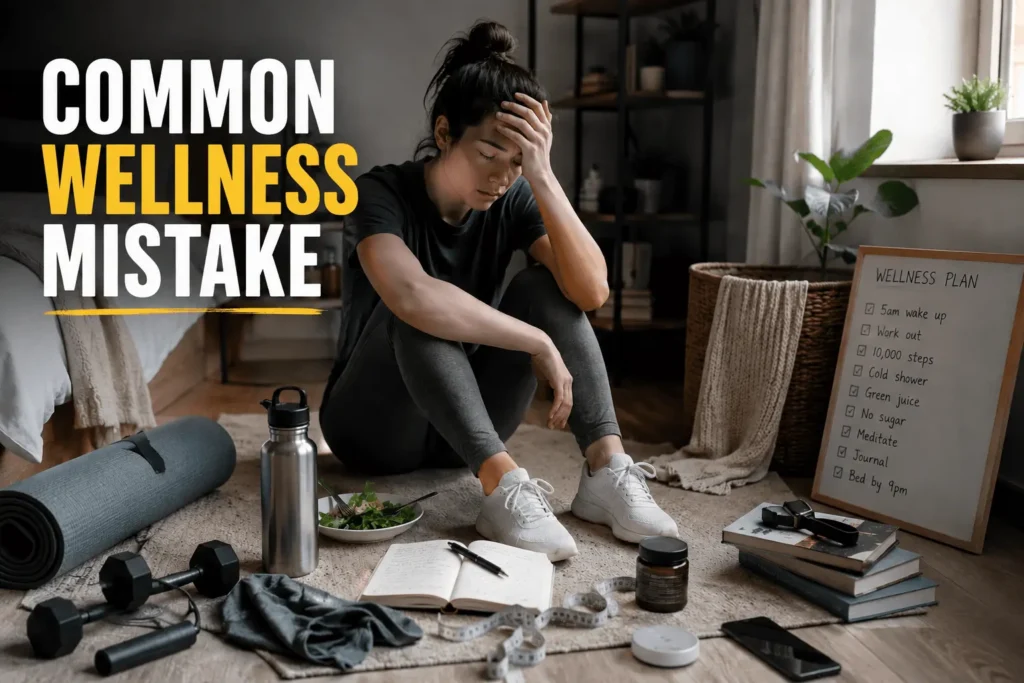
What I eventually understood was that my approach to wellness was actually creating more stress than it relieved. I was making classic wellness mistakes without even recognizing them. These common wellness mistakes are widespread precisely because they often look like healthy behaviors from the outside. Understanding these common wellness mistakes can help you create healthier daily wellness habits without unnecessary stress.
The wellness industry continues expanding rapidly, with global market analysis showing spending in the trillions. We have access to more health data, more wearable technology, more personalized nutrition plans, and more expert guidance than any generation before us. Yet rates of burnout, sleep disorders, and anxiety continue climbing.
Something isn’t adding up.
The problem is not a lack of wellness tools. The problem is how we are using them. Many of the daily wellness habits people cling to are either scientifically outdated, poorly applied, or so rigid that they can’t survive contact with actual life. Unhealthy wellness habits often disguise themselves as dedication.
This article walks through 15 common wellness mistakes I’ve either made myself or watched others make repeatedly. Some are small mistakes in healthy living that are easy to fix. Some are patterns that take years to recognize. All of them are fixable.
.
Are Your Wellness Habits Actually Helping You?
Many people follow healthy routines but still feel tired, stressed, or disconnected. This often happens because some daily wellness habits look beneficial but create unnecessary pressure. Recognizing common wellness mistakes is the first step toward building a healthier and more sustainable lifestyle. Bad wellness habits don’t announce themselves ,they feel like discipline until they don’t.
Before diving into the specific mistakes, it’s worth asking yourself a few questions. Do your habits make you feel more energized or more depleted? Do they connect you to others or isolate you? Do they create flexibility or rigidity? The answers often reveal whether you’re dealing with healthy lifestyle mistakes or genuine health-supporting practices.
Why Most Wellness Advice Fails Real People
Wellness content tends to assume a version of life that does not exist. It assumes you have consistent energy levels, predictable schedules, no care giving responsibilities, unlimited grocery budgets, and the emotional bandwidth to journal every morning.
That’s not life. That’s a simulation.
The common wellness mistakes I see most often stem from this gap between the ideal and the actual. People absorb advice designed for someone with perfect circumstances and then feel broken when it does not work for them.
Recent wellness market analysis shows something interesting. Consumer spending on wellness products continues to rise sharply, but self-reported well-being scores have remained flat for several years. People are buying more wellness but feeling roughly the same.
That disconnect matters. It suggests many people are investing in wellness habits that are harmful to their mental well-being even while trying to improve their physical well-being.
At least in my experience, the most damaging daily wellness habits are the ones that look healthy on the surface but slowly erode your relationship with your own body. They teach you to override hunger cues, ignore fatigue, and treat rest as a reward you have to earn.
What helped most was stepping back and asking a simpler question: Is this habit actually making my life better, or just making my life more complicated?
Once I started evaluating wellness habits by that standard, a lot of things fell away. I stopped making so many wellness mistakes simply by checking in with myself more honestly.
Common Wellness Mistakes That Affect Your Physical and Mental Well-Being
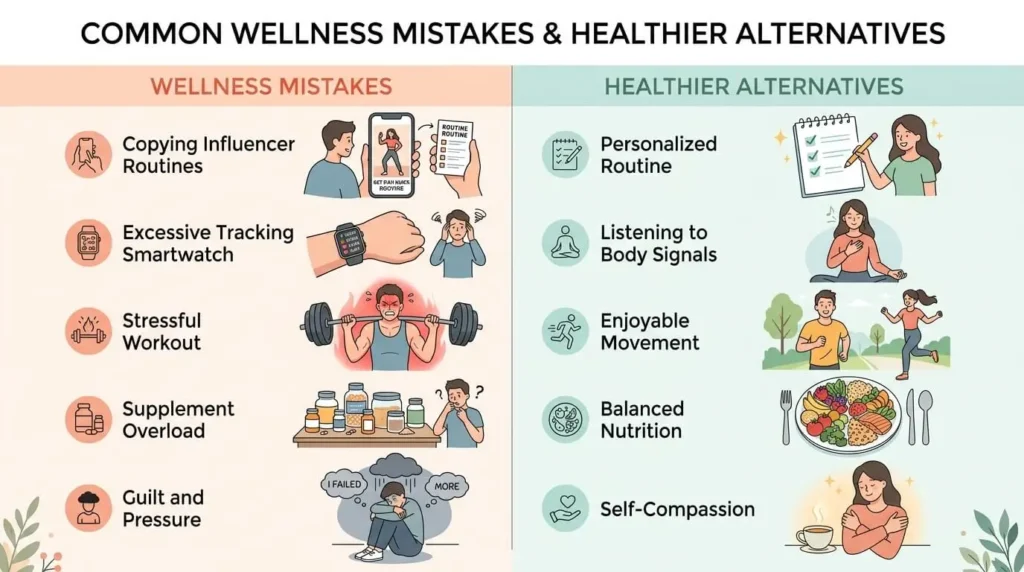
Before getting into the specific mistakes, here’s a quick overview of what we’re covering and why each one matters:
| Wellness Mistake | Why It Happens | Better Approach |
|---|---|---|
| Copying other’s routines | Social media influence | Borrow principles, adapt practices |
| Over-optimizing sleep | Tracking obsession | Focus on consistency, not scores |
| Forced hydration | Misleading health rules | Drink according to thirst |
| Punishing exercise | Appearance-based motivation | Move for how it feels |
| Unnecessary food restriction | Diet culture pressure | Eliminate only with medical reason |
| Neglecting social health | Individualistic wellness culture | Prioritize relationships equally |
| Supplement over-reliance | Looking for shortcuts | Fix sleep, nutrition, movement first |
| Wellness guilt | Perfectionism | Practice self-compassion |
| Data override | Over-trusting technology | Listen to body signals first |
| Skipping rest | Hustle culture | Schedule rest like workouts |
| Blaming discipline | Misunderstanding behavior | Redesign environment and systems |
| Ignoring environment | Lack of awareness | Address air, water, living space |
| Identity fusion | Wellness as personality | Keep perspective and balance |
| Avoiding checkups | Assuming good health | Get annual blood work and screenings |
| Waiting for perfect timing | Fear of imperfection | Start small and messy today |
Mistake 1: Following Someone Else’s Wellness Routine Exactly
Between 2021 and 2025, I probably tested more than a dozen morning routines. The five-step skincare-influencer routine. The CEO power-morning routine. The Ayurvedic seasonal routine. I would copy them precisely, right down to the specific brand of lemon for the warm water.
They never lasted more than two months.
The mistake was not that the routines were bad. Some of them were thoughtfully designed by people who clearly knew what worked for their bodies and their lives. The mistake was assuming their solution would automatically be my solution.
One of the most common wellness mistakes is adopting an entire daily wellness habits system without asking whether the person who created it shares any of your constraints. If someone designs a two-hour morning routine and they do not have kids and you do, that routine will make you feel like a failure before 8 AM.
My friend tried this with a famous trainer’s program. She lasted eleven days. The problem wasn’t discipline she’s one of the most disciplined people I know. The problem was that the program assumed she had no evening commitments and could prep meals for two hours every Sunday. She had a toddler and a demanding job. The wellness routine was incompatible with her life, and following it made her feel worse, not better.
What I eventually realized was that borrowing principles works better than copying practices. Maybe the principle is “start the day with intention.” That can look like an hour of meditation for one person and thirty seconds of standing silently by the coffee maker for someone else.
A wellness routine needs to fit into your actual life, not the life you wish you had. This is one of those mistakes in healthy living that comes from good intentions but leads to burnout.
Mistake 2: Treating Sleep Like a Math Problem
Sleep optimization culture has gotten intense. People track sleep stages, calculate REM percentages, and adjust bedtime in fifteen-minute increments looking for the perfect score.
Sleep research highlights something counterintuitive. While sleep tracking adoption has increased dramatically over the past few years, average sleep duration has actually decreased slightly in the same period. People are monitoring their sleep more and sleeping less.
The turning point came when I noticed something strange: my best nights of sleep were often the nights when I stopped trying to control every variable. Not because tracking is useless, but because the performance anxiety around sleep was keeping me awake.
This is one of those wellness mistakes that comes from good intentions. Sleep is genuinely foundational to health. According to the National Sleep Foundation’s healthy sleep recommendations, adults need consistent sleep timing and adequate duration for optimal health. But when you start lying in bed feeling anxious about your sleep score, you’ve created a problem that didn’t exist before.
Many people reach a point where they check their wearable before they check how they actually feel. The data becomes more real than the experience. A friend of mine started waking up anxious, immediately checking his sleep score, and letting a number determine his mood for the day. That’s not wellness. That’s performance.
For a long time I thought sleep quality was something I could engineer if I just controlled enough variables. Blackout curtains, white noise, magnesium, temperature regulation, blue light glasses three hours before bed. I had a system.
What I noticed was that on nights when I forgot to charge my sleep tracker, I slept better. Not because the tracker was doing anything wrong. Because I wasn’t performing sleep for an audience of data. I was just sleeping.
The fundamentals matter consistent timing, darkness, temperature, avoiding alcohol before bed. But beyond those basics, the pursuit of perfect sleep can become the thing that prevents it. Unhealthy wellness habits around sleep often involve more anxiety than actual health benefit.
Mistake 3: Over-Optimizing Hydration
Somewhere around 2023, carrying a giant water bottle became a personality signifier. By 2025, smart water bottles that track sips and send reminders were a standard wellness accessory. Now you can buy bottles that analyze your hydration levels through sensors in the mouthpiece.
Drinking enough water is important. But the idea that everyone needs exactly eight glasses or two liters or a gallon has no solid scientific basis. Fluid needs vary enormously based on body size, activity level, climate, diet, and individual physiology. The NHS guidelines on hydration emphasize drinking according to thirst rather than fixed targets for most healthy adults.
The more insidious version of this wellness mistake is when people start ignoring thirst because their app hasn’t told them to drink yet. Or forcing themselves to drink when they’re not thirsty because they’re behind on their hydration goal.
Your body has a remarkably sophisticated hydration regulation system. It’s called thirst. Overriding it with external metrics is one of those daily wellness habits that sounds responsible but actually trains you to distrust your own signals.
I bought a smart water bottle in late 2024. By March I noticed I was drinking water mechanically, without any awareness of whether I actually wanted it. I’d finish the bottle while working and feel bloated and uncomfortable, but the app said I was hydrated so I assumed I was fine.
Eventually I gave the bottle away and went back to a regular glass. I drink when I’m thirsty now. Sometimes I forget and get slightly dehydrated. That’s probably healthier than systematically overriding my body’s signals every day. This is one of those common wellness mistakes where technology solves a problem that didn’t exist for most people.
Mistake 4: Making Exercise a Punishment
The relationship many people have with exercise is transactional and vaguely hostile. They exercise to earn food, to atone for indulgence, to fix a body they’ve been taught to dislike.
This is one of those wellness mistakes that can take years to recognize because the behavior looks healthy from the outside. Someone who works out six days a week must be doing wellness correctly. But if every workout is driven by self-criticism, the mental well-being cost might outweigh the physical well-being benefit.
According to the World Health Organization’s physical activity guidelines, adults should aim for at least 150–300 minutes of moderate activity per week. But the WHO also emphasizes that any movement is better than none—and that enjoyment predicts adherence better than intensity.
My neighbor Mark spent years doing workouts he hated because they were “effective.” He’d drag himself through high-intensity sessions, feel wrecked afterward, and dread the next one. Eventually he quit entirely for six months. When he started again, he tried something different—he just walked. Then he added some basic strength work. Then he found a recreational soccer league. Now he’s consistent without forcing himself.
What surprised me was how much easier movement became when I stopped tracking it obsessively. I spent years logging every set and rep, weighing myself daily, taking progress photos. I was disciplined. I was also miserable.
Now I move in ways that feel good and stop when I’m tired. Some weeks that means four structured workouts. Some weeks it means long walks and stretching. My body hasn’t fallen apart. If anything, I have fewer injuries and a better relationship with exercise than I did during my most “dedicated” years. Better wellness habits around movement often involve less intensity and more consistency.
Mistake 5: Cutting Out Entire Food Groups Without Reason
Elimination diets have a legitimate medical purpose. They help identify food sensitivities, allergies, and triggers for conditions like IBS or autoimmune disorders.
But the cultural enthusiasm for cutting out food groups has outpaced the medical justification. People eliminate gluten, dairy, lectins, nightshades, FODMAPs, and entire macronutrient categories based on something they read or heard on a podcast.
The Academy of Nutrition and Dietetics has warned that unnecessary dietary restriction is associated with higher rates of disordered eating, social isolation, and nutritional deficiencies. Restriction creates stress. Chronic stress undermines both physical well-being and mental well-being.
I did a strict elimination diet in 2023. By the end, I was afraid of about thirty different foods. It took me over a year to reintroduce most of them and realize I did notreact to the vast majority. I had just convinced myself I did.
Unless you have a diagnosed condition, cutting out entire food groups is usually one of those common wellness mistakes that solves a problem you didn’t actually have while creating several new ones. Healthy lifestyle mistakes around food often involve being too restrictive rather than too permissive.
Mistake 6: Ignoring the Social Dimension of Health
Wellness culture tends to be individualistic. Your sleep. Your nutrition. Your meditation practice. Your step count. All of it happens in isolation.
The Harvard Study of Adult Development, now in its 88th year, continues to find that close relationships are the single strongest predictor of happiness and longevity. Not diet, not exercise, not genetics. Relationships.
Neglecting social connection while optimizing everything else is one of the most overlooked wellness mistakes. You can have perfect blood work and be lonely. And loneliness has health consequences comparable to smoking fifteen cigarettes a day, according to research from the U.S. Surgeon General’s office.
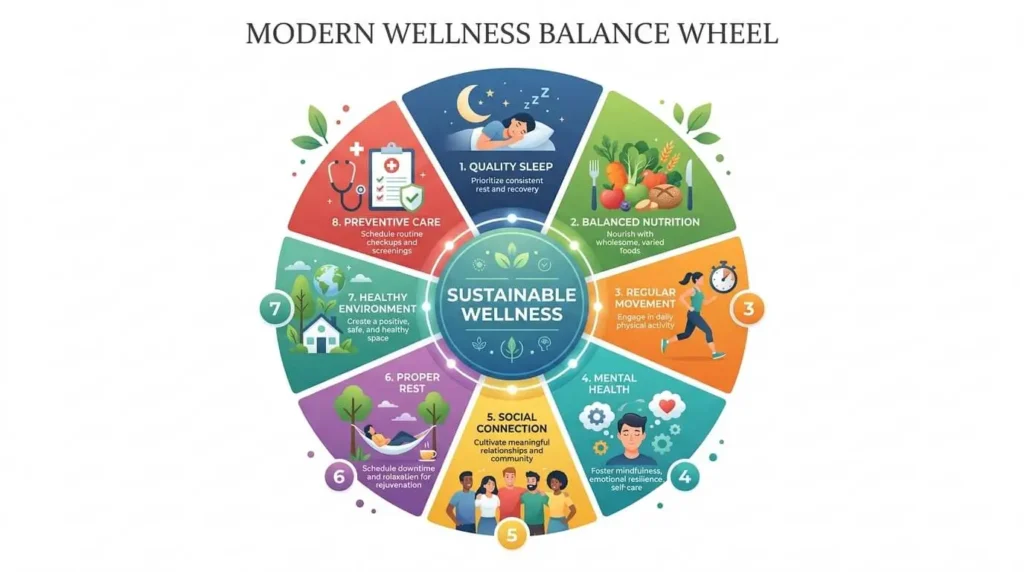
Holistic wellness means looking beyond individual habits and considering physical health, mental well-being, emotional balance, relationships, environment, and purpose together. Social wellness is one of the eight dimensions of wellness that tends to get neglected in highly individualized wellness approaches.
My wellness habits used to isolate me. I had skip social events because they interfered with my sleep schedule. I would bring my own food everywhere. I would decline dinner invitations because restaurants didn’t fit my meal plan. I was “healthy” and increasingly alone.
What helped most was recognizing that wellness includes community. A meal shared with people you love might have more health value than a perfectly optimized meal eaten alone. Some of the most common wellness mistakes involve sacrificing connection for optimization.
Mistake 7: Relying on Supplements Before Fixing Fundamentals
The supplement industry in the United States continues to grow rapidly, with estimates showing it has surpassed $60 billion. People are spending more on pills, powders, and potions than ever before.
Meanwhile, most Americans don’t meet the basic physical activity guidelines from the WHO. Most don’t eat the recommended servings of vegetables. A significant portion are chronically sleep-deprived.
Taking supplements without addressing fundamentals is one of those classic wellness mistakes. It’s trying to optimize a system that isn’t functioning at baseline. The potential benefits of wellness from basic lifestyle changes far outweigh what most supplements can provide.
A colleague spent hundreds of dollars monthly on adaptogens, greens powders, and recovery formulas while averaging five hours of sleep and eating fast food most days. When he finally prioritized sleep and started cooking simple meals at home, his energy improved more in three weeks than it had in a year of supplementation.
I went through a supplement phase. Adaptogens, nootropics, pre-workouts, recovery formulas, sleep stacks. I had a supplement organizer that looked like a tackle box. Some of them probably helped marginally. None of them did anything close to what consistent sleep, regular movement, and adequate nutrition accomplished.
Supplements can be useful. Vitamin D in winter makes sense for many people. Creatine has solid evidence. Magnesium before bed helps some individuals. But supplements should supplement a foundation, not substitute for one. Bad wellness habits often involve spending money on supplements while ignoring free interventions that work better.
Mistake 8: Letting Wellness Become Another Source of Guilt
This might be the most damaging of all common wellness mistakes. When your daily wellness habits start generating guilt, they stop being wellness habits and start being a wellness problem.
Skipping a workout shouldn’t ruin your day. Eating dessert shouldn’t trigger a shame spiral. Sleeping in shouldn’t make you feel lazy. Wellness should support mental well-being, not create additional pressure and guilt.
The research on health behavior change increasingly emphasizes self-compassion over self-criticism. People who respond to lapses with understanding rather than judgment are more likely to resume healthy behaviors quickly. Guilt is one of the clearest signs your wellness routine is unhealthy.
One thing that surprised me was how much mental space opened up when I stopped keeping score. I used to have an internal ledger. Good decisions earned points. Bad decisions cost points. The goal was to end each day in the positive. It was exhausting and it made wellness feel like an accounting job.
Now if I miss a workout, I miss a workout. The world doesn’t end. I don’t have to do extra the next day to make up for it. I just do the next thing. This shift alone eliminated one of the most persistent wellness mistakes I was making, and my emotional well-being improved noticeably within weeks.
Mistake 9: Trusting Wearable Data Over Body Signals
Wearable technology has advanced dramatically. Consumer devices can now track heart rate variability, blood oxygen, skin temperature, sleep stages, stress levels, and even predict illness onset a day or two in advance.
This data can be useful. It can also become a substitute for listening to your body.
One of the wellness mistakes that’s becoming more common as wearables improve is data override. You feel tired but your recovery score says you should train, so you train. You feel hungry but your fasting window hasn’t closed, so you wait. You feel awake but your bedtime reminder went off, so you lie in bed frustrated.
Many people reach a point where they check their wearable before they check how they actually feel. A number on a screen overrides the physical sensation of fatigue or hunger. That’s a reversal of how the relationship should work.
Technology should inform your decisions, not make them for you. Your body’s signals contain information that no sensor can capture. Learning to interpret those signals is a skill worth developing. This is one of those wellness habits that are harmful when taken to extremes.
I used to need my wearable to tell me how I slept. Now I can usually tell within five minutes of waking up. The data is interesting, but I no longer need it to know how I’m doing.
Mistake 10: Never Taking Rest Seriously
Rest is not the absence of activity. Rest is an active physiological process that enables recovery, learning, immune function, and emotional regulation.
But most wellness routines are built around doing more. More workouts, more steps, more practices, more optimization. Rest gets treated as a concession, not a priority.
The World Health Organization has highlighted inadequate recovery as a growing global health concern, linked to cardiovascular disease, mental health conditions, and reduced life expectancy. Skipping rest might be one of the most physically damaging common wellness mistakes.
Scheduling rest with the same commitment you schedule exercise might sound strange. But for people prone to overdoing it, that’s sometimes necessary.
A colleague of mine took up running and got injured three times in her first year. Each time, she’d recover just enough to run again, then push too hard and end up back on the couch. It took a physical therapist telling her “rest is part of the training” for it to click.
I’ve had periods where I was training hard, working long hours, and sleeping less than I needed. I told myself I was dedicated. I was actually just running a deficit that my body eventually collected on.
Now I take rest days seriously. Not as lazy days or cheat days, but as essential components of a sustainable wellness routine. Mistakes in healthy living often involve treating rest as optional rather than essential.
Mistake 11: Assuming More Discipline Is Always the Answer
When wellness habits fall apart, the most common response is to blame yourself. I need more discipline. I need more willpower. I need to want it more.
Sometimes that’s true. But often, the problem isn’t willpower. The problem is that the habit you’re trying to maintain is incompatible with your actual life.
If you keep failing at a 5 AM workout routine, maybe you’re not undisciplined. Maybe 5 AM doesn’t work for your body or your schedule. If meal prepping on Sundays keeps falling apart, maybe you need a different system entirely.
Behavioral design research consistently shows that environment and systems matter more than willpower. The most disciplined person in the world will struggle to maintain habits that fight against their circumstances. Unrealistic wellness goals are one of the main reasons wellness habits fail.
This is where people often get stuck. They keep trying harder at something that needs to be redesigned rather than approached with more effort.
One thing I changed was asking “what would make this easier” instead of “how can I try harder.” The answers led to much more sustainable daily wellness habits. How to improve wellness often comes down to reducing friction rather than increasing effort.
Mistake 12: Overlooking Environmental Factors
You can optimize your diet, exercise, sleep, and stress management. But if you’re breathing polluted air, drinking contaminated water, or living in a space with mold, those optimizations are working against a headwind.
Environmental health gets less attention in wellness conversations than it deserves. According to the Environmental Protection Agency’s indoor air quality information, indoor air can be significantly more polluted than outdoor air, and most people spend approximately 90% of their time indoors.
This is one of those wellness mistakes that’s easy to overlook because the effects are gradual. You don’t notice what chronic low-level exposure is doing until symptoms accumulate.
A few years ago I moved from an apartment with good ventilation to one without. Within months my sleep got worse, my allergies flared up, and I generally felt run down. I assumed I needed to optimize my diet or supplements. What I actually needed was an air purifier and better airflow.
Environmental factors aren’t as glamorous as biohacking. But they probably matter more for most people. These are the kinds of common wellness mistakes that fly under the radar because they’re not discussed enough in wellness media.
Mistake 13: Confusing a Wellness Routine with a Personality
There’s a certain type of person whose entire identity becomes their daily wellness habits. Every conversation circles back to their diet, their training, their protocols, their hacks.
This is understandable. When you put a lot of effort into something, it becomes part of who you are. But making wellness your entire personality creates fragility. If the practices slip, the identity crumbles. This is one of those wellness mistakes that has psychological consequences beyond physical well-being.
It also makes you less interesting. I say this as someone who went through a phase where I definitely talked about intermittent fasting too much.
Wellness should support your life, not consume it. If you removed every wellness practice from your identity, would there still be a person there? That’s a question worth sitting with. Healthy lifestyle mistakes sometimes involve losing perspective on what wellness is actually for.
Mistake 14: Skipping Regular Blood Work and Checkups
Some people optimize endlessly based on how they feel without ever getting objective data. Others get too much data from wearables but skip actual medical screening.
Annual blood work, age-appropriate screenings, and regular checkups provide a baseline that no amount of wellness optimization can replace. You can feel great while your cholesterol is climbing or your blood sugar is trending in the wrong direction.
The U.S. Preventive Services Task Force regularly updates screening recommendations based on age and risk factors. Keeping up with these is a foundational wellness practice that many self-optimizers neglect.
I went three years without blood work during my “healthiest” phase because I assumed I was fine. When I finally got tested, I had deficiencies I didn’t expect. Things that were easy to fix once I knew about them. This is one of those common wellness mistakes that can have serious long-term consequences for physical well-being.
Mistake 15: Waiting for the Perfect Time to Start
The last of these common wellness mistakes is also the most universal. The belief that you need the right circumstances to begin.
A new month. A new week. After the holidays. When work calms down. When the kids are older. When you have more energy. When you can do it properly.
The perfect time never arrives. Conditions are never ideal.
I’ve delayed more healthy changes than I can count waiting for the stars to align. What eventually became clear is that imperfect action today beats perfect action someday. Understanding what wellness actually means helped me see that it’s a direction, not a destination.
Starting small, starting messy, starting before you feel ready—this is the only way anything actually changes. This is one of those wellness mistakes where the solution is simpler than most people think.
Signs Your Wellness Routine Is Actually Harmful
Not all wellness practices are healthy. Some daily wellness habits create more problems than they solve. If you notice several of these signs, you might be dealing with wellness habits that are harmful rather than helpful.
Constant guilt about missed workouts or “imperfect” meals is a red flag. Wellness should improve your relationship with yourself, not create a running tally of failures.
Obsession with tracking every metric can indicate that data has replaced intuition. If you can’t function without checking your numbers, the tools are using you rather than the other way around.
Avoiding social events because they might disrupt your routine suggests your wellness habits are creating isolation. Health thrives in community, not in isolation.
Fatigue despite following all your healthy habits often means you’re overdoing it or missing something fundamental. More isn’t always better. Sometimes the answer is doing less.
These are signs your wellness routine is unhealthy and may need adjustment. The goal is sustainable wellness habits, not perfect compliance.
Healthy Wellness vs. Toxic Wellness

The line between healthy discipline and unhealthy obsession can be thin. Here’s how to tell the difference between better wellness habits and bad wellness habits that wear a healthy disguise.
Healthy Wellness is flexible. If life disrupts your routine, you adapt and continue. Toxic Wellness is rigid. Disruption feels like failure, and you may abandon efforts entirely rather than adjust.
Healthy Wellness practices self-care. You rest when tired, eat when hungry, and listen to your body’s signals. Toxic Wellness practices self-punishment. You push through fatigue, ignore hunger cues, and treat your body as something to overcome.
Healthy Wellness seeks balance. Movement, rest, nutrition, and social connection all have a place. Toxic Wellness seeks optimization. Everything is measured, maximized, and controlled.
Healthy Wellness values progress. Small improvements over time are celebrated. Toxic Wellness demands perfection. Anything less than complete adherence feels like failure.
If you recognize yourself in the toxic column, you’re making some of the most common wellness mistakes people face. The good news is that awareness is the first step toward change.
Quick Wellness Mistake Checklist
If you’re wondering whether your current approach contains common wellness mistakes, run through these questions:
- Are you ignoring sleep in favor of early morning workouts?
- Are you chasing every new wellness trend without evaluating whether it helps you?
- Are you relying on supplements while neglecting nutrition, movement, and rest?
- Are you avoiding social events to maintain your wellness routine?
- Are you feeling guilty about missed workouts or imperfect meals?
- Are you trusting your wearable data more than your body’s signals?
- Are you treating rest as something you have to earn?
- Are you waiting for the perfect circumstances to start taking care of yourself?
If you answered yes to several of these, you’re probably dealing with some unhealthy wellness habits. The following sections cover how to build sustainable wellness habits that actually work.
How to Build Daily Wellness Habits That Actually Stick
After years of making every wellness mistake on this list, I’ve settled into an approach that’s less impressive on social media but far more sustainable in practice. Learning how to improve wellness isn’t about adding more—it’s often about being smarter with less.
The principles are simple.
Start smaller than you think you need to. If you want to meditate daily, start with two minutes. If you want to exercise regularly, start with something so easy it barely counts. The point is establishing the pattern, not optimizing the output. This is one of the most reliable wellness routine tips I can offer.
Anchor new habits to existing ones. If you already brush your teeth every night, add one minute of stretching afterward. Your brain already has a trigger and a reward pathway for the existing habit. Attaching something new is easier than building from nothing. This creates better wellness habits with less effort.
Plan for disruption. Travel, illness, busy periods, holidays—these aren’t exceptions, they’re part of a normal year. A wellness routine that can’t survive disruption isn’t a routine, it’s a fair-weather hobby. Sustainable wellness habits include backup plans for difficult periods.
Focus on return rate over perfection. Missing one day is irrelevant. Missing one day and then giving up because you broke your streak is the real problem. How quickly you return to a habit after disruption matters far more than how long you maintain it uninterrupted. This is why wellness habits fail, not because of lapses, but because of what happens after lapses.
These healthy lifestyle habits work because they are realistic, flexible, and designed for long-term consistency rather than short-term perfection.
The Wellness Routine That Works When Life Gets Messy
Most wellness content shows you how to optimize for ideal conditions. But ideal conditions account for maybe 20% of actual life. The rest is chaos. Healthy daily routines need to function in the mess, not just the calm.
During busy periods, my wellness routine collapses to three things.
Sleep as much as I reasonably can. That might mean going to bed at 8:30 PM some nights.
Move at least a little every day. A ten-minute walk counts. If that’s all I can do, that’s all I do.
Eat something with nutritional value at least once a day. Maybe it’s a smoothie. Maybe it’s some vegetables with whatever else I’m eating.
That’s it. Everything else supplements, structured workouts, meditation, journaling, cold exposure is optional. When life calms down, I add things back.
The alternative is letting perfect be the enemy of good enough and abandoning wellness entirely during hard periods. That’s one of those wellness mistakes that compounds over time. Sustainable wellness habits aren’t the ones that look best on paper—they’re the ones that survive a crisis.
What the Research Says About Sustainable Wellness
The research landscape on wellness behavior change is converging on a few key findings that can help you avoid common wellness mistakes.
Sustainability beats intensity. Short-term aggressive protocols produce short-term results followed by rebound. Moderate approaches maintained over years produce better long-term outcomes. This is why unrealistic wellness goals tend to backfire.
Self-compassion supports adherence. People who are kind to themselves about lapses get back on track faster than people who are harsh. This directly addresses why wellness habits fail for so many people.
Social support amplifies everything. Wellness habits maintained in community last longer than habits maintained alone. This connects back to the social dimension of health mentioned earlier.
Context matters more than content. The best diet or exercise program is the one you’ll actually do. Adherence trumps optimization every time.
None of this is particularly exciting. But understanding it helps you avoid the wellness mistakes that come from chasing novelty at the expense of consistency. Better wellness habits are usually simpler, not more complicated.
Frequently Asked Questions
What is the biggest wellness mistake people make?
The biggest wellness mistake is probably treating wellness as a set of rigid rules rather than a flexible framework. When your habits can’t bend, they break. The people who sustain wellness long-term are the ones who adapt their practices to changing circumstances. Rigidity is one of the most common wellness mistakes because it masquerades as discipline.
How do I know if my wellness routine is actually working?
Look at how you feel over weeks and months, not days. Are you sleeping better? Do you have more energy? Is your mood more stable? Are you getting sick less often? Objective measures like blood work help too. But if your wellness routine is making you anxious, rigid, or isolated, it’s not working regardless of what your metrics say. Signs your wellness routine is unhealthy include dread, guilt, and social withdrawal.
Can too many wellness habits be harmful?
Yes. When wellness habits consume excessive mental bandwidth, interfere with social connection, or create anxiety about deviation, they’ve become part of the problem. The dose makes the poison, and that applies to wellness practices too. Unhealthy wellness habits often involve doing too much rather than too little.
How long does it take to fix common wellness mistakes?
Fixing a wellness mistake is usually faster than the time spent making it. Most adjustments show benefits within days or weeks. The harder part is recognizing the mistake in the first place, which can take months or years. Many common wellness mistakes go unnoticed because they look like dedication.
What should I prioritize first when improving my wellness?
Sleep, basic nutrition, and some form of regular movement. These three fundamentals affect everything else. If those aren’t in reasonable shape, adding more sophisticated practices usually doesn’t help much. Our guide on how to improve your overall well-being walks through the prioritization process. Most wellness mistakes come from optimizing advanced variables while neglecting basics.
What areas of wellness do these mistakes affect?
These mistakes can affect physical well-being, mental well-being, emotional well-being, and social connection. Because the dimensions of wellness are interconnected, a mistake in one area often creates ripple effects in others. For example, over-exercising might improve physical fitness temporarily while damaging mental well-being and social relationships.
Why do wellness habits fail even when people are motivated?
Motivation is a feeling, and feelings fluctuate. When wellness habits rely entirely on motivation, they fail whenever motivation dips—which it always does eventually. Sustainable habits rely more on environment design, reasonable expectations, and self-compassion than on sustained motivation. This is one of the most important lessons for avoiding mistakes in healthy living.
Where to Go From Here
If you recognize yourself in several of these common wellness mistakes, that’s not a failure. That’s just information. Most people make these mistakes because wellness culture actively encourages many of them. Learning to identify common wellness mistakes is one of the first steps toward building sustainable health habits.
The fix isn’t trying harder. It’s trying differently.
Pick one mistake that resonated. Just one. Think about what a more flexible, more compassionate version of that wellness practice might look like. Try that version for a couple weeks.
Maybe that means drinking water when you’re thirsty instead of when your app tells you. Maybe it means going to bed when you’re tired instead of when your schedule says. Maybe it means eating dinner with friends without analyzing the macronutrients.
Small adjustments compound. Over months and years, they reshape your relationship with wellness from something stressful into something supportive. Sustainable wellness habits are built this way—not through dramatic overhauls, but through quiet, consistent adjustments.
If you want to understand the foundation better, explore what is wellness for the fundamentals and benefits of wellness for why these changes matter. Those articles cover the basics that this one assumes you already understand.
But mostly, just start where
Written by Hussnain Ali — a wellness and healthy habits writer who focuses on behavior change, sustainable routines, and evidence-informed lifestyle practices. His work explores practical ways to improve physical, mental, and emotional well-being through everyday habits