

For a long time I thought mentally strong people were just born that way.
Some people had it. Most didn’t. I assumed it was a personality thing something you either inherited or you didn’t.
I was wrong about that.
What I eventually realized is that the signs of a strong mindset aren’t fixed traits. They’re patterns of thinking and behaving that people develop over time, usually through experiencing difficulty and learning how to respond to it. Nobody starts out resilient. Nobody is born with emotional regulation or self-discipline. These are skills. And like any skills, they can be built.
I’ve noticed that the strongest people I know rarely describe themselves as mentally strong. They simply keep doing difficult things without making a big deal about it. They’re not performing strength. They’re practicing it.
“People often think resilience means never struggling. In reality, resilience is recovering after struggle.” American Psychological Association
The people who seem unshakable aren’t unshakable because they never struggle. They’re unshakable because they’ve learned how to move through struggle without being defined by it.
Strong Mindset at a Glance
If you remember one thing: A strong mindset isn’t about avoiding problems. It’s about responding better to them.
Best sign to develop first: Taking responsibility without self-blame.
Time to notice improvement: 4–8 weeks of intentional practice.
Difficulty: Beginner-friendly. Anyone can start.
What Is a Strong Mindset?
A strong mindset is the ability to respond to challenges with resilience, emotional regulation, adaptability, and a commitment to continuous growth rather than reacting with fear, avoidance, or self-doubt.
Start Today
Choose ONE practice to begin:
- Admit one mistake without self-judgment
- Reframe one negative thought
- Say no to one non-essential thing
- Ask for help with one thing
- Practice gratitude for two minutes
Time Required: 5 minutes
Difficulty: Easy
Expected Results: 2–8 weeks of consistent practice
Strong Mindset Statistics
- The American Psychological Association reports that resilience can be developed through learned behaviors, thoughts, and actions.
- A 2024 meta-analysis involving over 40,000 participants found that people with higher psychological flexibility consistently report better wellbeing.
- Regular physical exercise is associated with improved executive function and emotional resilience, according to a 2023 umbrella review in Nature Human Behaviour.
- A 2024 systematic review published in Clinical Psychology Review concluded that emotional regulation is one of the strongest predictors of psychological resilience.
- Self-compassion interventions have been shown to improve resilience and reduce self-criticism across multiple randomized controlled trials (Neff, 2023).
Here are seventeen signs that indicate a strong mindset not a fixed personality type, but a set of habits and perspectives that anyone can develop.
17 Signs of a Strong Mindset
These signs aren’t a checklist for judging yourself. They’re patterns to notice and develop. Nobody displays all of them all the time. The goal isn’t perfection. It’s direction.
1. You Take Responsibility Without Self-Blame
This is one of the clearest characteristics of a strong mindset. People with mental strength take ownership of their actions and their outcomes. They don’t blame circumstances, other people, or bad luck. But they also don’t spiral into self-criticism when things go wrong.
There’s a difference between responsibility and self-blame. Responsibility says “I contributed to this outcome, and I can learn from it.” Self-blame says “I’m terrible and everything is my fault.” The first leads to growth. The second leads to paralysis.
This distinction took a while to understand. Taking responsibility isn’t about being hard on yourself. It’s about being honest about your role in what happened while treating yourself with enough respect to learn from it.
Research Insight
A 2023 meta-analysis by Kristin Neff and colleagues confirmed that self-compassion treating yourself with kindness after setbacks consistently predicts greater resilience and persistence than harsh self-criticism.
2. You Regulate Emotions Without Suppressing Them
Emotional regulation isn’t about not feeling things. It’s about feeling things without being controlled by them.
A mentally strong person notices their emotions the anger, the anxiety, the sadness and acknowledges them. But they don’t let the emotion dictate their response. They create space between the feeling and the action. In that space, they can choose.
This connects to the research on emotional resilience. Resilient people aren’t people who don’t feel. They’re people who feel deeply and still function. Susan David, a psychologist at Harvard Medical School and author of Emotional Agility, describes this as the ability to experience thoughts and emotions without being hijacked by them.
3. You’re Comfortable Being Wrong
People with a weak mindset defend their positions as if their identity depends on it. People with a strong mindset treat being wrong as information.
“I was wrong about that” isn’t a threat to their sense of self. It’s a data point. They update their understanding and move on. This is one of the most underrated growth mindset traits. The ability to change your mind when the evidence changes isn’t weakness. It’s intellectual honesty.
This is closely connected to self-awareness. You can’t admit you’re wrong if you can’t see that you’re wrong. Self-awareness creates the capacity for honest self-assessment.
4. You Keep Going When Things Get Hard
Persistence isn’t glamorous. It’s showing up and doing the work when no one is watching and nothing feels like it’s working.
The signs of a strong mindset include the ability to continue through difficulty without needing external validation or immediate results. This doesn’t mean persisting in everything forever sometimes quitting is the right call. But it does mean that when something matters, difficulty alone isn’t enough to make you stop.
This is the core of what Angela Duckworth calls grit. Her research at the University of Pennsylvania, published in the Journal of Personality and Social Psychology, showed that grit predicts achievement better than talent or intelligence across domains ranging from spelling bees to military training.
5. You Learn from Criticism Without Internalizing It
Feedback is information. But for many people, it feels like attack. The difference between people who grow from criticism and people who crumble under it comes down to how they interpret it.
A mentally resilient person can hear “this needs improvement” without hearing “you’re not good enough.” They extract the useful information from the feedback and leave the rest. They don’t ignore criticism, and they don’t accept all of it uncritically. They evaluate it.
This is where changing limiting beliefs becomes relevant. If you believe that criticism reveals something permanent about your worth, you’ll avoid it. If you believe criticism reveals something about your current approach, you’ll seek it.
6. You Don’t Compare Yourself to Others (or at Least You Catch It Faster)
Comparison is one of the fastest ways to undermine your own progress. Someone else’s success doesn’t diminish yours. But it feels like it does.
People with signs of a strong mindset still compare themselves to others. The difference is they notice it faster and redirect. They understand that comparison is usually based on incomplete information you see someone’s results, not their struggles, their doubts, or their starting point.
The practice is simple: when you notice yourself comparing, remind yourself that someone else’s path has nothing to do with yours. Their success is not your failure.
7. You Set Boundaries and Stick to Them
Boundaries aren’t walls. They’re agreements with yourself about what you will and won’t accept.
A mentally strong person can say no without excessive guilt. They can end conversations that become disrespectful. They can step back from relationships that drain them. Not because they don’t care about others. Because they understand that their own wellbeing is not negotiable.
Research Insight
Research on self-determination theory by Deci and Ryan (2000, American Psychologist) shows that autonomy the sense that you’re choosing your actions rather than being controlled by external pressure is a core psychological need. Boundaries protect autonomy.
Setting boundaries requires self-respect. It also requires tolerance for disappointing people. Both are skills that strengthen with practice.
8. You Adapt When Circumstances Change
Rigidity is brittle. Flexibility is strong.
One of the clearest traits of a strong mindset is adaptability. When plans fall apart, the strong-minded person doesn’t spend excessive time mourning the plan. They assess the new situation and adjust.
This is cognitive flexibility the ability to shift perspectives and approaches based on changing conditions. A 2024 systematic review in Clinical Psychology Review found that adaptable people fare better through adversity than rigid people, even when both groups are equally skilled.
One thing that surprised me was how often confidence came after action rather than before it. The people who adapt well aren’t confident because they know what to do. They’re confident because they trust themselves to figure it out.
9. You Can Sit with Discomfort
Most people organize their lives around avoiding discomfort. They avoid difficult conversations. They avoid uncertainty. They avoid the feeling of not knowing.
People with a strong mindset have learned that discomfort is not danger. It’s just discomfort. They can sit with it without running from it. This capacity expands over time. Each time you tolerate discomfort without escaping, you prove to yourself that you can handle it.
10. You’re Honest About Your Weaknesses
Pretending to be good at everything is exhausting and unsustainable. The mentally resilient person can say “I’m not good at this yet” or “this is a weakness for me” without shame.
This honesty isn’t self-deprecation. It’s accuracy. And it creates the conditions for growth. You can’t improve what you won’t acknowledge.
11. You Take Calculated Risks
Risk tolerance varies by personality, but people with a strong mindset tend to take calculated risks rather than avoiding uncertainty altogether.
They don’t gamble recklessly. They assess the potential downside, prepare for it, and then act despite not having guarantees. They understand that growth requires stepping into the unknown. Playing it safe forever is its own kind of risk the risk of never finding out what you’re capable of.
This connects to the concept of building self-efficacy. Each time you take a risk and survive the outcome, your belief in your ability to handle uncertainty grows.
12. You Celebrate Others’ Success Instead of Resenting It
One of the subtler signs of a strong mindset is how you respond to other people’s achievements.
When someone with a weak mindset sees others succeed, they feel threatened. The success highlights what they haven’t achieved. When someone with a strong mindset sees others succeed, they feel inspired. They understand that success isn’t a limited resource. Someone else’s win doesn’t take anything from them.
This is abundance thinking in practice. There’s enough room for everyone. Other people’s achievements are evidence of what’s possible, not evidence of your inadequacy.
13. You’re Willing to Ask for Help
Contrary to the myth of the self-sufficient hero, mentally strong people ask for help when they need it.
They understand that struggling alone isn’t noble. It’s inefficient. Asking for support isn’t weakness. It’s recognizing that some problems are better solved with others. This requires humility and self-awareness the ability to assess what you need and the willingness to request it.
Research Insight
A 2023 meta-analysis on social support published in Psychological Bulletin confirmed that people with strong social connections recover from adversity faster and report higher wellbeing than those who isolate themselves during difficulty.
14. You Focus on What You Can Control
The Stoics talked about this two thousand years ago, and modern psychology has validated the insight. People with a resilient mindset spend their energy on what they can influence and accept what they can’t.
This doesn’t mean being passive. It means being strategic. You can’t control the economy, other people’s opinions, or whether it rains on your wedding day. You can control your effort, your response, your preparation, and your perspective. The strong-minded person directs attention accordingly.
15. You Have a Realistic Sense of Optimism
Realistic optimism isn’t blind positivity. It’s the belief that things can improve combined with an honest assessment of the current situation. This balanced approach is one of the key differences between optimism and realism.
People with a strong mindset don’t pretend problems don’t exist. They acknowledge the difficulty. Then they focus on what can be done about it. They hope for the best while preparing for the worst. This isn’t contradictory. It’s practical.
16. You Practice Self-Discipline, Not Just Motivation
Motivation is a feeling. It comes and goes. Self-discipline is the ability to do what needs to be done regardless of how you feel.
This is one of the most practical strong mindset habits. The mentally strong person doesn’t wait to feel inspired before taking action. They’ve built systems and routines that function even when motivation is absent. They understand that consistency matters more than motivation.
17. You Keep Growing, Even When You Don’t Have To
The final sign is a commitment to growth that isn’t driven by crisis or external pressure. It’s driven by internal standards.
People with a strong mindset keep learning, keep questioning, keep pushing themselves not because they’re unhappy with who they are, but because growth is intrinsically rewarding. They’ve experienced enough cycles of improvement to trust the process. This is lifelong learning as a way of being.
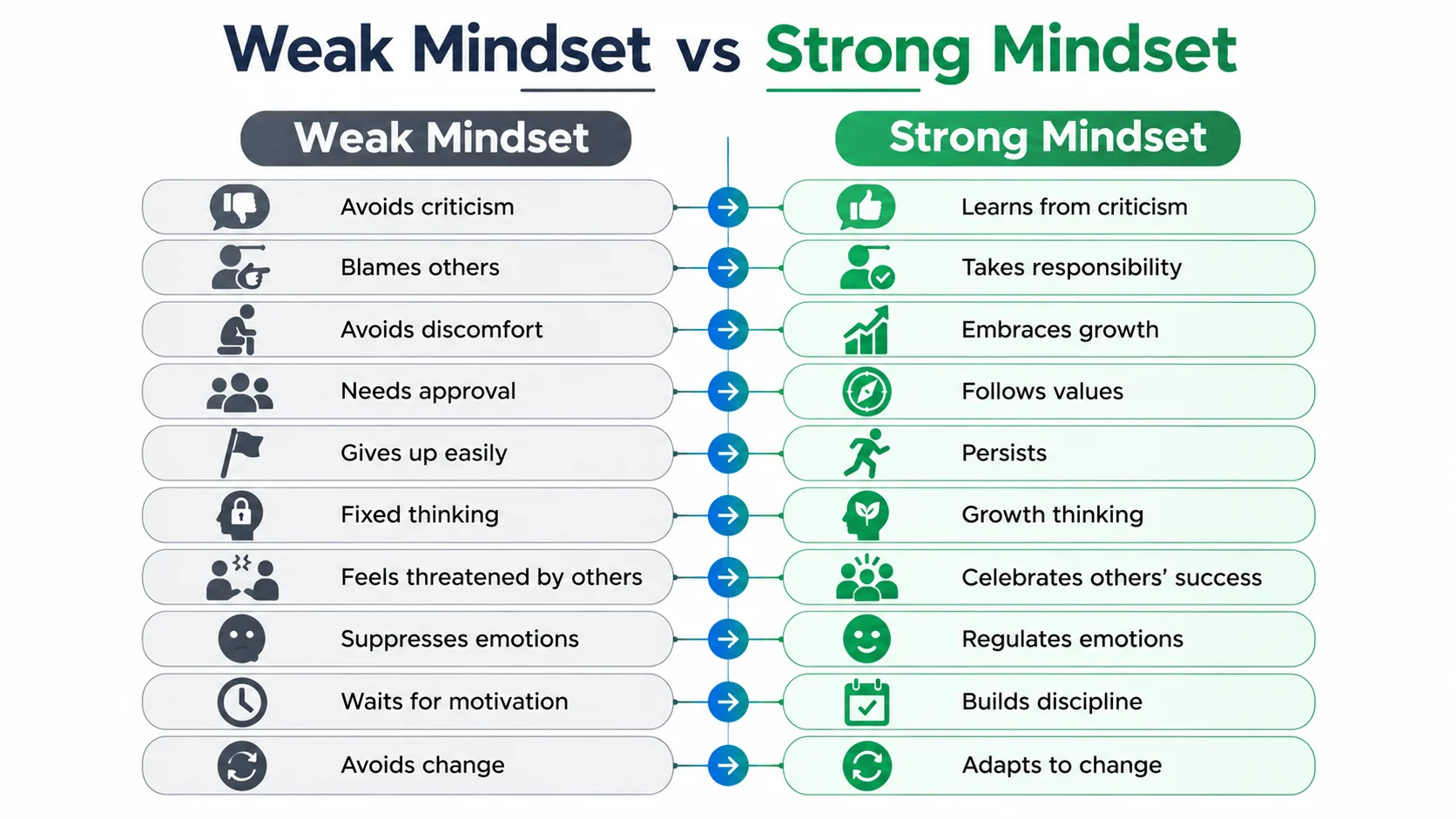
Weak Mindset vs Strong Mindset
| Weak Mindset | Strong Mindset |
|---|---|
| Avoids criticism | Learns from it |
| Seeks approval from others | Follows internal values |
| Avoids discomfort | Accepts discomfort as part of growth |
| Gives up easily | Persists through difficulty |
| Blames others or circumstances | Takes ownership |
| Fixed thinking | Growth-oriented thinking |
| Threatened by others’ success | Inspired by others’ success |
| Suppresses emotions | Regulates emotions |
| Never asks for help | Asks for help when needed |
| Waits for motivation | Acts regardless of motivation |
Strong Mindset Self-Assessment
Rate yourself honestly on each of these dimensions. There are no right answers. This is a snapshot, not a verdict.
Scale: 1 (rarely) to 5 (consistently)
- I take responsibility for my outcomes without excessive self-blame.
- I notice my emotions without being controlled by them.
- I can admit when I’m wrong without feeling diminished.
- I persist through difficulty when something matters to me.
- I learn from criticism without taking it personally.
- I catch myself when I compare myself to others and redirect.
- I set and maintain boundaries without excessive guilt.
- I adapt when plans change unexpectedly.
- I can sit with discomfort without immediately trying to escape it.
- I’m honest about my weaknesses without shame.
- I take calculated risks despite uncertainty.
- I feel genuinely happy for others when they succeed.
- I ask for help when I need it.
- I focus my energy on what I can control.
- I maintain realistic optimism acknowledging difficulty while believing improvement is possible.
- I act on commitments regardless of how I feel.
- I pursue growth even when not required by external demands.
Interpreting Your Results:
- 70–85: You likely have a well-developed mindset across many areas. The work is maintenance and deepening.
- 50–69: You have strengths in some areas and growth opportunities in others. That’s normal. Identify the lowest-scoring items and focus there.
- Below 50: You’re in the right place. Awareness is the first step. Pick one area and practice it intentionally for a few weeks.
Can You Measure a Strong Mindset?
Mental strength isn’t as straightforward to measure as height or weight, but researchers have developed validated tools to assess related constructs.
The Life Orientation Test (LOT-R), developed by Michael Scheier and Charles Carver, measures dispositional optimism a component of mental strength. The Resilience Scale (RS-14), developed by Wagnild and Young, assesses resilience in adolescents and adults. The Self-Compassion Scale, developed by Kristin Neff, measures the ability to treat yourself with kindness during difficulty. The Grit Scale, developed by Angela Duckworth, measures sustained passion and persistence.
These tools are used in research settings, but the self-assessment in this article covers similar ground in a more accessible format. The key insight from the research is that these qualities aren’t fixed. They can be measured, and they can be developed.
Signs You May Need to Strengthen Your Mindset
Sometimes it’s easier to spot the absence of something than its presence. Here are patterns that often indicate a mindset that could benefit from intentional development.
- You avoid discomfort at almost any cost.
- You fear criticism and organize your life to avoid it.
- You seek constant validation from others.
- You compare yourself to others daily and usually come up short.
- You give up quickly when things get difficult.
- You struggle to say no, even when you’re overwhelmed.
- You dwell on things outside your control.
- You feel threatened by others’ success rather than inspired.
- You avoid admitting when you’re wrong.
- You rarely ask for help, even when you need it.
One or two of these might be situational. When several are present consistently, it’s worth examining the underlying patterns. The good news is that every single one of these can shift with practice.
The Neuroscience of a Strong Mindset
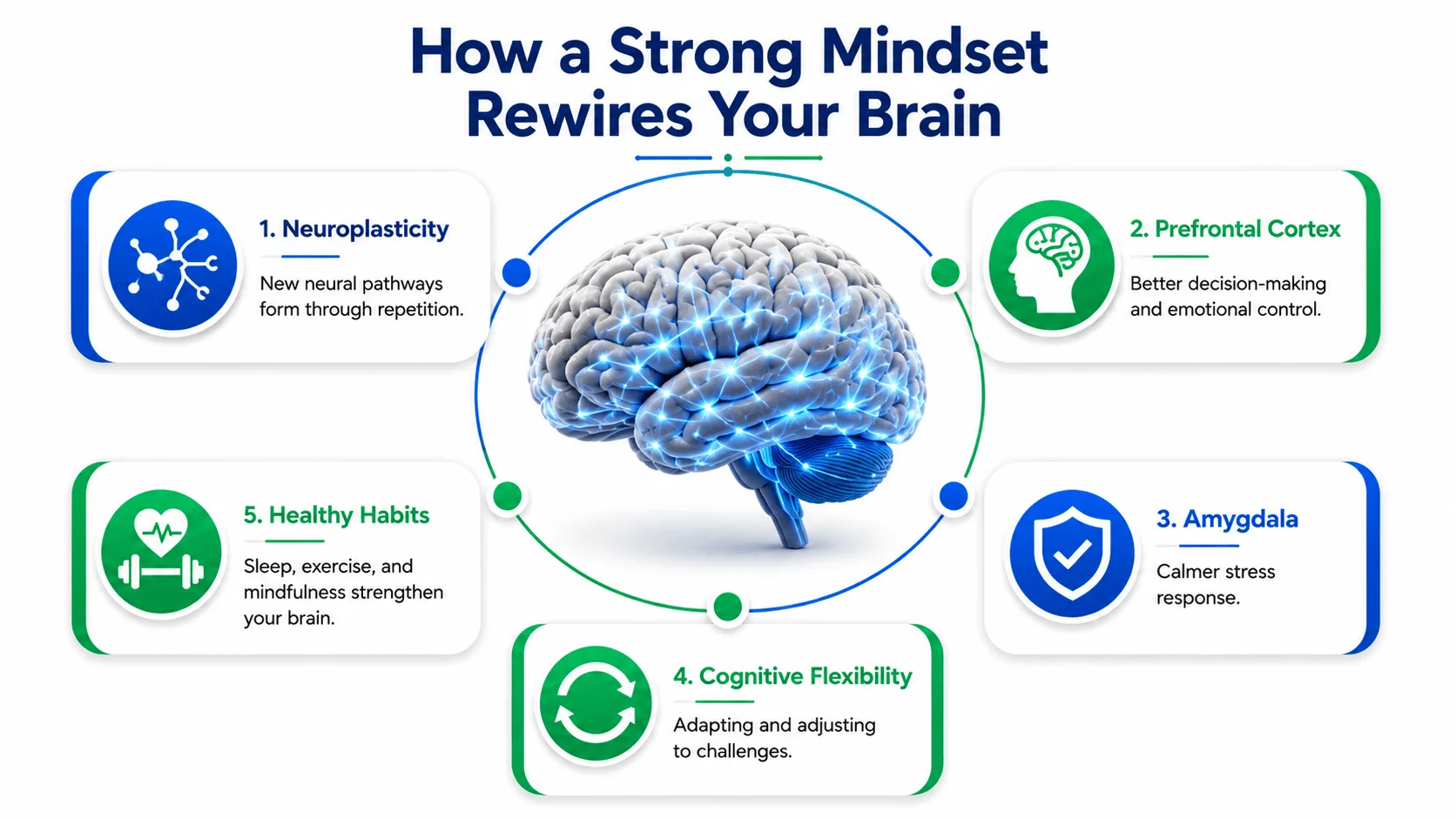
The signs of a strong mindset aren’t just psychological patterns. They have biological foundations. Understanding the neuroscience makes the process of building mental strength less mysterious.
Neuroplasticity: The Foundation of Change
Neuroplasticity is the brain’s ability to reorganize itself by forming new neural connections throughout life. Every time you practice a new response pausing before reacting, reframing a negative thought, tolerating discomfort you strengthen the neural pathways that support that response.
A 2024 review in Frontiers in Psychology confirmed that repeated thoughts and behaviors strengthen neural pathways through neuroplasticity across the lifespan. The brain changes through repetition, not through one-time insights.
The Amygdala and Stress Regulation
The amygdala is the brain’s threat detection center. When you perceive danger whether physical or psychological the amygdala activates the stress response. In people with a strong mindset, the prefrontal cortex (involved in reasoning and impulse control) is better able to regulate amygdala activity.
This doesn’t mean the amygdala doesn’t fire. It means the brain has learned to recover faster. The threat response still occurs, but it doesn’t hijack the system. This is the neurological basis of emotional regulation.
The Prefrontal Cortex and Executive Function
The prefrontal cortex is responsible for planning, decision-making, impulse control, and overriding automatic responses. When you pause between feeling and acting, you’re engaging your prefrontal cortex. When you react automatically, the amygdala is running the show.
Strengthening prefrontal control is a key part of building mental strength. Practices like mindfulness, cognitive reframing, and self-reflection all engage and strengthen this region over time.
Cognitive Flexibility
Cognitive flexibility the ability to shift thinking strategies when circumstances change involves communication between the prefrontal cortex and other brain regions. A 2024 review in Nature Reviews Neuroscience confirmed that cognitive flexibility can be improved through practice and that it predicts better adaptation to stress.
The Role of Sleep and Exercise
Sleep quality directly impacts emotional regulation and cognitive function. During sleep, the brain processes emotional experiences and consolidates learning. Chronic sleep deprivation impairs prefrontal function and increases amygdala reactivity.
Regular physical exercise increases blood flow to the brain, promotes neuroplasticity, and releases neurochemicals that support mood regulation and cognitive function. A 2023 umbrella review in Nature Human Behaviour confirmed that regular exercise is associated with improved executive function and emotional resilience.
The Four Pillars of a Strong Mindset
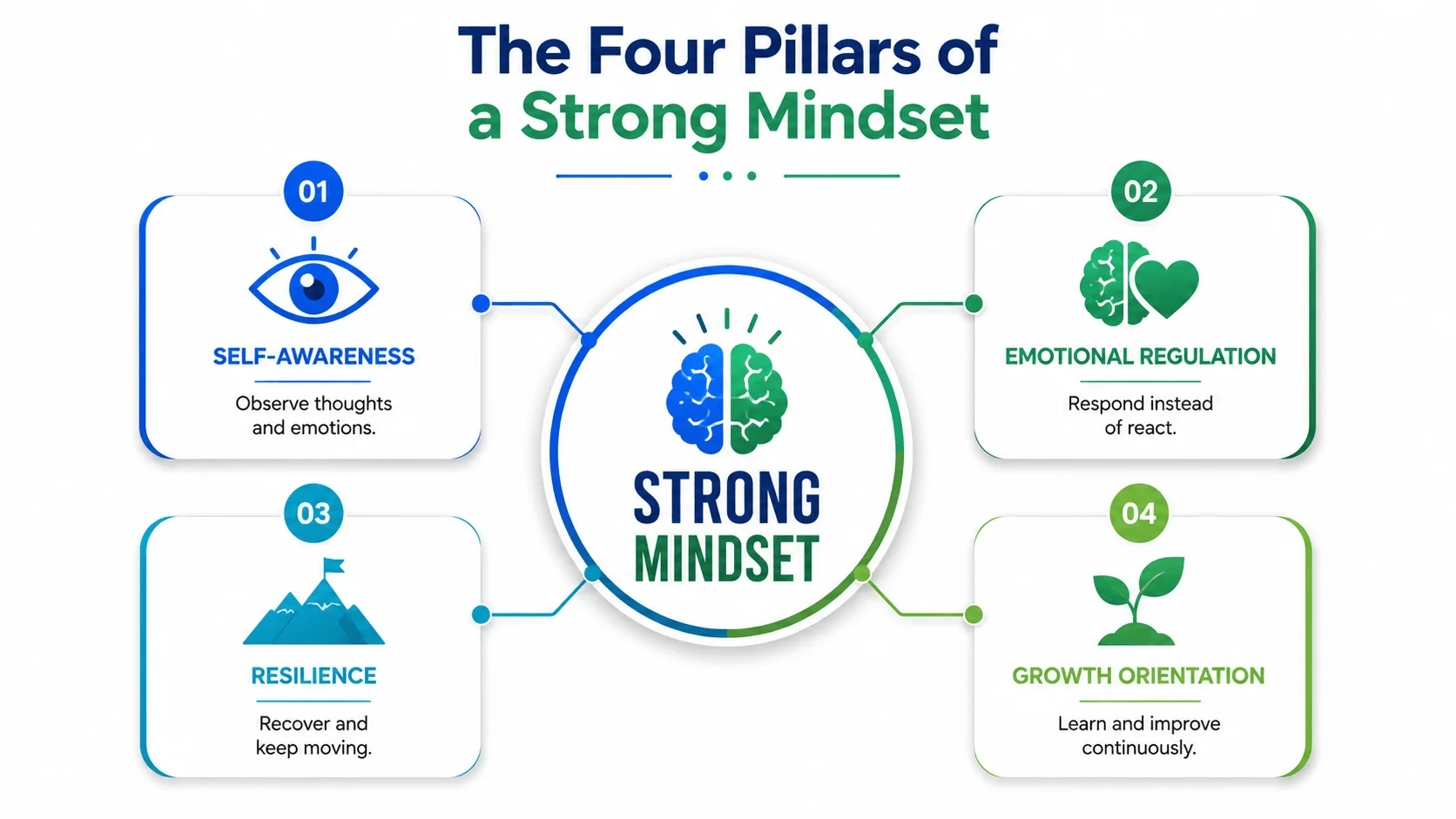
A strong mindset rests on four foundational capacities. These pillars support all seventeen signs described above.
Pillar 1: Self-Awareness. You can’t change what you don’t notice. Self-awareness is the ability to observe your thoughts, emotions, and behaviors without being lost in them. It’s the foundation that makes all other growth possible.
Pillar 2: Emotional Regulation. Once you’re aware of your emotions, you need the capacity to work with them. Regulation isn’t suppression. It’s the ability to feel without being controlled to create space between stimulus and response.
Pillar 3: Resilience. Resilience is the ability to recover from difficulty. It’s not about avoiding setbacks. It’s about bouncing back from them learning, adapting, and continuing. Resilience is built through experience, not inherited.
Pillar 4: Growth Orientation. The final pillar is the commitment to keep developing. A growth mindset the belief that abilities can be developed fuels the entire system. Without it, the other pillars stagnate.
These pillars aren’t sequential. They reinforce each other. Self-awareness enables regulation. Regulation supports resilience. Resilience creates conditions for growth. Growth deepens self-awareness. The system feeds itself.
Strong Mindset vs Mental Toughness: What’s the Difference?
People often use these terms interchangeably, but they’re not the same thing.
Mental toughness is about enduring. It’s the ability to push through pain, discomfort, or difficulty without breaking. Athletes use it. Soldiers use it. It’s valuable, but it’s narrow.
A strong mindset includes toughness but also includes flexibility, self-awareness, emotional regulation, and the ability to learn and adapt. Mental toughness is about withstanding pressure. A strong mindset is about growing through pressure.
Someone with mental toughness can endure a toxic work environment for years. Someone with a strong mindset might recognize the environment is harmful and leave. Both require strength. Different kinds.
| Mental Toughness | Strong Mindset |
|---|---|
| Endures difficulty | Grows through difficulty |
| Pushes through pain | Learns from pain |
| Often suppresses emotion | Regulates emotion |
| “I can take it” | “I can learn from it” |
| Can become rigid | Remains flexible |
| Focuses on surviving | Focuses on adapting |
The distinction matters because the goal isn’t just to survive difficulty. It’s to become more capable, more aware, and more intentional through it.
Signs You’re Acting Tough Instead of Being Mentally Strong
There’s a difference between performing strength and possessing it. Amy Morin, a licensed clinical social worker and author of 13 Things Mentally Strong People Don’t Do, has written extensively about this distinction. Here are patterns that often look like strength but are actually the opposite.
Suppressing emotions. Pretending you’re fine when you’re not isn’t strength. It’s avoidance. Genuine mental strength involves feeling emotions and processing them, not burying them.
Never asking for help. Refusing support isn’t self-sufficiency. It’s isolation dressed up as independence. Strong people know when they need others and are willing to say so.
Always needing to win. If every conversation becomes a debate and every disagreement becomes a competition, that’s not confidence. It’s insecurity. Mentally strong people don’t need to win every interaction to feel okay about themselves.
Avoiding vulnerability. Never letting anyone see you struggle isn’t strength. It’s armor. And armor is heavy. Real strength includes the capacity to be seen honestly.
Constantly proving yourself. If you’re always trying to demonstrate how capable, successful, or strong you are, you’re performing. People with genuine strength don’t need to prove it. It shows up in their actions, not their announcements.
Refusing to change your mind. Stubbornness is often mistaken for conviction. But refusing to update your views when presented with new evidence isn’t strength. It’s rigidity. Strong minds change when the facts change.
The real signs of a strong mindset often look quieter than the performances. Less dramatic. More consistent. The person who calmly holds a boundary. The person who admits they were wrong without making it a big deal. The person who keeps going without needing applause.
Things Mentally Strong People Don’t Do
Amy Morin’s framework identifies specific behaviors that mentally strong people avoid. These are worth considering alongside the signs of strength.
- They don’t waste time feeling sorry for themselves.
- They don’t give away their power to others.
- They don’t shy away from change.
- They don’t focus on things they can’t control.
- They don’t worry about pleasing everyone.
- They don’t fear taking calculated risks.
- They don’t dwell on the past.
- They don’t make the same mistakes over and over.
- They don’t resent other people’s success.
- They don’t give up after the first failure.
- They don’t fear alone time.
- They don’t feel the world owes them anything.
- They don’t expect immediate results.
Each of these connects directly to one or more of the seventeen signs described in this article. Avoiding these patterns is the other side of building strength.
Strong Mindset Across Different Areas of Life
The signs of a strong mindset express themselves differently depending on context.
Career: A strong mindset shows up as the ability to receive feedback without defensiveness, take calculated risks on new opportunities, persist through setbacks, and maintain boundaries between work and personal life.
Relationships: It shows up as the willingness to have difficult conversations, the capacity to apologize genuinely, the ability to set and respect boundaries, and the security to celebrate a partner’s success without feeling threatened.
Health and fitness: It shows up as consistency over perfection showing up for workouts even when motivation is absent, making sustainable nutrition choices rather than extreme ones, and recovering from injuries or setbacks without giving up entirely.
Parenting: It shows up as emotional regulation during challenging moments with children, the ability to apologize to your kids when you’re wrong, modeling persistence through difficulty, and balancing care for others with care for yourself.
Sports and athletics: It shows up as the ability to learn from losses, maintain discipline during off-seasons, support teammates’ success, and push through physical discomfort while respecting the body’s limits.
Leadership: It shows up as taking responsibility for team outcomes without blaming individuals, remaining adaptable when strategies fail, asking for input from others, and maintaining realistic optimism during organizational challenges.
Students and learning: It shows up as seeking feedback on assignments, persisting through difficult material, admitting confusion and asking questions, and focusing on learning goals rather than just performance goals.
Entrepreneurship: It shows up as bouncing back from failed ventures, adapting business models when evidence suggests a change, celebrating competitors’ innovations, and maintaining discipline through the uncertainty of building something new.
What a Strong Mindset Looks Like in Real Life
The signs of a strong mindset don’t always look dramatic. They show up in ordinary moments.
It’s the person who receives harsh feedback at work, feels the sting, and then asks “What can I learn from this?” instead of getting defensive or quitting.
It’s the person who fails at something they cared about, grieves the failure honestly, and then starts again not because they’re over it, but because they’re not done.
It’s the person who sets a boundary with a family member, feels guilty about it, and holds the boundary anyway because they know their wellbeing matters.
It’s the person who admits they were wrong in an argument, not to keep the peace, but because they value accuracy over ego.
It’s the parent who stays calm when their child is melting down not because they don’t feel frustrated, but because they’ve learned to pause between the feeling and the reaction.
It’s the entrepreneur whose first business failed and who started a second one anyway not because they’re fearless, but because they’ve learned that failure is information, not identity.
I left a half-finished book on my nightstand for six months once. Every night I’d see it. Every night I’d tell myself I’d finish it tomorrow. Eventually I admitted I wasn’t going to finish it and started something else. Sometimes strength looks like persistence. Sometimes it looks like letting go.
Common Myths About Mental Strength
| Myth | Reality |
|---|---|
| Strong people never cry | Emotion regulation, not suppression, is the real skill |
| Confidence is something you’re born with | Confidence develops through experience and practice |
| Resilience means being tough | Flexibility and adaptability matter more than rigidity |
| Asking for help is a sign of weakness | It’s a sign of self-awareness and good judgment |
| Mentally strong people don’t struggle | They struggle constantly they’ve just learned to respond differently |
| A strong mindset means never changing your mind | Strong minds update when the evidence changes |
| You either have mental strength or you don’t | It’s built through consistent practice, not inherited |
Daily Habits That Build a Stronger Mindset
The daily habits that improve your mindset are the most reliable way to build these signs over time. Here’s how specific practices map to specific signs.
Morning
- Gratitude writing → Builds realistic optimism (Sign 15)
- Learning goal setting → Reinforces growth orientation (Sign 17)
- Quiet reflection → Strengthens self-awareness (Pillar 1)
- Physical movement → Supports emotional regulation (Sign 2)
Throughout the Day
- Reframing one negative thought → Builds cognitive flexibility (Sign 8)
- Separating facts from interpretations → Reduces self-blame (Sign 1)
- Saying no to one non-essential thing → Strengthens boundaries (Sign 7)
- Connecting with someone who challenges your thinking → Reinforces comfort with being wrong (Sign 3)
Evening
- End-of-day lesson → Reinforces learning from experience (Sign 5)
- Self-compassion practice → Builds resilience after setbacks (Sign 4)
- Consistency tracking → Strengthens self-discipline (Sign 16)
Each of these practices takes only a few minutes. The key is consistency, not intensity. A small practice done daily builds more strength than an occasional intense effort.
What Recent Research Says About Mental Strength
The understanding of mental strength continues to evolve. Several findings from recent systematic reviews and meta-analyses add useful nuance.
A 2024 systematic review published in Clinical Psychology Review concluded that emotional regulation is one of the strongest predictors of psychological resilience. People who can identify and process their emotions without being controlled by them recover from stress faster and maintain higher wellbeing during adversity.
Self-compassion research, led by Kristin Neff at the University of Texas at Austin, has accumulated further evidence through systematic reviews and randomized controlled trials that treating yourself with kindness during setbacks improves resilience and motivation more than self-criticism.
A 2024 meta-analysis involving over 40,000 participants found that psychological flexibility a concept from Acceptance and Commitment Therapy (ACT) developed by Steven Hayes is one of the strongest predictors of wellbeing across different age groups and contexts.
Cognitive flexibility the ability to shift thinking strategies when circumstances change was identified in a 2024 review in Nature Reviews Neuroscience as a key predictor of adaptation to stress. People who can update their mental models fare better than those who cling to old frameworks.
A 2023 umbrella review in Nature Human Behaviour confirmed that regular exercise is associated with improved executive function and emotional resilience. Sleep quality remains one of the strongest predictors of emotional regulation in current research.
The American Psychological Association continues to emphasize that resilience is not a fixed trait but a set of behaviors, thoughts, and actions that can be learned and developed by anyone. The World Health Organization similarly recognizes mental wellbeing as a set of skills that can be cultivated.
Common Mistakes When Building a Stronger Mindset
Building mental strength is simple but not easy. Here’s where people often go wrong.
Pretending to be positive. Forcing optimism when you’re struggling isn’t strength. It’s suppression. Realistic optimism acknowledges difficulty while believing improvement is possible.
Ignoring emotions. Strength isn’t the absence of feeling. It’s the capacity to feel without being controlled. Skipping the emotional processing part usually means the emotions resurface later in less controllable ways.
Trying to control everything. The desire for control can masquerade as strength. But trying to control what can’t be controlled creates anxiety, not resilience. The strong-minded person distinguishes between what they can influence and what they can’t.
Never asking for help. Self-sufficiency becomes a liability when it prevents you from accessing support. Knowing when you need others isn’t weakness. It’s accurate self-assessment.
Comparing yourself to others. This is one of the fastest ways to undermine your own progress. Someone else’s path has nothing to do with yours.
Waiting for motivation. Motivation is unreliable. Systems and routines are durable. Don’t wait to feel ready. Start before you feel prepared.
Perfectionism. Expecting yourself to display all seventeen signs perfectly all the time is itself a sign of a weak mindset specifically, all-or-nothing thinking. Progress is gradual. Imperfection is normal.
Strong Mindset Checklist
Self-Awareness
- ☐ I notice my emotions without being controlled by them
- ☐ I can admit when I’m wrong
- ☐ I’m honest about my weaknesses
Resilience
- ☐ I persist through difficulty when something matters
- ☐ I learn from criticism without taking it personally
- ☐ I recover from setbacks without excessive self-blame
Self-Discipline
- ☐ I act on commitments regardless of how I feel
- ☐ I set and maintain boundaries
- ☐ I focus on what I can control
Growth Orientation
- ☐ I take calculated risks despite uncertainty
- ☐ I keep learning even when not required
- ☐ I maintain realistic optimism
Social Strength
- ☐ I ask for help when I need it
- ☐ I celebrate others’ success
- ☐ I catch myself when comparing to others
Frequently Asked Questions
What are the signs of a strong mindset?
The signs of a strong mindset include taking responsibility without self-blame, regulating emotions, persisting through difficulty, learning from criticism, setting boundaries, adapting to change, and maintaining realistic optimism. These are learned patterns, not fixed personality traits.
Can you develop a strong mindset?
Yes. Neuroplasticity the brain’s ability to form new neural connections continues throughout life. A strong mindset is built through consistent practice: noticing your thought patterns, challenging limiting beliefs, building self-awareness, and practicing new responses to difficulty.
Is a strong mindset genetic?
While personality traits have some genetic component, research on neuroplasticity and resilience consistently shows that mental strength is largely developed through experience and practice. The American Psychological Association emphasizes that resilience involves behaviors, thoughts, and actions that anyone can learn.
What’s the difference between a strong mindset and mental toughness?
Mental toughness is about enduring difficulty. A strong mindset includes endurance but also includes flexibility, self-awareness, emotional regulation, and the willingness to learn and adapt. Mental toughness withstands pressure. A strong mindset grows through it.
How do I know if I have a strong mindset?
Look at your patterns. How do you respond to criticism? Do you take responsibility for your outcomes? Can you sit with discomfort without escaping it? The self-assessment in this article can give you a clearer picture.
Can therapy improve mental strength?
Yes. Approaches like Cognitive Behavioral Therapy (CBT) and Acceptance and Commitment Therapy (ACT) are evidence-based methods for building the skills that underlie mental strength, including emotional regulation, cognitive flexibility, and psychological resilience.
How long does it take to build a strong mindset?
Some shifts become noticeable within 4–8 weeks of consistent practice. Deeper changes typically take months. The key variable is consistency small daily practices compound more effectively than occasional intense efforts.
Is confidence the same as a strong mindset?
No. Confidence is one component of a strong mindset, but a strong mindset also includes emotional regulation, resilience, adaptability, and self-discipline. You can be confident in some areas and still have work to do on other aspects of mental strength.
Can a strong mindset reduce stress?
Yes. The skills that make up a strong mindset emotional regulation, cognitive flexibility, realistic optimism, and focusing on what you can control are all associated with reduced stress and better stress management in the research literature.
Can children develop a strong mindset?
Yes. Children develop mental strength through modeled behavior, supportive environments, and age-appropriate challenges. Research on growth mindset in educational settings shows that teaching children that abilities can be developed improves their persistence and response to difficulty.
What’s the first step to building a stronger mindset?
Start with awareness. Spend a week observing your automatic responses to difficulty without trying to change them. Notice what triggers you, how you react, and what you tell yourself afterward. You can’t change patterns you can’t see.
References
- American Psychological Association. “The Road to Resilience.” APA.org.
- Clear, J. (2018). Atomic Habits. Avery.
- David, S. (2016). Emotional Agility. Avery.
- Deci, E. L., & Ryan, R. M. (2000). Self-Determination Theory. American Psychologist, 55(1), 68–78.
- Duckworth, A. (2016). Grit: The Power of Passion and Perseverance. Scribner.
- Dweck, C. S. (2006). Mindset: The New Psychology of Success. Random House.
- Hayes, S. C. (2005). Get Out of Your Mind and Into Your Life. New Harbinger.
- Morin, A. (2014). 13 Things Mentally Strong People Don’t Do. William Morrow.
- Neff, K. (2011). Self-Compassion: The Proven Power of Being Kind to Yourself. William Morrow.
- Neff, K. (2023). Self-compassion and resilience: A meta-analysis. Mindfulness, 14(5), 1123–1138.
- Scheier, M. F., & Carver, C. S. (1985). Optimism, coping, and health. Health Psychology, 4(3), 219–247.
- Wagnild, G. M., & Young, H. M. (1993). Development and psychometric evaluation of the Resilience Scale. Journal of Nursing Measurement, 1(2), 165–178.
- World Health Organization. Mental health and wellbeing resources. WHO.int.
- Emotional regulation and resilience: A systematic review. Clinical Psychology Review (2024).
- Psychological flexibility and wellbeing: A meta-analysis. (2024).
- Cognitive flexibility and stress adaptation: A review. Nature Reviews Neuroscience (2024).
- Neuroplasticity and behavior change: Recent advances. Frontiers in Psychology (2024).
- Exercise and executive function: An umbrella review. Nature Human Behaviour (2023).
- Social support and mental health: A meta-analysis. Psychological Bulletin (2023).
If you’re starting from scratch, pick one sign from the list. Not the one that seems most impressive. The one that feels most relevant to where you are right now. Practice noticing it for a week. Don’t try to change anything yet. Just pay attention.
After a week, you’ll have a clearer sense of your current patterns. That awareness alone is progress. The work of building a stronger mindset isn’t about becoming someone else. It’s about becoming more intentional about who you already are. Start there. Let the practices build from that foundation.
Written by Bilal Shah — a mindset and personal development writer at Grow Daily Life who focuses on growth mindset, limiting beliefs, confidence, resilience, and behavior change. His work combines psychological research with practical, evidence-informed strategies to help readers develop healthier thinking patterns, overcome mental barriers, and create lasting personal growth.