For a long time I thought optimism was a little bit delusional.
Not the clinical kind. Just the everyday kind where people walk around insisting everything will work out fine while ignoring the obvious problems in front of them. I had a friend like that. He’d start businesses that made no financial sense, and when they failed, he’d say things like “the universe is redirecting me.” I’d nod and think, the universe isn’t redirecting you. Your numbers never added up.
At the same time, I knew people on the opposite end. The realists. They could tell you exactly why something wouldn’t work. They had spreadsheets. They had historical data. They were often right about the problems. But they also never seemed to start anything that mattered. Their realism had slowly become a reason to stay put.
I spent years bouncing between these two poles. One month I’d be optimistic, convinced things would work out. The next month I’d swing back to realism, trying to protect myself from disappointment. Neither felt quite right.
Optimism vs Realism in One Sentence
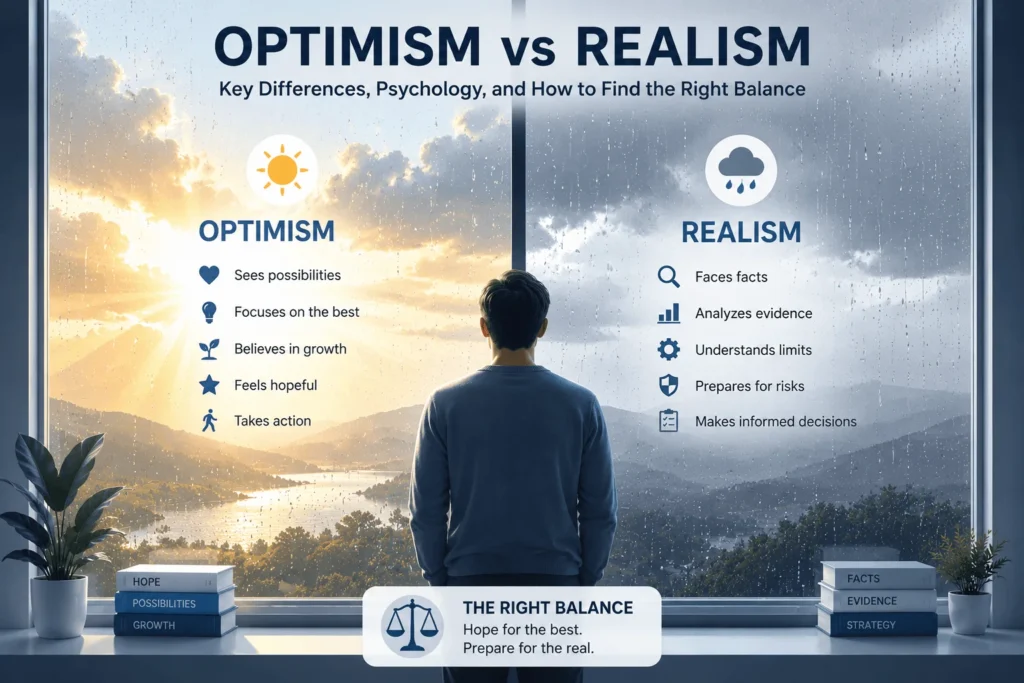
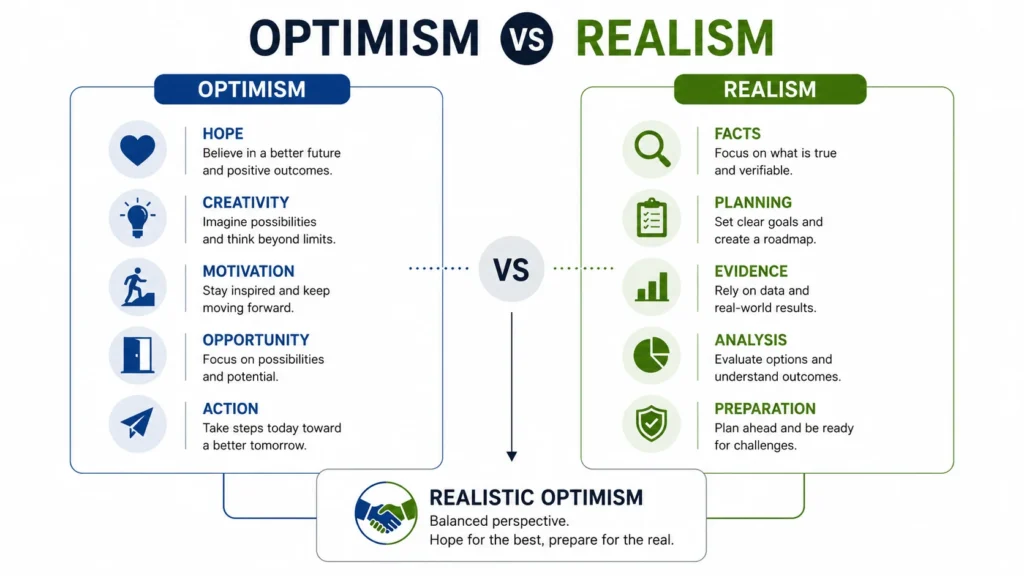
Optimism vs realism is the difference between expecting positive outcomes and evaluating situations based on objective evidence. Optimism emphasizes hope and possibility, while realism emphasizes facts and probability. The most effective approach combines both into realistic optimism acknowledging difficulty while believing effort matters.
The optimism vs realism debate is usually framed as a choice. Pick a side. Glass half full or glass half empty. But that framing is wrong, and it took me a while to understand why.
What is optimism vs realism?
Optimism vs realism is the difference between expecting positive outcomes and evaluating situations based on available evidence. Optimism focuses on possibilities and hope. Realism focuses on facts and accuracy. Healthy decision-making doesn’t require choosing one over the other. It combines both approaches through realistic optimism acknowledging difficulty while believing effort matters.
Optimism vs Realism at a Glance
| Feature | Optimism | Realism |
|---|---|---|
| Thinking Style | Positive, possibility-focused | Evidence-based, fact-focused |
| Risk Approach | Accepts more risk | Evaluates risk carefully |
| Motivation | High | Moderate |
| Decision Making | Fast, intuitive | Careful, analytical |
| Weakness | Overconfidence, ignoring problems | Analysis paralysis, avoiding action |
| Best Used When | Starting something new, creative work | Planning, high-stakes decisions |
Research Snapshot
• Research suggests that approximately 80% of people demonstrate some degree of optimism bias.
• Optimism is linked with lower cardiovascular risk.
• Flexible thinking predicts resilience better than optimism alone.
• Learned optimism can be developed through practice.
What Optimism and Realism Actually Mean
Before getting into which is better, it helps to define terms. People use these words loosely, and a lot of confusion comes from not being clear about what they mean.
What is optimism? Optimism is the tendency to expect positive outcomes and focus on possibilities rather than limitations. It’s a mindset that assumes things will work out, which creates motivation and hope. At its best, optimism drives action. At its worst, it becomes denial ignoring real problems because acknowledging them feels uncomfortable.
What is realism? Realism is the tendency to see things as they are, without filtering through hope or fear. It’s an attempt to perceive reality accurately and make decisions based on evidence rather than wishes. At its best, realism produces clear-eyed assessment and good judgment. At its worst, it becomes pessimism dressed up as objectivity assuming the worst because it feels safer than hoping.
In psychology, optimism refers to the tendency to expect positive outcomes, while realism refers to accurately evaluating situations based on available evidence rather than hope or fear. Modern psychology suggests that neither extreme is ideal. The healthiest mindset balances hope and reality what researchers call realistic optimism.
The two aren’t actually opposites, even though they’re often treated that way. You can be optimistic about some things and realistic about others. You can believe things might work out while also acknowledging the obstacles. The tension between them isn’t a problem to solve. It’s a balance to manage.
Optimism vs Realism: The Key Differences
When people talk about optimistic vs realistic thinking, they’re usually pointing to a few core differences in how people approach life.
How They Interpret Setbacks
An optimist tends to see setbacks as temporary, specific, and external. “That project failed because the timing was off.” The failure doesn’t say anything about who they are or what they’re capable of.
A realist might interpret the same setback differently. “That project failed. Here are the specific reasons. Some of them were in my control, some weren’t.” The assessment is more balanced but can sometimes drift toward self-blame if the realist isn’t careful.
A pessimist which is what realism sometimes becomes sees setbacks as permanent, pervasive, and personal. “That project failed because I’m not good enough, and everything I try fails, and it always will.”
How They Approach Decisions
Optimists are more likely to act. They assume things will work out, so they take risks. This leads to more attempts, more failures, and sometimes more successes. The bias toward action means they get more data, even if some of it is negative.
Realists are more likely to analyze. They want to understand the situation before committing. This leads to better-informed decisions but can also lead to paralysis. Analysis becomes a substitute for action. Preparation becomes procrastination.
How They Handle Uncertainty
Optimists are comfortable with uncertainty because they assume the unknown will resolve favorably. They don’t need to know exactly how things will work out. They trust the process.
Realists are less comfortable with uncertainty. They want to reduce it through information and planning. This is useful when uncertainty can actually be reduced. It’s less useful when uncertainty is inherent and you just have to act anyway.
The Core Difference
At the center of the optimism vs realistic thinking distinction is a single question: do you assume the best or do you assume the most likely outcome based on evidence?
Neither is always right. The best assumption depends on the situation.
What Psychology Says About Optimism and Realism
The research on realism vs optimism psychology is more nuanced than you might expect. Both have benefits, and both have downsides.
Research Highlights:
| Finding | Source |
|---|---|
| Lower cardiovascular risk among optimists | Meta-analysis, American Psychologist |
| Optimistic individuals may have 10–15% lower risk of cardiovascular events | Rasmussen et al., Annals of Behavioral Medicine |
| Realistic planning reduces costly mistakes | Journal of Behavioral Decision Making |
| Flexible thinking predicts resilience better than either mindset alone | Nature Reviews Psychology (2025) |
| Optimistic people experience lower chronic stress | Journal of Personality and Social Psychology |
| Realistic thinkers make fewer financial errors | Journal of Economic Psychology |
Optimism research consistently shows that optimists tend to be healthier, live longer, and recover from setbacks faster. They’re more likely to persist through difficulty because they believe their efforts will eventually pay off. This is the self-fulfilling part: believing things can improve makes you more likely to do the things that lead to improvement. Researchers like Charles Carver and Michael Scheier, who developed the Life Orientation Test to measure dispositional optimism, have documented these effects across decades of study.
Realism research shows that accurate perception of reality is associated with better decision-making in certain contexts. People who can assess situations without bias make fewer errors in judgment. They’re less likely to take on debt they can’t handle or start projects they can’t finish. Realism protects against catastrophic failure.
But here’s where it gets interesting. The people who function best aren’t pure optimists or pure realists. They’re people who can shift between the two depending on the situation.
Expert Insight
Martin Seligman argues that optimism is most useful when paired with accurate reality testing. Optimism should encourage action not replace preparation.
Seligman, one of the founders of positive psychology, has written about what he calls “flexible optimism.” The idea is that optimism is a tool, not a default. As he put it: “Optimism is invaluable for meaningful achievement.” But the skill is knowing when to use it and when to set it aside. Sometimes you need to see the world accurately. Other times you need the motivational boost that comes from believing things can work out.
Barbara Fredrickson’s broaden and build theory adds another layer. Her research suggests that positive emotions including those generated by optimistic thinking broaden people’s awareness and encourage novel, varied thoughts and actions. Over time, this builds lasting personal resources, from physical health to social connections. The key insight is that optimism isn’t just about feeling better. It’s about building capacity.
What Is Optimism Bias?
What is optimism bias? Optimism bias is the well-documented human tendency to overestimate the likelihood of positive events and underestimate the likelihood of negative ones. It’s a cognitive bias present in roughly 80% of people, not a personality quirk (Sharot, The Optimism Bias, 2011).
Tali Sharot, a neuroscientist who has studied this extensively, found that most people expect to live longer than average, succeed more often than average, and experience fewer negative events than average. Statistically, this can’t be true for everyone. But the bias persists.
Why does it exist? Probably because it’s adaptive. People who expect good things are more likely to pursue goals, take risks, and persist through difficulty. The bias creates motivation. Without it, we might not bother trying.
The downside is obvious. The same bias can lead to poor planning, underestimating risks, and being unprepared when things go wrong. People don’t save enough for retirement because they assume everything will work out. They don’t get insurance because they assume nothing bad will happen. The same tendency that motivates action can also create vulnerability.
The practical takeaway: this bias is normal and often useful. But it needs to be balanced with deliberate realism in situations where the cost of being wrong is high.
Learned Optimism: What Martin Seligman Discovered
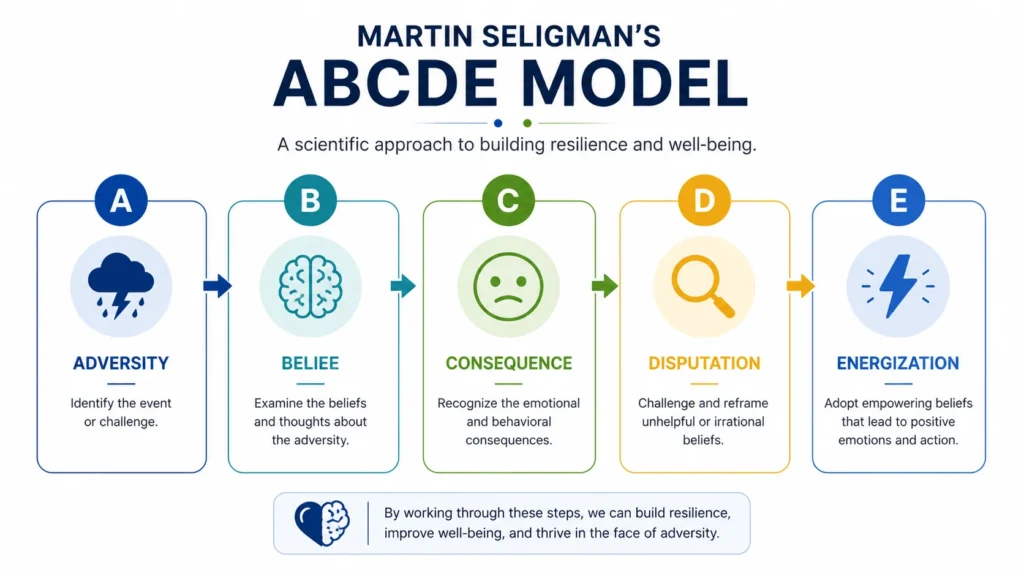
Martin Seligman’s work on learned optimism is central to understanding how optimism actually functions and how it can be developed.
Seligman started his career studying learned helplessness. He found that when animals (and humans) experience repeated negative events they can’t control, they eventually stop trying to improve their situation, even when escape becomes possible. They learn to be helpless.
But Seligman noticed something else. Not everyone becomes helpless. Some people remain resilient despite adversity. The difference, he discovered, was in their explanatory style how they explained good and bad events to themselves.
Optimists explain bad events as temporary, specific, and external. Pessimists explain them as permanent, pervasive, and personal. The same event can produce completely different responses depending on the explanation.
Seligman developed the ABCDE model for building learned optimism:
- Adversity: The negative event that occurs.
- Belief: The automatic interpretation of that event.
- Consequence: The emotional and behavioral result of that belief.
- Disputation: Challenging the belief with evidence.
- Energization: The renewed motivation that follows successful disputation.
The key insight is that optimism can be learned. It’s not a fixed personality trait. It’s a set of thinking habits that can be practiced and strengthened over time. This connects directly to the growth mindset concept the belief that abilities, including the ability to think optimistically, can be developed.
Research on whether optimism is genetic suggests that while there may be a heritable component, learned thinking patterns play a significant role. Studies of twins indicate that roughly 25–30% of dispositional optimism may be heritable, with the rest shaped by environment, experience, and deliberate practice (Plomin et al., Behavioral Genetics). This means most people have substantial room to shift their thinking style.
Defensive Pessimism: A Different Approach
Not everyone benefits from optimism. Some people use a strategy called defensive pessimism, and it works differently.
Defensive pessimism is when people set low expectations and mentally rehearse everything that could go wrong not because they lack confidence, but because it helps them prepare. The anxiety about potential problems becomes fuel for planning and effort.
Research by Julie Norem has shown that defensive pessimists often perform just as well as optimists, but through a different mechanism. The optimist succeeds because positive expectations create motivation. The defensive pessimist succeeds because negative expectations create preparation.
The important distinction: defensive pessimism isn’t the same as dispositional pessimism. Dispositional pessimists just expect bad things and give up. Defensive pessimists expect bad things and then work hard to prevent them. The negative thinking is strategic, not defeatist.
For some people, trying to become more optimistic actually backfires. If their natural style is defensive pessimism, forcing positive thinking increases anxiety and reduces performance. The goal isn’t to make everyone an optimist. It’s to find the thinking style that works for you while remaining flexible enough to adapt when needed.
What Is Depressive Realism?
Depressive realism is a psychological concept that deserves attention in any discussion of optimism versus realism. It refers to the finding that people with mild to moderate depression sometimes make more accurate assessments of their control over situations than non depressed people.
The research, originally conducted by Lauren Alloy and Lyn Abramson, found that non-depressed individuals tend to overestimate their control over events, while mildly depressed individuals were more accurate in their judgments. In other words, the “realistic” view was held by people experiencing depressive symptoms, not by the mentally healthy.
This finding generated significant debate. Does it mean depression makes people see reality more clearly? Not exactly. Current understanding suggests that the effect is context-dependent and may be limited to specific types of judgment. The non-depressed bias toward overestimating control appears to be functionally useful it helps people take action and persist through difficulty.
The practical implication is clear: perfect realism may not be the ideal. A slight positive bias seems to support wellbeing and motivation. The goal isn’t to eliminate bias entirely. It’s to keep bias within a range that supports action without leading to reckless decisions.
The Problem with Pure Optimism
So far we’ve looked at what psychology says about these thinking styles. The next question is more practical: what happens when either optimism or realism is taken too far?
I’ve watched pure optimism fail enough times to know its limits.
The issue isn’t hope. Hope is useful. The issue is that unfiltered optimism ignores information that could prevent failure. Extreme optimism may cause people to underestimate important risks. If you assume everything will work out, you don’t prepare for things going wrong. When they do go wrong and sometimes they will you’re caught off guard.
There’s also a social cost. Chronic optimists can be exhausting to be around. When someone dismisses every concern with “it’ll be fine,” it feels invalidating. The positivity starts to feel less like hope and more like avoidance.
Pure optimism also creates a weird kind of fragility. If your motivation depends on believing things will work out, what happens when you hit a real obstacle? The optimism collapses, and there’s nothing underneath it. You haven’t built the capacity to keep going when things look bad because you never let yourself acknowledge that things could look bad.
None of this means optimism is bad. It means optimism needs boundaries. Hope needs to share space with honesty.
The Problem with Pure Realism
Realism has its own problems, and they’re easier to miss because realism often sounds reasonable.
The main issue is that realism can become a sophisticated form of avoidance. It’s easy to call yourself a realist when what you’re really doing is protecting yourself from the discomfort of trying. You’ve analyzed the situation. The odds aren’t great. The logical conclusion is to wait for better conditions. But those conditions never arrive, and the analysis was never neutral. It was biased toward finding reasons not to act.
I’ve done this. I’ve spent weeks researching something and concluded it wasn’t the right time. Was that realism? Maybe. But it was also fear. The line between the two is hard to see from the inside.
Another problem is that extreme realism can reduce momentum by encouraging excessive caution. Realism is based on past data and current conditions. But people do things that past data would have predicted were unlikely. Businesses succeed in terrible economies. People learn skills later in life that they “shouldn’t” be able to learn. Realism would have told them not to bother. Sometimes being wrong about the odds is the only way to beat them.
There’s also the emotional atmosphere that pure realism creates. If you’re constantly focused on what’s realistic, you’re constantly focused on limitations. That’s demoralizing over time. It drains the energy that action requires. You become accurate and stuck.
Realism is useful as a tool. It’s less useful as an identity.
Signs You Lean Too Far in Either Direction
Most people have a default. Recognizing when you’ve drifted too far toward one extreme is the first step toward balance.
Signs You’re Too Optimistic:
- You ignore warning signs because you assume things will work out.
- You overcommit to projects and people, underestimating what’s required.
- You don’t prepare for problems because preparation feels negative.
- You’re repeatedly surprised when things go wrong.
- Your plans don’t include contingencies for failure.
- People close to you feel unheard when they express concerns.
Signs You’re Too Realistic:
- You overthink decisions to the point of paralysis.
- You rarely start things because the odds don’t look favorable.
- You mistake fear for good judgment.
- You’re often right about problems but rarely involved in solutions.
- You feel safer not hoping because hope feels risky.
- Your default response to new ideas is explaining why they won’t work.
Neither list makes you a bad person. They’re just patterns. Patterns can be adjusted.
Can Optimism Become Dangerous?
Yes. There are situations where optimism stops being helpful and becomes genuinely harmful.
Financial scams and bad investments often exploit optimism bias. People invest in things that are clearly too good to be true because they want to believe. The optimism overrides the evidence.
Gambling is sustained by irrational optimism. The belief that the next bet will pay off, despite mathematical certainty that it won’t, ruins lives.
Unhealthy relationships sometimes persist because one person is optimistic that the other will change. They ignore consistent patterns of behavior because they’re focused on potential rather than reality.
Ignoring medical advice can have serious consequences. Believing that symptoms will resolve on their own when medical attention is needed isn’t optimism. It’s denial.
The common thread: optimism becomes dangerous when the cost of being wrong is catastrophic and the evidence clearly suggests a different course of action. In these situations, realism isn’t optional. It’s necessary.
Toxic Positivity vs Realistic Thinking
A related issue that comes up often in the optimism vs realism conversation is toxic positivity.
Toxic positivity is the insistence that people should maintain a positive mindset regardless of circumstances. It’s the “good vibes only” approach. Negative emotions are treated as problems to eliminate rather than normal human responses to difficulty.
This isn’t optimism. It’s emotional suppression.
The difference between toxic positivity vs realistic thinking comes down to how negative information is handled. Toxic positivity denies it. Realistic thinking acknowledges it. A toxic positivity response to someone struggling might be “just stay positive” or “look on the bright side.” A realistic response would be “that sounds difficult, and here’s what we might be able to do about it.”
Realistic thinking doesn’t require you to feel good about bad situations. It requires you to see them accurately. Sometimes that means acknowledging that things are genuinely hard right now. The optimism, if it shows up, comes in the form of believing you can handle the difficulty, not denying that the difficulty exists.
Where optimism becomes toxic is when it’s used to avoid uncomfortable truths. Where realism becomes toxic is when it’s used to avoid hope. The healthy position is somewhere in between: clear-eyed about problems, open to the possibility of improvement.
Myth vs Fact: Common Misconceptions
| Myth | Fact |
|---|---|
| Optimists ignore problems. | Healthy optimists acknowledge problems and prepare for them. |
| Realists are just pessimists. | Realism seeks accuracy. Pessimism expects the worst. They’re different. |
| Positive thinking solves everything. | Positive thinking helps, but action and preparation matter more. |
| Realism kills dreams. | Realism improves planning and makes dreams more achievable. |
| You’re either optimistic or realistic. | Both are tools. Most people can learn to shift between them. |
| Optimism can’t be learned. | Research shows optimism is largely a learned thinking style. |
Realistic Optimism: The Middle Ground That Works
So if pure optimism has problems and pure realism has problems, what’s the alternative?
The answer is an approach that combines clear-eyed assessment with genuine hope. It’s the ability to see situations accurately including obstacles and risks while still believing that your efforts matter and that improvement is possible.
A person with this balanced perspective doesn’t say “everything will work out.” They say “here’s what we’re up against, and here’s what we can do about it, and I believe it’s worth trying.”
The difference sounds small but it changes everything.
They prepare for things to go wrong. They have contingency plans. They’re not shocked when obstacles appear because they already accounted for them. But they also don’t use those obstacles as reasons to stop. The preparation makes the persistence possible.
They acknowledge when things are genuinely difficult. They don’t pretend the difficulty away. They just don’t treat difficulty as a verdict. It’s information, not fate.
They hold their beliefs loosely. They’re not attached to a particular outcome. They’re attached to the process of trying, learning, and adjusting. If the evidence suggests their approach isn’t working, they change the approach. They don’t change their belief that some approach will eventually work.
“Hope without preparation becomes wishful thinking. Preparation without hope becomes paralysis.”
The realistic mindset provides the grounding. The optimistic mindset provides the motivation. Neither works as well alone as they do together.
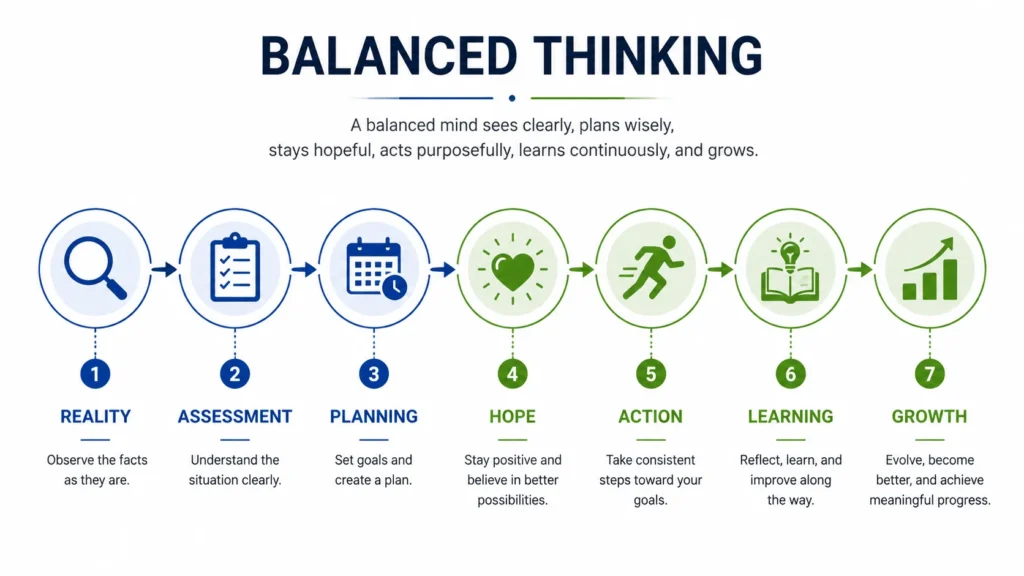
The flow looks something like this:
Reality → Assessment → Planning → Hope → Action → Learning → Better Results
Each step depends on the one before it. You can’t plan without assessing reality. You can’t act without hope. You can’t improve without learning. The sequence requires both mindsets working together.
Research Snapshot
People who combine optimistic expectations with obstacle planning consistently outperform those who rely on positive thinking alone. Preparation without hope becomes paralysis. Hope without preparation becomes wishful thinking.
Mental Contrasting (WOOP): A Practical Tool
Gabriele Oettingen’s research on mental contrasting provides one of the most practical frameworks for developing a balanced perspective. Her work challenges the popular idea that positive visualization alone leads to success. As she put it: “Positive fantasies alone often reduce effort.”
Oettingen found that simply imagining a positive future can actually reduce motivation. People who fantasize about success without also imagining the obstacles tend to exert less effort. They’ve already experienced the reward mentally, so their drive to pursue it in reality diminishes.
Mental contrasting, which Oettingen developed into the WOOP framework, combines positive visualization with realistic obstacle identification:
- Wish: Identify a meaningful goal or desire.
- Outcome: Visualize the best possible result if you achieve it.
- Obstacle: Identify the main internal obstacle that stands in your way.
- Plan: Create a specific if-then plan for when you encounter that obstacle.
For example: “I want to exercise regularly (Wish). I imagine feeling strong and energized (Outcome). But I know I often feel too tired after work to go to the gym (Obstacle). If I feel too tired after work, then I will put on my workout clothes anyway and go for just ten minutes (Plan).”
This approach is balanced thinking in practice. It acknowledges the obstacle without letting it become a reason to quit. It pairs hope with preparation.
Psychological Flexibility and Cognitive Flexibility
Two related concepts from modern psychology help explain why a balanced perspective works.
Psychological flexibility, a core concept in Acceptance and Commitment Therapy (ACT), is the ability to stay present and adapt your behavior based on what the situation requires, rather than reacting automatically based on old patterns or rigid beliefs. Rather than forcing positive thoughts, it teaches people to accept reality while choosing actions aligned with their values.
Cognitive flexibility is the ability to switch between different perspectives and thinking styles depending on the situation. A cognitively flexible person can be optimistic when starting a new project, realistic when reviewing the budget, and shift back to optimism when the team needs encouragement.
These two capacities explain why some people navigate the optimism-realism balance more naturally than others. They’re not stuck in one mode. They can move between them as circumstances change. And both capacities can be developed with practice.
The connection to the growth mindset is worth noting here. People who believe their abilities can develop are more likely to practice cognitive flexibility because they don’t see their thinking style as fixed. They’re willing to experiment with different approaches and learn from what works. Building mental resilience follows a similar pattern it comes from repeated practice, not sudden insight.
Benefits of Balanced Thinking
When you combine clear-eyed assessment with genuine hope, you get something neither can produce alone.
Better decisions. You see the situation clearly, including risks, but you don’t let risk paralyze you. You make informed choices and then act on them.
More resilience. When setbacks happen, you’re not shocked because you knew they were possible. And you’re not defeated because you believe your efforts still matter.
More sustainable motivation. Pure optimism burns out when reality doesn’t cooperate. A balanced approach keeps going because it expected reality to be difficult in the first place.
Better relationships. People trust those with a balanced perspective more than pure optimists or pure pessimists. The optimism makes them encouraging to be around. The realism makes them credible. They’re not selling a fantasy, and they’re not draining hope. They’re just honest about what’s possible.
Less anxiety. Trying to maintain pure optimism is exhausting. You’re constantly managing the gap between how you’re supposed to feel and how you actually feel. A grounded perspective removes that burden. You’re allowed to acknowledge difficulty. That alone reduces stress.
More learning. People with a balanced mindset examine their failures because they’re not threatened by them. They want to understand what went wrong so they can adjust. Pure optimists sometimes skip this step because examining failure feels like betraying hope. Pure realists sometimes skip it too because they already assumed failure was likely. The balanced approach captures the best of both: the motivation to improve and the clarity to see what needs improving.
Where Optimism Works Better
Despite everything I just said about balance, there are situations where leaning toward optimism is genuinely more useful.
At the beginning of something new. When you’re starting a project, a habit, a relationship, or a career change, you don’t have enough data to be truly realistic. You don’t know what’s possible. Optimism fills the gap and provides the motivation to start. Realism can wait until you have something real to be realistic about.
During creative work. Creativity requires a tolerance for uncertainty and failure. Most creative ideas don’t work. If you’re too realistic about those odds, you’ll never generate enough ideas to find the ones that do work. Optimism keeps the tap running.
When morale matters. If you’re leading a team through a difficult period, pure realism can be demoralizing. People need to believe that their efforts matter and that things can improve. Optimism, even slightly exaggerated, helps people keep going long enough to reach the other side.
When the cost of failure is low. If trying something and failing won’t cause serious harm, there’s not much downside to optimism. You might as well believe it’ll work and give it your best shot. If it doesn’t work, you’ll learn something and move on.
In relationships. Relationships benefit from assuming the best about the other person. If you’re too realistic about someone’s flaws, you’ll talk yourself out of connection. Optimism creates the space for people to show up as their better selves.
Where Realism Works Better
Other situations call for realism. Sometimes optimism is genuinely dangerous.
When the cost of failure is high. If the downside of being wrong is catastrophic, you need realism. You need to understand the risks and prepare for them. Optimism in these situations isn’t hope. It’s recklessness.
Financial decisions. Money doesn’t care about your mindset. It responds to math. Realism about income, expenses, risk, and return is more useful than optimism. You can be optimistic about your ability to earn more in the future, but you should be realistic about what you have right now.
Health decisions. Your body also doesn’t respond to optimism alone. You can believe you’ll recover while still being realistic about what recovery requires. The optimism provides motivation. The realism ensures you actually follow the treatment plan.
When you’re responsible for others. If people depend on your decisions, you owe them realism. You can be optimistic about the future while being realistic about the present. But you can’t make decisions based on what you hope will happen when people’s wellbeing is on the line.
Evaluating past performance. Looking back at what worked and what didn’t requires realism. If you’re too optimistic, you’ll overlook mistakes. You’ll repeat them. Honest assessment of what actually happened is the foundation of improvement.
When to Use Each: A Comparison Table
| Situation | Optimism Level | Realism Level | Best Approach |
|---|---|---|---|
| Starting a business | High | Medium | Balanced |
| Investing money | Low | High | Realistic planning |
| Creative work | High | Medium | Optimism with feedback |
| Health decisions | Medium | High | Balanced |
| Parenting | Medium | Medium | Balanced |
| Job interviews | High | Medium | Optimism with preparation |
| Crisis management | Medium | High | Realism with hope |
| Learning new skills | High | Medium | Optimism with practice |
| Budgeting | Low | High | Pure realism |
| Building relationships | High | Medium | Optimism with boundaries |
| Strategic planning | Medium | High | Balanced |
| Optimism Wins | Realism Wins |
|---|---|
| Motivation | Planning |
| Creativity | Budgeting |
| Confidence | Risk Analysis |
| Starting Goals | Crisis Decisions |
| Relationships | Investing |
The skill isn’t being optimistic or realistic. It’s knowing which to use when.
Real Life Examples of Balanced Thinking
Abstract concepts make more sense with concrete examples. Here’s how a grounded, hopeful approach shows up across different situations.
The Student
- Pure Optimist: “I’ll pass the exam. I’m sure it’ll be fine.”
- Pure Realist: “The pass rate is only 60%. The odds aren’t great.”
- Balanced Thinker: “I know the pass rate is 60%, so I need to study consistently. I believe I can pass if I follow a solid study plan.”
The Entrepreneur
- Pure Optimist: “This business is going to be huge. Everyone will love it.”
- Pure Realist: “Most businesses fail within five years. The market is saturated.”
- Balanced Thinker: “I know the failure rate is high, so I’m starting small, testing assumptions early, and keeping my day job until I have traction. I believe this can work if I execute well and adapt quickly.”
The Person Getting Fit
- Pure Optimist: “This year I’m going to get in the best shape of my life.”
- Pure Realist: “I’ve tried before and it never sticks. I’m probably just not a fitness person.”
- Balanced Thinker: “I’ve struggled with consistency before, so I’m starting with two workouts a week instead of five. I’ll build from there. I believe I can get stronger if I’m patient with the process.”
The Person in a Relationship
- Pure Optimist: “If it’s meant to be, it’ll work out.”
- Pure Realist: “Relationships always end eventually. No point getting too invested.”
- Balanced Thinker: “I don’t know where this will go, and that’s okay. I’m going to show up honestly and see what we can build together. If it doesn’t work out, that doesn’t mean it wasn’t worth trying.”
In each case, the person isn’t ignoring difficulty. They’re acknowledging it and moving forward anyway. That’s the difference.
Optimism vs Realism in the Workplace
The optimism vs realism dynamic plays out constantly in professional settings. Understanding it can make you more effective regardless of your role.
Leaders need both. Optimism creates vision and inspires people to follow. Realism ensures the vision is grounded in something achievable. Leaders who are too optimistic make promises they can’t keep. Leaders who are too realistic never inspire anyone to reach for more.
Managers need to shift between modes depending on the situation. During planning, realism dominates accurate timelines, honest resource assessment, realistic goals. During execution, optimism helps teams push through obstacles. The best managers can do both without contradicting themselves.
Entrepreneurs face a unique challenge. Starting a business requires enough optimism to attempt something with uncertain odds. Running a business requires enough realism to make sound decisions about cash flow, hiring, and strategy. The entrepreneurs who survive tend to combine both. They believe in their vision but they’re honest about their numbers.
Sales professionals need optimism to handle rejection and maintain energy through long pipelines. But they also need realism to forecast accurately and qualify leads honestly. The ones who burn out are usually too far in one direction.
Healthcare workers face a particularly difficult balance. They need to maintain hope for patients and families while being medically realistic about outcomes. The best practitioners deliver difficult news honestly while preserving a sense of what’s still possible.
Teachers juggle the balance daily. They need optimism to believe every student can improve. They need realism to identify where each student actually is and what specific support they need. The optimism keeps them engaged. The realism makes their teaching effective.
Teams benefit from having both perspectives represented. An all-optimist team generates energy but misses risks. An all-realist team spots problems but lacks momentum. The healthiest teams have both and create space for both voices to be heard.
Optimism vs Realism in Parenting
How parents handle the optimism-realism balance shapes how their children learn to think.
Purely optimistic parenting (“you can be anything you want to be”) builds confidence but can set children up for disappointment when reality doesn’t cooperate. It also fails to teach the skills of planning, risk assessment, and persistence through difficulty.
Purely realistic parenting (“let’s be honest about your abilities”) can protect children from disappointment but may also limit their sense of what’s possible. Children internalize the realism as a ceiling.
Balanced parenting sounds like: “You can work toward anything you care about. Some things will be harder than others. Let’s talk about what it would actually take to get there, and I’ll support you through the hard parts.”
Here’s what that sounds like in practice:
Child: “I’ll never pass math.”
Parent: “You’re struggling today, but that’s different from never succeeding. Let’s figure out what’s making it difficult and work on it together.”
The goal isn’t to make children optimistic or realistic. It’s to give them access to both modes so they can choose what fits the situation as they grow older. Research on childhood development suggests that children learn thinking patterns from modeled behavior watching how parents respond to setbacks matters more than what parents say about positivity. Building self-confidence in children comes from showing them that struggle is normal and that improvement follows effort, not from telling them they’re already great at everything.
Optimism vs Realism in Different Cultures
Western cultures often celebrate optimism, encouraging people to believe they can shape their future through effort and positive thinking. The American Dream narrative, for example, is built on the idea that optimism plus hard work leads to success. This cultural emphasis has benefits it drives innovation and risk-taking but it can also create shame around acknowledging difficulty.
Many Eastern philosophies, however, place greater emphasis on accepting reality, adapting to circumstances, and reducing attachment to outcomes. Traditions such as Buddhism and Stoicism encourage seeing situations clearly while responding wisely rather than simply hoping for the best. The focus is less on controlling outcomes and more on controlling responses.
These aren’t incompatible perspectives. Modern psychology increasingly supports combining elements of both. Accept reality first see it clearly without flinching. Then choose the most constructive response, which may include hope, planning, or patient persistence. The cultural insight is that optimism and realism aren’t just individual choices. They’re shaped by the values and expectations of the environments we’re part of.
What Recent Research Says (2024–2026)
The conversation around optimism and realism has evolved significantly in recent years. Several findings from 2024 onward add nuance to the traditional understanding.
A 2025 review in Nature Reviews Psychology concluded that psychological flexibility consistently predicts resilience across changing environments more strongly than optimism alone. People who could adapt their thinking style to fit circumstances fared better than those who stayed fixed in either optimistic or realistic mode.
A 2024 study published in Emotion found that emotional acceptance allowing both positive and negative feelings without trying to suppress or amplify either—was more strongly associated with long-term wellbeing than forced positive thinking (Ford et al., 2024). This aligns with the balanced mindset model, which doesn’t require feeling good about difficult situations.
Research published in 2025 in the Journal of Positive Psychology found that realistic goal setting combined with optimistic expectations improved persistence more than optimism by itself. Participants who paired ambitious goals with concrete obstacle planning outperformed those who simply visualized success.
Post-pandemic resilience research has continued to highlight psychological flexibility as a key protective factor. People who could shift between hope and clear-eyed assessment during periods of uncertainty maintained better mental health outcomes than those stuck in either extreme.
Cognitive flexibility training has emerged as a promising intervention. Recent studies show that people can improve their ability to shift between thinking styles through deliberate practice, and that this skill transfers across different areas of life including work performance, relationship satisfaction, and stress management.
Across multiple reviews published between 2024 and 2026, researchers consistently found that psychological flexibility predicts long-term wellbeing more reliably than maintaining either optimism or realism alone. The old debate between optimism and realism is giving way to a more integrated understanding. The healthiest, most effective mindset isn’t one or the other. It’s the capacity to access both, depending on what the situation requires.
How to Develop Flexible Optimism
Shifting from whatever your default is toward a more balanced perspective takes practice. It’s not about changing your personality. It’s about building a skill.
1. Separate Facts from Interpretations
When you’re assessing a situation, distinguish between what actually happened and the story you’re telling yourself about what it means.
“I didn’t get the job.” That’s a fact. “I’ll never get a job in this field.” That’s an interpretation, and probably not an accurate one.
Honest thinking means being accurate about the facts while being careful about the interpretations. You can acknowledge a setback without turning it into a permanent verdict.
2. Ask “What’s the Most Likely Outcome” and “What’s the Best Case”
Pure optimists only ask about the best case. Pure realists only ask about the most likely outcome. A flexible approach asks both.
What’s most likely? Prepare for that. What’s the best case? Work toward that.
This gives you a plan that’s grounded in reality but oriented toward possibility.
3. Prepare for Obstacles
One thing that distinguishes flexible thinkers from pure optimists is that they expect things to go wrong. Not in a pessimistic way. In a practical way.
Before starting something, ask: what could go wrong? What will I do if it does? Having answers to these questions doesn’t make you a pessimist. It makes you prepared.
4. Practice Acknowledging Difficulty Without Giving Up
This is the central skill. Can you say “this is really hard right now” without adding “so I should probably stop”?
The two thoughts don’t have to go together. Difficulty is just difficulty. It doesn’t have to mean anything about whether you should continue.
5. Notice When You’re Using Realism as an Excuse
This is the self-check that keeps realism honest. Ask yourself: am I being realistic, or am I protecting myself from the discomfort of trying?
If the answer is the second one, your realism isn’t serving you. It’s just fear with a more respectable name.
6. Surround Yourself with Both Kinds of People
Spend time with optimists who remind you what’s possible. Spend time with realists who help you see what’s actually in front of you.
The combination is more useful than either alone. You’ll absorb both perspectives over time.
Daily Balanced Thinking Journal
A simple evening practice can reinforce the habits of balanced thinking over time. It takes about five minutes.
Answer these four questions each day:
- What happened today? Describe one event objectively, without interpretation.
- What evidence supports my thoughts about it? Separate facts from the story you’re telling yourself.
- What’s one hopeful possibility? Allow yourself to imagine a positive outcome, even if it feels unlikely.
- What’s one action I can take tomorrow? Identify a small step that moves things forward.
Example entry:
- What happened: I didn’t hear back from the job I interviewed for.
- Evidence: It’s been three days. The interviewer said they’d respond within a week. I don’t actually know anything yet.
- Hopeful possibility: They might be interviewing other candidates and haven’t made a decision yet. Silence doesn’t mean rejection.
- Action tomorrow: Send a brief follow-up email thanking them for the interview and reiterating my interest.
The journal works because it interrupts the automatic cycle of interpretation and reaction. It forces you to examine evidence before drawing conclusions. Over time, this becomes a mental habit.
Common Mistakes When Trying to Find Balance
Finding the balance between optimism and realism is harder than it sounds. Here’s where people often go wrong.
Thinking you have to pick a side. You don’t. You can be optimistic about some things and realistic about others. These aren’t identities. They’re tools. Use whichever fits the situation.
Confusing realism with pessimism. Pessimism is the assumption that things will go badly. Realism is the attempt to see things as they are. They’re different. But it’s easy to slide from one into the other without noticing, especially if you’ve been burned by disappointment in the past.
Using optimism to avoid preparation. “It’ll be fine” isn’t a plan. Optimism should coexist with preparation, not replace it.
Using realism to avoid hope. “I’m just being realistic” can be a way of protecting yourself from disappointment. The logic goes: if I don’t hope, I can’t be disappointed. The problem is that avoiding hope also avoids the motivation that hope provides. You end up safe and stuck.
Trying to be perfectly balanced all the time. You won’t be. Some days you’ll be too optimistic. Some days you’ll be too realistic. That’s fine. The goal is to notice and adjust, not to achieve perfect equilibrium.
Are You More Optimistic or More Realistic? A Self-Assessment
Answer each question honestly. There are no right answers.
- When starting something new, do you assume it will work out or do you analyze the risks first?
- After a setback, do you focus on what went wrong or what you can try next?
- When someone shares a big idea, is your first instinct to get excited or to ask practical questions?
- Do you plan for problems in advance, or do you prefer to handle things as they come?
- When things go well, do you attribute it to luck or to your own effort?
- Do you find it easy to stay hopeful during difficult periods, or does hope feel risky?
- When making a financial decision, do you trust your gut or consult the numbers?
- Do people describe you as positive, practical, or somewhere in between?
- When you imagine your future, is it mostly positive, mostly uncertain, or a mix of both?
- Can you acknowledge problems without feeling defeated by them?
Interpreting Your Results:
- If you answered optimistically to most questions, you lean toward optimism. The growth area is building more preparation and risk awareness into your process.
- If you answered realistically to most questions, you lean toward realism. The growth area is allowing more hope and action into your process, especially when the stakes are low.
- If your answers were mixed, you may already be practicing a balanced approach. The skill to develop is knowing when to dial each mode up or down.
There’s no ideal score. The point is self-awareness. Once you know your default, you can choose to adjust when the situation calls for it.
What This Looks Like in Ordinary Life
Balanced thinking shows up in small ways more than big ones.
It’s the person who starts a workout routine knowing they’ll probably miss some days, and plans for how to restart when they do. Not someone who assumes they’ll never miss a workout, and not someone who assumes they’ll fail so they don’t bother starting.
It’s the entrepreneur who builds a business plan with realistic revenue projections but works as if they can exceed them. They know the odds. They also know that odds aren’t destiny.
It’s the job seeker who applies to roles they’re not fully qualified for, understanding that most applications will be rejected, but also understanding that it only takes one yes. The realism keeps them from being crushed by the rejections. The optimism keeps them applying.
I left a book on my nightstand for months once. Every night I told myself I’d read a chapter. Every night I didn’t. Eventually I moved the book to my bag and started reading on the train instead. The optimism was believing I could become a reader. The realism was admitting that bedtime wasn’t going to work.
Most of life is like this. Small adjustments. Not grand transformations.
People Also Ask
- Is optimism better than realism?
- Can realism become pessimism?
- What is realistic optimism?
- Is optimism genetic?
- Does optimism reduce anxiety?
- Can optimism improve health?
- Can you be optimistic and realistic at the same time?
- What is toxic positivity?
- Is optimism a strength or weakness?
- Are successful people optimistic?
Frequently Asked Questions
What is the difference between optimism and realism?
Optimism vs realism is the difference between expecting positive outcomes and evaluating situations based on available evidence. Optimism focuses on possibilities and hope. Realism focuses on facts and accuracy. The healthiest approach combines both through realistic optimism.
Is it better to be optimistic or realistic?
Neither is better in all situations. Optimism works better when starting something new, during creative work, or when the cost of failure is low. Realism works better when the stakes are high, in financial decisions, or when others depend on your judgment. The skill is knowing which to use when.
What is realistic optimism?
Realistic optimism is the ability to see situations accurately including obstacles and risks while still believing that your efforts matter and that improvement is possible. It combines the clear-eyed assessment of realism with the motivation of optimism without the downsides of either extreme.
Can you be both optimistic and realistic?
Yes. Being both optimistic and realistic means acknowledging what’s difficult or uncertain while still believing in your ability to handle challenges and work toward better outcomes. The two mindsets aren’t opposites. They’re complementary.
What is toxic positivity?
Toxic positivity is the insistence on maintaining a positive mindset regardless of circumstances. Unlike realistic optimism, which acknowledges difficulty, toxic positivity denies or suppresses negative emotions and real problems. It’s not genuine optimism. It’s avoidance.
Is realism actually pessimism?
No. Realism is the attempt to see things accurately. Pessimism is the assumption that things will go badly. They’re often confused because both can sound negative, but the motivation is different. Realism seeks truth. Pessimism expects disappointment.
What is optimism bias?
Optimism bias is the human tendency to overestimate the likelihood of positive events and underestimate the likelihood of negative ones. It’s a cognitive bias present in roughly 80% of people. It can motivate action but also lead to poor planning when not balanced with realism.
Can optimism be learned?
Yes. Martin Seligman’s research on learned optimism shows that optimism is largely a set of thinking habits that can be developed through practice. The ABCDE model provides a framework for building more optimistic explanatory styles.
Is optimism genetic?
Research suggests that roughly 25–30% of dispositional optimism may be heritable, with the rest shaped by environment, experience, and deliberate practice. This means most people have substantial room to shift their thinking style regardless of their natural tendencies.
Can too much realism increase anxiety?
Yes. Excessive focus on risks, problems, and negative outcomes can contribute to anxiety and paralysis. When realism tips into rumination repeatedly dwelling on problems without moving toward solutions it stops being helpful and starts being harmful. The antidote is balancing realism with hope and action.
Is optimism a strength or weakness?
Optimism is a strength when it motivates action, builds resilience, and helps people persist through difficulty. It becomes a weakness when it ignores real risks, prevents preparation, or dismisses others’ legitimate concerns. Like any trait, its value depends on how and when it’s used.
Are successful people optimistic?
Research suggests that successful people tend to be realistic optimists rather than pure optimists. They believe in their ability to succeed while also preparing for obstacles and adapting to setbacks. Pure optimism without realism is less common among sustained high achievers.
Does optimism reduce stress?
Yes. Optimistic thinking is associated with lower levels of perceived stress and better stress management. However, the benefits come from flexible optimism the ability to adjust thinking to fit the situation not from forced positivity or denying stressors exist.
Can optimism improve physical health?
Research has found associations between optimism and better cardiovascular health, stronger immune function, and faster recovery from illness. The mechanisms likely include lower chronic stress, healthier behaviors, and greater persistence with medical treatment and lifestyle changes.
Can children learn optimism?
Yes. Children learn optimistic or pessimistic thinking patterns largely through observation and experience. Parents and teachers who model realistic optimism acknowledging difficulties while believing in the possibility of improvement help children develop flexible, resilient thinking styles.
Key Takeaways:
- Optimism creates motivation. Realism improves judgment.
- Neither mindset is enough alone.
- Realistic optimism combines evidence with hope.
- The healthiest mindset balances preparation with possibility.
- The skill isn’t picking a side. It’s knowing which tool to use when.
References
- Alloy, L. B., & Abramson, L. Y. (1979). Judgment of contingency in depressed and nondepressed students: Sadder but wiser? Journal of Experimental Psychology: General, 108(4), 441–485.
- Carver, C. S., & Scheier, M. F. (2014). Dispositional optimism. Trends in Cognitive Sciences, 18(6), 293–299.
- Ford, B. Q., et al. (2024). Emotional acceptance and psychological wellbeing. Emotion, 24(1), 112–126.
- Fredrickson, B. L. (2001). The role of positive emotions in positive psychology: The broaden-and-build theory of positive emotions. American Psychologist, 56(3), 218–226.
- Norem, J. K. (2001). The Positive Power of Negative Thinking. Basic Books.
- Oettingen, G. (2014). Rethinking Positive Thinking: Inside the New Science of Motivation. Current.
- Plomin, R., et al. (2016). Behavioral Genetics (7th ed.). Worth Publishers.
- Rasmussen, H. N., Scheier, M. F., & Greenhouse, J. B. (2009). Optimism and physical health: A meta-analytic review. Annals of Behavioral Medicine, 37(3), 239–256.
- Seligman, M. E. P. (2006). Learned Optimism: How to Change Your Mind and Your Life. Vintage.
- Sharot, T. (2011). The Optimism Bias: A Tour of the Irrationally Positive Brain. Pantheon.
- Psychological flexibility and resilience: A review. Nature Reviews Psychology (2025).
- Realistic goal setting and optimistic expectations. Journal of Positive Psychology (2025).
The question was never whether optimism or realism is better. That framing assumes you have to choose, and you don’t.
The better question is which mindset your current situation needs. Some moments call for hope and momentum. Others call for clear-eyed honesty and careful planning. Most call for some of both.
Use realism to understand where you actually are. Use optimism to believe you can get somewhere better. Use the combination to bridge the gap between the two one honest assessment, one hopeful action at a time.
If you’re starting from scratch, pick one thing from the practical framework section and try it for a week. Notice what shifts. Adjust from there. The goal isn’t to become a different person. It’s to have more options available when you need them. Balanced thinking isn’t a personality type. It’s a practice. And like any practice, it gets easier the more you do it.
Written by Bilal Shah — a mindset and personal development writer at Grow Daily Life who focuses on growth mindset, limiting beliefs, confidence, resilience, and behavior change. His work combines psychological research with practical, evidence-informed strategies to help readers develop healthier thinking patterns, overcome mental barriers, and create lasting personal growth.