

I used to think waking up early was just a matter of willpower.
Set the alarm for 5 AM. Force yourself out of bed. Push through the grogginess. Eventually your body would adapt. That was the theory, anyway.
What actually happened was different. I’d manage it for two or three days, then crash. By Thursday I’d be exhausted, sleeping through the alarm, and feeling like a failure. The cycle repeated every time I decided to “finally become an early riser.”
The problem wasn’t discipline. The problem was that I was trying to change when I woke up without changing when I went to bed. You can’t shift one end of your sleep schedule without shifting the other. At least not for long.
Learning how to wake up earlier isn’t about forcing yourself out of bed exhausted. It’s about gradually adjusting your sleep schedule, protecting your sleep quality, and creating mornings that feel worth getting up for.
After enough failed attempts, I stopped trying to force the change overnight. Not the 5 AM miracle routine. The realistic version.
Why Waking Up Earlier Feels So Hard
Waking up earlier is hard partly because your body follows a circadian rhythm.
That rhythm is influenced by environmental cues such as light, darkness, meal timing, physical activity, and the regularity of your sleep schedule. When you try to suddenly wake up at 5 AM after weeks of waking up at 7:30, you’re fighting your body’s internal clock. It doesn’t know the plan changed. It just knows it’s still in the middle of its usual sleep window.
The result can be sleep inertia—that groggy, disoriented feeling that can make the first part of the morning difficult. Forcing yourself through it feels bad and usually doesn’t stick.
Consistency matters here too. Keeping sleep and wake times regular gives your body repeated cues that help reinforce the new schedule. Your sleep schedule is shaped by both biology and repetition, so changing it usually works better through gradual, consistent adjustments than sudden force.
The other reason waking up earlier feels hard is that people often try to do it while sleep-deprived. They go to bed late, set an early alarm, and expect the morning to work out. It doesn’t. Adequate sleep isn’t optional. It’s the foundation.
The Foundation: Waking Up Earlier Usually Means Going to Bed Earlier
This is the part that took me years to accept.
I kept trying to wake up earlier while going to bed at the same late hour. I’d lie awake for a while, finally fall asleep, and then the alarm would go off five or six hours later. I’d drag myself through the day, exhausted, only to repeat the cycle.
It never worked. Not once.
If you want to wake up earlier without sacrificing sleep, your bedtime usually needs to move earlier too. That’s the foundation of the strategy. Shift both ends of your sleep schedule together, gradually, until you’re getting roughly the same amount of sleep at an earlier time.
Most adults should regularly get at least seven hours of sleep, although individual sleep needs can vary. Some people need more. If you’re currently sleeping from midnight to 7:30 and you want to wake up at 6, you need to shift your bedtime earlier too. Not just your alarm. Waking earlier should never come at the expense of adequate sleep.
Most habits fail because people try to change too much at once without adjusting the surrounding context. Waking up earlier without adjusting bedtime is a perfect example.
How to Wake Up Earlier: A Step-by-Step Approach
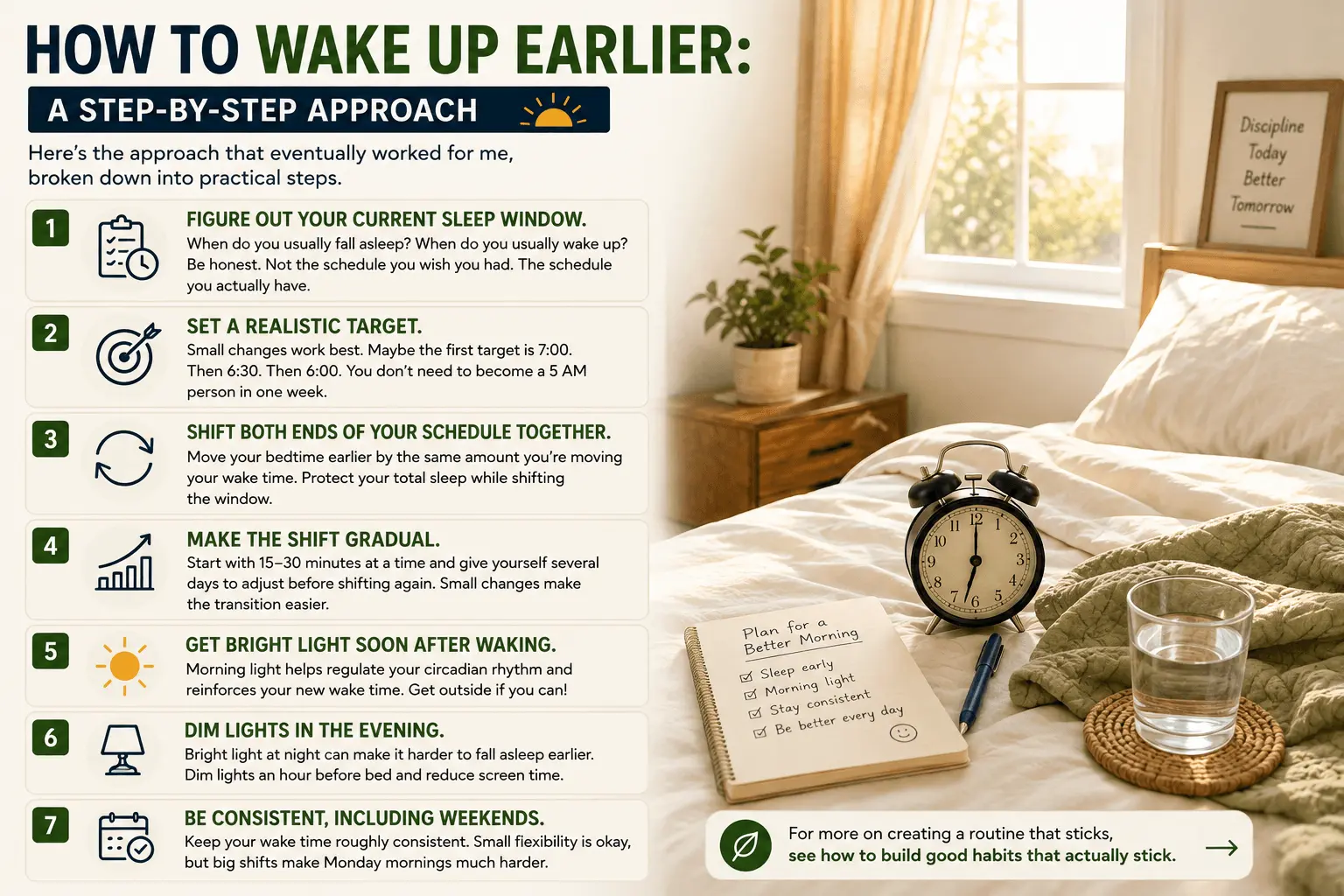
Here’s the approach that eventually worked for me, broken down into practical steps.
Step 1: Figure out your current sleep window. When do you usually fall asleep? When do you usually wake up? Be honest. Not the schedule you wish you had. The schedule you actually have.
Step 2: Set a realistic target. If you’re waking up at 7:30 and want to wake up at 5, that’s a big jump. Most people do better with smaller changes. Maybe the first target is 7:00. Then 6:30. Then 6:00. You don’t need to become a 5 AM person in one week.
Step 3: Shift both ends of your schedule together. Move your bedtime earlier by the same amount you’re moving your wake time. If you’re waking up 30 minutes earlier, go to bed 30 minutes earlier too. The goal is to protect your total sleep while shifting the window.
Step 4: Make the shift gradual. Start with small shifts, such as 15–30 minutes at a time, and give yourself several days to adjust before shifting again. Your circadian system doesn’t always adjust immediately to a new schedule, so smaller changes can make the transition easier.
Step 5: Get bright light soon after waking. Light is one of the strongest environmental signals that helps regulate your circadian rhythm. Getting outdoor daylight shortly after waking can help reinforce your new wake time. If it’s still dark outside, bright indoor lighting can provide a useful cue as well.
Step 6: Dim lights in the evening. The flip side of morning light is evening light. Bright light in the evening can signal daytime to your circadian system, which may make it harder to fall asleep earlier. Dim the lights an hour before bed. Reduce screen time if you can.
Step 7: Be consistent, including weekends. This is the hardest part for most people. Sleeping in on weekends shifts your rhythm back and makes Monday mornings feel brutal. Try to keep your wake time roughly consistent. A small amount of weekend flexibility may be easier to maintain than large shifts from your weekday schedule.
For more on creating a routine that sticks, see how to build good habits that actually stick.
How to Shift Your Sleep Schedule Gradually
The gradual approach works because it respects how your body actually functions.
Your circadian rhythm usually doesn’t adjust instantly to a major schedule change. It can shift over time in response to consistent cues such as light and sleep timing. Trying to force a three-hour shift in one night is like trying to change time zones instantly. You might manage it for a day or two, but the resulting sleep debt can catch up with you.
The approach I eventually settled on was making small shifts—about 15 minutes at a time—and giving myself a few days to adjust before shifting again. I’d go to bed 15 minutes earlier and set the alarm 15 minutes earlier. After a few days, that started to feel normal. Then another 15 minutes. The process took a few weeks, but the change actually stuck.
I bought a sunrise alarm clock during this period. It gradually brightens the room over 30 minutes before the alarm goes off. The first few mornings I used it, the light woke me up before the sound did. For me, the gradual light made waking feel less abrupt. Not dramatically earlier. Just less jarring. I stopped using it after a while, but it helped during the transition.
Understand Your Natural Sleep Preference
Not everyone is naturally wired for the same schedule. Some people naturally feel more alert early in the morning, while others tend to feel more awake later in the day.
If you’re naturally a night person, moving your wake time earlier may take more effort. That doesn’t mean you lack discipline. It means your starting point may be different.
Pay attention to when you naturally become sleepy and when you feel most alert. You may still be able to shift your schedule earlier, but forcing yourself into an extremely early routine may not be necessary.
The goal isn’t to wake up at the earliest possible time. It’s to find a sleep schedule that gives you enough sleep and works with your responsibilities.
Evening Habits That Make Early Mornings Easier
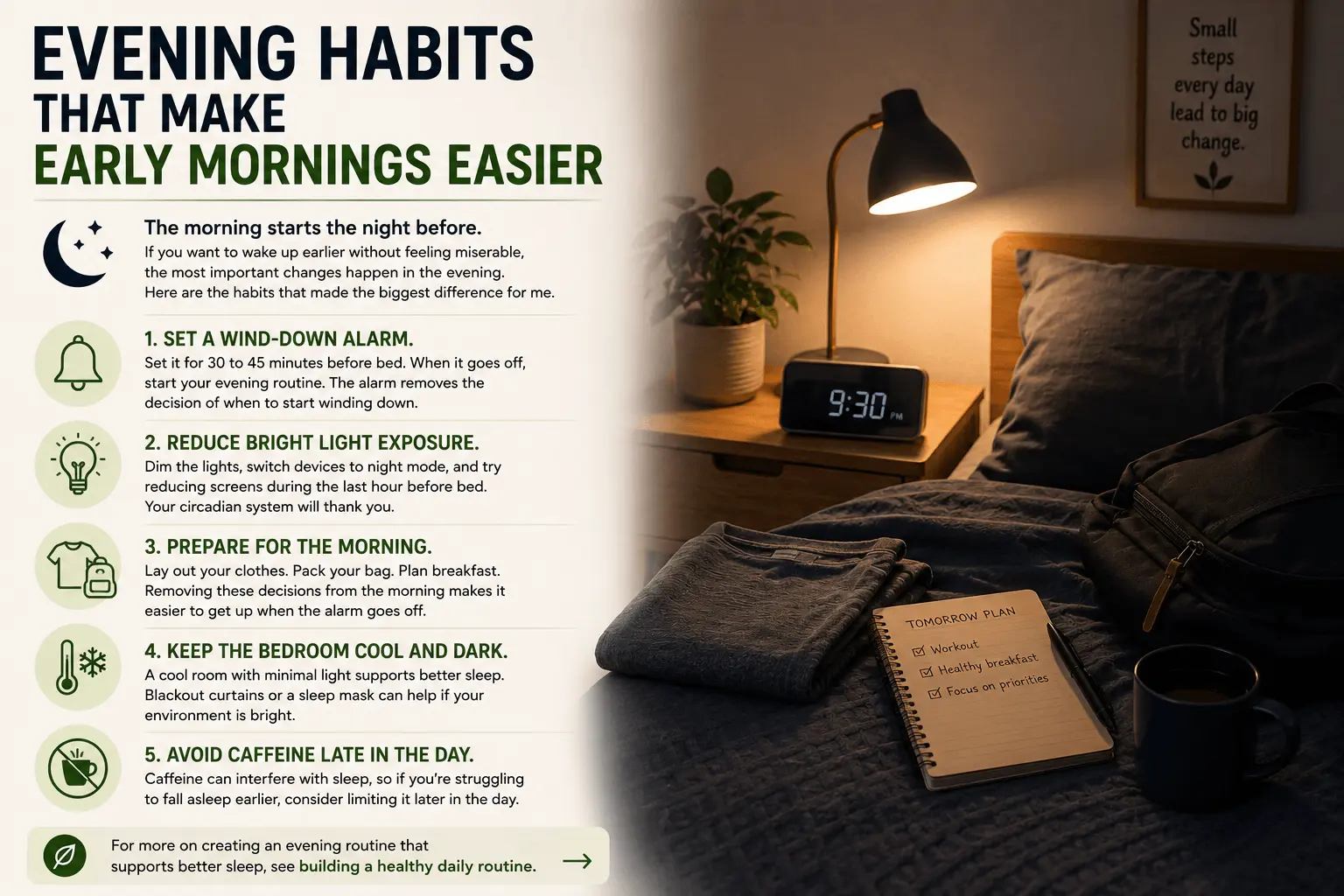
The morning starts the night before.
If you want to wake up earlier without feeling miserable, the most important changes happen in the evening. Here are the habits that made the biggest difference for me.
Set a wind-down alarm. Not a bedtime alarm. A wind-down alarm. Set it for 30 to 45 minutes before you want to be in bed. When it goes off, start your evening routine. Brush your teeth. Get changed. Dim the lights. The alarm removes the decision of when to start winding down.
Reduce bright light exposure. Bright light in the evening can signal daytime to your circadian system, which may make it harder to fall asleep earlier. Dim the lights. Switch devices to night mode. If screens seem to make it harder for you to wind down, try reducing them during the last hour before bed.
Prepare for the morning. Lay out your clothes. Pack your bag. Know what you’re eating for breakfast. Removing these decisions from the morning makes it easier to get up when the alarm goes off.
Keep the bedroom cool and dark. A cool room with minimal light supports better sleep. Blackout curtains or a sleep mask can help if your environment is bright.
Avoid caffeine late in the day. Caffeine can interfere with sleep, so if you’re struggling to fall asleep earlier, consider limiting it later in the day.
For more on creating an evening routine that supports better sleep, see building a healthy daily routine.
Morning Habits That Help You Feel More Energized
The way you start the morning affects how the rest of the day feels.
Get bright light soon after waking. Morning light is one of the most effective ways to help reinforce your circadian rhythm and support a consistent wake time. Step outside. Open the blinds. Turn on bright indoor lights if it’s still dark. Light tells your brain the day has started.
Drink some water if you’re thirsty. You’ve gone several hours without fluids. If you’re thirsty, drinking water is a simple way to address that need. If you enjoy coffee or tea in the morning, you don’t necessarily need to avoid it; just be mindful of how late-day caffeine affects your sleep.
Move your body for a few minutes. Not a workout. Just movement. Stretching. A short walk. A few pushups. Something that gets your body moving and makes the transition into the day feel easier.
Delay your phone for the first part of the morning. Checking messages and social media first thing fragments your attention before the day has even started. Give yourself a little phone-free time before the input begins.
For more on this, see how to build a morning routine for energy.
Common Mistakes When Trying to Wake Up Earlier
I’ve made all of these.
Changing too much too fast. Trying to jump from 7:30 to 5 AM in one day. It doesn’t work for most people. The shift needs to be gradual.
Not adjusting bedtime. This is the biggest one. Waking up earlier without going to bed earlier just means less sleep. Less sleep means exhaustion. Exhaustion means the new schedule collapses.
Sleeping in on weekends. It’s tempting. But big weekend sleep-ins shift your rhythm and make Monday mornings harder. Keep the variation small.
Relying on caffeine to compensate. Caffeine can help with alertness, but it’s not a substitute for sleep. If you’re using it to push through sleep deprivation, the underlying problem remains.
Hitting snooze repeatedly. If repeated snoozing leaves you feeling more groggy, experiment with using one alarm and getting up when it goes off.
Expecting to feel great immediately. An earlier schedule may feel uncomfortable at first, especially after a large change. Give your body time to adjust.
For more on the mindset that makes this process easier, see why consistency matters more than motivation.
How to Wake Up Earlier Without Feeling Tired
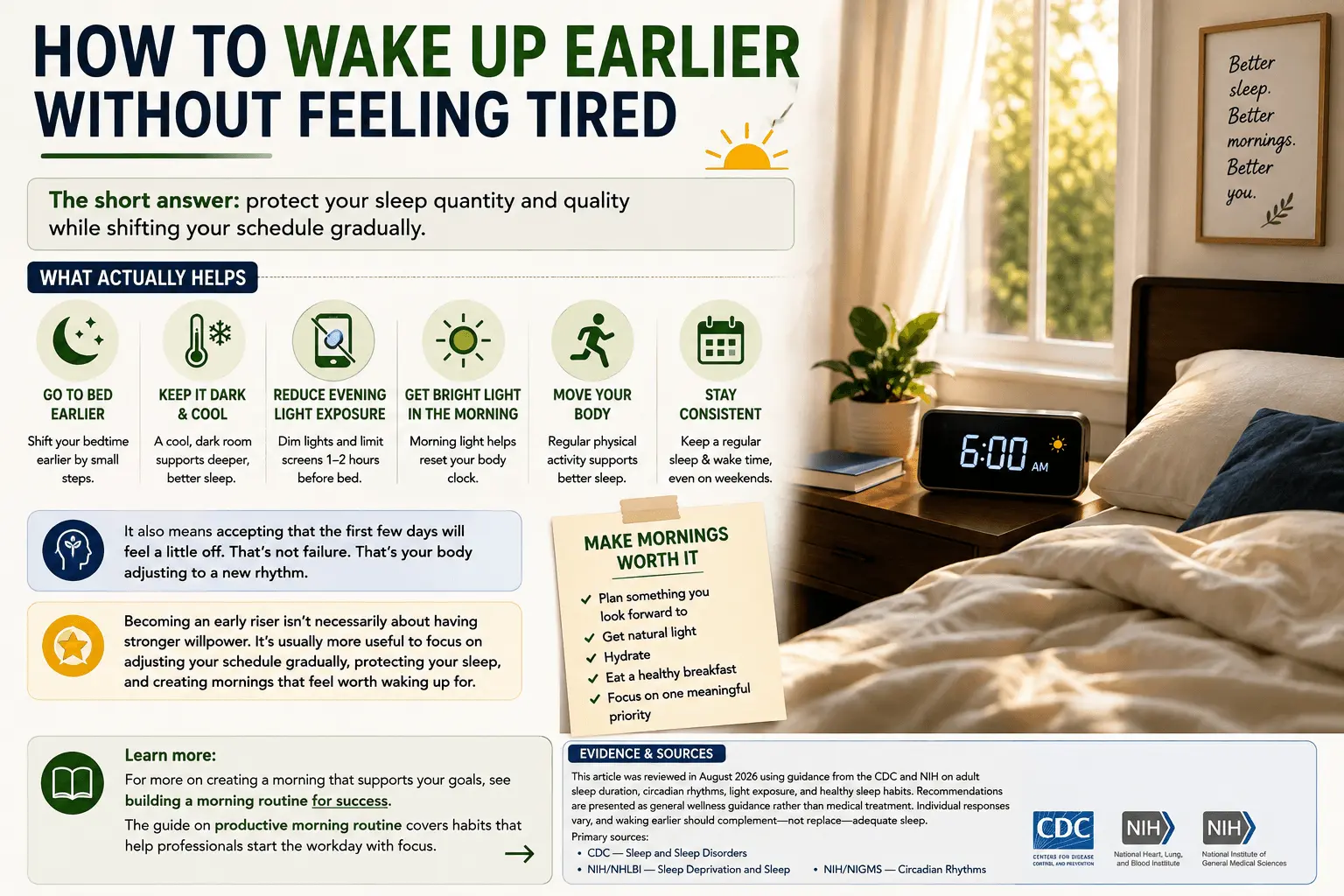
The short answer: protect your sleep quantity and quality while shifting your schedule gradually.
That means going to bed earlier. Keeping your sleep environment dark and cool. Reducing evening light exposure. Getting bright light in the morning. Moving your body. Staying consistent.
It also means accepting that the first few days will feel a little off. That’s not failure. That’s your body adjusting to a new rhythm.
Becoming an early riser isn’t necessarily about having stronger willpower. It’s usually more useful to focus on adjusting your schedule gradually, protecting your sleep, and creating mornings that feel worth waking up for.
For more on creating a morning that supports your goals, see building a morning routine for success. The guide on productive morning routine covers habits that help professionals start the workday with focus.
Evidence & Sources: This article was reviewed in August 2026 using guidance from the Centers for Disease Control and Prevention (CDC) and the National Institutes of Health (NIH) on adult sleep duration, circadian rhythms, light exposure, and healthy sleep habits. Recommendations are presented as general wellness guidance rather than medical treatment. Individual responses vary, and waking earlier should complement—not replace—adequate sleep.
Primary sources:
- CDC — Sleep and Sleep Disorders
- NIH/NHLBI — Sleep Deprivation and Sleep
- NIH/NIGMS — Circadian Rhythms
Frequently Asked Questions
How long does it take to adjust to waking up earlier?
It varies depending on how much you’re shifting your schedule and how consistently you maintain the new timing. Smaller changes may feel easier to adapt to than a major overnight change. Give yourself several days between adjustments and focus on consistency rather than speed.
Is it better to wake up earlier gradually or all at once?
Gradually is often easier to sustain. A large, sudden change can be difficult to adjust to, particularly if it reduces your total sleep. Smaller shifts allow you to protect your sleep while moving your schedule earlier.
What if I can’t fall asleep earlier?
Look at your evening habits. Bright light exposure, late caffeine, and screen time before bed all make it harder to fall asleep. Try dimming lights an hour before bed, limiting caffeine later in the day, and creating a wind-down routine. If you consistently can’t fall asleep despite good habits, consider talking with a healthcare professional.
Can I wake up at 5 AM if I’m naturally a night person?
Maybe, but it depends on your circumstances and your biology. Some people have a naturally later chronotype and will always find early mornings difficult. The quality of your routine depends on what you do with your mornings, not on what time they start. If early waking consistently makes you feel worse, it might not be the right goal for you.
Should I use an alarm clock or wake up naturally?
For most people, an alarm is necessary during the transition. The goal is to eventually wake up around the same time naturally because your sleep schedule supports it. If you need the alarm, use it. Just avoid repeated snoozing.
What if I miss a day and sleep in?
Don’t panic. One late morning doesn’t erase the progress you’ve made. Get back to your usual schedule the next day. The pattern matters more than any individual day.
Final Thoughts
Learning how to wake up earlier isn’t about forcing yourself out of bed exhausted. It’s about shifting your sleep schedule gradually, protecting your sleep quality, and creating mornings that feel worth getting up for.
Go to bed earlier. Dim the lights in the evening. Get bright light in the morning. Move your body. Delay your phone. Keep your schedule consistent.
Start with a small shift. Fifteen minutes. Adjust your bedtime to match. Do that for a few days. Then another fifteen minutes. Give your body time to adjust instead of trying to force the change overnight.
The goal isn’t to become a 5 AM person. It’s to create a schedule that supports how you want to live. That’s enough.