

I used to think a healthy daily routine required hours.
Wake up early. Exercise for an hour. Meditate. Journal. Make a nutritious breakfast. Read something educational. The whole thing felt like a part-time job I hadn’t applied for. I’d manage it for a few days, maybe a week, and then life would intervene. An early meeting. A bad night of sleep. A kid who needed something. The routine would collapse and I’d feel like I’d failed.
What eventually worked was shrinking everything down to ten minutes.
Not an impressive morning. Not an optimized morning. Just ten minutes of simple, repeatable actions that made me feel slightly better than if I’d done nothing at all. Water. A few minutes of movement. One sentence written down. That was pretty much it.
A healthy daily routine isn’t about how much you do. It’s about doing something consistently enough that it becomes part of who you are. Ten minutes is enough. Ten minutes that actually happens is infinitely better than two hours that never does.
A healthy daily routine is a short series of intentional habits performed consistently each morning that support your physical and mental well-being. It doesn’t require hours. Ten minutes of the right small actions, done most days, is enough to build momentum that carries through the rest of your day.
One thing worth mentioning upfront: a morning routine, no matter how well-designed, can’t compensate for chronic sleep deprivation. Most adults need between seven and nine hours of sleep. Current sleep research continues to emphasize that consistent sleep and wake times generally matter more than waking up at an arbitrary early hour. The routine supports your day. Sleep is the foundation it rests on.
What a Healthy Daily Routine Actually Means
A healthy daily routine isn’t a specific set of activities. It’s a specific outcome.
The outcome is starting your day with something that supports your physical or mental well-being. That could be almost anything. Drinking water when you wake up. Moving your body for a few minutes. Stepping outside. Writing something down. Taking a few deep breaths.
What makes a routine healthy isn’t the activity itself. It’s the direction it moves you over time. A routine that improves your energy, mood, or capacity to handle stress is a healthy routine. A routine that depletes those things, even if it looks productive on paper, is not.
From what I’ve noticed, the healthiest routines are the ones you barely notice. They don’t feel like discipline. They just feel like what you do in the morning. The guide on building healthy daily habits covers how these everyday habits compound into meaningful change over months and years.
A healthy daily routine also doesn’t need to happen at dawn. Shift workers, parents of young children, people with chronic illness, all of these folks might have mornings that look completely different. The principle is the same. Start the day with one small thing that supports your well-being. The clock doesn’t care what time it is.
Why Most Morning Routines Are Too Long
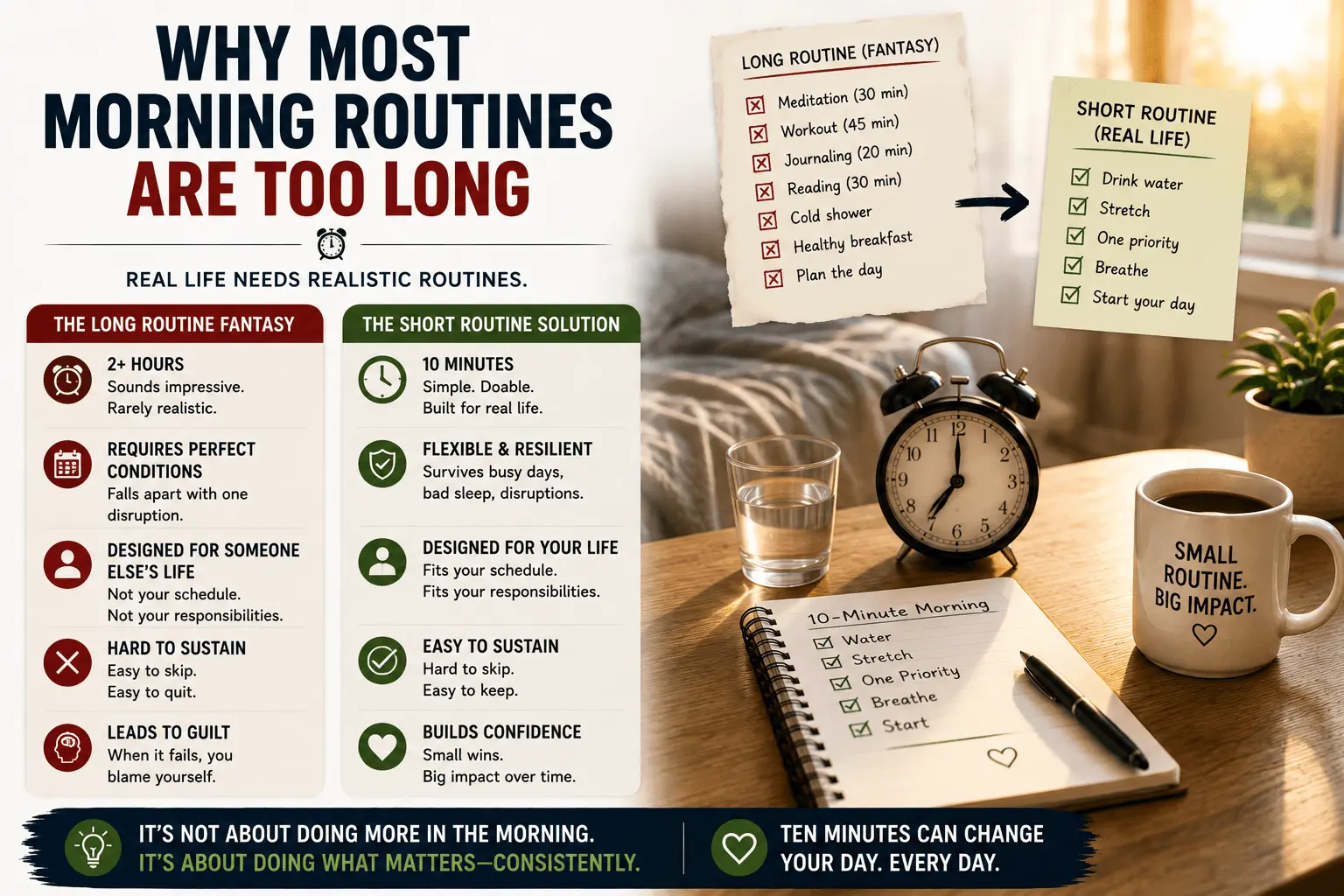
Most morning routine advice comes from people with unusual control over their schedules.
Entrepreneurs. Authors. Content creators. People who don’t have to clock in at a specific time or get kids ready for school or commute an hour each way. Their routines sound impressive because their lives allow for impressive routines.
For everyone else, a two-hour morning routine is a fantasy. And when people try to follow that kind of advice and inevitably fail, they blame themselves. I’m not disciplined enough. I don’t want it enough. The problem isn’t motivation. The problem is that the routine was designed for someone else’s life.
The guide on why habit building fails covers this pattern in detail. Most habits don’t fail because people are lazy. They fail because the habits are too big and too rigid to survive real life.
A short routine solves this problem by being realistic. Ten minutes is short enough to survive early meetings, disrupted sleep, and mornings when everything goes wrong. You might skip a two-hour routine when you’re tired. You can almost always manage ten minutes.
What surprised me was how much those ten minutes actually mattered. I expected a short routine to feel insignificant. Instead, it became the most consistent part of my day. Not because it was impressive. Because it was doable.
The 10-Minute Morning Plan
Here’s the actual plan. Ten minutes. Five steps. Each step takes about two minutes.
Step 1: Drink a glass of water (1 minute). You’re dehydrated after sleeping. Water takes thirty seconds and makes a noticeable difference in how you feel. Keep a glass or bottle on your nightstand so it’s the first thing you see.
Step 2: Move your body (3 minutes). Not a workout. Just movement. Stretching. A short walk around the block. A few pushups. Dancing in the kitchen while the coffee brews. Something that tells your body the day has started.
Step 3: Step outside or open a window (1 minute). Natural light helps regulate your circadian rhythm. Fresh air on your face signals wakefulness. If you can step outside, do that. If you can’t, open a window and breathe for sixty seconds.
Step 4: Write down one thing (2 minutes). Not a full to-do list. Not a journal entry. Just one thing. A priority for the day. A thought you want to remember. Something you’re looking forward to. The act of writing something down before the day’s chaos begins creates a small anchor of intention.
Step 5: Avoid your phone until the routine is done (the whole 10 minutes). This isn’t a separate step so much as a rule for the other four. Don’t check messages or social media until you’ve finished the routine. Charge your phone in another room if you need to. Those ten minutes of undivided attention are yours.
That’s the whole plan. It works because it’s small. It works because it’s flexible. It works because you can do it even when you’re tired, rushed, or traveling.
The guide on building a morning routine for success has more examples of routines that survive real life.
Why Short Routines Work Better Than Long Ones
Short routines have several advantages that long routines don’t.
They survive disruption. A ten-minute routine can happen almost anywhere, on almost any schedule. Travel. Illness. Busy periods at work. The routine bends without breaking.
They require less motivation. A two-hour routine needs you to feel driven. A ten-minute routine just needs you to show up. On days when motivation is absent, which is most days, the shorter routine still gets done.
They build momentum faster. Completing a short routine gives you a quick win. That win makes the next positive choice slightly easier. Long routines often feel like a hurdle you have to clear before the day can start. Short routines feel like a small gift you give yourself.
They’re easier to be consistent with. Consistency matters more than intensity. The guide on why consistency matters more than motivation explains why showing up regularly beats showing up perfectly. A ten-minute routine that happens every day produces more results over a year than a two-hour routine that happens twice a week.
I abandoned my phone habit, or tried to, for years. What finally worked was leaving it in another room during the first ten minutes of the day. The phone was still there. I could check it whenever I wanted. But the friction of getting up to get it was usually enough to stop me.
How to Customize Your 10-Minute Routine
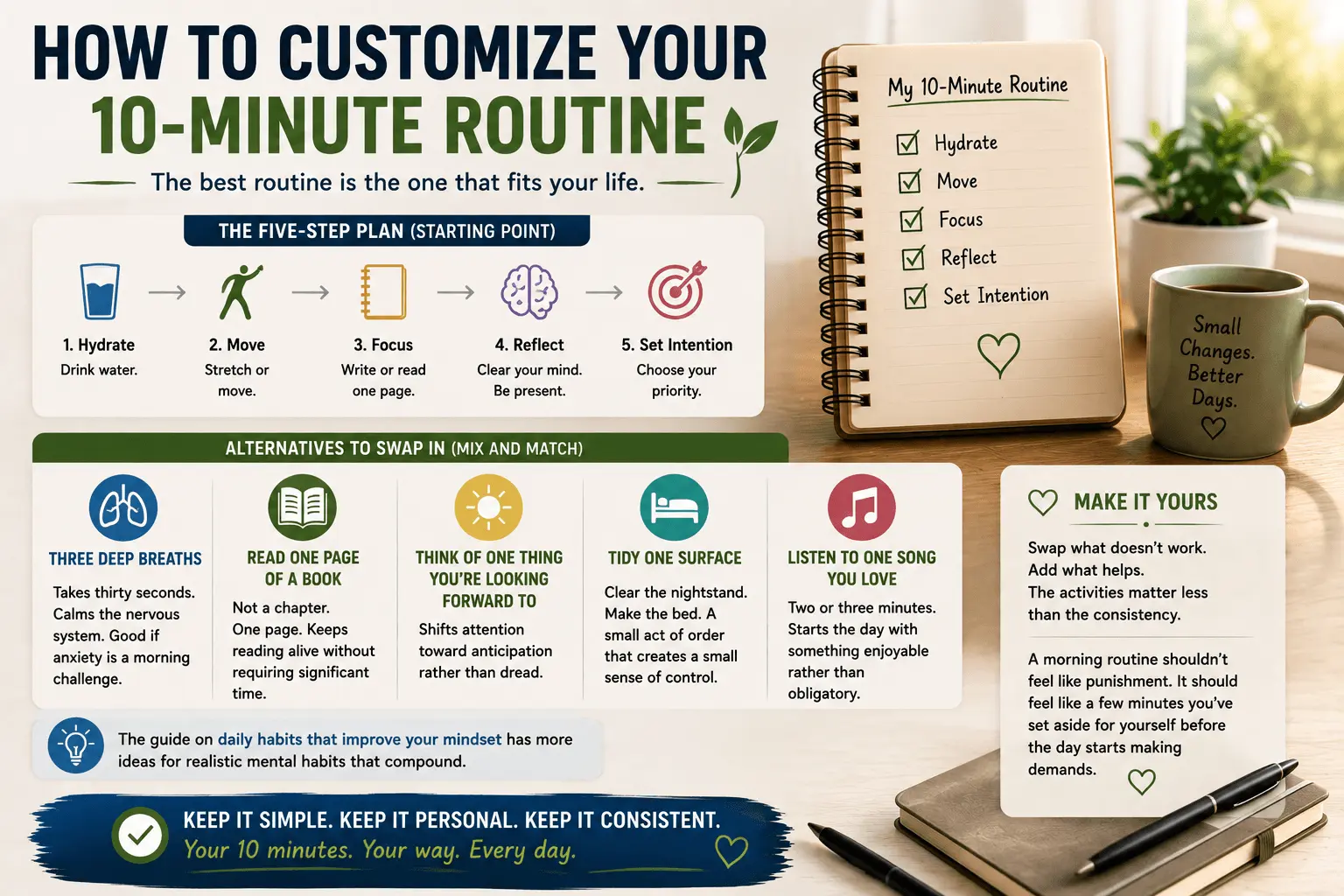
The five-step plan is a starting point. The best routine is the one that fits your life.
If you already drink water first thing, swap that step for something else. If stretching does nothing for you, replace it with something that does. If writing feels like a chore, skip it. The activities matter less than the consistency.
Here are some alternatives you can swap in.
- Three deep breaths. Takes thirty seconds. Calms the nervous system. Good if anxiety is a morning challenge.
- Read one page of a book. Not a chapter. One page. Keeps reading alive without requiring significant time.
- Think of one thing you’re looking forward to. Shifts attention toward anticipation rather than dread.
- Tidy one surface. Clear the nightstand. Make the bed. A small act of order that creates a small sense of control.
- Listen to one song you love. Two or three minutes. Starts the day with something enjoyable rather than obligatory.
The guide on daily habits that improve your mindset has more ideas for realistic mental habits that compound.
The important part is picking things you actually want to do. A morning routine shouldn’t feel like punishment. It should feel like a few minutes you’ve set aside for yourself before the day starts making demands.
Habit Stacking for a Faster Morning
Habit stacking makes a short routine even easier to maintain.
The idea is to attach each new habit to something you already do automatically. Instead of trying to remember to stretch at some point in the morning, you stretch while the coffee brews. The existing habit becomes the trigger for the new one.
The guide on what is habit stacking explains the method in detail. The short version is that stacking removes the need to remember. The coffee maker triggers the stretching. The stretching triggers the deep breath. The sequence runs on its own.
A stacked version of the 10-minute plan might look like this:
- Wake Up
- Drink Water (while coffee brews)
- Stretch for 3 Minutes (while coffee cools)
- Step Outside for 1 Minute (after pouring coffee)
- Write One Sentence (while drinking coffee)
Each habit triggers the next. The coffee maker anchors the entire chain. You’re not trying to remember four different things. You’re just following the sequence.
The guide on what habits are and how they work explains the cue-routine-reward loop that makes stacking effective. The existing habit provides the cue. The new habit becomes the routine. The satisfaction of completing the chain is the reward.
Common Mistakes When Starting a Morning Routine
I’ve made all of these.
Starting too big. Enthusiasm makes a one-hour routine feel possible. By day four, it feels like a burden. Start with ten minutes. You can always expand later. You can’t expand something you’ve already abandoned.
Trying to be perfect. Missing a day doesn’t mean the routine is dead. It means you missed a day. Come back tomorrow. The pattern matters more than any individual day.
Not adapting the routine to your life. A morning routine that works for a single person with no kids might not work for a parent of three. Build a routine that fits your actual mornings, not someone else’s.
Focusing on what you should do instead of what you want to do. If you hate meditating, don’t meditate. If you love walking, walk. The best habits are the ones you’ll actually do.
Waiting for the right time to start. There’s never a right time. Next week won’t be less busy. Start tomorrow with one thing. Water. Stretching. One sentence. Adjust as you go.
The guide on how to build good habits covers practical strategies for starting small and scaling up over time.
How to Keep Your Routine Going When Life Gets Busy
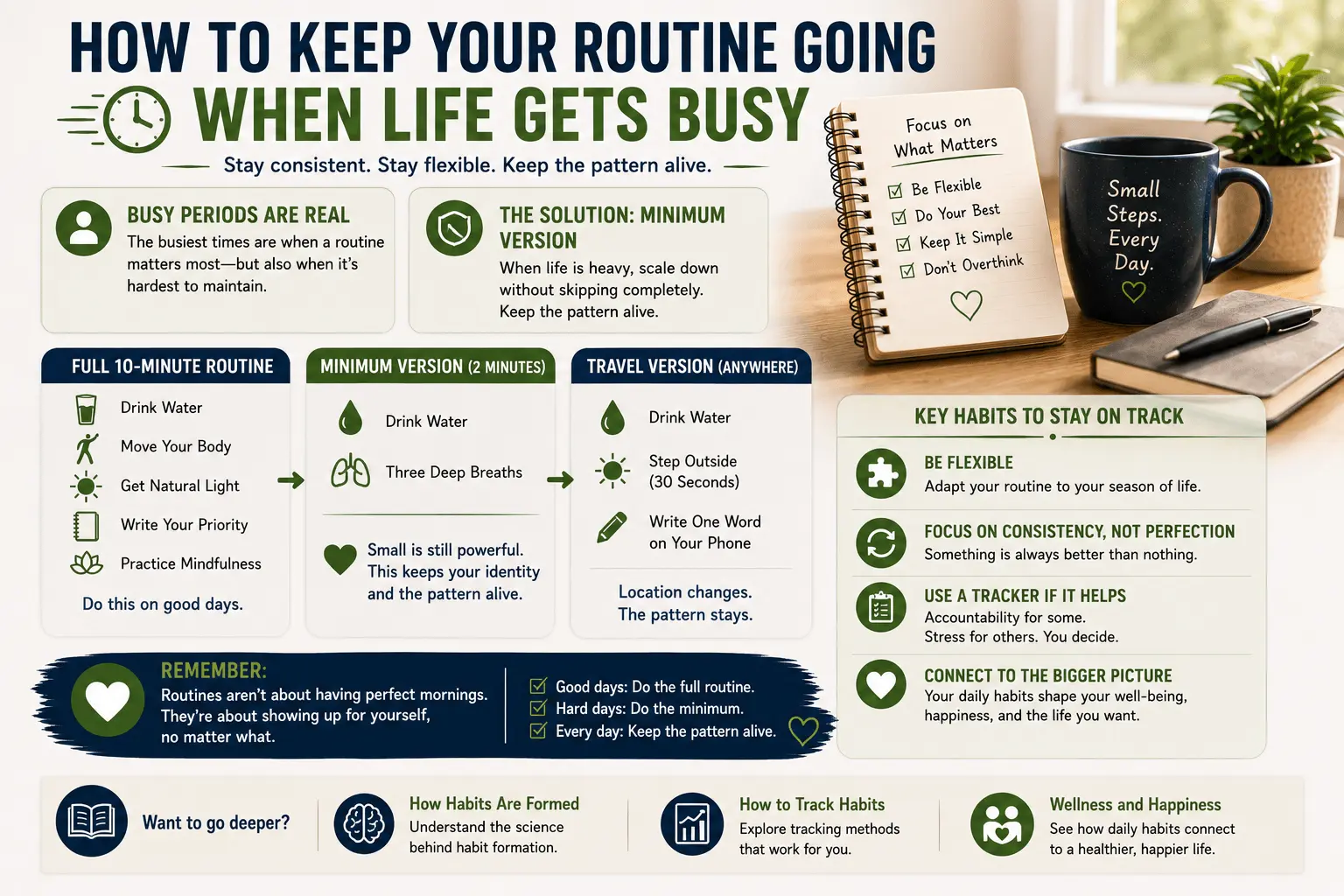
The busiest periods are when a morning routine matters most. They’re also when it’s hardest to maintain.
I’ve had weeks where work consumed everything. The full ten-minute routine wasn’t happening. What saved me was having a minimum version. Water and three deep breaths. That’s it. Two minutes total. Enough to preserve the pattern without requiring energy I didn’t have.
The minimum version is the secret to long-term consistency. On good days, do the full routine. On hard days, do the minimum. Both versions preserve the identity of someone who has a morning routine. Both versions keep the pattern alive.
Travel disrupts routines too. Different time zone. Different space. Different cues. My travel version of the routine is even simpler. Water. Step outside for thirty seconds. Write one word on my phone. The location changes but the pattern stays intact.
The guide on how habits are formed explains why context stability matters. Habits are tied to cues in your environment. When the environment changes, the cues weaken. Having a portable minimum version helps bridge the gap until you’re back in your usual space.
The guide on how to track habits covers whether tracking helps during busy periods. For some people, a simple tracker provides accountability. For others, it creates additional stress. Use tracking if it helps. Skip it if it doesn’t.
Building a healthy routine is part of a larger picture. The guide on wellness and happiness explores how daily habits connect to broader well-being.
Frequently Asked Questions
What is the best healthy daily routine for beginners?
A short routine with three to five simple steps. Drink water. Move for a few minutes. Step outside or open a window. Write down one thing. Avoid your phone until the routine is done. The whole thing takes about ten minutes. Start there. Adjust based on what works.
Can a 10-minute morning routine actually make a difference?
Yes, if you do it consistently. Ten minutes of daily movement, hydration, and intention adds up to more than sixty hours of intentional morning time over a year. A two-hour routine that happens twice a week adds up to less. Consistency beats intensity over the long run.
How do I stick to a morning routine when I’m always rushed?
Have a minimum version that takes two minutes or less. Water and three deep breaths. Stretching for sixty seconds. One sentence written on your phone. The minimum version preserves the pattern when time is tight. You can always do the full version on less rushed days.
Do I need to follow the same routine every day?
No. Flexibility is more sustainable than rigidity. Have a full version for good days and a minimum version for hard days. The key is that both versions include at least one intentional habit that starts the day with purpose.
What if I’m not a morning person?
You don’t need to wake up early to have a morning routine. The routine starts whenever you wake up, whatever time that is. The principle is the same. Start the day with one small thing that supports your well-being. The clock doesn’t matter.
How long does it take for a morning routine to become automatic?
Research suggests an average of about 66 days, but the range is wide. Simple routines form faster. Complex ones take longer. Rather than counting days, pay attention to whether the routine feels natural. When you do it without having to talk yourself into it, it’s probably automatic.
Final Thoughts
A healthy daily routine doesn’t require hours. It requires ten minutes and the willingness to show up most days.
Pick a few small things. Water. Movement. Fresh air. One sentence. String them together in whatever order feels natural. Do them tomorrow. Then do them again. Let the routine bend when life gets messy. Come back to it when you can.
The goal isn’t a perfect morning. It’s a morning where you did something for yourself before the world started asking for things. Ten minutes is enough. Ten minutes that actually happens is everything.