

For years I thought the problem was motivation. If I could just get motivated enough, I’d finally make progress. So I waited for motivation. Read books about motivation. Tried to manufacture motivation through morning routines and goal-setting frameworks and accountability partners.
None of it stuck.
What I eventually realized is that motivation wasn’t the problem. The problem was the thinking patterns running underneath everything I was doing or not doing. The beliefs I’d never examined. The mental habits I’d mistaken for personality traits. The mindset mistakes that were quietly shaping my decisions without ever announcing themselves.
Research suggests that most people regularly experience cognitive distortions such as catastrophizing, perfectionism, or negative self-talk. Left unchecked, these thinking patterns contribute to stress, procrastination, and lower life satisfaction.
These mistakes aren’t always obvious. They don’t feel like mistakes when you’re making them. They feel like being realistic. Being careful. Being prepared. But they’re not any of those things. They’re patterns that protect you from short-term discomfort at the cost of long-term growth.
What Are Mindset Mistakes?
Mindset mistakes are recurring patterns of thinking such as perfectionism, fear of failure, and negative self-talk that lead to poor decisions, avoidance, and self-sabotage. They are learned mental habits that can be changed through awareness and consistent practice.
Mindset Mistakes at a Glance
If you remember one thing: Most mindset mistakes aren’t character flaws. They’re learned patterns and like any learned pattern, they can be unlearned and replaced.
Most common mistake: Waiting until you feel ready before taking action.
Time to notice improvement: 4–8 weeks of consistent practice.
Difficulty: Moderate. The work is simple but requires consistent effort.
You May Be Making Mindset Mistakes If…
- You overthink every decision
- You wait until you feel confident before starting
- You compare yourself constantly to others
- You avoid difficult conversations
- You fear making mistakes more than you want growth
- You feel stuck despite wanting to move forward
- Your internal dialogue is harsher than how you’d speak to a friend
Start Today
Choose ONE mistake to address:
- Catch one negative thought and reframe it
- Take one small action before you feel ready
- Identify one limiting belief and question it
- Practice self-compassion after one mistake
- Say no to one thing that doesn’t align with your priorities
Time Required: 5–10 minutes
Difficulty: Easy to Moderate
Expected Results: 2–8 weeks of consistent practice
Why do intelligent, hardworking people stay stuck for years while others keep growing?
Often, the difference isn’t intelligence, talent, or luck.
It’s invisible thinking patterns quietly shaping every decision they make.
Before exploring these common mistakes, it’s helpful to understand what mindset really is and how it shapes your decisions.
Why Mindset Mistakes Feel Worse in 2026
Some thinking traps have always been part of being human. But the current environment amplifies them in ways previous generations didn’t experience.
Social media comparison has become more intense. Algorithms surface everyone else’s highlights promotions, vacations, achievements while your own struggles remain invisible. The gap between your behind-the-scenes and everyone else’s highlight reel has never been wider. According to the American Psychological Association’s 2025 Stress in America report, social media comparison continues to be a significant source of stress, particularly among adults under 35.
Information overload fragments attention. The average person now encounters more information in a day than someone in the 15th century encountered in a lifetime. Constant notifications, endless content, and the pressure to stay informed create a mental environment where overthinking and catastrophizing thrive.
AI and career uncertainty have introduced new forms of anxiety. As artificial intelligence reshapes industries, the fear of being left behind of skills becoming obsolete, of entire career paths disappearing fuels perfectionism, comparison, and the feeling that you should be doing more, faster.
Perfection culture has intensified. According to a 2024 meta-analysis published in Clinical Psychology Review, perfectionism has increased significantly over recent decades, particularly among young adults. The same review linked socially prescribed perfectionism feeling that others demand perfection from you to higher rates of burnout, anxiety, and depression. Approximately 30% of young adults now report maladaptive perfectionistic tendencies.
The blurring of work and life through remote and hybrid arrangements means there’s no natural off switch. The mental patterns that affect your work follow you home. The ones that affect your home life show up in your work. There’s less separation and more opportunity for mindset mistakes to compound.
None of this means the situation is hopeless. It means understanding these patterns is more important than it used to be. The environment amplifies self-defeating thinking. Awareness of that amplification is the first step to turning down the volume.
Why Mindset Mistakes Keep People Stuck
Mindset mistakes don’t just affect how you feel. They affect what you do and what you don’t do.
The mechanism is a self-reinforcing loop. A psychological barrier produces a thought (“I’m not ready yet”). The thought produces avoidance (not applying, not starting, not speaking up). The avoidance prevents you from getting evidence that would disprove the original thought. The lack of evidence strengthens the block. The cycle continues.
This is why these patterns can persist for years. They’re not maintained by reality. They’re maintained by the avoidance that prevents reality from getting in.
The brain also plays a role. Familiar patterns, even when they’re unhelpful, require less energy than new ones. The brain defaults to what it knows. Changing a thinking trap means building new neural pathways while the old ones gradually weaken. This takes time and repetition which is why insight alone rarely produces lasting change.
Understanding this mechanism is the first step to interrupting it. The cycle only continues as long as the avoidance does. When you start taking small actions that challenge the old belief, you start generating new evidence. The new evidence weakens the old pattern. Over time, the new pattern becomes the default.
Here are fifteen of the most common ones how to recognize them, why they hold you back, what the research says, and what to do instead.
15 Mindset Mistakes That Hold People Back
1. Waiting Until You Feel Ready
Why people make it: The logic seems sound. Don’t start until you’re prepared. Don’t apply until you’re qualified. Don’t speak until you’re confident. The problem is that the feeling of readiness rarely arrives before the action. It usually arrives after.
Psychological explanation: Confidence doesn’t precede action. It follows it. Albert Bandura’s research on self-efficacy demonstrated that the belief in your ability to succeed grows primarily through mastery experiences actually doing the thing not through waiting to feel confident. This is one of the most common mental blocks because it masquerades as prudence.
Real-life example: Someone who wants to start a business spends years researching, planning, and waiting for the “right time.” Meanwhile, someone with less preparation launches, learns from mistakes, and adjusts. Five years later, the second person has a business. The first person is still preparing.
Research Insight
Bandura’s work on self-efficacy (1997, Self-Efficacy: The Exercise of Control) showed that mastery experiences are the most effective way to build belief in your capabilities. You don’t become confident and then act. You act and then become confident.
How to fix it: Start before you feel ready. Take one small action today that you’d normally postpone until you felt more prepared. The readiness will build as you go. Want to understand why action builds confidence? Read our guide on Fixed Mindset vs Growth Mindset.
Action step: Identify one thing you’ve been waiting to feel ready for. Do the smallest possible version of it within the next 24 hours.
2. Believing Talent Matters More Than Effort
Why people make it: We see successful people and assume they were born with something we don’t have. The narrative of innate talent is more compelling than the narrative of years of invisible practice. It also lets us off the hook if success requires talent we don’t possess, we don’t have to try.
Psychological explanation: Carol Dweck’s research on fixed vs. growth mindsets demonstrated that people who believe abilities are fixed avoid challenges, give up more easily, and achieve less over time than those who believe abilities can be developed. The belief becomes self-fulfilling.
Expert Insight: Carol Dweck
“The beliefs you hold about your abilities have a profound effect on what you achieve.”
Research Insight
Angela Duckworth’s research on grit, published in the Journal of Personality and Social Psychology, found that sustained effort and interest over time predicted achievement better than IQ or talent across multiple domains including spelling bees, military training, and sales performance.
Real-life example: Two people start learning a language. One believes language ability is innate and quits after struggling with grammar. The other believes effort produces improvement and persists through the difficult early months. A year later, the second person is conversational. The first person still says “I’m just not good at languages.”
How to fix it: When you notice yourself attributing success to talent, ask “What am I not seeing?” Behind most visible achievement is invisible work. Focus on what you can control your effort, your strategy, your consistency.
Action step: Pick one skill you’ve written off as something you’re “just not good at.” Spend 15 minutes practicing it today. Pay attention to the experience of being a beginner without judging it.
3. Catastrophizing—Assuming the Worst Will Happen
Why people make it: The brain is wired to detect threats. For most of human history, overestimating danger was safer than underestimating it. The cost of a false positive (running from a stick that looked like a snake) was lower than the cost of a false negative (ignoring an actual snake).
Psychological explanation: Catastrophizing is a cognitive distortion where a small negative event spirals into a worst-case scenario. Aaron Beck identified this pattern as central to anxiety. The brain treats imagined catastrophes similarly to real ones, activating the stress response even when no actual threat exists.
Real-life example: Someone makes a minor mistake at work. By the end of the day, they’ve convinced themselves they’ll be fired. By the end of the week, they’re certain their career is over. The actual outcome: their manager barely noticed the mistake.
How to fix it: When you notice yourself catastrophizing, ask two questions: “What’s the most likely outcome?” and “If the worst did happen, could I handle it?” The first question brings you back to reality. The second reminds you that even worst-case scenarios are usually survivable.
Action step: Next time you catch yourself in a catastrophic spiral, write down the worst-case scenario, the best-case scenario, and the most likely scenario. Compare them.
4. Perfectionism Disguised as High Standards
Why people make it: Perfectionism is socially rewarded. “I have high standards” sounds admirable. But perfectionism isn’t about quality it’s about fear. Fear of criticism, fear of failure, fear of being seen as inadequate.
Psychological explanation: Research distinguishes between adaptive perfectionism (setting high standards while accepting imperfection) and maladaptive perfectionism (setting impossibly high standards and being devastated by any shortfall). Maladaptive perfectionism is associated with anxiety, depression, and procrastination.
Research Insight
A 2024 meta-analysis published in Clinical Psychology Review found that perfectionism has increased significantly over the past three decades, particularly among young adults. The same review linked perfectionism to higher rates of burnout, anxiety, and depression. Approximately 30% of young adults now report maladaptive perfectionistic tendencies.
Real-life example: A writer spends months editing the first chapter of their book. It never feels ready. Meanwhile, another writer finishes a rough draft, gets feedback, and improves through revision. The first writer has a perfect chapter. The second has a completed manuscript.
How to fix it: Set a “good enough” standard before you start. Define what completion looks like. Ship when you reach it. You can always improve later. Done is better than perfect because done exists in the world and perfect doesn’t. If perfectionism keeps holding you back, read How to Change Your Mindset.
Action step: Identify one project you’ve been over-polishing. Set a deadline for completion not perfection and ship it.
5. Defining Yourself by Your Failures
Why people make it: When something goes wrong, it’s easy to internalize it. “I failed” becomes “I’m a failure.” The leap from outcome to identity happens automatically.
Psychological explanation: This is labeling a cognitive distortion where you attach a global negative label to yourself based on a specific event. Instead of describing behavior (“I made a mistake”), you describe identity (“I’m incompetent”). The label then shapes future behavior, creating the very outcomes you fear.
Real-life example: An entrepreneur’s first business fails. They conclude they’re “not cut out for business” and return to a job they don’t enjoy. Another entrepreneur fails, analyzes what went wrong, and starts a second venture with better information. The first person defined themselves by the failure. The second treated it as data.
How to fix it: Describe failures in specific, behavioral terms. “This approach didn’t work” instead of “I’m not capable.” Separate the outcome from the self.
Action step: Think of a recent failure. Write down what happened in purely factual terms no interpretations, no identity claims. Then write down what you learned.
6. Comparing Your Behind-the-Scenes to Everyone Else’s Highlight Reel
Why people make it: You have access to your full experience the doubts, the struggles, the failed attempts. You only see other people’s results. The comparison is never fair, but it feels fair in the moment.
Psychological explanation: Social comparison theory, developed by Leon Festinger, suggests that people naturally evaluate themselves relative to others. Upward comparison (comparing to those doing better) can inspire or discourage depending on mindset. The problem isn’t comparison itself. It’s comparing your complete picture to someone else’s curated one.
Real-life example: Someone scrolls through social media, sees peers getting promoted, publishing books, and hitting milestones. They feel behind, not realizing one peer’s promotion came after three rejected applications, another’s book required five years of invisible work, and a third is struggling privately despite the public success.
How to fix it: Compare yourself to your past self. Are you growing? Are you learning? Are you slightly better than you were six months ago? That’s the comparison that matters.
Action step: Instead of checking social media, spend five minutes writing down three ways you’ve improved over the past year.
7. All-or-Nothing Thinking
Why people make it: Black-and-white categories feel simpler. Something is either a success or a failure. You’re either talented or you’re not. The gray areas require more mental energy to navigate.
Psychological explanation: All-or-nothing thinking, also called dichotomous thinking, is a cognitive distortion where situations are viewed in only two categories rather than on a continuum. It eliminates the vast middle ground where most real progress happens.
Real-life example: Someone starts a workout routine. On day four, they miss a session. Instead of continuing, they conclude “I’ve already failed” and abandon the entire plan. The all-or-nothing frame turned one missed workout into complete defeat.
How to fix it: When you notice all-or-nothing language (“always,” “never,” “completely,” “ruined”), pause and look for the middle ground. One missed workout doesn’t erase three completed ones. Progress doesn’t require perfection.
Action step: Catch yourself using all-or-nothing language today. Reframe it: “I missed one workout” instead of “I’ve ruined my routine.”
8. Avoiding Discomfort at All Costs
Why people make it: Discomfort feels like a signal to stop. The brain interprets it as a warning. Avoiding discomfort provides immediate relief, which reinforces the avoidance.
Psychological explanation: The comfort zone isn’t a physical place. It’s a behavioral pattern maintained by negative reinforcement avoiding something unpleasant produces relief, which makes future avoidance more likely. Over time, the comfort zone shrinks as more and more situations get categorized as “too uncomfortable.”
Research Insight
Research on psychological flexibility, a core concept in Acceptance and Commitment Therapy (ACT), shows that the ability to experience discomfort without escaping it predicts resilience, goal achievement, and overall wellbeing. A 2025 systematic review in Nature Reviews Psychology confirmed that psychological flexibility is one of the strongest predictors of mental health outcomes.
Real-life example: Someone avoids difficult conversations at work. Short-term, they feel relief. Long-term, issues fester, relationships stay shallow, and their career stalls. The avoidance protected them from momentary discomfort at the cost of meaningful growth.
How to fix it: Practice small doses of voluntary discomfort. Speak up when you’d normally stay quiet. Try something you’re bad at. The goal isn’t to eliminate discomfort. It’s to build evidence that discomfort is survivable.
Action step: Do one small uncomfortable thing today that you’d normally avoid. Notice that the discomfort peaks and then passes.
9. Needing Approval Before Taking Action
Why people make it: External validation feels good. It quiets doubt temporarily. But relying on others to greenlight your decisions outsources your sense of what’s possible.
Psychological explanation: This pattern often connects to self-esteem that’s contingent on external feedback. People with contingent self-esteem need approval to feel okay about themselves. The problem is that approval is unreliable you might not get it, or you might get it and still not feel ready.
Real-life example: Someone has an idea at work but waits for their manager to explicitly approve before pursuing it. Another person with the same idea starts working on it, shares progress early, and gets feedback along the way. The first person is still waiting. The second is already building.
How to fix it: Give yourself permission. Decide what “good enough to start” looks like and begin there. Seek feedback after you have something concrete, not before you’ve started.
Action step: Identify one decision you’ve been waiting for approval on. Make a small move on it today without asking anyone’s permission.
10. Dwelling on Things Outside Your Control
Why people make it: The mind gravitates toward problems. Uncontrollable things feel urgent precisely because they’re uncontrollable. Dwelling on them creates the illusion of engagement without requiring actual action.
Psychological explanation: The Stoics recognized this pattern two millennia ago. Epictetus wrote: “Some things are within our power, while others are not.” Modern research validates the insight people who focus on controllable factors experience less stress and greater wellbeing than those who ruminate on things beyond their influence.
Real-life example: Someone spends hours worrying about what a colleague thinks of them. They replay conversations, analyze facial expressions, and imagine worst-case scenarios. None of this produces useful information or changes the situation. It just consumes attention and energy.
How to fix it: When you catch yourself ruminating, ask “Is there anything I can do about this right now?” If yes, do it. If no, practice redirecting your attention to something you can influence.
Action step: Make a list of things currently worrying you. Put each item in one of two columns: “Can Control” or “Can’t Control.” Focus your energy on the first column.
11. Overthinking Decisions to the Point of Paralysis
Why people make it: More information feels like more safety. If you just research enough, plan enough, analyze enough, you’ll find the right answer. But for many decisions, the right answer only emerges through action, not through analysis.
Psychological explanation: Analysis paralysis occurs when the fear of making the wrong decision prevents any decision. The brain treats uncertainty as threat, and the instinct is to reduce uncertainty through information. But at a certain point, more information doesn’t improve the decision it just delays it.
Real-life example: Someone spends months researching which gym to join, which workout program to follow, which diet to try. Meanwhile, another person picks a gym, starts a basic program, and adjusts as they go. Six months later, the second person is in better shape. The first person is still comparing options.
How to fix it: Set a time limit for decisions. Give yourself a deadline, gather enough information to make an informed choice, and then decide. Most decisions are reversible. You can adjust course later.
Action step: Identify one decision you’ve been overthinking. Give yourself 24 hours to make it. Accept that it won’t be perfect.
12. Negative Self-Talk You’d Never Direct at a Friend
Why people make it: The internal critic feels like it’s helping pushing you to do better, protecting you from complacency. But the research doesn’t support this. Harsh self-criticism doesn’t improve performance. It undermines it.
Psychological explanation: Self-criticism activates the threat response, which narrows focus and impairs problem-solving. Self-compassion, in contrast, activates the care system, which calms the threat response and enables learning.
Research Insight
Kristin Neff’s research at the University of Texas at Austin has consistently shown through randomized controlled trials that self-compassion treating yourself with kindness during difficulty improves motivation, resilience, and performance more than self-criticism. A 2023 meta-analysis confirmed that self-compassion interventions produce meaningful improvements in psychological wellbeing.
Real-life example: Someone makes a mistake and their internal voice says “You’re so stupid. How could you mess this up?” They feel worse and perform worse on the next task. Another person makes the same mistake and thinks “That didn’t go well. What can I learn?” They feel disappointed but remain engaged.
How to fix it: When you notice harsh self-talk, pause and ask: “What would I say to a friend who was in this situation?” Then say that to yourself instead.
Action step: Catch yourself in negative self-talk today. Replace one critical statement with a compassionate one.
13. Victim Mentality—Believing Life Happens to You
Why people make it: Blaming external circumstances protects self-esteem in the short term. If your problems are caused by forces outside your control, they’re not your fault. But the protection comes at a cost it also means they’re outside your power to change.
Psychological explanation: This connects to the concept of locus of control, developed by Julian Rotter. People with an external locus of control believe outcomes are determined by luck, fate, or other people. Those with an internal locus of control believe their actions influence outcomes. Internal locus of control is consistently associated with higher achievement and wellbeing.
Real-life example: Two people are passed over for a promotion. One blames office politics and concludes there’s no point trying. The other acknowledges external factors but also asks what they could improve for next time. The first person stays stuck. The second grows.
How to fix it: When something goes wrong, ask “What role did I play in this outcome?” and “What can I do differently next time?” The questions aren’t about self-blame. They’re about reclaiming agency.
Action step: Identify one area where you’ve been blaming circumstances. Identify one thing you could do differently.
14. Ignoring Feedback Instead of Learning from It
Why people make it: Feedback can feel like attack. The instinct is to defend, explain, or dismiss. But feedback is information. Rejecting it protects the ego in the moment but prevents growth over time.
Psychological explanation: This pattern often connects to fixed mindset beliefs. If you believe abilities are fixed, feedback reveals permanent inadequacy. If you believe abilities can be developed, feedback reveals what to work on next.
Real-life example: Someone receives constructive feedback on a presentation. They spend more energy defending their approach than considering the input. Another person receives the same feedback, asks clarifying questions, and improves their next presentation. The first person protected their ego. The second person improved.
How to fix it: When you receive feedback, your only job is to listen and say “thank you.” You can evaluate the feedback later. Not all feedback is useful. But you can’t extract the useful parts if you’re busy defending yourself.
Action step: Ask one person you trust for feedback on something you’re working on. Listen without defending.
15. Trying to Change Everything at Once
Why people make it: Enthusiasm feels like capacity. When you’re inspired, you believe you can overhaul your entire life simultaneously. But enthusiasm fades. When it does, the unsustainable load collapses.
Psychological explanation: The brain can only sustain so much conscious effort before it reverts to automatic patterns. This is why research on habit formation consistently shows that small, sequential changes outperform dramatic overhauls. BJ Fogg’s work on Tiny Habits emphasizes starting with behaviors so small they feel trivial. James Clear’s work on atomic habits focuses on 1% improvements that compound over time.
Real-life example: Someone decides to wake up at 5 AM, exercise daily, eat perfectly, meditate, journal, and stop procrastinating all starting Monday. By Wednesday, they’re exhausted. By Friday, they’ve abandoned everything. The ambition was the problem, not the solution.
How to fix it: Pick one mistake from this list. Work on it for a few weeks. Notice what shifts. Then pick another. Progress compounds. Overwhelm doesn’t.
Action step: Choose one mindset mistake to address. Commit to working on it for two weeks. Ignore the others for now.
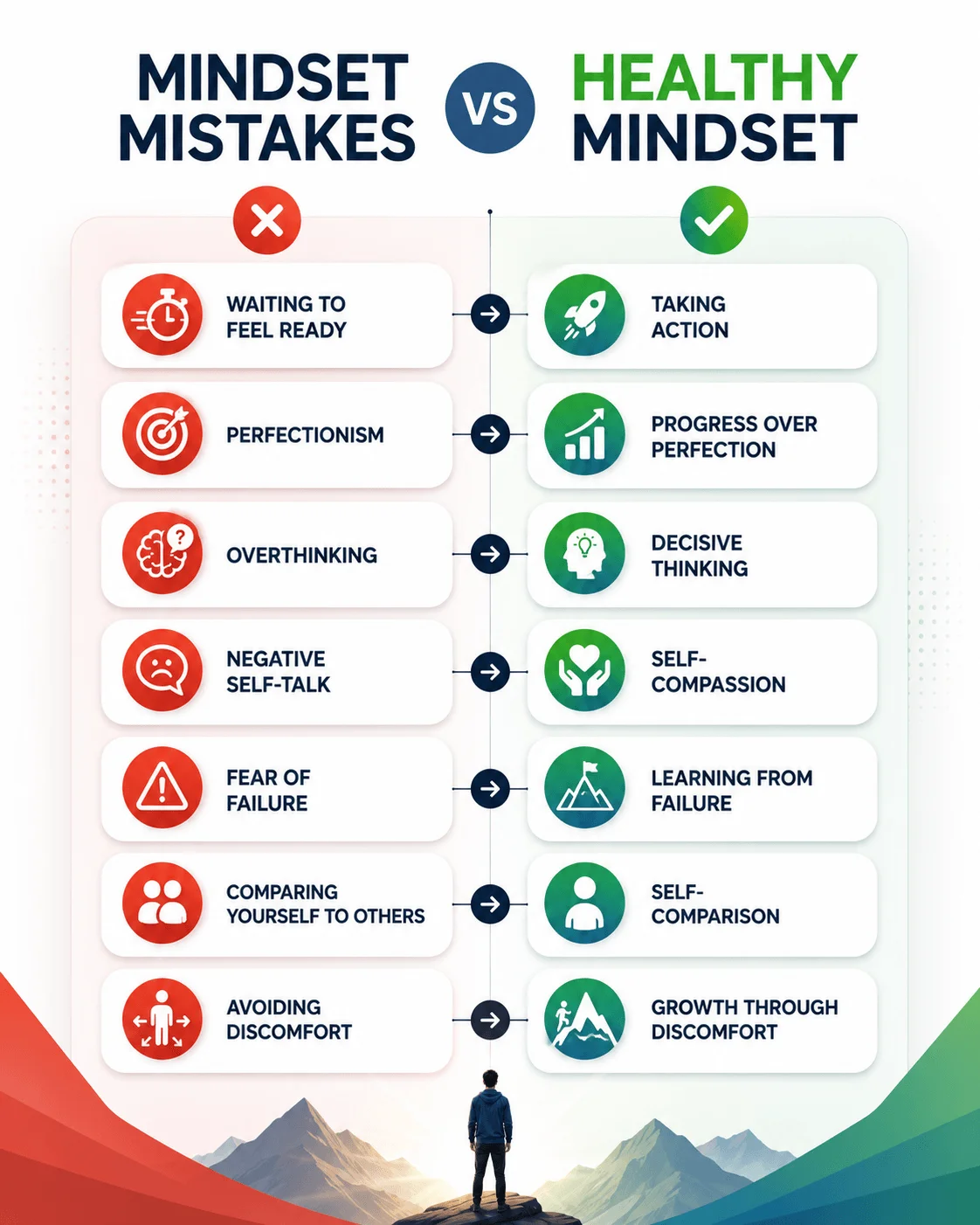
Mindset Mistakes vs Healthy Mindset
| Mindset Mistake | Healthy Alternative |
|---|---|
| Waiting until you feel ready | Starting before you feel prepared |
| Believing talent matters more than effort | Believing effort produces improvement |
| Catastrophizing | Asking “What’s most likely?” |
| Perfectionism | Setting “good enough” standards |
| Defining yourself by failures | Treating failure as information |
| Comparing to others | Comparing to your past self |
| All-or-nothing thinking | Seeing the middle ground |
| Avoiding discomfort | Practicing voluntary discomfort |
| Needing approval | Giving yourself permission |
| Dwelling on the uncontrollable | Focusing on what you can influence |
| Overthinking | Setting decision deadlines |
| Negative self-talk | Practicing self-compassion |
| Victim mentality | Taking ownership |
| Ignoring feedback | Listening and evaluating |
| Trying to change everything | Changing one thing at a time |
Fixed Mindset vs Growth Mindset
| Fixed Mindset | Growth Mindset |
|---|---|
| Avoids failure | Learns from failure |
| Needs approval from others | Takes initiative independently |
| Fear of mistakes | Curiosity about mistakes |
| Requires perfection | Values progress |
| Talent is fixed | Talent can be developed |
| Effort is a sign of inadequacy | Effort is the path to mastery |
| Threatened by others’ success | Inspired by others’ success |
| Gives up when challenged | Persists through difficulty |
Signs You Have These Mental Blocks
Unhelpful thinking patterns often operate below awareness. Here are signs they may be present:
- You frequently feel stuck despite wanting to move forward.
- You avoid situations where you might fail or look bad.
- You spend more time planning than doing.
- You compare yourself to others and usually come up short.
- Your internal dialogue is harsher than how you’d speak to a friend.
- You feel like circumstances are mostly outside your control.
- You get defensive when receiving feedback.
- You start new habits with enthusiasm but abandon them quickly.
- You wait for confidence before taking action.
- You often feel like you’re falling behind.
One or two signs might be situational. When several appear consistently, mindset traps are likely operating beneath the surface.
Self-Assessment: Which Thinking Traps Show Up for You?
Rate each statement from 1 (rarely true for me) to 5 (very true for me).
- I wait until I feel ready before taking on new challenges.
- I believe some people are naturally talented and others aren’t.
- When something goes wrong, I assume the worst possible outcome.
- I struggle to finish projects because they never feel ready.
- After a failure, I question my abilities or worth.
- I compare my progress to others and feel behind.
- I see situations in black-and-white terms.
- I avoid uncomfortable situations whenever possible.
- I need reassurance from others before making decisions.
- I spend time worrying about things I can’t change.
- I overthink decisions and delay taking action.
- I criticize myself harshly after mistakes.
- I feel like circumstances are mostly responsible for my situation.
- I get defensive when someone offers criticism.
- I try to improve multiple areas of my life simultaneously and burn out.
Scoring:
- 60–75: Mindset mistakes are likely having a significant impact. Focus on one at a time.
- 40–59: Some patterns are present. Awareness is your advantage.
- 15–39: You have relatively healthy thinking patterns. The work is maintenance and deepening.
This isn’t a clinical assessment. It’s a snapshot to help you identify where to focus.
The Psychology Behind Mindset Mistakes
Understanding why these patterns exist makes them easier to change.
Most mindset mistakes originate from cognitive distortions systematic errors in thinking that Aaron Beck identified as central to how people maintain negative beliefs. These include all-or-nothing thinking, catastrophizing, overgeneralization, labeling, mind reading, and emotional reasoning.
Other psychological mechanisms also play a role:
- Negativity bias: The brain gives more weight to negative experiences than positive ones. One criticism outweighs five compliments. This bias made evolutionary sense missing a threat was costlier than missing an opportunity but it distorts modern decision-making.
- Confirmation bias: Once you hold a belief, you notice evidence that supports it and ignore evidence that contradicts it. If you believe you’re not capable, you’ll notice every struggle and overlook every success.
- Loss aversion: Daniel Kahneman’s research showed that losses feel about twice as intense as equivalent gains. The pain of potential failure often outweighs the anticipated benefit of success, leading to avoidance.
- Fixed mindset: Carol Dweck’s research demonstrated that believing abilities are fixed leads to avoiding challenges, giving up easily, and ignoring useful feedback.
- Learned helplessness: Martin Seligman’s early research showed that repeated experiences of lack of control can lead people to stop trying even when control becomes available.
These mechanisms aren’t signs of being broken. They’re normal features of human cognition. The goal isn’t to eliminate them. It’s to recognize them and choose a more accurate response.
The Neuroscience of Unhelpful Thinking Patterns
Mindset mistakes have biological foundations. Understanding the neuroscience makes the process of change less mysterious.
The amygdala and threat detection: The amygdala activates when you perceive danger physical or psychological. Criticism, rejection, and failure can all trigger the same threat response as physical danger. When the amygdala fires, the prefrontal cortex (responsible for reasoning and impulse control) temporarily loses influence. You react rather than respond.
Neuroplasticity and change: The brain reorganizes itself throughout life. Each time you practice a new thinking pattern, you strengthen the neural pathways that support it. Old pathways weaken with disuse. A 2024 review in Frontiers in Psychology confirmed that repeated thoughts and behaviors strengthen neural pathways through neuroplasticity across the lifespan.
The prefrontal cortex and executive function: The prefrontal cortex is involved in planning, decision-making, and overriding automatic responses. When you pause between feeling and acting, you’re engaging this region. Strengthening prefrontal control through practice is a key part of overcoming mindset mistakes.
Dopamine and reinforcement: Behaviors that produce relief or reward get reinforced through dopamine. Avoiding discomfort provides relief, which strengthens the avoidance. Taking action and experiencing progress provides reward, which strengthens the action.
The habit loop: Charles Duhigg’s research on habits identified a three-part loop: cue, routine, reward. Mindset mistakes follow the same pattern. A trigger activates the pattern. The pattern produces a response. The response provides temporary relief. Breaking the loop requires interrupting it at the cue or routine stage.
Mindset Mistakes by Life Area
Career and Work: Waiting to feel qualified before applying. Catastrophizing about feedback. Perfectionism that delays projects. Needing approval before sharing ideas. Overthinking decisions.
Health and Fitness: Believing fitness is genetic and unchangeable. All-or-nothing thinking about diet and exercise. Avoiding discomfort during workouts. Comparing progress to others. Trying to change everything at once.
Relationships: Defining yourself by past failures. Avoiding difficult conversations. Needing validation from partners. Dwelling on what others think. Negative self-talk that affects connection.
Learning and Education: Believing intelligence is fixed. Comparing progress to classmates. Perfectionism that prevents submitting work. Avoiding challenging subjects.
Entrepreneurship: Waiting for the perfect time to launch. Defining yourself by business failures. Avoiding uncomfortable tasks like sales. Ignoring customer feedback. Trying to build everything simultaneously.
Leadership: Needing approval before making decisions. Taking team failures personally. Avoiding difficult feedback conversations. Dwelling on factors outside your control.
Parenting: Comparing your parenting to others. Catastrophizing about children’s futures. Perfectionism about being the “perfect” parent. Negative self-talk about parenting abilities.
How to Fix Mindset Mistakes: A Step-by-Step Framework
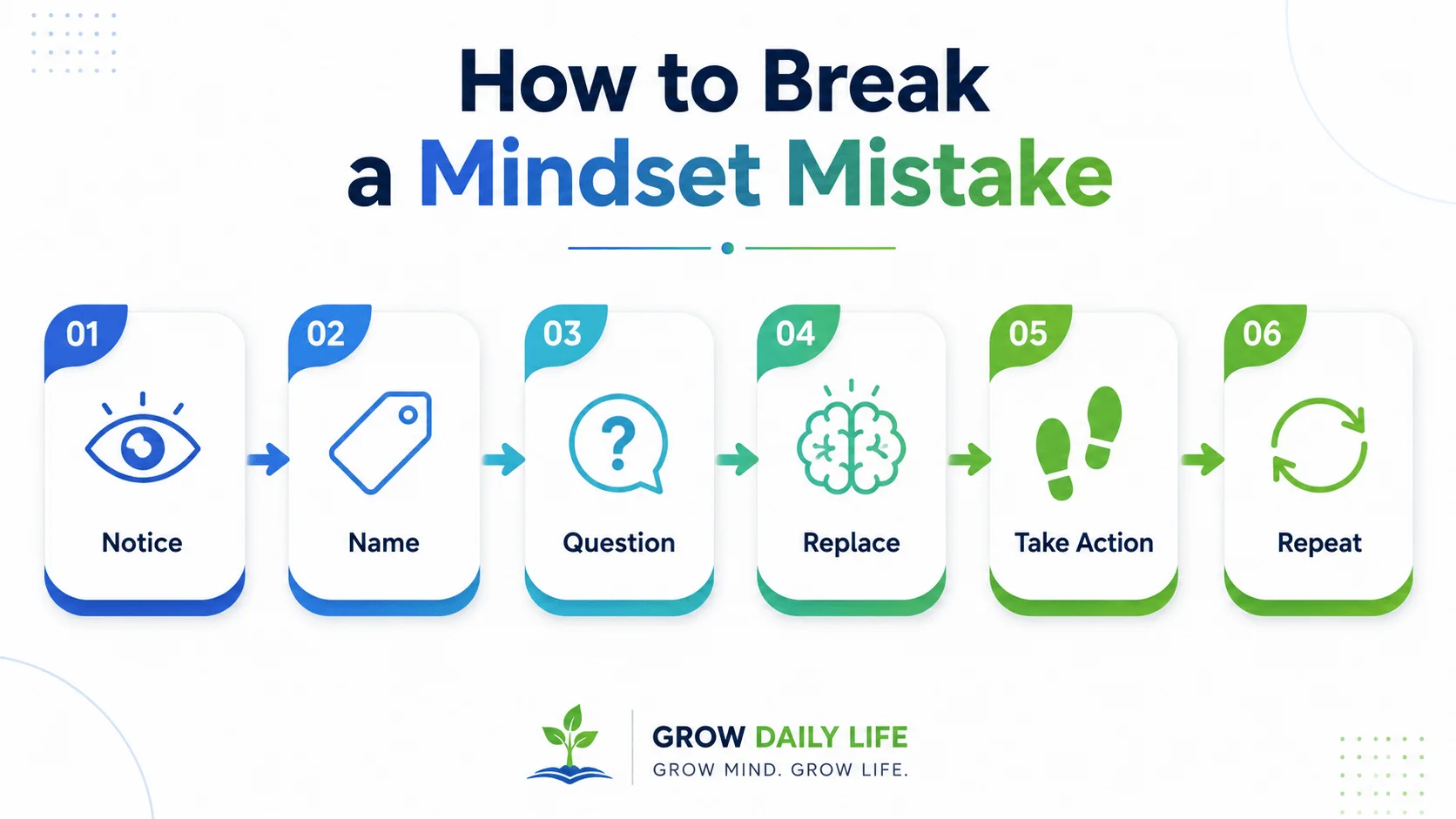
Step 1: Notice the Pattern
Spend a week observing your thinking without trying to change it. When do the mistakes show up? What triggers them? What do they sound like? Write them down. The act of writing creates distance. The thought becomes something you’re observing rather than something you’re immersed in.
Step 2: Name the Mistake
Label the pattern. “That’s catastrophizing.” “That’s perfectionism.” “That’s all-or-nothing thinking.” Naming does two things. It reminds you that this is a known cognitive pattern not a unique insight about your inadequacy. And it creates a pause. In that pause, you have options.
Step 3: Question the Thought
Ask: Is this actually true? What’s the evidence? What would I tell a friend who was thinking this way? Most mindset mistakes crumble under direct examination.
Step 4: Choose a Different Response
Replace the old thought with a more accurate or useful one. “I’m not ready” becomes “I’ll start and learn as I go.” “I’m a failure” becomes “This approach didn’t work. I’ll try something different.”
Step 5: Take One Small Action
The best way to weaken an old pattern is to generate evidence against it. Take one action the old pattern would have prevented. The action generates evidence. The evidence weakens the old belief. Over time, the new pattern becomes the default.
Step 6: Repeat
This isn’t a one-time process. The old patterns will resurface, especially during stress. Each time you notice, name, question, and choose differently, you’re strengthening new neural pathways. The goal isn’t perfection. It’s consistency over time.
Daily Mindset Checklist
Morning
- ☐ I noticed one negative thought without believing it
- ☐ I set an intention for how I want to respond today
Throughout the Day
- ☐ I challenged one negative thought
- ☐ I took action before feeling ready
- ☐ I practiced self-compassion after one mistake
- ☐ I accepted one imperfect result
- ☐ I focused on what I can control
Evening
- ☐ I reflected on one lesson learned today
- ☐ I celebrated one small win
30-Day Mindset Reset Challenge
Week 1: Awareness
- Day 1–3: Notice your thoughts without trying to change them. Write down patterns you observe.
- Day 4–5: Identify which mindset mistakes show up most frequently.
- Day 6–7: Pick the one mistake you want to address first.
Week 2: Questioning
- Day 8–10: When the chosen mistake appears, name it and pause.
- Day 11–12: Ask “Is this thought actually true? What’s the evidence?”
- Day 13–14: Write down alternative interpretations.
Week 3: Practicing New Responses
- Day 15–17: Each time the old pattern appears, consciously choose the alternative response.
- Day 18–19: Notice what happens when you respond differently.
- Day 20–21: Reflect on what’s shifting.
Week 4: Integrating and Expanding
- Day 22–24: The new response should start feeling more natural. Keep practicing.
- Day 25–27: Identify a second mindset mistake and begin the process again.
- Day 28–30: Review your progress. What’s different? What still needs work?
Common Myths About Mindset Mistakes
| Myth | Reality |
|---|---|
| Positive thinking solves everything | Awareness and intentional practice matter more than forced positivity |
| Mindset mistakes are personality traits | They’re learned patterns that can be changed |
| You should fix all your mistakes at once | Focusing on one at a time produces better results |
| Confidence comes before action | Action builds confidence, not the other way around |
| Mentally strong people don’t make mindset mistakes | Everyone makes them; the difference is how quickly they’re recognized |
| Once you fix a mindset mistake, it’s gone forever | Old patterns can resurface during stress; maintenance is ongoing |
| Mindset mistakes are a sign of weakness | They’re normal features of human cognition |
What Therapists Notice Most
While individual experiences vary, therapists and psychologists who work with mindset patterns often observe several recurring themes.
Many people don’t recognize that their thinking patterns are patterns. They experience the thought as reality rather than as a mental habit that can be examined. This is why the first step of any change process is usually awareness simply learning to notice what’s happening in your mind.
Another common observation is that mindset mistakes often develop as protective strategies. Catastrophizing may have helped someone prepare for unpredictable environments. People-pleasing may have kept them safe in critical households. The patterns made sense in context. The work isn’t about blaming yourself for having them. It’s about recognizing they no longer serve you.
The good news therapists often share is that these patterns respond well to consistent practice. Neuroplasticity means the brain can change. Cognitive behavioral approaches have decades of evidence supporting their effectiveness. Change takes time, but it’s genuinely possible.
If you’re experiencing persistent distress, difficulty functioning, or patterns that feel overwhelming, speaking with a licensed therapist can provide support beyond what self-directed work offers. Self-help and professional help aren’t mutually exclusive. They often work best together.
Frequently Asked Questions
What are the most common mindset mistakes?
The most common mindset mistakes include waiting until you feel ready, believing talent matters more than effort, catastrophizing, perfectionism, defining yourself by failures, comparing yourself to others, all-or-nothing thinking, avoiding discomfort, needing approval, dwelling on the uncontrollable, overthinking, negative self-talk, victim mentality, ignoring feedback, and trying to change everything at once.
Why do mindset mistakes feel so automatic?
Mindset mistakes are reinforced neural pathways. Each repetition strengthened the connection. After years of practice, the thought fires automatically. The automatic feeling doesn’t mean the thought is true. It means it’s familiar.
Can mindset mistakes really be changed?
Yes. Neuroplasticity the brain’s ability to form new neural connections continues throughout life. Mindset mistakes are learned patterns, and what’s learned can be unlearned through consistent practice.
How long does it take to fix a mindset mistake?
Some shifts become noticeable within 2–4 weeks of consistent practice. Deeper changes typically take months. The timeline depends on how long the pattern has been running and how consistently you practice the new response.
What’s the difference between a mindset mistake and a personality trait?
Mindset mistakes are learned thinking patterns that can be changed through practice. Personality traits are broader, more stable tendencies. Many things people attribute to personality (“I’m just a worrier”) are actually mindset mistakes that can shift.
What’s the first mindset mistake to address?
Start with the one that shows up most frequently or causes the most interference. If you’re unsure, “waiting until you feel ready” is a good starting point because it affects so many areas.
Can mindset mistakes affect physical health?
Yes. Chronic patterns like catastrophizing, rumination, and harsh self-criticism are associated with elevated stress hormones, poor sleep, and increased risk for stress-related health conditions. Improving mindset patterns can support physical as well as mental wellbeing.
Are some people more prone to mindset mistakes?
Certain factors increase vulnerability, including high-stress environments, critical parenting, traumatic experiences, and perfectionistic cultures. However, everyone experiences mindset mistakes to some degree regardless of background. You may also find our guide on How to Improve Your Overall Well-Being helpful.
Why do mindset mistakes feel worse in the current environment?
Social media comparison, information overload, AI-driven career uncertainty, perfection culture, and the blurring of work-life boundaries all amplify common thinking traps. The current environment makes these patterns more intense but also more addressable once recognized.
When should I seek professional help?
If mindset patterns are causing persistent distress, interfering with daily functioning, or feeling overwhelming despite your efforts, consider speaking with a licensed therapist. Self-directed work and professional support often complement each other effectively.
Key Takeaways
- Mindset mistakes are learned thinking patterns, not character flaws.
- They feel automatic because they’ve been reinforced through repetition, not because they’re true.
- The psychology behind them includes cognitive distortions, negativity bias, confirmation bias, and fixed mindset beliefs.
- Neuroscience shows that these patterns can be changed through neuroplasticity and consistent practice.
- The fix is a repeatable process: notice, name, question, choose a different response, and act.
- Change takes time. Small consistent efforts compound more than occasional intense ones.
- The current digital environment amplifies many mindset mistakes awareness of this amplification is the first step to reducing it.
- Everyone makes these mistakes. The difference is how quickly they’re recognized and corrected.
References
- American Psychological Association. Resources on resilience and cognitive behavioral therapy. APA.org.
- American Psychological Association. (2025). Stress in America Report.
- Bandura, A. (1997). Self-Efficacy: The Exercise of Control. W.H. Freeman.
- Beck, A. T. (1979). Cognitive Therapy and the Emotional Disorders. Penguin.
- Clear, J. (2018). Atomic Habits. Avery.
- Duckworth, A. (2016). Grit: The Power of Passion and Perseverance. Scribner.
- Duhigg, C. (2012). The Power of Habit. Random House.
- Dweck, C. S. (2006). Mindset: The New Psychology of Success. Random House.
- Fogg, B. J. (2019). Tiny Habits. Houghton Mifflin Harcourt.
- Hayes, S. C. (2005). Get Out of Your Mind and Into Your Life. New Harbinger.
- Kahneman, D. (2011). Thinking, Fast and Slow. Farrar, Straus and Giroux.
- Morin, A. (2014). 13 Things Mentally Strong People Don’t Do. William Morrow.
- Neff, K. (2011). Self-Compassion: The Proven Power of Being Kind to Yourself. William Morrow.
- Neff, K. (2023). Self-compassion and resilience: A meta-analysis. Mindfulness, 14(5), 1123–1138.
- Seligman, M. E. P. (2006). Learned Optimism. Vintage.
- World Health Organization. Mental health and wellbeing resources. WHO.int.
- Perfectionism and mental health: A meta-analysis. Clinical Psychology Review (2024).
- Neuroplasticity and behavior change: Recent advances. Frontiers in Psychology (2024).
- Psychological flexibility and resilience: A systematic review. Nature Reviews Psychology (2025).
If you’re starting from scratch, pick one mistake from the list. The one that shows up most often in your life. Spend a week just noticing it. Don’t try to change anything. Just pay attention to when it appears and what it sounds like.
After a week, you’ll see the pattern more clearly. That awareness alone is progress. Then start practicing the alternative response. Not perfectly. Just consistently.
The people who successfully change their thinking patterns aren’t the ones with the most willpower. They’re the ones who practiced the small daily repetitions that built new neural pathways over time. Start small. Stay consistent. Let the repetitions do the work.
Written by Bilal Shah — a mindset and personal development writer at Grow Daily Life who focuses on growth mindset, limiting beliefs, confidence, resilience, and behavior change. His work combines psychological research with practical, evidence-informed strategies to help readers develop healthier thinking patterns, overcome mental barriers, and create lasting personal growth.