
For years I thought personal transformation was supposed to feel dramatic.
A breakthrough moment. A before-and-after. Something you’d tell a story about later.
I kept waiting for that moment. It never came. What happened instead was quieter. I’d notice I was reacting differently to something that used to set me off. I’d realize I hadn’t had a particular negative thought in a while. Small shifts. Barely noticeable day to day. But when I looked back over a year, the difference was real.
Research in behavioral psychology suggests that nearly 40–45% of our daily actions are habits rather than conscious decisions, showing why lasting transformation depends on changing automatic patterns instead of relying on motivation alone. The popular version of personal transformation is mostly fiction. It’s sold as an event a seminar, a book, a sudden insight that changes everything. The reality is slower, less photogenic, and a lot more interesting once you understand how it actually works.
Real change has a psychology behind it. It follows patterns. And once you understand those patterns, you stop waiting for breakthroughs and start building something that lasts.
Personal Transformation at a Glance
Personal transformation is the long-term process of changing your beliefs, identity, behaviors, and emotional patterns to create lasting improvements in your life. Unlike temporary motivation, it focuses on deep internal change that influences every decision, habit, and relationship over time.
How to Start Personal Transformation
- Identify one area of your life you want to change.
- Change one small daily behavior.
- Focus on who you’re becoming, not just what you’re doing.
- Practice consistently, even when progress feels invisible.
- Reflect weekly on what’s working and what isn’t.
What is Personal Transformation?
Definition: Personal transformation is the ongoing process of changing your identity, beliefs, behaviors, and emotional patterns to create lasting improvements in how you think, feel, and live. Unlike temporary motivation, it focuses on deep internal change rather than short-term behavior.
Personal transformation is the long-term process of changing your identity, beliefs, behaviors, and emotional patterns to create lasting improvements in how you think, feel, and live. Unlike temporary motivation or surface-level habit change, this kind of transformational change alters the underlying mental models that guide daily decisions.
A mindset transformation is usually at the center of it. The way you think about yourself and your abilities determines what you attempt, how you respond to setbacks, and what you believe is possible. When that mindset shift happens, everything else can shift with it.
But self transformation isn’t just mental. It involves behavior change, emotional growth, and often a shift in identity a change in who you understand yourself to be. This is the heart of identity development and the transformational journey.
Someone who transforms their relationship with money doesn’t just learn budgeting. They stop being someone who says “I’m bad with money” and start being someone who makes intentional financial decisions. Someone who transforms their health doesn’t just start exercising. They become someone who sees themselves as active, as capable, as the kind of person who moves their body regularly.
That identity shift is where most of the lasting change happens.
Personal Transformation vs Self-Improvement vs Personal Growth
People often use these terms interchangeably, but they’re different things. Understanding the distinctions clarifies what you’re actually pursuing.
| Self-Improvement | Personal Growth | Personal Transformation | |
|---|---|---|---|
| Focus | Skills and behaviors | Development and awareness | Identity and beliefs |
| Timeframe | Short to medium-term | Continuous and ongoing | Deep, lasting change |
| What Changes | Habits and abilities | Understanding and perspective | Core identity and mental models |
| Example | Learning time management | Becoming more self-aware | Becoming someone who doesn’t need external pressure to act |
Self-improvement is about adding skills, habits, or knowledge. You learn to manage time better. You start exercising. You read more books. The changes are real but often stay at the level of behavior.
Personal growth is gradual, ongoing development. You’re becoming more self-aware, more emotionally regulated, more skilled at relationships. The changes accumulate over time, but they don’t necessarily involve a fundamental shift in identity.
Personal transformation goes deeper. It’s not just about what you do or what you understand. It’s about who you understand yourself to be. The behaviors change because the identity underneath them changed.
“Transformation isn’t becoming someone else. It’s becoming more fully yourself.”
Someone who transforms their relationship with work doesn’t just learn productivity techniques. They stop being someone who needs external pressure to do meaningful work. The motivation comes from within this is the shift from external motivation to intrinsic motivation.
Can Anyone Experience Meaningful Change?
Yes. The capacity for life transformation is built into human biology.
Neuroplasticity the brain’s ability to reorganize itself by forming new neural connections continues throughout life. This means the biological foundation for change exists in everyone, regardless of age, background, or circumstances.
That said, the path to transforming yourself varies. Some people have more support, more resources, or fewer obstacles. Some face structural barriers that make change more difficult. Acknowledging that isn’t defeatism. It’s accuracy. The work looks different depending on where you start.
What the research consistently shows is that the core mechanisms of change identity shift, behavior change, cognitive restructuring, psychological flexibility work across populations. The principles are universal even when the specific application varies.
The belief that “people like me don’t change” or “I’m too old to transform” is itself a limiting belief. It’s a thought that can be examined and challenged like any other. The biology supports change at any age. The psychology supports change across circumstances. The question isn’t whether transformation is possible. It’s what approach will work for your specific situation.
Different Types of Personal Transformation
Personal transformation doesn’t look the same for everyone. It shows up in different areas of life, and the process varies by domain.
Mental transformation involves changes in thinking patterns, beliefs, and mindset. This is the shift from fixed to growth mindset, from limiting beliefs to expansive ones, from rigid thinking to psychological flexibility. It’s the foundation that makes other types of transformation possible. This is where cognitive restructuring plays a central role.
Emotional transformation involves changes in how you relate to your feelings. You stop being controlled by emotional reactions. You develop the capacity to feel difficult emotions without being overwhelmed by them. This connects to building mental resilience and developing emotional intelligence.
Physical transformation involves changes in how you relate to your body. The deeper transformation isn’t the physical change itself. It’s the shift in identity becoming someone who values and cares for their physical self.
Career transformation involves fundamental changes in your relationship with work. It might mean changing fields, but it might also mean staying in the same role while completely shifting why you do it and how you approach it.
Financial transformation involves changing your relationship with money. Not just earning more or spending less. Shifting from scarcity thinking to intentionality.
Relationship transformation involves changing patterns in how you connect with others. This might mean learning to set boundaries, to communicate differently, or to choose different kinds of relationships.
Spiritual or values-based transformation involves shifts in what you find meaningful. Your core values reorganize. What used to matter might matter less. New priorities emerge. This connects to self-actualization becoming more fully who you’re capable of being.
Most people who experience deep transformation find it touches multiple areas. The changes in one domain ripple into others. This is inner transformation the shift that happens beneath the surface and expresses itself across different areas of life.
Signs You’re Experiencing Inner Growth
Transformation isn’t always obvious while it’s happening. Here are signs that deeper self-discovery and change is underway.
- You react differently to situations that used to trigger you. The reaction is still there, but it’s quieter. You have more space between the event and your response.
- Your priorities shift. Things that used to feel important don’t anymore. New interests and values emerge that surprise you.
- Old habits fall away without as much effort. You’re not forcing yourself to stop. The behavior just doesn’t fit anymore.
- Your emotional regulation improves. You still feel difficult emotions, but they don’t hijack you the way they used to.
- Your confidence becomes quieter. You don’t need external validation as much. This is character development in action.
- Some relationships change or fade. As you shift, certain connections no longer fit. New ones form that align with who you’re becoming.
- Your goals evolve. What you wanted a year ago might not resonate anymore.
- You’re more comfortable with uncertainty. The need to have everything figured out diminishes.
One or two signs might be temporary. When several appear together and persist, transformation is probably happening beneath the surface.
The Six Stages of Personal Transformation
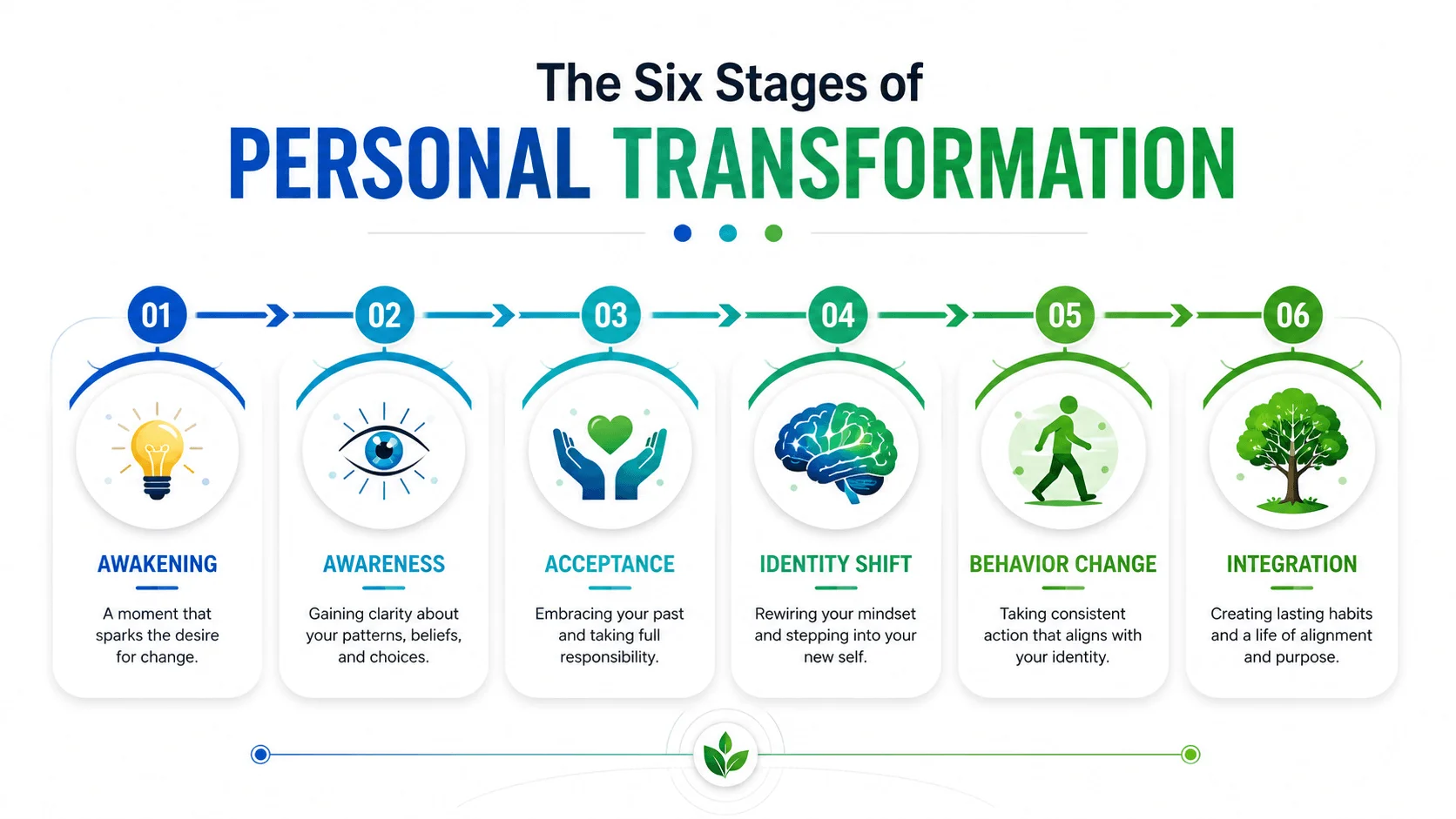
Lasting change tends to follow a pattern. The stages aren’t rigid, and people move through them at different speeds, but the sequence is common enough to be useful. This aligns with the Transtheoretical Model of Change developed by James Prochaska and Carlo DiClemente, while adapting it specifically for deeper identity work.
Stage 1: Awakening. Something shifts your awareness. It might be a crisis, a conversation, a book, or just a growing sense that something needs to change. You start seeing your current patterns as patterns rather than as fixed reality.
Stage 2: Awareness. You start paying attention to what’s actually happening inside you. Your automatic thoughts. Your habitual reactions. Your limiting beliefs. This stage is about gathering data without judgment.
Stage 3: Acceptance. You acknowledge where you are without denying it or beating yourself up for it. Acceptance means seeing clearly without either defense.
Stage 4: Identity Shift. You start clarifying who you’re becoming. Not just what you want to do differently. Who you understand yourself to be. This is where identity transformation diverges from simple behavior change.
Stage 5: Behavior Change. The new identity expresses itself through new actions. You’re acting in alignment with who you now understand yourself to be.
Stage 6: Integration and Maintenance. The new patterns stabilize. The old patterns still appear occasionally especially during stress but they no longer define you.
People cycle through these stages at different rates. You might reach integration in one area while still awakening in another. That’s normal.
The Psychology Behind Personal Transformation
“People’s beliefs about their abilities have a profound effect on those abilities.” — Carol Dweck
The behavioral psychology behind lasting change isn’t mysterious. Decades of research have identified the mechanisms that make it possible.
Self-Determination Theory
Self-Determination Theory (SDT), developed by Edward Deci and Richard Ryan, is one of the most well-established frameworks in understanding motivation and change. It identifies three core psychological needs:
- Autonomy: The sense that you’re choosing your actions, not being controlled by external forces.
- Competence: The experience of making progress and developing mastery.
- Relatedness: The feeling of connection to others. Transformation doesn’t happen in isolation.
When these three needs are met, intrinsic motivation flourishes. When they’re absent, even well-intentioned change efforts tend to collapse.
Self-Efficacy: The Belief That You Can
Self-efficacy, a concept developed by psychologist Albert Bandura, is the belief in your ability to succeed in specific situations.
Expert Insight — Albert Bandura
Self-efficacy predicts whether people persist after failure. It grows through mastery experiences, not through positive thinking alone.
Each time you attempt something and persist through difficulty, your belief in your capability strengthens.
Psychological Flexibility: Adapting to Reality
Psychological flexibility is the ability to stay present and adapt your behavior based on what the situation requires. It’s a core concept in Acceptance and Commitment Therapy (ACT), developed by psychologist Steven Hayes.
People with high psychological flexibility can notice difficult thoughts and feelings without being controlled by them. They don’t have to eliminate negative thoughts. They just have to stop letting those thoughts dictate their actions. This is the foundation of an adaptive mindset.
Five Principles of Personal Transformation
- Identity before behavior. Who you believe you are shapes what you do. Shift the identity first.
- Small habits compound. A single small change feels insignificant. Over months and years, it’s undeniable. Research suggests that around 40–45% of daily behaviors are habitual, which is why small consistent changes matter so much.
- Consistency beats motivation. Motivation fades. Systems and routines don’t.
- Self-awareness creates change. You can’t change what you don’t notice.
- Reflection accelerates growth. Regularly reviewing what’s working and what isn’t builds momentum.
Key Insight
Lasting transformation doesn’t begin when your habits change. It begins when your identity changes.
What Neuroscience Says About Lasting Change
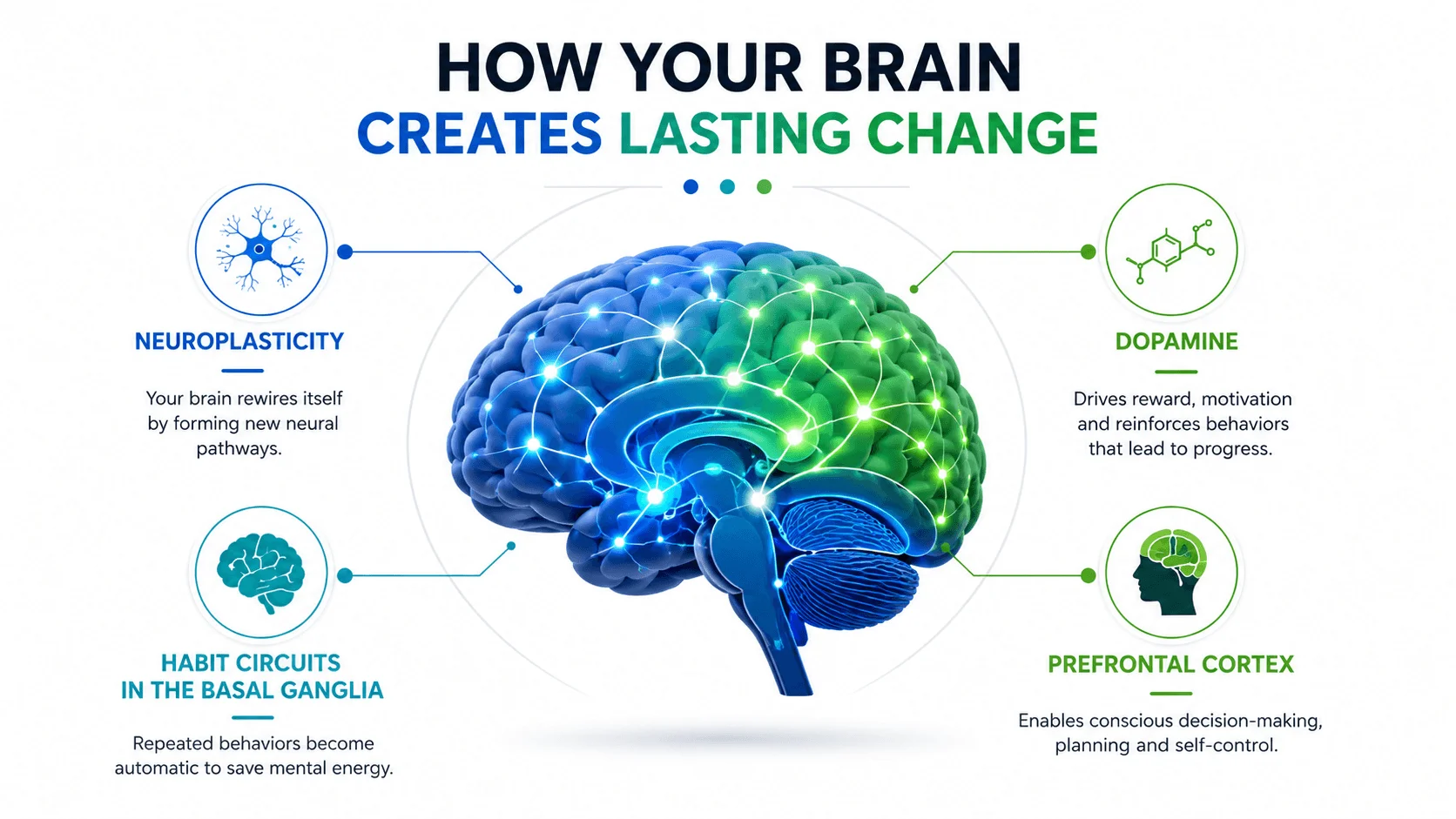
The biology of personal change is well-documented. According to a 2024 neuroscience review published in Frontiers in Psychology, repeated thoughts and behaviors strengthen neural pathways through neuroplasticity, supporting the importance of consistent practice over one-time interventions. Research continues to affirm neuroplasticity across the lifespan.
Neuroplasticity is the brain’s ability to reorganize itself by forming new neural connections throughout life. Every thought, every behavior, every emotional response strengthens certain pathways and weakens others.
“The brain changes through repetition, not inspiration.”
Dopamine and learning are closely linked. Dopamine is central to motivation and the reinforcement of new behaviors. When you take action and experience even small progress, dopamine helps encode that behavior for repetition.
Habit circuits in the basal ganglia automate repeated behaviors. Old habits are stored in these circuits. Building new habits involves creating competing circuits through repetition. The old ones weaken with disuse.
The prefrontal cortex is involved in conscious decision-making and overriding automatic responses. Strengthening prefrontal control through practice is a key part of transformation.
Emotional memory, stored in the amygdala and hippocampus, shapes how you respond to situations based on past experiences. Transformation involves updating these emotional memories.
Why Your Brain Resists Change
Understanding why change is difficult doesn’t make it easy, but it makes the struggle feel less personal.
The brain evolved to prioritize safety and efficiency. Familiar patterns, even when they’re unhelpful, feel safe because they’re predictable. New patterns, even when they’re objectively better, feel threatening because they’re unknown.
Specific mechanisms include:
Comfort zone protection. The brain interprets unfamiliar situations as potential threats.
Identity protection. Your current identity is stable. Changing it threatens the stability.
Loss aversion. Psychologically, losses feel about twice as intense as equivalent gains.
Ego preservation. Admitting that change is needed can feel like admitting something was wrong with you.
Uncertainty intolerance. Transformation often pushes past your threshold for uncertainty.
None of this means change is impossible. It means resistance is normal.
Biggest Obstacles to Personal Transformation
Beyond the brain’s natural resistance, specific obstacles can slow meaningful change.
Fear. Fear of failure, fear of judgment, fear of the unknown. Fear often overestimates the danger and underestimates the capacity to cope.
Comfort zone attachment. The familiar is comfortable even when it’s painful. Many people turn back at the first sign of discomfort.
Negative environment. If the people around you reinforce your old identity, the work becomes harder.
Perfectionism. Waiting until you’re ready, until conditions are right. Transformation doesn’t require perfection.
Trauma. Unresolved trauma can anchor old patterns in place. Professional support is often essential.
Low self-belief. Self-efficacy is built through action, which creates a difficult cycle to break.
Lack of patience. Expecting fast results and quitting when they don’t come. The early stages often feel like nothing is happening.
Research Snapshot
- Around 43% of everyday behaviors are habitual (Wood & Neal).
- Habit formation takes 18–254 days, averaging 66 days (Lally et al.).
- Neuroplasticity continues throughout adulthood.
- Psychological flexibility predicts long-term wellbeing.
- Self-compassion improves resilience more than self-criticism (Neff).
Why Most Attempts at Change Don’t Last
Most people approach transformation as a decision. “I’ve decided to be different now.” The decision creates a surge of motivation. But motivation is temporary. It fades.
The problem isn’t the decision. It’s that the decision didn’t address the underlying structures that maintain the old behavior. Habits, beliefs, environment, identity these forces determine what you do day to day. Only repeated practice changes them.
Another common failure point: people try to change everything at once. By Wednesday, they’re exhausted. By Friday, they’ve given up.
This isn’t weakness. It’s biology. The brain can only sustain so much conscious effort before it reverts to automatic patterns. Research on habit formation suggests that new behaviors can take anywhere from 18 to 254 days to become automatic, averaging around 66 days. Lasting change happens through small, consistent shifts, not dramatic overhauls.
The research on why habit building fails covers this in more detail.
The Identity Shift That Makes Change Stick
One of the most reliable findings in the psychology of change is that identity-based approaches outperform motivation-based approaches.
When you try to change through motivation alone, you’re relying on willpower. Willpower is a limited resource. When you change through identity, you’re shifting the default. You’re not “trying to exercise.” You’re becoming someone who exercises.
| Motivation | Identity |
|---|---|
| Temporary | Permanent |
| Emotion-based | Belief-based |
| Requires Willpower | Becomes Automatic |
| Easy to Quit | Hard to Quit |
| “I want to write a book” | “I am a writer” |
“Every action you take is a vote for the type of person you wish to become.” — James Clear
James Clear describes this as the difference between outcome-based habits and identity-based habits. Outcome-based: “I want to write a book.” Identity-based: “I am a writer.” The second one leads to daily writing.
“Identity changes before behavior becomes effortless.”
Identity transformation works because it aligns your behavior with your sense of self. When there’s a gap between what you do and who you believe you are, the gap creates discomfort. If you can shift the identity first, the behavior follows more naturally.
This connects to the most powerful mindset for success. The growth mindset—the belief that abilities can be developed is itself an identity shift.
Identity-Based Habits
Identity-based habits flip the usual approach to change.
Instead of asking “What should I do?” ask “Who am I becoming?” This shifts the focus from outcomes to identity. Every small action becomes evidence for the person you want to become. Over time, repeated behaviors strengthen that identity and make new habits feel natural rather than forced.
Someone trying to write doesn’t ask “How do I finish a book?” They ask “What would a writer do today?” The answer is usually simple: write something. Even if it’s small. Even if it’s imperfect. The action reinforces the identity. The identity sustains the action.
This is why identity work precedes behavior work in lasting transformation. The behaviors don’t create the identity. The identity creates the behaviors. When you start with who you’re becoming, the daily actions follow more naturally. This is personal reinvention at its most practical level.
Internal vs External Transformation
Transformation operates on two levels.
External transformation involves changes in circumstances. Better job. Improved finances. Different body. These are visible from the outside.
Internal transformation involves changes in beliefs, values, emotional patterns, and identity. These aren’t visible from the outside. But they’re the foundation that makes external changes sustainable.
The common mistake is pursuing external transformation without internal transformation. The new job feels the same as the old one after a few months. The new relationship repeats old patterns. The external changed but the internal didn’t.
The more reliable approach is to work on both simultaneously or to prioritize the internal work first and let it guide the external changes.
How Behavior Change Actually Works
The research on behavioral psychology identifies several key principles.
Small changes compound. A single small change feels insignificant. Done consistently over time, it produces significant results.
Environment shapes behavior more than intention. If you want to change a behavior, change the environment that supports it.
Reinforcement drives repetition. Behaviors that produce immediate positive feelings tend to be repeated. Find ways to make the new behavior satisfying in the short term.
Consistency beats intensity. A small effort repeated daily produces more change than a large effort done occasionally. This is the principle behind why consistency matters more than motivation.
The Role of Self-Awareness in Transformation
You can’t change what you don’t notice. Self-awareness is the foundation of lasting change because it creates the gap between stimulus and response. That gap is where choice lives.
Most people go through their days reacting automatically. Building self-awareness means learning to notice what’s happening inside you in real time. What am I thinking right now? What am I feeling? What belief is driving this reaction?
A practical way to build self-awareness is through reflection. Just a few minutes at the end of the day asking: what happened? How did I respond? What was going on beneath that response?
Over time, the awareness starts to show up in the moment instead of only in hindsight. That’s when transformation becomes possible.
Emotional Growth and Psychological Flexibility
Personal transformation isn’t just about thinking differently. It’s about relating differently to your emotions.
Many people organize their lives around avoiding difficult emotions. They don’t take risks. They don’t have hard conversations. They don’t try things that might fail.
Emotional growth means developing the capacity to experience difficult emotions without being controlled by them. It’s the ability to feel fear and still act. To feel sadness and not numb it.
Psychological flexibility is central to this. The emotion is present, but it doesn’t dictate the response.
This connects to building mental resilience. Resilient people aren’t people who don’t feel difficult things. They’re people who feel them and keep going anyway.
How Long Does Personal Transformation Take?
There’s no fixed timeline for the personal transformation journey, but the research on habit formation, neuroplasticity, and behavior change gives a rough sense.
First week: Building awareness. Noticing patterns you didn’t see before.
First month: Experimenting with new responses. Old patterns still dominate. This is normal.
90 days: New patterns start to feel more natural. You catch old thoughts faster.
6 months: New thinking and behavior patterns become more automatic. You recover faster from setbacks.
1 year: The new identity feels more like who you actually are than something you’re practicing.
Beyond 1 year: Transformation continues. Each life stage brings new challenges. The process never fully ends. That’s not failure. That’s personal evolution.
Small daily repetitions beat occasional marathon efforts.
Practical Steps for Lasting Change
Start with Identity
Before changing what you do, clarify who you’re becoming. State the identity explicitly: “I am someone who learns from feedback.” The statement will feel unnatural at first. Keep returning to it.
Pick One Thing
Not five things. One thing. Focus there until it starts to feel more natural. Then add another.
This is one of the core principles from how to improve your overall well-being.
Design Your Environment
Make the new behavior easier and the old behavior harder. Don’t rely on willpower. Environment is the primary system.
Practice Self-Compassion
You will fall back into old patterns. That’s not failure. That’s the process. Treat yourself the way you’d treat a friend who was struggling.
Track Consistency, Not Perfection
A mediocre workout is infinitely better than a skipped workout.
Reflect Regularly
Take a few minutes each week to look at what’s working and what isn’t.
Stay Patient
The patterns you’re changing were built over decades. They won’t be replaced in a month.
A 10-Minute Personal Transformation Exercise
Grab something to write with.
Step 1: Current Identity (2 minutes)
Write: “Who am I today?” Describe yourself honestly. What do you believe about yourself? What patterns define your current life?
Step 2: Future Identity (2 minutes)
Write: “Who do I want to become?” Be specific. Who would you be if the transformation you’re seeking had already happened?
Step 3: The Gap (2 minutes)
Write: “What belief is stopping me?” Identify the single most significant limiting belief.
Step 4: The Challenge (2 minutes)
Ask: “Is this belief actually true?” What evidence supports it? What evidence contradicts it?
Step 5: One Action (2 minutes)
Write: “What is one small action I can take today that aligns with my future identity?” Then do it.
The Personal Transformation Wheel
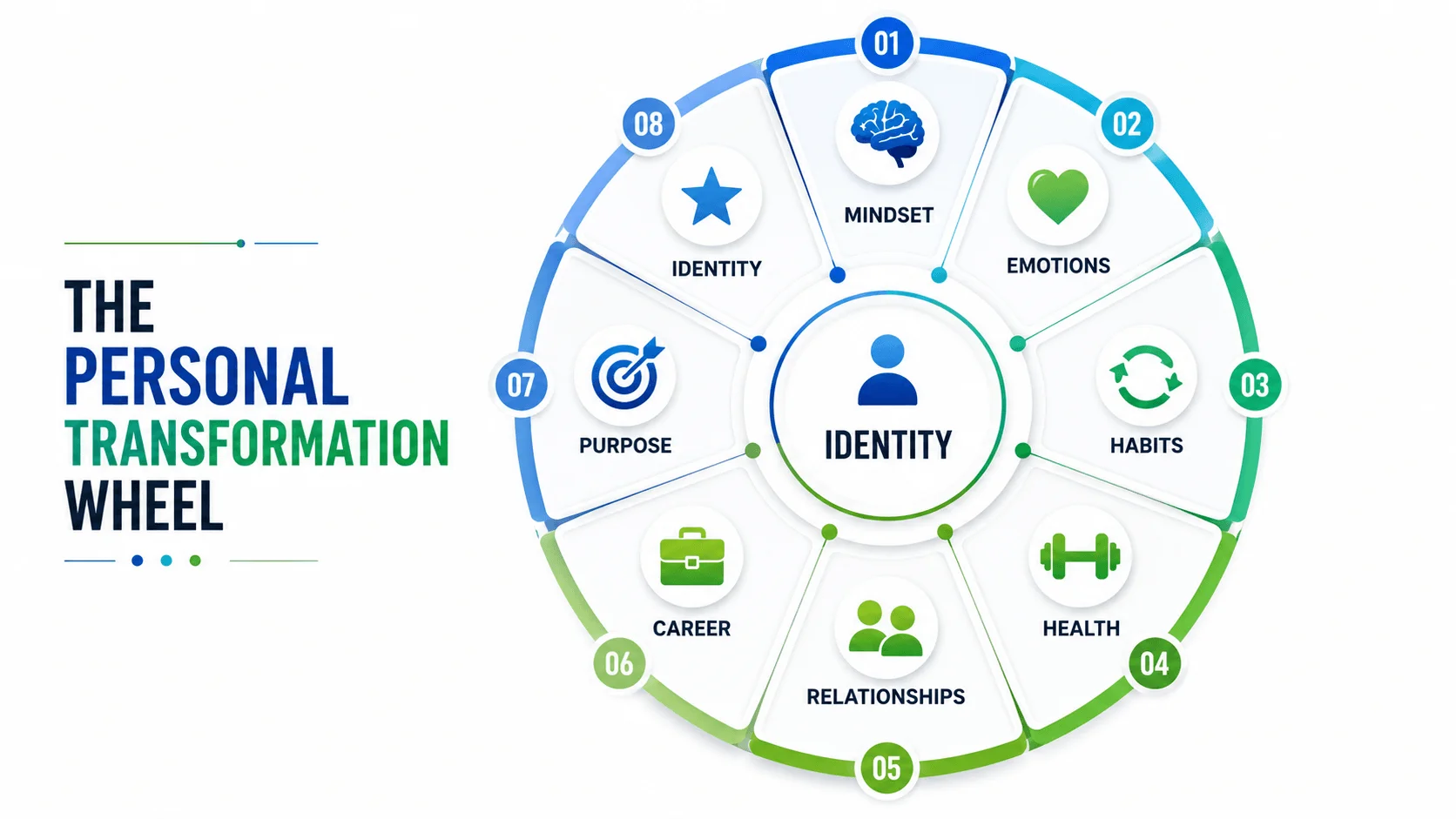
The wheel includes these dimensions:
- Mindset: Beliefs about yourself and what’s possible.
- Emotions: How you relate to your feelings.
- Habits: The daily behaviors that shape your life.
- Health: Physical wellbeing and how you care for your body.
- Relationships: Patterns in how you connect with others.
- Career: Your relationship with work.
- Purpose: What gives your life meaning.
- Identity: The core sense of who you are.
At any given time, some dimensions might be transforming while others are stable. The wheel helps you see the whole picture.
Common Mistakes and Transformation Traps
Confusing insight with change. Understanding why you do something isn’t the same as changing it.
Trying to change without changing your environment. Environment shapes behavior.
Expecting linear progress. Some weeks you’ll feel like you’re moving backward. That’s normal.
Comparing your journey to others. Everyone’s timeline is different.
Waiting until you feel ready. The feeling follows the action.
Pursuing external change without internal work. New circumstances often reproduce old patterns without internal shifts.
Treating transformation as a destination. There’s no finish line.
Common Transformation Myths
Myth: Transformation happens in a single moment.
Reality: Breakthrough moments are usually preceded by months or years of quieter work.
Myth: You need to hit rock bottom to transform.
Reality: Crisis can catalyze change, but many people transform through gradual awareness.
Myth: Transformation means becoming a completely different person.
Reality: It’s more about becoming more fully yourself.
Myth: Once transformed, you stay that way.
Reality: Old patterns can resurface during stress. The difference is you recognize them faster.
Myth: Some people are too old to transform.
Reality: Neuroplasticity continues throughout life.
What the Research Says
A review published in Nature Reviews Psychology found that psychological flexibility was one of the strongest predictors of long-term wellbeing. People who could adapt their thinking and behavior to fit circumstances fared better than those stuck in rigid patterns.
A neuroscience review published in Frontiers in Psychology confirmed that repeated thoughts and behaviors strengthen neural pathways through neuroplasticity, supporting the importance of consistent practice over one-time interventions. Research continues to affirm neuroplasticity across the lifespan.
Studies on identity-based behavior change consistently show that starting with “who am I becoming” produces more sustainable change than starting with “what should I do.” The identity shift creates the foundation. The behaviors follow.
According to a review published in the Annual Review of Clinical Psychology, psychological flexibility has emerged as a central mechanism in successful personal transformation, predicting outcomes across mental health, behavior change, and overall life satisfaction.
Self-compassion research, led by Kristin Neff at the University of Texas at Austin, has consistently found that treating yourself with kindness during setbacks improves motivation and resilience more than self-criticism. Recent studies continue to challenge the assumption that being hard on yourself drives improvement.
Growth mindset interventions show measurable improvements in academic persistence and motivation across multiple studies, supporting Dweck’s core finding that beliefs about ability shape behavior and achievement.
Expert Insights from Leading Psychologists
Expert Insight — Carol Dweck
“Becoming is better than being.” Growth begins when you believe your abilities can improve.
Expert Insight — Albert Ellis
“People are disturbed not by things, but by the view they take of them.”
Albert Bandura demonstrated that self-efficacy the belief in your ability to succeed is one of the strongest predictors of actual success.
Kristin Neff has shown that treating yourself with kindness during difficulty improves resilience more effectively than self-criticism.
Steven Hayes, founder of ACT, developed the concept of psychological flexibility. His work shows that trying to eliminate difficult thoughts is less effective than learning to coexist with them.
Angela Duckworth, author of Grit, demonstrated that sustained passion and persistence predict achievement better than talent or intelligence.
What Transformation Looks Like in Real Life
“Real personal transformation doesn’t happen the day you feel inspired. It happens the day you continue even when inspiration disappears.”
It’s catching yourself before you spiral into a familiar negative thought pattern. Not every time. More than before.
It’s having a difficult conversation you would have avoided a year ago. Not perfectly. But you had it.
It’s noticing that something that used to trigger you doesn’t hit the same way anymore.
I used to think that once I’d “transformed,” I’d be a different person. Fixed. Finished. What I’ve found instead is that personal development is ongoing. There’s no endpoint. There’s just the process of becoming more aware, more intentional, more aligned with who you want to be. Some days it goes well. Some days it doesn’t. The work continues either way.
Frequently Asked Questions
What is personal transformation?
Personal transformation is the long-term process of changing your identity, beliefs, behaviors, and emotional patterns to create lasting improvements in how you think, feel, and live. Unlike temporary motivation, it alters the underlying mental models that guide daily decisions.
Is personal transformation the same as personal development?
No. Personal development focuses on improving skills, knowledge, and habits, while personal transformation involves deeper changes in identity, beliefs, and the way you see yourself. Personal development can contribute to transformation, but transformation goes beyond skill-building by reshaping the underlying patterns that guide your behavior.
How long does personal transformation take?
Some shifts become noticeable within weeks. Deep transformation the kind that involves identity change and rewiring long-held patterns typically takes months to years. Habit formation research suggests new behaviors can take 18 to 254 days to become automatic, averaging around 66 days.
Is personal transformation really possible?
Yes. Research on neuroplasticity shows the brain remains adaptable throughout life. Psychological research on cognitive restructuring, habit formation, and identity change all confirm that fundamental change is possible.
What triggers personal transformation?
Common catalysts include dissatisfaction that reaches a threshold, exposure to new ideas, significant life transitions, supportive relationships, and sometimes crisis. Many people also transform through gradual awareness without a dramatic event.
What’s the difference between personal transformation and self-improvement?
Self-improvement often focuses on adding skills or habits. Personal transformation goes deeper it involves changing the underlying beliefs and identity that shape your behavior.
Can trauma lead to personal transformation?
Post-traumatic growth is a documented phenomenon. Growth and suffering can coexist. However, professional support is often essential for processing trauma before growth becomes possible.
Does age affect the ability to transform?
Neuroplasticity continues throughout life, making transformation possible at any age.
What role does mindset play in personal transformation?
Mindset is central. A growth mindset the belief that abilities can be developed creates the psychological foundation for transformation.
How do I start a personal transformation journey?
Start with awareness. Identify one area you want to change. Clarify the identity you’re building. Take one small action aligned with that identity and practice it consistently.
Key Takeaways
- Personal transformation begins with identity, not just behavior.
- Small consistent actions create lasting change more reliably than dramatic efforts.
- Neuroplasticity makes change possible at any age.
- Consistency beats motivation over the long term.
- Self-awareness is the foundation of all meaningful change.
- Progress is gradual and nonlinear—that’s normal.
- Psychological flexibility supports resilience through the ups and downs of growth.
Sources and Further Reading
- American Psychological Association. “The Road to Resilience.” APA.org.
- Bandura, A. (1997). Self-Efficacy: The Exercise of Control. W.H. Freeman.
- Clear, J. (2018). Atomic Habits. Avery.
- Deci, E. L., & Ryan, R. M. (2000). Self-Determination Theory. American Psychologist, 55(1), 68–78.
- Duckworth, A. (2016). Grit: The Power of Passion and Perseverance. Scribner.
- Dweck, C. S. (2006). Mindset: The New Psychology of Success. Random House.
- Hayes, S. C. (2005). Get Out of Your Mind and Into Your Life. New Harbinger.
- Lally, P., et al. (2010). How are habits formed? European Journal of Social Psychology, 40(6), 998–1009.
- Neff, K. (2011). Self-Compassion: The Proven Power of Being Kind to Yourself. William Morrow.
- Prochaska, J. O., & DiClemente, C. C. (1983). Stages and processes of self-change. Journal of Consulting and Clinical Psychology, 51(3), 390–395.
- Wood, W., & Neal, D. T. (2007). A new look at habits. Psychological Review, 114(4), 843–863.
- Psychological flexibility and resilience: A review. Nature Reviews Psychology.
- Neuroplasticity and behavior change: Recent advances. Frontiers in Psychology.
- Psychological flexibility as a mechanism of change. Annual Review of Clinical Psychology.
This guide is based on findings from psychology, neuroscience, behavioral science, and habit formation research, combined with practical strategies that emphasize gradual, sustainable change rather than quick fixes.
Personal transformation doesn’t happen overnight. It happens one identity-based decision at a time. Every small action you repeat strengthens the person you’re becoming. Start with one meaningful change today, stay consistent, and trust the process. The future version of yourself is built through the choices you make now.
If you’re starting from scratch, pick one area. Clarify the identity you’re building. Take one small action today. Then do it again tomorrow. The people who sustain real change aren’t the ones who have dramatic breakthroughs. They’re the ones who practice the small daily repetitions that build new neural pathways over time. The work is simple. It’s just not easy. But it works if you keep showing up.
Written by Bilal Shah — a mindset and personal development writer at Grow Daily Life who focuses on growth mindset, limiting beliefs, confidence, resilience, and behavior change. His work combines psychological research with practical, evidence-informed strategies to help readers develop healthier thinking patterns, overcome mental barriers, and create lasting personal growth.