

For a long time I thought the secret to getting better at things was just working harder.
Unfortunately, I was wrong.
Not completely wrong. Effort matters. But effort without the right underlying beliefs tends to fizzle out. You push for a while, hit a wall, and then quietly abandon whatever you were trying to do. I’ve done this more times than I can count. What changed things wasn’t some dramatic breakthrough. It was slowly realizing that the way I thought about my own abilities was quietly determining everything I achieved.
A growth mindset, combined with ownership, resilience, and consistent action, is the most powerful mindset for success. It’s not about positive thinking or repeating affirmations in the mirror. It’s something more practical, more researched, and honestly more difficult to maintain than most people expect.
But once you understand how it works, a lot of things start to make sense.
What Is the Most Powerful Mindset for Success?
A growth mindset, combined with ownership, resilience, and consistent action, is the most powerful mindset for success. It’s the belief that abilities can be developed through effort and learning, paired with the willingness to take responsibility for outcomes and act before feeling ready. It’s not blind optimism. It’s a practical way of interpreting difficulty that leads to better results over time.
Key Takeaways:
- Success begins with beliefs that support learning and improvement.
- Growth mindset works best alongside deliberate practice and feedback.
- Neuroplasticity shows the brain can adapt throughout life.
- Limiting beliefs can be identified and reframed.
- Small daily actions reinforce long-term mindset change.
- Environment, coaching, and strategy matter as much as mindset.
Understanding What Mindset Actually Is
Mindset isn’t a vibe. It’s not optimism or a can-do attitude, though those things sometimes show up alongside it.
Psychologist Carol Dweck, who spent decades studying this, defined mindset as the set of beliefs you hold about your own abilities. Specifically, whether you believe those abilities are fixed or can be developed. That’s the core distinction. Everything else flows from there.
What makes this tricky is that most people don’t consciously think about their beliefs around ability and intelligence. They just react. A challenge appears, and the reaction is automatic either leaning in or pulling back. That reaction comes from somewhere, and usually it comes from a set of assumptions that were never examined.
Your mindset shapes what you attempt, how long you stick with it, how you handle criticism, and whether you feel threatened or inspired by other people’s success. That’s a lot of influence from something most people never think about directly.
What Modern Psychology Says About Success Mindset
The research on mindset didn’t start with Dweck, but she’s the one who brought it into mainstream understanding. Her work sits alongside several other researchers who’ve shaped how we think about achievement.
Carol Dweck demonstrated that beliefs about intelligence directly affect academic performance. Students who learned that the brain grows through effort improved their grades measurably compared to control groups.
Angela Duckworth studied grit sustained passion and persistence for long-term goals. Her research showed that grit predicted success better than IQ or talent in settings ranging from spelling bees to military training.
Anders Ericsson developed the concept of deliberate practice. His work showed that expert performance isn’t about innate gifts. It’s about thousands of hours of focused, feedback-driven effort on specific skills.
Albert Bandura established self-efficacy theory the belief that you can execute the behaviors necessary to produce specific outcomes. People with high self-efficacy set higher goals and persist longer through obstacles.
These researchers arrived at similar conclusions from different angles. The common thread: what you believe about your capabilities shapes what you attempt, how hard you try, and how long you persist. The beliefs aren’t just motivational fluff. They’re psychological mechanisms with measurable effects on performance.
How Mindset Affects Success: The Research
The connection between mindset and success isn’t just motivational content. There’s real research behind it.
Dweck’s work at Stanford tracked thousands of students over years. The pattern was consistent: students who believed intelligence could be developed consistently outperformed those who believed it was fixed. Not because they were smarter at the start. Often they weren’t. But because they responded differently to difficulty.
When fixed-mindset students hit a challenge, they tended to give up or cheat or find someone who did worse to feel better about themselves. Growth-mindset students looked for ways to improve. They tried different strategies. They asked for help. They didn’t interpret struggle as evidence of inadequacy.
The effects compound. Small differences in how you respond to a single challenge don’t matter much. But over years, responding constructively to hundreds of challenges versus avoiding them creates dramatically different trajectories.
Neuroscience backs this up too, which brings us to something worth understanding.
Why Neuroplasticity Makes Success Possible
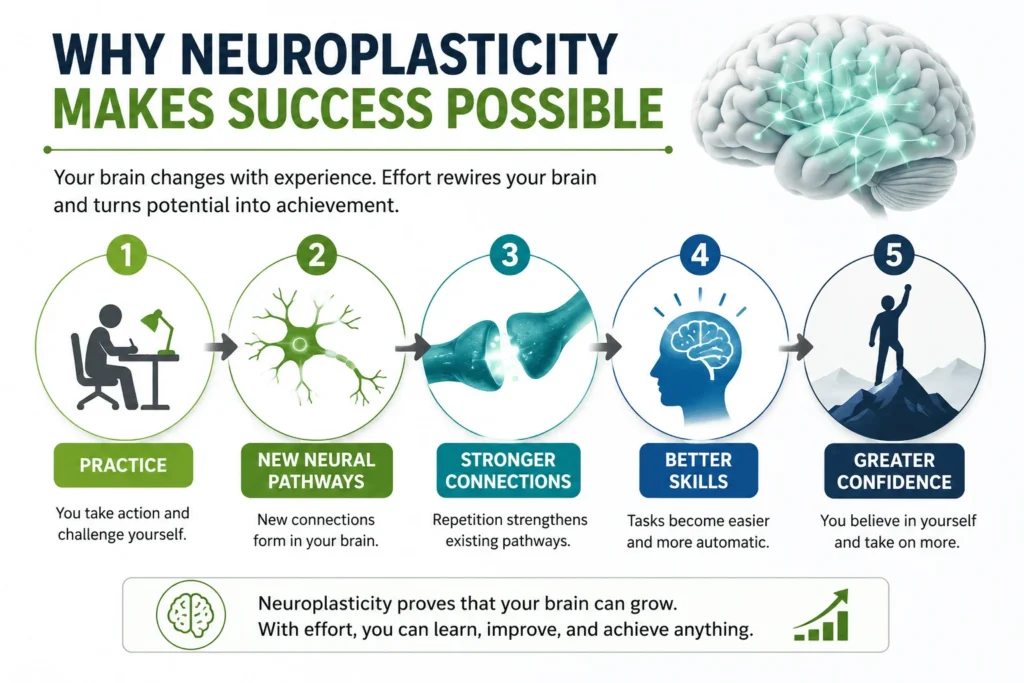
You can’t talk about mindset without understanding neuroplasticity. It’s the biological reason the growth mindset works.
Neuroplasticity is the brain’s ability to reorganize itself by forming new neural connections throughout life. For most of the 20th century, scientists believed the adult brain was relatively fixed. We now know that’s wrong. The brain changes with experience. New pathways form when you practice something. Existing pathways strengthen with repetition. Skills that once felt impossible become automatic.
This matters because it means the growth mindset isn’t just a nice belief. It’s anatomically accurate. Your brain literally changes in response to effort. When you struggle with something new, you’re not failing. You’re building infrastructure.
The process looks roughly like this:
Practice → New Neural Pathways → Stronger Connections → Better Skills → Greater Confidence
What surprised me was learning that this process continues throughout life. You don’t lose the ability to grow new neural connections as you age. The rate changes, but the mechanism persists. Although learning may become slower with age, research shows that older adults continue forming new neural connections through practice and experience. The belief that you’re “too old” to change is factually incorrect.
The practical implication is simple: repetition and focused practice physically change your brain. Every time you work on a skill, you’re not just practicing. You’re building the biological foundation for future performance.
Fixed Mindset vs Growth Mindset: Key Differences
Understanding the difference between these two is the foundation of everything else.
| Fixed Mindset | Success Mindset |
|---|---|
| Avoids challenges | Embraces challenges |
| Fears failure | Learns from failure |
| Seeks validation | Seeks improvement |
| Gives up quickly | Persists with better strategies |
| Avoids feedback | Welcomes useful feedback |
| Feels threatened by others’ success | Finds inspiration in others’ success |
Fixed Mindset
People with a fixed mindset believe intelligence and talent are mostly static. You have what you have. Effort might help at the margins, but fundamentally you’re either good at something or you’re not.
This leads to certain behaviors:
- Avoiding challenges that might expose weakness
- Giving up quickly when things get hard
- Seeing effort as a sign of inadequacy
- Ignoring or resenting feedback
- Feeling threatened by others’ success
I used to think I was just bad at math. Not “I haven’t learned it yet” or “I need a different approach.” Just bad at it. That belief prevented me from ever seriously trying to get better. Why invest effort in something you’re inherently bad at? Better to stick with what you’re already good at and protect your sense of competence.
Growth Mindset
A growth mindset is the belief that abilities can be developed through effort, learning, and persistence. It doesn’t deny that people have different starting points. It just rejects the idea that those starting points determine where you end up.
Growth mindset behaviors include:
- Embracing challenges as opportunities to stretch
- Persisting through obstacles
- Seeing effort as the path to mastery
- Learning from criticism rather than deflecting it
- Finding inspiration in others’ success
The growth mindset isn’t about pretending everything comes easily. It’s about interpreting difficulty differently. When someone with a growth mindset struggles, they think “I need to try a different approach” rather than “I’m not good at this.”
Why the Most Powerful Mindset for Success Is a Growth Mindset
If you had to pick one belief that changes everything downstream, it’s this: the belief that you can improve.
Everything else resilience, persistence, willingness to seek feedback, tolerance for discomfort flows from that core assumption. If improvement is possible, difficulty makes sense. If improvement isn’t possible, difficulty is just punishment.
People who sustain success rarely question whether they can get better. They might question their current approach. They might question whether they’re working on the right thing. But the underlying belief that improvement is possible with effort and strategy that’s rarely up for debate. It’s treated as obvious.
This is also why the fixed mindset is so limiting. It doesn’t just make you feel bad. It removes the logical reason to try. If talent is fixed, effort is pointless beyond a certain threshold. You might as well find what you’re already good at and stay there. The problem is that threshold is almost never where you think it is.
Five Traits of the Most Powerful Mindset for Success
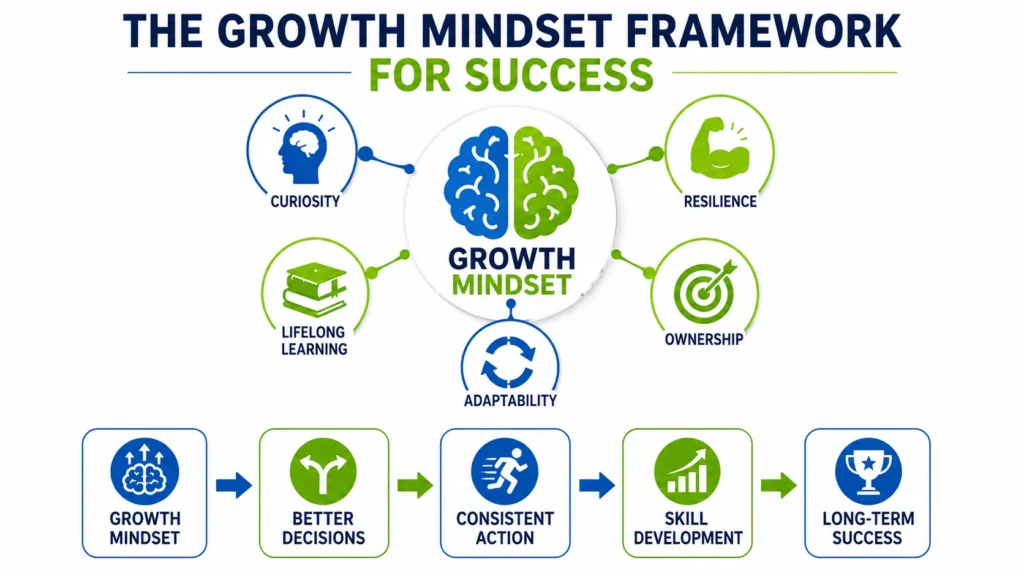
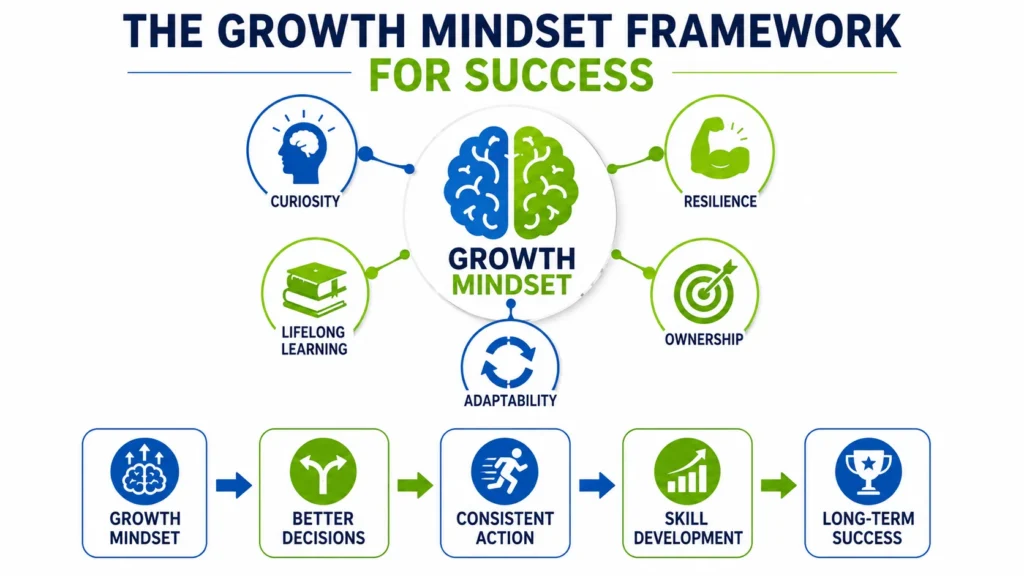
The growth mindset is the foundation, but the most powerful mindset for success includes several overlapping traits that show up consistently in people who sustain achievement over long periods.
Curiosity
Curiosity is the engine of learning. Without it, effort becomes grinding obligation. With it, difficulty becomes interesting. Curious people ask questions others don’t think to ask. They explore adjacent fields. They notice patterns. Curiosity also protects against the rigidity that sometimes comes with expertise.
Ownership
This is the belief that you’re responsible for your outcomes, even when external circumstances are genuinely unfair. People without ownership wait for conditions to improve. People with it ask “What can I do given the situation I’m in?” It’s not about self-blame. It’s about directing energy toward what you can actually influence.
Resilience
Resilience isn’t about being tough. It’s about recovering. The people who sustain success aren’t the ones who never get knocked down. They’re the ones who get back up faster and with less internal drama. Duckworth’s research on grit showed that this combination of passion and persistence predicts long-term achievement better than raw ability.
Adaptability
Things change. Industries shift. Skills become obsolete. People who cling to what used to work eventually get left behind. Adaptability means treating your current approach as temporary and revisable. It’s the opposite of “this is how I’ve always done it.”
Lifelong Learning
Formal education ends. Learning doesn’t have to. People with a success mindset treat learning as a permanent feature of life, not a phase that concludes with a diploma. They read, they ask questions, they seek out people who know things they don’t. This trait alone compounds enormously over decades.
A Success Mindset Is Not Blind Optimism
This distinction matters because a lot of people confuse the two.
Blind optimism says everything will work out regardless of what you do. A success mindset says your actions influence outcomes, so you should act thoughtfully and persistently.
Blind optimism ignores problems. A success mindset acknowledges problems and looks for solutions.
Blind optimism avoids negative emotions. A success mindset accepts that frustration, disappointment, and doubt are part of the process and doesn’t treat them as signs that something is wrong.
Realistic optimism which is closer to what a success mindset actually involves means believing that improvement is possible while accurately assessing the difficulty involved. It’s hope with its eyes open.
I’ve watched people burn out by trying to maintain relentless positivity. It’s exhausting and it doesn’t work. What works better is accepting that some days will be hard and still doing the thing anyway.
What Recent Research Says About Success Mindset
The conversation around mindset has evolved since Dweck’s early studies. The current understanding is more nuanced.
Growth mindset works. But it’s not a standalone solution. Researchers increasingly view mindset as one part of a broader system that includes motivation, effective learning strategies, emotional regulation, and supportive environments. Telling someone to believe they can improve without giving them the tools to actually improve is incomplete at best.
Deliberate practice matters. Ericsson’s work showed that not all practice is equal. Mindless repetition doesn’t produce growth. Focused, feedback-driven practice on specific weaknesses does. Mindset creates the willingness to engage in that kind of practice. But the practice itself requires structure.
Context plays a role. Opportunity, health, financial stability, and social support all influence outcomes. Mindset isn’t a substitute for addressing real barriers. It’s a tool for navigating them more effectively.
Coaching and feedback accelerate growth. People who combine a growth mindset with regular feedback from skilled mentors improve faster than those who try to figure everything out alone. The mindset makes you open to feedback. But you still need the feedback.
The current consensus among researchers is balanced: mindset is one factor among several. It’s a foundation, not a guarantee. It works best as part of a broader approach that includes skill development, strategy, and environmental support.
Limiting Beliefs That Hold People Back
Most people carry beliefs that quietly undermine them without ever being examined. Here are some of the most common ones.
“I’m too old to change.” Neuroplasticity continues throughout life. People change careers at 50, learn languages at 70, and develop new skills at every age. The belief is the barrier, not the biology.
“I’m not talented enough.” Talent helps at the starting line. But sustained effort and good strategy close most gaps over time. Many people who appear talented simply started earlier or practiced more deliberately.
“Successful people are different.” They’re not. They struggled with the same doubts and faced similar obstacles. What differed was their response over time, not their innate makeup.
“Failure means I’m not good enough.” Failure means the current approach didn’t work. That’s it. It’s information, not identity. Reframing this is one of the highest leverage shifts you can make.
“I’ll never change.” This is the most self-fulfilling belief of all. If you believe change is impossible, you won’t try. And if you don’t try, change is indeed impossible. The belief creates the reality.
“I need to feel ready first.” You almost never feel ready. Action comes first. Confidence follows, not the other way around.
Reframing these beliefs takes time. The first step is simply noticing when they show up. They usually appear as automatic thoughts during challenging moments.
6 Steps to Create a Mindset for Success
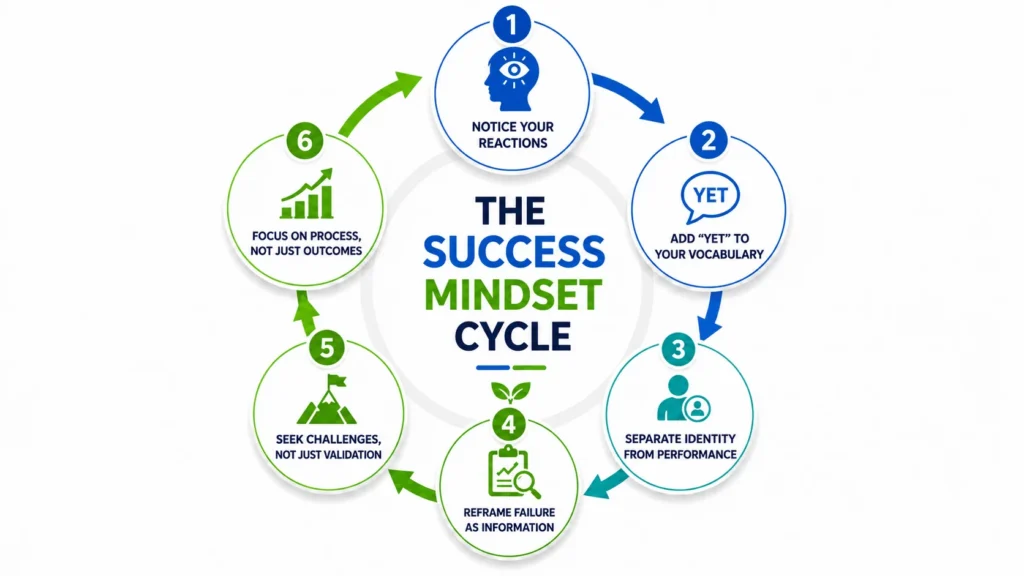
I’ve tried a lot of approaches over the years. Most of them didn’t stick. The ones that did had something in common: they were small enough to actually practice and concrete enough that I knew when I was doing them.
1. Notice Your Automatic Reactions
Before you can change anything, you have to see what’s already there.
Pay attention to what happens in your head when you face a challenge or receive criticism or see someone succeeding in an area where you’re struggling. Do you get defensive? Do you make excuses? Do you avoid? Just notice. Don’t try to change the reaction yet.
This step alone took me longer than I expected. Turns out I had a lot of fixed-mindset responses I’d never examined.
2. Add “Yet” to Your Vocabulary
This is the simplest technique in Dweck’s research and it actually works. When you catch yourself thinking “I’m not good at this” or “I can’t do this,” add the word “yet.”
“I’m not good at this yet.”
That single word changes the statement from a permanent verdict to a temporary state. I was skeptical when I first heard about this. Now I use it constantly.
3. Separate Your Identity from Your Performance
This is where people often struggle. When your performance is your identity, every failure becomes a threat to who you are. You can’t learn from criticism because criticism feels like an attack on your worth.
What helped most was realizing that I can be bad at something right now without being a bad person. Performance is temporary. Identity doesn’t have to be tied to it.
4. Reframe Failure as Information
Failure isn’t fun. I’m not suggesting you pretend it is. But failure does contain useful information if you’re willing to look at it.
What specifically went wrong? What could you try differently next time? These questions shift failure from an endpoint to a data point.
5. Seek Out Challenges, Not Just Validation
This one is uncomfortable. Most of us naturally gravitate toward things we’re already good at because it feels nice to succeed.
Building a growth mindset means deliberately spending time in situations where you might struggle or look incompetent. Not all the time. Just regularly enough that you get practice being a beginner.
6. Pay Attention to Process, Not Just Outcomes
Outcomes matter. But they’re often not fully under your control. What is under your control is the process: showing up, doing the work, trying different approaches when something isn’t working.
If you only feel successful when you get the result you wanted, you’re going to spend a lot of time feeling like a failure. If you can feel successful when you executed the process well regardless of outcome, you can sustain effort much longer.
Common Mistakes People Make
Over the years I’ve watched people (and myself) stumble in a few predictable ways when trying to shift their mindset.
Mistaking a growth mindset for blind optimism. Believing you can improve doesn’t mean believing improvement is guaranteed or easy. The growth mindset isn’t about positive thinking. It’s about accurate thinking.
Praising effort without results. This was a big correction Dweck had to make based on how her research was applied. Telling someone “good effort” when they failed isn’t helpful if the effort wasn’t effective. The point is to praise effort plus strategy adjustment, not just trying hard in the same ineffective way.
Thinking you either have it or you don’t. Nobody has a pure growth mindset. Everyone has triggers that send them into fixed-mindset thinking. The goal isn’t perfection. It’s catching yourself faster and recovering more smoothly.
Trying to change everything at once. I’ve done this. It doesn’t work. Mindset shifts happen gradually, through repeated small choices, not through dramatic declarations.
What This Looks Like in Ordinary Life
Most discussions of mindset use examples of famous people athletes, CEOs, historical figures. But a high-performance mindset shows up in ordinary situations more than extraordinary ones.
It looks like:
- Someone who gets passed over for a promotion, gets upset for a day, and then starts figuring out what skills to build for next time
- A person who tries to learn guitar, sounds terrible for months, and keeps practicing anyway because they believe sounding terrible is a phase, not a verdict
- Someone who receives harsh feedback on a project, feels the sting, and then actually reads through the comments to find useful points
- A runner who misses their goal time in a race, is disappointed, and adjusts their training plan rather than concluding they’re “just not a runner”
People who sustain progress aren’t necessarily more talented. They just interpret setbacks differently. The setback happens either way. The question is what happens after.
Mindset Traits of Highly Successful People
When you look at people who’ve sustained success over long periods, certain patterns emerge. These aren’t secrets. They’re observable behaviors that follow from the underlying mindset.
Curiosity. They ask more questions than average. They explore fields outside their own. They read widely. Curiosity keeps them learning long after most people settle into what they already know.
Ownership. They don’t blame circumstances, even when circumstances are genuinely to blame. They focus on what they can control and act on it. This isn’t denial. It’s pragmatism.
Discipline. Motivation comes and goes. They have systems that function regardless. Their identity isn’t tied to feeling inspired.
Adaptability. When conditions change, they adjust. They don’t cling to approaches that stopped working. They treat strategies as hypotheses, not identities.
Long-term thinking. They make decisions based on where they want to be in years, not how they want to feel right now. This shows up in career choices, health habits, financial decisions, and relationships.
Comfort with discomfort. They’ve learned that growth lives on the other side of difficulty. Not because they enjoy suffering. Because they’ve experienced enough cycles of struggle-then-improvement to trust the process.
Habits That Support the Most Powerful Mindset for Success
The habits of successful people aren’t secrets. They’re mostly boring, repeated behaviors that compound over time. Here are the ones that seem most connected to maintaining a growth-oriented mindset:
Reading and learning consistently. Not in a frantic, self-improvement-obsessed way. Just steadily. Successful people tend to treat learning as a permanent feature of life, not something that ends after formal education.
Seeking feedback actively. Most people avoid feedback because it’s uncomfortable. People who build successful careers tend to ask for it before it’s offered.
Maintaining routines even when motivation disappears. Motivation is unreliable. Systems are less so. The people I know who sustain success over decades have routines they follow regardless of how they feel.
Resting deliberately. This one doesn’t get mentioned enough. Burnout doesn’t produce growth. The people who last understand that recovery is part of performance, not an interruption of it.
Focusing on what they can control. Energy spent on things outside your control is energy not spent on things within it. This is simple to understand and hard to practice consistently.
Success Mindset in Different Areas of Life
The principles of a success mindset apply everywhere, but how they show up varies by context.
Career
In professional settings, a success mindset means seeking challenging assignments, asking for feedback even when it’s uncomfortable, and treating setbacks as learning opportunities. It also means taking ownership of your career development rather than waiting for someone else to manage it.
Business and Entrepreneurship
Business success requires tolerating uncertainty. Most ventures fail before they succeed. A success mindset here means treating failures as experiments, adapting quickly, and persisting through periods where nothing seems to work.
Education
Students with a growth mindset seek understanding rather than just grades. They ask questions when confused, study differently after poor performance, and treat difficulty as a normal part of learning rather than evidence they don’t belong.
Health and Fitness
Physical goals reveal mindset patterns quickly. People with a fixed mindset often quit after a few missed workouts, interpreting inconsistency as proof they’re not disciplined. People with a growth mindset accept that inconsistency happens and restart without self-judgment.
Relationships
Mindset affects relationships too. A fixed mindset treats conflict as evidence of incompatibility. A growth mindset treats it as a problem to solve together. One leads to ending things prematurely. The other leads to deeper understanding over time.
Financial Goals
Financial growth requires delayed gratification and learning about topics many people find intimidating. A success mindset here means educating yourself gradually, making mistakes without shame, and staying focused on long-term progress rather than short-term comparison.
Self-Talk Examples
The way you talk to yourself reveals your underlying mindset. Here are some common fixed-mindset thoughts and their growth-mindset alternatives.
| Fixed Mindset | Success Mindset |
|---|---|
| I can’t do this. | I can’t do this yet. |
| I’m not smart enough. | I need a different approach. |
| I’ll never change. | I’ve changed before. I can do it again. |
| Failure means I’m not good enough. | What can I learn from this? |
| They’re naturally talented. | What can I learn from how they practice? |
| This is too hard. | This is hard, which means I’m growing. |
| I’m not a math person. | I haven’t learned this type of math yet. |
| Criticism means I’m bad at this. | What’s useful in this feedback? |
The goal isn’t to never have the fixed-mindset thought. It’s to catch it and reframe it faster over time. The gap between the thought and the reframe shrinks with practice.
Daily Success Mindset Checklist
Small daily practices reinforce mindset more effectively than occasional big efforts. Here’s a simple checklist.
- Read something for at least 10 minutes
- Identify one lesson learned from the previous day
- Notice and reframe one limiting thought
- Ask for feedback from someone
- Do one thing outside your comfort zone
- Write down one thing you’re grateful for
- Review one goal and check alignment with current actions
Not every day will hit all seven. That’s fine. The point is to have a structure that keeps mindset practices present in your daily life rather than something you think about once and forget.
30-Day Success Mindset Challenge
This is a structured way to build momentum if you’re starting from scratch. Each week focuses on a different aspect of mindset development.
Week 1: Awareness
Days 1-7: Notice limiting beliefs.
Don’t try to change anything yet. Just pay attention. When you face a challenge, receive criticism, or compare yourself to someone else, notice what thoughts arise automatically. Write them down. You’re mapping your current mental landscape.
Week 2: Reframing
Days 8-14: Replace fixed-mindset language.
Start catching the limiting beliefs you identified in week one. When you notice “I can’t do this,” add “yet.” When you catch “I’m not good at this,” reframe to “I’m still learning this.” The goal is to make the reframe feel more natural by the end of the week.
Week 3: Seeking Feedback
Days 15-21: Ask for constructive feedback.
This is uncomfortable for most people. Start small. Ask a trusted colleague or friend for one thing you could improve. Listen without defending. Say “thank you.” Then decide whether the feedback is useful. The practice here is receiving input without treating it as a personal attack.
Week 4: Reflection and Adjustment
Days 22-30: Review and plan forward.
Look back at the past three weeks. What patterns did you notice? Which reframes were hardest? What feedback surprised you? Based on what you learned, adjust your approach for the next month. The challenge isn’t about perfection. It’s about building the habit of examining your own thinking.
When It Doesn’t Work
I should mention this because it’s rarely discussed in articles about mindset.
Sometimes a growth mindset isn’t the answer to the problem. If you’re in an environment that punishes mistakes harshly, or where feedback is consistently destructive rather than constructive, no amount of internal reframing will fix that. The environment matters.
Mindset is one contributing factor, not the whole picture. It doesn’t replace the need for actual skill development, good strategy, or supportive contexts. The current research is clear on this. Mindset works best alongside deliberate practice, quality coaching, and environments that reward learning.
Also, there are times when persisting is the wrong choice. Knowing when to quit something that isn’t working and not framing that as a personal failure is its own skill. The growth mindset shouldn’t become an excuse to stay in situations that genuinely don’t fit.
Final Thoughts
Your mindset doesn’t determine your future overnight, but it shapes the choices you make every day. A growth mindset, combined with deliberate practice, resilience, and ownership, creates the conditions for long-term success. The goal isn’t to become fearless or perfect. It’s to stay curious, keep learning, and continue improving one decision at a time.
Frequently Asked Questions
What is the most powerful mindset for success?
The most powerful mindset for success is a growth mindset combined with ownership, resilience, and action orientation. It’s the belief that abilities can be developed through effort and learning, paired with the willingness to take responsibility for outcomes and act before feeling ready.
How does mindset affect success?
Mindset affects success by shaping how you respond to challenges, setbacks, and feedback. A growth mindset leads to persistence, learning from mistakes, and seeking improvement, while a fixed mindset leads to avoidance, giving up, and ignoring useful criticism.
Can mindset be changed?
Yes. Mindset is not a fixed personality trait. It’s a set of beliefs that can shift through awareness, practice, and deliberate reframing. The process takes time and involves catching automatic reactions and choosing different interpretations.
What is the difference between fixed mindset and growth mindset?
A fixed mindset assumes abilities are static. A growth mindset assumes they can be developed. This single difference affects how people approach challenges, handle criticism, and respond to others’ success.
Why is mindset important for success?
Mindset is important because it creates the interpretive framework for everything that happens to you. Two people can face identical setbacks. One sees proof of inadequacy. The other sees information for improvement. Their outcomes diverge accordingly.
What are some examples of a growth mindset in everyday life?
Examples include someone learning a new language and accepting that mistakes are part of the process, a manager who asks their team for feedback on how they can improve, or a person who tries a hobby they’re terrible at and keeps going because the goal is learning, not immediate competence.
Remember: A growth mindset doesn’t mean believing you’ll succeed at everything. It means believing you can learn, adapt, and improve through consistent effort and effective strategies.
If you’re starting from scratch, pick one thing from the 30-day challenge and practice it for a couple of weeks before adding anything else. What usually happens is people read articles like this, feel inspired, try to change everything at once, and then revert to old patterns within a month. I’ve done that. It’s not a character flaw. It’s just how change works when you try to do too much at once.
Start with noticing. Just pay attention to what your mind does when things get hard. That alone will shift something.