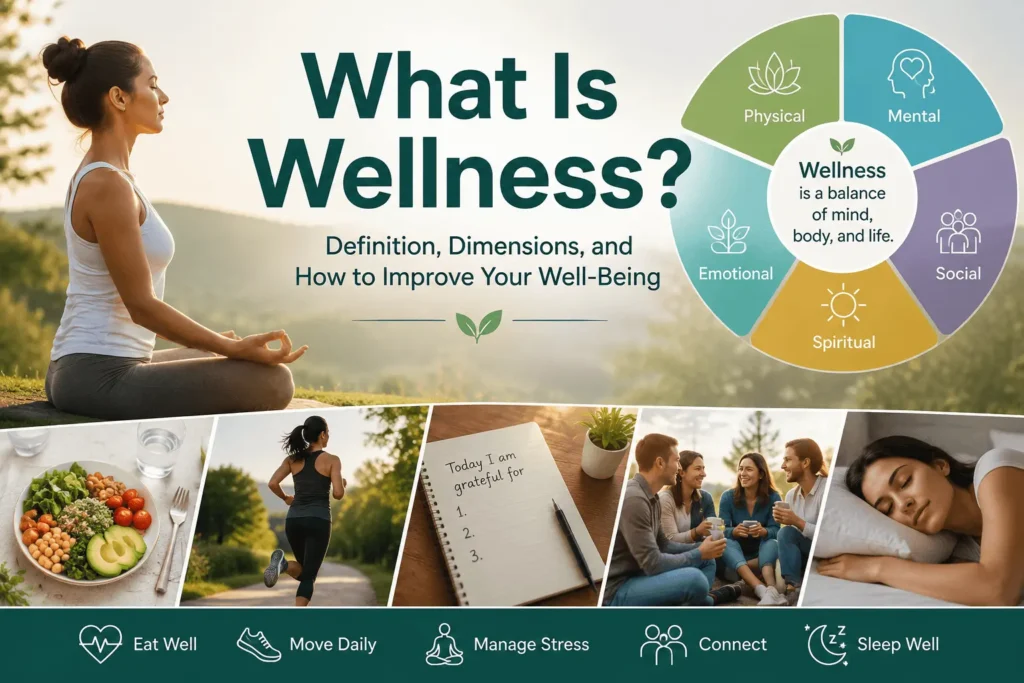
Wellness is the active pursuit of habits, behaviors, and lifestyle choices that support physical, mental, emotional, and social well-being. It goes beyond simply being free from illness. It is about proactively improving your overall quality of life through consistent, intentional actions across multiple areas of health.
For years, I thought wellness was just about eating salads and going to the gym. Maybe you have had the same impression. That it is something other people do. People who have their lives together in ways you do not quite manage.
Then I spent a year feeling exhausted, anxious, and disconnected, even though I was technically doing all the “right” things. I was exercising regularly. I was eating reasonably well. But something was still missing.
That is when I started looking more seriously at what wellness actually means. And I realized I had been thinking about it wrong. Understanding what is wellness and how it connects to overall well-being, health habits, and the different dimensions of wellness completely shifted my approach.
What is wellness? Wellness is the active pursuit of practices, habits, and mindsets that contribute to overall health and quality of life. It goes beyond simply being free from illness. It is about proactively improving your physical, mental, emotional, social, and spiritual well-being to live a more balanced and fulfilling life.
Organizations such as the Global Wellness Institute define wellness as “the active pursuit of activities, choices, and lifestyles that lead to holistic health.” The World Health Organization similarly emphasizes that health is a state of complete physical, mental, and social well-being, not merely the absence of disease.
The National Wellness Institute, one of the oldest organizations dedicated to this field, defines wellness as a conscious, self-directed, and evolving process of achieving full potential. Wellness frameworks used by universities and public health organizations consistently highlight that well-being is multidimensional and requires ongoing attention across different areas of life. World Health Organization definition of health, Global Wellness Institute definition, and National Wellness Institute wellness model all reinforce that wellness is an active, multidimensional process.
What Is Wellness? A Clear Definition
Wellness is often confused with health. Health typically means the absence of disease or injury. It is a state of being. Wellness is different. It is an active, ongoing process of making choices that support your well-being.
The Global Wellness Institute defines wellness as “the active pursuit of activities, choices, and lifestyles that lead to a state of holistic health.” The National Wellness Institute describes it as a conscious, self-directed, and evolving process of achieving full potential. That matters because it puts the emphasis on action. Wellness is not something you achieve and then stop working on. It is something you practice.
Public health organizations and university wellness programs typically break wellness down into multiple interconnected dimensions. While different frameworks use slightly different categories, most agree that true well-being requires attention to physical, mental, emotional, social, and spiritual health.
At its core, wellness means taking responsibility for your own well-being. It is recognizing that your daily choices, what you eat, how you move, who you spend time with, what you think about, all contribute to how you feel and function.
For me, understanding this distinction was a turning point. I stopped waiting to feel “well enough” and started focusing on small, daily choices that gradually improved how I felt. It was not dramatic. But over time, it added up.
I went through a phase of buying supplements I barely used, convinced that the right combination of vitamins would fix how I felt. For a few weeks I tried waking up at 5 AM because everyone online seemed to recommend it, only to realize I was just more tired. I rearranged my desk one afternoon and ended up focusing better without really knowing why. My environment was influencing me more than I had realized.
What Is Wellness and Why Is It Important?
Understanding what is wellness matters because it affects every aspect of your life. Not just how you feel physically, but also how you think, how you relate to others, and how you handle challenges.
When you understand what is wellness, you realize that it is not about being perfect or following someone else’s rules. It is about building a sustainable lifestyle that supports your overall well-being. The definition of wellness emphasizes that well-being is multidimensional and requires attention to physical, mental, emotional, and social health.
If someone asks what is wellness, the simplest answer is that it is the ongoing practice of improving your overall well-being. Wellness is important because it helps you:
- Have more consistent energy throughout the day
- Handle stress more effectively
- Build stronger relationships
- Feel more in control of your life
- Maintain better physical and mental health over time
This is where people often get stuck. They try to fix one area and ignore the others. But wellness is holistic. The different parts of your life do not exist in isolation, and pretending they do only makes improvement harder.
The wellness lifestyle is about recognizing that small, consistent actions across multiple areas of your life add up to meaningful change. It is not about perfection. It is about progress.
The Six Dimensions of Wellness
Wellness is usually broken down into several interconnected dimensions. Different models include slightly different categories, but most wellness frameworks agree on these core areas:
1. Physical Wellness
Physical wellness involves taking care of your body through regular movement, proper nutrition, adequate sleep, and avoiding harmful habits. It means listening to your body’s signals and responding to what it needs.
2. Mental Wellness
Mental wellness refers to how you process information, learn new things, and handle challenges. It includes cognitive flexibility, problem-solving ability, and the capacity to maintain focus.
3. Emotional Wellness
Emotional wellness is about understanding and managing your feelings. It includes stress management, self-awareness, and the ability to express emotions in healthy ways.
4. Social Wellness
Social wellness involves building and maintaining meaningful relationships. It includes communication skills, connection to community, and the ability to give and receive support.
5. Spiritual Wellness
Spiritual wellness is about finding meaning and purpose. It does not necessarily involve religion. It can mean anything that gives you a sense of direction, connection, and values to live by.
6. Occupational and Environmental Wellness
Occupational wellness relates to finding satisfaction and purpose in your work. Environmental wellness involves creating spaces that support your health and well-being, both your physical surroundings and the broader environment.
These dimensions overlap constantly. Improving one often helps another. Many universities and wellness programs use these dimensions as the foundation for their health promotion initiatives.
Physical Wellness: More Than Just Exercise
Physical wellness gets the most attention, which makes sense. It is the easiest to measure. Steps, pounds, hours of sleep, minutes of exercise. But it is also the area where people most often get stuck.
The standard advice around physical wellness tends to be: exercise more, eat better, sleep enough. That is accurate. But it is also incomplete.
Physical wellness is about building a sustainable relationship with your body. It is not about punishing yourself with workouts or restrictive eating. It is about moving in ways that feel good, eating food that nourishes you, and resting when you need to.
What I learned the hard way was that extreme approaches do not work. I went through phases of intense exercise followed by months of doing nothing. I tried restrictive diets that left me tired and craving everything. Eventually I realized that consistency matters more than intensity. A twenty-minute walk I actually do is more valuable than an hour-long workout I quit after two weeks.
Practical Physical Wellness Habits
- Move your body daily, even if it is just a short walk
- Eat a balanced diet with plenty of vegetables and protein
- Prioritize sleep, aim for consistent timing and duration
- Stay hydrated throughout the day
- Limit alcohol and avoid smoking
- Take breaks from sitting during the day
Mental Wellness: How You Think Matters
Mental wellness is about how you process information, handle challenges, and maintain focus. It includes cognitive flexibility, problem-solving ability, and the capacity to manage the demands of daily life.
For me, mental wellness was the area I neglected most. I assumed that as long as I was not anxious or depressed, my mental health was fine. But mental wellness is not just about avoiding mental illness. It is about actively building the mental capacity to handle whatever life throws at you.
This includes things like learning new skills, staying curious, and challenging your own thinking patterns. It is about recognizing when you are stuck in unhelpful thought loops and having strategies to shift out of them.
Digital overload has made this harder for everyone. Constant notifications, short-form videos, and the endless scroll have rewired attention spans in ways we are only beginning to understand. Mental wellness today means deliberately protecting your attention and creating space for deeper thinking.
The rise of remote work has also blurred the lines between professional and personal life. Many people now struggle to disconnect, leading to mental fatigue that spills into every other area of wellness.
Practical Mental Wellness Habits
- Read regularly, even if it is just a few pages a day
- Limit digital distraction and screen time
- Practice focusing on one task at a time
- Learn something new that challenges your brain
- Take breaks throughout the day to clear your mind
- Be aware of your thought patterns and question negative assumptions
Emotional Wellness: Understanding Your Feelings
Emotional wellness is often confused with being happy all the time. That is not what it means. Emotional wellness is about understanding and managing your emotions, not avoiding negative ones.
I used to think that emotional wellness meant staying calm and composed no matter what. I would suppress frustration, swallow anger, and pretend I was not stressed. That approach worked for a while. Then it did not.
What I eventually realized is that emotions are information. They tell you something about what is happening in your life and what you need. Suppressing them does not make them disappear. It just stores them up for later.
Emotional wellness includes the ability to recognize what you are feeling, understand why you are feeling it, and express it in ways that are healthy and productive. It is also about building resilience. The capacity to recover from setbacks and difficult experiences.
Practical Emotional Wellness Habits
- Practice naming your emotions without judgment
- Develop healthy ways to manage stress (deep breathing, journaling, talking to someone)
- Build a vocabulary for your feelings beyond “good” and “bad”
- Allow yourself to feel difficult emotions without trying to fix them immediately
- Seek support when you need it, whether from friends, family, or professionals
- Practice self-compassion rather than self-criticism
Social Wellness: The Connection Factor
Social wellness is about the quality of your relationships and your sense of belonging. It includes your ability to build and maintain meaningful connections with others.
Social wellness is often overlooked, partly because it can feel less urgent than physical or mental health. But large studies published over the past two decades have repeatedly linked strong social relationships with lower mortality risk, improved mental health, and better stress management. People with strong social networks tend to be healthier, live longer, and handle stress better.
Looking back, most of my friendships survived on proximity rather than intention. If someone moved away or changed jobs, we slowly stopped talking. When I started being more deliberate about who I spent time with and how I showed up in relationships, everything shifted.
Social wellness does not require a large social circle. The quality of your relationships matters more than the quantity. A few genuine connections are more valuable than dozens of superficial ones.
Social media fatigue and always-on culture have made social wellness more complicated. It is easy to mistake digital interaction for genuine connection. Taking intentional steps to build real-world relationships has become an important part of personal wellness.
Practical Social Wellness Habits
- Prioritize time with people who genuinely support you
- Practice active listening when others speak
- Reach out to friends and family regularly, even just to check in
- Join groups or activities that connect you with people who share your interests
- Set boundaries with people who drain your energy
- Be willing to ask for and offer help
Spiritual Wellness: Finding Meaning
Spiritual wellness is the most misunderstood dimension. Many people assume it means being religious, and if they are not religious, they disregard it entirely.
But spiritual wellness is not necessarily about religion. It is about finding meaning, purpose, and a sense of connection to something larger than yourself. This might be through organized religion, but it could also be through nature, art, community service, or personal values.
For me, spiritual wellness meant figuring out what I actually believe and what matters to me. It is not about having all the answers. It is about asking the questions and being open to what you find.
Practical Spiritual Wellness Habits
- Reflect on what gives your life meaning and purpose
- Spend time in nature
- Practice mindfulness or meditation
- Identify your core values and use them to guide decisions
- Engage in activities that make you feel connected to something greater
- Take time for quiet reflection and stillness
Occupational and Environmental Wellness
Occupational wellness is about finding satisfaction and purpose in your work. It does not mean you have to love every second of your job, but it does mean finding some sense of meaning and engagement in what you do.
Environmental wellness involves creating spaces that support your health and well-being. Your home, your workspace, your community. It also includes awareness of the broader environment and your impact on it.
Both of these areas can have a huge impact on how you feel. I did not realize how much my physical environment affected my mood until I spent months working in a dark, cluttered room during remote work. Creating a space that actually felt good to be in made a surprising difference.
Practical Occupational Wellness Habits
- Find work that aligns with your values and interests
- Set boundaries between work and personal time
- Take regular breaks during the workday
- Seek growth and learning opportunities at work
- Build positive relationships with colleagues
Practical Environmental Wellness Habits
- Create spaces that feel comfortable and calming
- Declutter your physical surroundings regularly
- Spend time outdoors when possible
- Support sustainable practices in your daily life
- Reduce exposure to noise and digital clutter
Benefits of Wellness for Physical and Mental Health
The benefits of wellness extend far beyond just feeling better in the moment. When you consistently work on your well-being across multiple dimensions, the positive effects accumulate over time.
Physical health benefits include:
- Improved cardiovascular health and lower blood pressure
- Better immune function and fewer illnesses
- More consistent energy levels throughout the day
- Better sleep quality and duration
- Reduced risk of chronic conditions
Mental health benefits include:
- Lower stress and anxiety levels
- Improved mood and emotional stability
- Better focus and cognitive function
- Greater resilience during difficult periods
- Enhanced self-awareness and emotional regulation
Even small improvements in wellness habits can lead to noticeable changes. Many people find that consistent exercise improves not just their physical health but also their mental clarity and emotional stability. Good sleep supports both physical recovery and emotional regulation. Social connection provides both emotional support and practical help during challenging times.
The benefits of wellness are cumulative. Each area you work on makes the others easier to maintain. Regular exercise improves sleep. Better sleep supports emotional regulation. Emotional stability helps maintain relationships. Strong relationships provide support for physical health habits.
The Long-Term Impact of Wellness
The long-term benefits of wellness are significant and well-documented. People who consistently practice wellness habits tend to have lower rates of chronic disease, better mental health outcomes, and higher overall life satisfaction. The importance of wellness becomes more apparent as people age. Those who have built sustainable wellness habits earlier in life often find it easier to maintain their health and independence later on.
The benefits of wellness are not just physical. They also include improved cognitive function, better emotional regulation, and stronger social connections. These benefits reinforce each other, creating a positive cycle that supports long-term well-being.
Why Wellness Is Important for Overall Quality of Life
Wellness is important because it directly affects how you experience your daily life. When you feel physically well, mentally sharp, and emotionally balanced, you are better equipped to handle challenges, build meaningful relationships, and pursue your goals.
The importance of wellness extends to every area of life, including work, relationships, and personal fulfillment. People who prioritize their well-being tend to have more energy, greater resilience, and a stronger sense of purpose. The benefits of wellness are not just about avoiding illness. They are about creating a life that feels good to live.
Examples of Wellness in Everyday Life
Wellness is not something you do separately from your regular life. It shows up in small, ordinary moments.
Here are some examples of what wellness can look like day to day:
- Taking a short walk after work instead of sitting on the couch immediately
- Staying hydrated by keeping a water bottle at your desk
- Calling a friend just to catch up, not because you need something
- Getting enough sleep by consistently going to bed at a reasonable hour
- Setting work boundaries by closing your laptop at the end of the day
- Spending time outdoors even if it is just sitting in a park for a few minutes
- Eating a real meal rather than grabbing something processed
- Taking a few deep breaths before reacting to something stressful
- Turning off notifications during focused work or family time
- Doing something creative just for the sake of enjoying it
These small actions add up. They form the foundation of a wellness lifestyle.
I once left a half-finished wellness journal on a shelf and did not notice it again for months. At first I felt guilty about it. Then I realized that the journal itself did not matter. What mattered was whether I was actually paying attention to how I felt.

Modern Wellness Challenges
Wellness today looks different than it did a generation ago. The challenges we face are often connected to modern life in ways that older wellness frameworks did not fully anticipate.
Digital overload is one of the biggest challenges. The average person spends several hours daily on screens, often without realizing the cumulative effect on attention, sleep, and mental health. Constant notifications fragment focus and make it harder to engage deeply with anything.
Remote work fatigue has become increasingly common. The blurring of professional and personal boundaries makes it harder to truly disconnect. Many people now find themselves working longer hours with fewer clear breaks.
Social media comparison affects mental wellness in ways that are still being understood. It is easy to mistake curated online content for reality and feel inadequate by comparison.
Sedentary behavior has increased significantly, partly due to remote work and partly due to the pull of digital entertainment. Extended sitting has been linked to various health concerns, independent of exercise habits.
Information overload makes it harder to focus and process information. The constant flow of news, notifications, and content can create a sense of mental clutter that affects emotional wellness.
Sleep disruption from screens affects a significant portion of adults. The blue light emitted by devices interferes with natural sleep cycles, and the content we consume before bed can keep our minds active when we need to wind down.
Technology and Wellness
Another emerging challenge is the pressure to optimize every aspect of life. Wellness apps, fitness trackers, and AI-powered productivity tools can be helpful, but they can also make people feel like they are constantly measuring themselves. The data they provide can be useful, but it can also create anxiety about whether you are doing “enough.” Sometimes wellness means stepping away from the data and paying attention to how you actually feel. It is about using technology as a tool, not letting it become a source of stress.
Addressing these modern challenges often requires intentional changes to digital habits. Setting screen time limits, creating device-free zones, and establishing clear boundaries around work hours can help protect wellness in a digital world.
How to Build a Daily Wellness Routine
The idea of improving your overall well-being can feel overwhelming. There are so many dimensions, so many habits, so many things you could do differently.
Here is what helped me. I stopped trying to work on everything at once.
Start Small
Choose one area to focus on. Maybe it is getting enough sleep. Maybe it is moving more. Maybe it is connecting with someone you care about.
Starting small means you are more likely to actually do it. Once that habit is established, you can add another.
Create Simple Daily Practices
You do not need a complicated morning routine. You need a few simple practices that you can actually maintain.
For me, the most sustainable approach involved:
- Morning: five minutes of stretching, drinking water, not checking my phone immediately
- Daytime: getting outside for a short walk, taking breaks, eating a real meal
- Evening: avoiding screens before bed, a consistent sleep time
Do Not Aim for Perfection
Wellness is not about being perfect. It is about being consistent. Missing a day does not mean you have failed. It just means you start again tomorrow.
I bought a wellness tracker once and obsessed over every metric for about three weeks. Then I forgot about it entirely. The habits I actually kept were the ones that felt easy and natural, not the ones I forced.
Pay Attention to What Works
Wellness is personal. What works for someone else might not work for you. Pay attention to how different habits make you feel and adjust accordingly.
I noticed, for instance, that morning walks made a bigger difference in my mood than intense workouts. That does not mean exercise is bad. It just means walking worked better for me.
Consider Your Wellness Journey as Ongoing
Your personal wellness will shift over time. What you need in your twenties might look different in your forties. Life transitions, moving, changing jobs, starting a family, will require you to adjust your approach. That is normal, not a sign that you are failing.
Common Wellness Mistakes
Most people make the same mistakes when trying to improve their wellness. I have made all of them.
Mistake 1: Focusing Only on Physical Health
It is tempting to think wellness is just about eating well and exercising. But the other dimensions matter just as much. You can be physically fit and still feel miserable if your emotional or social needs are not being met.
Mistake 2: Trying to Change Everything at Once
This is the most common mistake. People try to overhaul their entire lifestyle overnight. New diet, new workout routine, new sleep schedule, meditation, journaling. It is unsustainable. You burn out and give up.
Mistake 3: Ignoring Your Environment
Your surroundings have a huge impact on your behavior. If your home is cluttered, your workspace is distracting, and your phone is always in reach, it is harder to maintain healthy habits. Changing your environment is often easier than changing your behavior directly.
Mistake 4: Waiting for Motivation
Motivation comes and goes. Wellness is not about waiting to feel like it. It is about creating systems that work even when you do not feel motivated. This means making good choices convenient and bad choices harder.
Mistake 5: Neglecting Social Connection
Many people focus on fitness and nutrition but overlook their social life. Social connection is essential for well-being, not optional. Spending time with people who support you matters as much as eating well.
Mistake 6: Thinking Wellness Is the Same for Everyone
Wellness looks different for different people. What works for someone else might not work for you. Pay attention to your own needs and preferences rather than following generic advice.
Frequently Asked Questions
What is the definition of wellness?
Wellness is the active pursuit of practices, habits, and mindsets that contribute to overall health and quality of life. It goes beyond simply being free from illness to proactively improving physical, mental, emotional, social, and spiritual well-being.
What does wellness mean in daily life?
In daily life, wellness means making choices that support your health and happiness. This could include moving your body, eating nourishing food, getting enough sleep, managing stress, connecting with others, and doing things that give your life meaning.
What are the six dimensions of wellness?
The six dimensions typically include physical wellness, mental wellness, emotional wellness, social wellness, spiritual wellness, and occupational or environmental wellness. Each dimension supports the others and all contribute to overall well-being.
What are the 8 dimensions of wellness?
Some wellness frameworks include eight dimensions. In addition to physical, mental, emotional, social, spiritual, occupational, and environmental wellness, the eighth dimension is often financial wellness. Managing financial resources in a way that reduces stress and supports long-term well-being.
Why is wellness important?
Wellness matters because it affects how you feel, how you function, and your ability to handle challenges. People who actively work on their wellness tend to have more energy, better relationships, and a greater sense of purpose and satisfaction in life.
How can I improve my wellness starting today?
Start with one small change. Choose an area that matters to you. Maybe it is taking a short walk, drinking more water, getting to bed earlier, or calling someone you care about. Consistency matters more than intensity, so focus on something sustainable.
Is wellness the same as health?
Not exactly. Health typically refers to the absence of illness, while wellness is an active process of making choices that support your well-being. You can be physically healthy in a medical sense but still feel unwell in other areas. Wellness is broader and more proactive.
What are some examples of wellness habits?
Examples include regular physical activity, balanced eating, consistent sleep, stress management, reading, spending time outdoors, maintaining relationships, practicing gratitude, setting boundaries, and taking time for activities that bring you joy.
How does wellness affect mental health?
Wellness and mental health are deeply connected. Good physical health supports mental health, and vice versa. Practices like exercise, social connection, good sleep, and stress management all contribute to better mental health. Neglecting one area can affect the others.
What is holistic wellness?
Holistic wellness means considering the whole person, physical, mental, emotional, social, and spiritual dimensions, rather than focusing on one area in isolation. It recognizes that all aspects of well-being are interconnected and that true health requires attention to all of them.
What are the benefits of wellness?
The benefits of wellness include improved physical health, better mental clarity, stronger emotional resilience, more meaningful relationships, greater life satisfaction, and a reduced risk of many chronic conditions. These benefits accumulate over time when wellness practices become consistent.
Final Thoughts
If you are wondering where to start, pick one thing that matters to you and make it small enough to actually do consistently. That could mean a ten-minute walk instead of a gym session. Taking five minutes to breathe instead of meditating for an hour. Calling one friend instead of trying to build a whole social network.
The people I know who have built sustainable wellness practices did not do it overnight. They made small changes, paid attention to what worked, adjusted when something did not, and kept going. They do not have it all figured out. They just keep showing up.
Wellness is not about being perfect. It is not about doing everything right. It is about moving in the right direction, most of the time, and being kind to yourself when you do not.
The goal is not to become someone different. It is to create a life that supports the things that actually matter to you. The more you can build systems that make wellness easier, the less energy you spend fighting yourself. And the more energy you have for the things that make life meaningful.