
I’ve started more morning routines than I can count.
Some lasted a few months. Some lasted three days. One involved waking up at 5 AM to journal and meditate, and I genuinely believed I’d finally cracked the code. Then I went on a weekend trip, came home late Sunday night, and never did it again.
For a long time I thought the problem was me. That I lacked discipline or didn’t want it badly enough. But after years of starting, stopping, restarting, and paying attention to what actually worked versus what only worked temporarily, I realized something different.
The problem wasn’t motivation. The problem was that most habit advice assumes life stays predictable.
It doesn’t.
Learning how to build good habits isn’t about designing a perfect morning routine or finding the right app. It’s about understanding why you keep falling off and what to do differently so the next attempt lasts longer than the last one.
Key Takeaways
- Good habits compound quietly. A single repetition feels insignificant. Repeated consistently over months and years, small actions produce results that look like transformation from the outside.
- Willpower is unreliable as a primary strategy. The habits that stick are the ones that require the least mental effort to maintain, especially on difficult days.
- Disruption is normal, not failure. Travel, illness, and busy periods will interrupt your routines. The skill that matters most is coming back quickly rather than maintaining a perfect streak.
- Identity carries habits further than motivation. When a behavior becomes part of how you see yourself, it stops being something you have to convince yourself to do.
- Start smaller than you think is reasonable. A habit that feels almost too easy is far more likely to survive than one that requires constant effort.
Why Good Habits Are the Quiet Engine of Long-Term Growth
There’s a version of personal growth that looks exciting. Big breakthroughs. Dramatic transformations. The kind of change people write book titles about.
Habits are not that.
Habits are the small, unglamorous things you do on a Tuesday morning when no one is watching. They don’t feel important in the moment. A single workout doesn’t change your body. One writing session doesn’t make you an author. Reading ten pages before bed doesn’t make you well-read overnight.
But over months and years, those small repeated actions compound into something that looks like transformation from the outside. From the inside, it just feels like showing up.
The importance of good habits is easy to miss because the results are delayed. You can eat well for a week and feel exactly the same. You can practice a skill for a month and still feel like a beginner. That delay tricks people into quitting right before the curve starts to bend.
What I’ve noticed is that successful people tend to be stubborn about their habits even when the results aren’t visible yet. They’ve internalized that the reward comes later, sometimes much later, and they’re okay with that. Most people aren’t, which is why most habit attempts end quietly after a few weeks.
This isn’t a character flaw. It’s how human motivation works. We’re wired to prefer immediate rewards. The trick isn’t to fight that wiring directly. It’s to work around it.
The Difference Between Good Habits and Bad Habits
The way people usually talk about good habits and bad habits makes it sound like a moral distinction. Good people have good habits. Bad habits mean something is wrong with you.
That’s nonsense.
A good habit is simply a behavior that moves you toward something you genuinely want in the long run. A bad habit is a behavior that moves you away from that same thing. The same action could be good for one person and neutral for another depending on what they’re trying to do.
Waking up early isn’t inherently virtuous. If you’re a night shift worker, it makes no sense. Daily exercise might be important for someone training for a specific goal, but less relevant for someone whose priority right now is finishing a degree while working full-time.
What makes something a bad and good habit question is context. The problem arises when a behavior that was once neutral becomes automatic and starts working against you without you noticing. Scrolling on your phone for ten minutes before bed is fine. Scrolling for two hours when you meant to sleep is a habit that’s quietly stealing something you need.
At least in my experience, the most dangerous habits aren’t the obviously destructive ones. They’re the ones that feel harmless in the moment but slowly crowd out things that matter more. You don’t notice the erosion until months have passed.
Positive habits work the same way in reverse. One healthy daily habit doesn’t change anything immediately. Stack enough of them over time and suddenly you’re living a completely different life without having made a single dramatic change.
Why Most People Struggle With Habit Formation
Here’s what usually happens.
You decide to build a new habit. You’re excited. The first few days go well. You tell yourself this time is different.
Then something ordinary happens. You get sick. Work gets busy. A family thing comes up. You miss one day, then two. The momentum evaporates. You feel like you’ve failed, so you quit entirely and decide to try again later.
Later never comes, or when it does, the same cycle repeats.
This pattern is so common that it’s almost universal. The reason isn’t that people are weak or undisciplined. It’s that most approaches to forming habits rely on a level of consistency that real life doesn’t support.
When people talk about habit formation, they often describe it as a linear process. Do something for 21 days, or 30 days, or 66 days, and it becomes automatic. The problem is that this only works if nothing significant disrupts those days. No travel. No illness. No major life events. No periods of low energy or low mood.
That’s not realistic.
One thing that surprised me was how quickly a “solid” habit could unravel. I had a daily writing habit that lasted nearly two years. Then I had a child and didn’t write anything for six months. The habit didn’t feel automatic anymore. I had to rebuild it almost from scratch, and the second time was harder in some ways because I kept comparing my current output to what I could do before.
This is where people often get stuck. They think if a habit was real, it wouldn’t fall apart so easily. But most habits are fragile. They require maintenance. That’s not a sign you’re doing it wrong. It’s just how it works.
Why Habits Become Automatic (The Science Part)
I’ve mostly talked about personal experience so far, but there’s actual science behind why habits work the way they do. Understanding it helped me stop blaming myself for things that were never really about willpower in the first place.
At the core of every habit is a simple loop: cue, routine, reward. The cue is a trigger in your environment or emotional state. The routine is the behavior itself. The reward is what your brain gets from doing it. Over time, your brain begins to associate the cue directly with the reward, and the routine becomes increasingly automatic.
This process happens in a part of the brain called the basal ganglia, which handles automatic behaviors and procedural learning. The prefrontal cortex, which manages deliberate decision-making and self-control, becomes less involved as the behavior solidifies. That’s actually efficient. Your brain is conserving mental energy by offloading repetitive behaviors to a more primitive system.
The tricky part is that this same mechanism works identically for behaviors you want and behaviors you don’t. Your brain doesn’t distinguish between a good habit and a bad one. It just learns what gets repeated and makes it easier to repeat again.
A widely cited study by Phillippa Lally and her colleagues at University College London found that habit formation averaged 66 days across participants, though the range was enormous, from 18 days to 254 days depending on the person and the complexity of the behavior. Simple habits like drinking a glass of water after breakfast formed faster. More complex behaviors like doing 50 sit-ups took longer.
More recent behavioral intervention reviews through 2024 and 2025 continue to find that stable cues and supportive environments predict long-term habit adherence more reliably than motivation alone. In other words, what surrounds the behavior matters more than how badly you want it.
Wendy Wood’s research at USC estimates that around 43% of daily behaviors are performed habitually, meaning they happen without conscious deliberation. That’s a significant portion of your day running on autopilot. The question isn’t whether you have habits. You do. The question is whether they’re moving you toward what you actually want.
This is also why replacing a bad habit tends to work better than simply trying to eliminate it. The cue and reward can often stay the same while you swap out the routine. If you always have a sugary snack at 3 PM when your energy dips, the cue is the time and the slump, and the reward is a temporary energy boost. Swapping the candy bar for a handful of almonds keeps the same structure while shifting the outcome. Peter Gollwitzer’s work on implementation intentions, sometimes called “if-then plans,” supports this approach. The formula is straightforward: “If [cue] happens, then I will do [new behavior].” Over time, the new response becomes automatic in response to the old trigger.
Understanding this loop changed how I approach building habits. Instead of trying to force behaviors through sheer effort, I started paying more attention to cues and rewards. What actually triggers the behavior I want to change? What reward am I really after? Often the answer is different from what I assumed.
Not everyone needs to know the neuroscience to build better habits, but knowing that automaticity is a real, measurable process helped me stop treating habit failures as moral failures. The brain is doing exactly what it evolved to do. Working with that rather than against it makes everything easier.
How to Build Good Habits Without Relying on Willpower
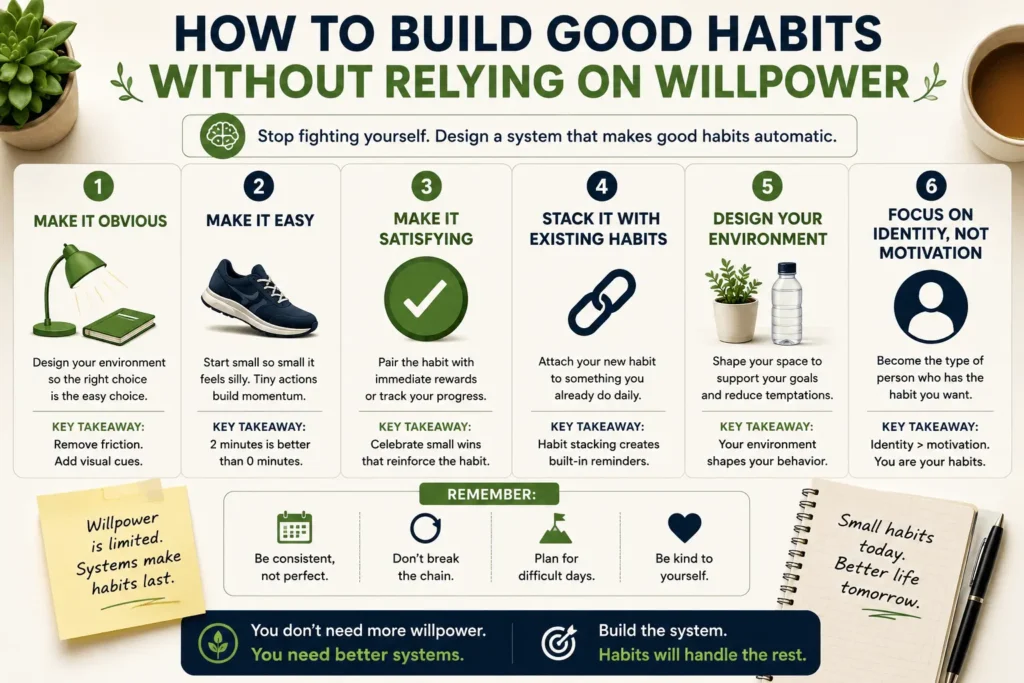
Willpower is not a great primary strategy. Research suggests self-control can become more difficult after repeated effort, although scientists continue to debate the underlying mechanisms. Whether or not you accept the full ego depletion model, most people can relate to the experience of having less self-control at the end of a demanding day than at the beginning.
If your habit strategy depends on waking up every day with iron discipline, you’re going to lose eventually. Everyone does.
What actually works is reducing the amount of willpower your habit requires.
The easiest way to do this is to make the habit so small that it’s harder to skip than to do. Not fifty pushups. One pushup. Not writing a thousand words. Writing one sentence. Not meditating for twenty minutes. Sitting still for sixty seconds.
This sounds ridiculous. You might think something that small can’t possibly matter. But the point isn’t the one pushup. The point is that you showed up. You reinforced the identity of someone who does the thing. That matters far more than the intensity of any single session.
Another thing that helps is attaching the new habit to something you already do. This is sometimes called habit stacking, and it’s closely related to the cue-routine-reward structure I mentioned earlier. For a deeper explanation of how the underlying loop works, see my guide on what habits are and how they function.
I started doing this before I knew it had a name. I noticed that I never forgot to make coffee in the morning, so I put my vitamins next to the coffee maker. Now I take them every day without thinking about it. The existing habit carries the new one.
The trick is to be honest about what you actually do consistently, not what you wish you did. I don’t always floss, but I always brush my teeth. So flossing happens right after brushing, not at some random time I’ll forget.
I’ve probably read five books on habit formation over the years, and all of them circle around the same ideas. Small actions. Clear triggers. Environment design. Reducing friction for good habits and increasing friction for bad ones. It’s not complicated. But it does require paying attention to your actual behavior rather than your idealized intentions.
The Smallest Habit That Actually Changed Something
I want to tell you about one specific habit that shifted how I think about all of this.
A few years ago I started making my bed in the morning. Not because I read some book about it. My partner asked me to. It seemed like a small thing that mattered to them, so I started doing it.
What I noticed after a few weeks was unexpected. The bed itself didn’t matter. But the act of doing something I’d committed to, first thing in the morning, created a tiny ripple. It wasn’t about discipline or achievement. It was about starting the day having already kept one promise to myself.
That small win, as minor as it was, made it slightly easier to keep the next commitment. And the next one. Not every day. Some days I made the bed and did nothing else productive. But over time, that single habit became an anchor. When everything else fell apart, at least the bed was made.
I’m not saying everyone should make their bed. That’s not the point. The point is that a good habit to build is one that’s so small it feels almost meaningless, because those are the ones that survive when motivation disappears.
For someone else, it might be drinking a glass of water first thing. Or writing down one thing they’re grateful for. Or reading one page of a book. The specific action matters less than the fact that it’s repeatable and doesn’t depend on feeling inspired.
Consistency and Success: The Boring Truth Nobody Likes
There’s a quote I think about often. I can’t remember who said it, but it goes something like: “We overestimate what we can do in a day and underestimate what we can do in a year.”
Consistency and success are linked in a way that’s genuinely annoying. Because consistency isn’t exciting. It doesn’t make for good social media content. Nobody posts about their 847th consecutive day of doing the same boring thing. They post about breakthroughs and milestones.
But breakthroughs are almost always the result of consistent work that looked unremarkable from the outside.
The habits of successful people tend to be remarkably boring. They show up. They do the work. They do it again. They miss days and come back. They don’t wait until they feel ready or motivated. They’ve decoupled the action from their emotional state.
That last part is key. Most people wait until they feel like doing something. But feelings are unreliable. Some days you’ll feel motivated. Some days you won’t. If the habit only happens on motivated days, it’s not really a habit. It’s a hobby you do when it’s convenient.
Building daily habits for success means accepting that many repetitions will feel flat, unproductive, or pointless. You do them anyway. Not because you’re disciplined, but because you’ve set up your life so that doing the thing is the path of least resistance.
Daily Routine Habits That Survived When Everything Else Fell Apart
Over the years, I’ve tried and abandoned dozens of habits. Most of them were too ambitious or too dependent on ideal conditions.
The ones that stuck were the boring ones that didn’t require much setup, special equipment, or perfect timing.
Here are a few daily routine habits that actually lasted:
- Going for a walk at lunch. No step count goal. No specific route. Just leaving my desk and walking for however long I had. Some days fifteen minutes. Some days forty-five. The only rule was that I went outside.
- Reading before bed instead of looking at my phone. This one took multiple attempts. What finally worked was charging my phone in another room. I couldn’t scroll if the phone wasn’t there. The friction of getting up to check it was usually enough to stop me.
- Preparing my workspace the night before. I close my laptop, clear the desk, and set out what I need for the next morning. Takes two minutes. Makes the morning start feel less chaotic.
- Writing things down immediately. I used to trust my memory for tasks and ideas. That was a mistake. Now I write things down the moment they occur to me. My phone’s notes app is a disaster zone, but nothing important gets lost.
- Automatic savings transfers. I set up a small weekly transfer from checking to savings years ago. I forget it exists most of the time. Every few months I check and there’s more money than I expected. That’s the whole strategy.
- Laying out exercise clothes the night before. I don’t always work out in the morning, but when the clothes are already sitting there, the odds are significantly higher.
What these habits share is flexibility. They survived travel, illness, schedule changes, and periods of low energy because they could bend without breaking. A ten-minute walk still counts. Reading two pages still counts. There’s no minimum threshold that triggers a sense of failure.
Successful Habits for Students (Or Anyone With an Unpredictable Schedule)
Students deal with a particular kind of chaos. Every semester the schedule changes. Exam periods obliterate routines. Holidays disrupt everything. Then a new semester starts and you’re back to square one.
I went through this for years, and I see friends going through it now with their kids.
The successful habits for students that seem to work are the ones that attach to fixed points rather than specific times. Instead of “study at 7 PM,” it’s “study right after dinner.” Dinner moves around, but it always happens. The habit follows the anchor.
Another pattern I’ve observed is that students who do well usually have some version of a capture system. They don’t try to remember deadlines, assignments, or ideas. They write everything down in one place and check that place daily. The specific tool doesn’t matter. A notebook works as well as an app. What matters is that nothing lives in their head.
Self-improvement habits for students also need to account for energy fluctuations. Studying at 10 PM after a full day of classes is usually ineffective no matter how disciplined you are. The students who seem to struggle less are the ones who schedule difficult work during their natural peak hours and protect that time aggressively.
I’ve also seen sleep consistency make a bigger difference than most people expect. Students who maintain roughly the same sleep and wake times, even on weekends, tend to have an easier time sustaining other habits. When sleep is all over the place, everything else becomes harder to anchor.
That said, I don’t think there’s a perfect system. I tried about four different productivity methods in university and none of them survived contact with exam season. What got me through was lowering my standards and doing what I could with the energy I had. Sometimes that meant studying for twenty focused minutes instead of two distracted hours. It wasn’t ideal, but it was better than doing nothing.
Forming Habits When Life Keeps Interrupting
The biggest lie in habit literature is the idea of an unbroken streak.
Streaks are motivating when they’re intact and crushing when they break. I’ve abandoned habits simply because I missed two days and the streak was ruined. The number going back to zero felt like a judgment.
Eventually I realized that streaks don’t matter. What matters is whether you come back.
Life will interrupt your habits. You’ll get sick. You’ll travel. You’ll have weeks where you’re just surviving. That’s normal. The question isn’t whether you can maintain perfect consistency. It’s whether you can resume after a disruption without turning a lapse into a complete abandonment.
This is where positive lifestyle habits differ from performance habits. A performance habit might require daily practice to maintain a skill. But most health and growth habits are cumulative. Missing a week doesn’t erase months of previous effort. The deposit you made is still in the bank.
One thing that helped me was having a “minimum viable day” version of each important habit. The workout minimum is a five-minute walk. The writing minimum is one sentence. The meditation minimum is three breaths. On terrible days, I do the minimum and count it as a win. On better days, I do more. But the minimum is always available.
This approach makes it possible to maintain habits through difficult periods without feeling like you’re failing. It keeps the identity alive even when the output drops.
Why Positive Habits Often Die After Vacation
This is a pattern I’ve experienced personally and heard from countless others.
You go on vacation for a week. You let your routines slide, which is reasonable. You’re on vacation. You tell yourself you’ll pick everything back up when you return.
Then you get home. There’s laundry. There’s a backlog of emails. There’s jet lag or just the general disorientation of being back in your regular life. The first day back, you don’t exercise. Or you don’t journal. Or whatever it is. The second day, the same thing happens. By day four, the habit feels distant. By week two, you’ve forgotten it entirely.
I bought a habit tracker and forgot about it after a month. Same principle. The tool was supposed to keep me accountable, but when my routine was disrupted, the tool became just another thing I was failing to use.
What I’ve learned is that habits need a restart protocol. Something specific you do immediately after returning from travel or illness or any disruption. Mine is simple. The evening before my first day back to normal life, I set out one thing related to my most important habit. Running shoes by the door. Notebook open on the desk. Whatever the visual cue is, I make it impossible to miss.
The first day back, I only do the minimum version of the habit. I’m not trying to make up for lost time. I’m just reestablishing contact. The second day, same thing. By day three or four, the habit usually feels natural again.
I could be wrong, but I think the reason people fail after disruptions isn’t laziness. It’s the unspoken pressure to return at full intensity. Lowering the bar for the first few days removes that pressure.
What to Do When You Abandon a Habit Tracker (Again)
Habit trackers are seductive. You buy the notebook or download the app and it feels like you’ve already accomplished something. The clean grid of empty boxes holds so much promise.
Then you miss a day. Then another. The blank boxes start to feel accusatory. Eventually you stop opening the tracker entirely because looking at it makes you feel bad.
I’ve done this at least four times.
Here’s what I think about habit trackers now. They’re useful for a specific purpose and counterproductive for everything else. The purpose they serve is awareness. If you genuinely don’t know whether you’re doing a habit consistently, tracking can reveal the truth. That’s valuable information.
But as a motivation tool, trackers tend to backfire for a lot of people. They externalize the reward, so you’re doing the habit to fill a box rather than because the habit itself matters. When the box stops getting filled, the motivation disappears with it.
If you’re going to track habits, track only one or two at a time. Don’t try to track ten things simultaneously. That’s a recipe for tracker abandonment within two weeks. And if you miss a day, don’t leave the box empty. Put a slash through it or write a small note about why you missed. Something that acknowledges the miss without treating it like a failure.
Productive daily habits don’t require documentation to be real. Plenty of consistent people have never used a habit tracker in their lives. The tracking is optional. The doing is not.
How to Build Habits That Outlast Your Initial Enthusiasm
When you first start a new habit, you’re running on novelty. Everything feels fresh. You’re seeing quick improvements. This is the fun part.
The novelty always wears off. Always.
What happens after that determines whether the habit sticks. When the initial excitement fades, you’re left with the actual experience of the habit. If that experience is unpleasant, inconvenient, or too demanding, you’ll probably stop.
The way to build habits that last is to design them for the post-novelty phase from the beginning. Ask yourself: will I still want to do this on a rainy Tuesday in February when I’m tired and behind on everything? If the honest answer is no, simplify the habit until the answer becomes yes.
Another thing worth mentioning is the role of identity. At some point, the habit needs to become part of how you see yourself. Not “I’m trying to exercise more” but “I’m someone who moves their body regularly.” Not “I should read more” but “I’m a reader.” The behavior flows from the identity rather than the other way around.
This sounds abstract but it’s surprisingly practical. Every time you do the habit, you’re casting a vote for that identity. Every time you skip, you’re casting a vote against it. The goal isn’t to win every vote. It’s to win enough of them that the identity tips.
For personal growth, this is what matters. Not the streak. Not the intensity. The gradual accumulation of evidence that you are the kind of person who does the thing.
Start Smaller Than You Think: A Comparison
If you’ve been trying to build habits at a level that keeps failing, it’s probably not a motivation problem. The habit itself might be too large. Here’s what scaling down looks like for common goals:
| Instead of… | Try… |
|---|---|
| Exercise for one hour | Walk for five minutes |
| Read 50 pages | Read two pages |
| Journal for 20 minutes | Write one sentence |
| Meditate for 30 minutes | Take three deep breaths |
| Save $500 per month | Save $5 per week |
| Learn a language for hour | Review five flashcards |
| Meal prep everything | Prep one ingredient |
None of these smaller versions will transform your life in a week. That’s not the point. The point is that you’ll actually do them, and doing something consistently for months produces more results than doing something intensely for eight days and then stopping.
Frequently Asked Questions
How long does it really take to form a new habit?
The popular 21-day rule is mostly a myth. Phillippa Lally’s 2009 study found an average closer to 66 days, but participants ranged from 18 to 254 days depending on the person and the complexity of the habit. Simple behaviors like drinking water after breakfast formed faster. Complex routines took significantly longer. What’s more useful than counting days is noticing when the behavior starts feeling automatic. When you don’t have to talk yourself into it, the habit is probably formed.
Is it better to focus on one habit at a time?
For most people, yes. Trying to change multiple behaviors simultaneously splits your attention and depletes self-control resources faster. I’ve had the most success focusing on one habit until it feels relatively stable, then adding another. The exception is when two habits naturally pair together, like exercising and drinking more water. Those can often be built concurrently without extra strain.
What if I keep failing at the same habit over and over?
That usually means the habit is too big, too vague, or attached to the wrong cue. If you’ve tried and failed to build a meditation habit four times, a three-breath session after waking might be a better starting point than twenty minutes at some unspecified time. Also worth examining whether you actually want the habit or just feel like you should want it. Obligation-based habits rarely stick.
Are bad habits easier to break or replace?
Replacing tends to work better than pure elimination. Research on implementation intentions by Peter Gollwitzer supports this. If you try to simply stop doing something without putting anything in its place, the void often pulls you back. If you scroll social media before bed and want to stop, replacing it with reading a physical book is more effective than just trying to “stop scrolling.” The new behavior fills the same slot in your routine while the old cue and reward structure remains intact.
Do habit tracking apps actually help?
They can, but they’re not necessary and they backfire for some people. If you’re the kind of person who finds streaks motivating and doesn’t spiral when you miss a day, a tracking app might help. If blank boxes make you feel guilty and lead to avoidance, skip the app and focus on the behavior itself. The tracking is secondary to the doing.
How do I get back on track after completely falling off?
Start smaller than you think you need to. If you haven’t exercised in six months, a full workout routine on day one is probably going to fail. A five-minute walk is better. Then do it again tomorrow. The priority is rebuilding the pattern, not making up for lost time. Expect the first week to feel awkward. It usually does. That’s not a sign you’re failing.
Final Thoughts
If you’re starting from scratch, pick one thing and make it small enough that skipping it feels harder than doing it. Not the thing you think you should pick. The thing you actually care about. The thing that, if you did it consistently for a year, would genuinely change something you want changed.
Then do it badly if you have to. A bad workout counts. A badly written page counts. A meditation session where your mind wanders the entire time counts. The consistency matters more than the quality.
You’ll fall off eventually. Everyone does. That’s not the problem. The problem is staying off. The difference between people who build lasting habits and people who don’t isn’t perfect execution. It’s faster recovery after a miss.
So when you inevitably skip a day or a week, come back. Don’t reset. Don’t start over. Just continue. The habit isn’t gone just because you missed it. It’s just waiting for you to pick it back up.