
I used to think there was a clear line between good habits and bad habits. Good habits were things like exercising and eating vegetables. Bad habits were things like smoking and staying up too late. Simple.
Then I noticed something that complicated the picture.
Some “good” habits made me miserable. I’d force myself to wake up early because that’s what productive people supposedly do, except I’d be exhausted and resentful all morning. Meanwhile, some of my “bad” habits genuinely helped me cope during stressful periods. Playing video games for an hour after a hard day wasn’t destroying my life. It was giving my brain a chance to reset.
The more I paid attention, the less clear the categories became.
This article is about what I’ve figured out since then. Not a list of good habits vs bad habits with checkmarks and moral judgments. More like a framework for telling the difference in your own life, where context matters more than any generic list ever could.
Why the Good habits vs Bad Habits Distinction Isn’t as Clean as People Pretend
Most habit advice draws a hard line. This is good. That is bad. Do more of this. Stop doing that.
The problem is that real life doesn’t fit neatly into those boxes.
Take exercise. Generally considered one of the best habits you can have. But I’ve known people who developed genuinely unhealthy relationships with working out. They’d exercise through injuries, skip social events, and feel guilty on rest days. At what point does a good habit become a problem?
Or take watching TV. Usually labeled as a bad habit or at least a waste of time. But when my dad was recovering from surgery and couldn’t do much else, watching shows together became something that genuinely helped him get through a difficult period. Was that a bad habit during those months? I’d argue it wasn’t.
Context changes everything.
What I’ve learned is that the difference between good and bad habits often comes down to three things: direction, dosage, and what you’re trading away. A habit that moves you toward the life you want, in a sustainable amount, without quietly sacrificing something more important, is probably a good one. But the same behavior in a different context could be something else entirely.
This won’t work for everyone, but I’ve stopped trying to classify habits in the abstract. I ask myself what a specific behavior is doing for me right now, in this season of life, and whether it’s helping or hurting the things I actually care about. The answer changes sometimes. That’s okay.
What Makes a Habit Good or Bad (The Framework That Actually Works)
Instead of sorting habits into fixed categories, I’ve started using a simpler filter.
A good habit is a repeated behavior that moves you closer to something you genuinely want in the long run. It builds something. It creates options. It makes future-you slightly better off than present-you.
A bad habit is a repeated behavior that moves you away from those same things. It might feel fine in the moment. It might even be helpful short-term. But over time, it closes options, creates problems, or quietly erodes something you value.
Notice what’s missing from that definition. There’s no moral judgment. A bad habit doesn’t make you a bad person. It’s just a behavior with negative long-term returns.
The tricky part is that most habits don’t announce themselves as good or bad. They feel neutral. You don’t notice the effect until it’s compounded. Scrolling social media for ten minutes before bed seems harmless. Do it every night for three years and you’ve spent hundreds of hours on something that probably didn’t improve your life in any measurable way.
Some positive habits feel pointless in the moment. Saving a small amount of money each week doesn’t feel meaningful until you check the balance two years later and realize you’ve built a financial cushion without ever feeling the sacrifice.
For a deeper explanation of how habits form at the neurological level and why they become automatic, you might find the guide on what habits are and how they work useful.
At least in my experience, the habits worth keeping are rarely the ones that feel dramatic. They’re the quiet, boring behaviors that compound into something meaningful over years. The habits worth questioning are the ones you do without thinking, that you’d be slightly embarrassed to explain to someone you respect.
How Habits Affect Your Life Over Time
One habit on its own is almost meaningless.
The problem, and the opportunity, is that habits don’t stay singular. They multiply. They connect. A single late-night scrolling session doesn’t ruin your life. But it leads to less sleep, which makes you tired the next day, which makes you reach for more caffeine and skip your workout, which makes you feel sluggish, which makes you more likely to scroll again that night.
No single link in that chain is catastrophic. But the chain itself shapes days, then weeks, then months.
How habits affect your life isn’t always obvious because the feedback is delayed. You don’t get a notification telling you that today’s choices just cost you something three years from now. The consequences and the rewards both arrive quietly.
A friend of mine tracked his spending for a year. Not because he had debt or money problems. He was just curious. What he found was that his daily coffee habit, plus the pastry he usually bought with it, added up to nearly $1,800 over twelve months. That’s not life-changing money, but it was more than he’d spent on a vacation that year that he actually remembered and enjoyed.
The coffee itself wasn’t bad. The pattern was just mindless. He still drinks coffee. He just makes it at home most days now. The habit didn’t disappear. It shifted.
This is where I think people get stuck. They try to eliminate every “bad” habit and adopt every “good” one, as if life is a spreadsheet to optimize. But optimization has diminishing returns. At some point, the effort of maintaining perfect habits costs more than the habits themselves are worth. The goal isn’t purity. It’s awareness. Know what your habits are costing you, and decide if you’re okay with the price.
10 Good Habits and Bad Habits (With Real-World Examples)
Lists of good habits examples usually sound like they were written by someone who’s never had a chaotic week. Here’s one that’s a bit more realistic.
10 Good Habits
- Moving your body in a way that feels sustainable. This doesn’t have to be the gym. Walking counts. Dancing in your kitchen counts. The best exercise habit is the one you’ll actually do.
- Going to bed at roughly the same time. Sleep consistency matters more than most people realize. More on this when we talk about morning routines later.
- Drinking water before you reach for caffeine. Small shift. Noticeable difference in energy stability.
- Writing things down instead of trusting your memory. Your brain is for thinking, not storage.
- Spending five minutes tidying before bed. Waking up to a clear space is genuinely underrated.
- Eating something green most days. Not a salad every meal. Just something. Spinach in eggs counts.
- Checking your bank account regularly. Awareness alone changes spending behavior.
- Responding to messages within a reasonable window. Not instantly. But not three weeks later either. It preserves relationships.
- Spending time outside. Doesn’t need to be a hike. Standing on a balcony counts.
- Putting your phone somewhere else when you need to focus. Physical distance works better than willpower.
10 Bad Habits
- Checking your phone immediately upon waking. It sets a reactive tone for the entire day. I still do this sometimes.
- Saying yes to things you don’t want to do out of guilt. This is a habit, not just a personality trait.
- Eating lunch at your desk without stepping away. It feels productive. It isn’t.
- Staying up late for no reason. Not because you’re working or socializing. Just because you don’t want the day to end. Revenge bedtime procrastination is real.
- Letting small tasks pile up. One unopened email becomes fifty. The mental weight grows even if you’re not thinking about it.
- Comparing yourself to strangers online. You know this isn’t helpful. Everyone knows this. Still hard to stop.
- Skipping meals and then overeating later. The body keeps score.
- Interrupting people. I used to do this constantly without realizing it. Someone pointed it out and I was mortified.
- Buying things you don’t need because they’re on sale. You’re not saving money if you weren’t going to buy it anyway.
- Avoiding difficult conversations. The avoidance causes more stress than the conversation would have.
These lists aren’t universal. Some things on my “bad” list might be fine for you. The point isn’t the specific items. It’s the pattern of noticing which behaviors build and which ones quietly drain.
The Difference Between Good and Bad Habits Is Direction, Not Morality
I want to return to this point because it’s the one that took me the longest to understand.
For a long time I thought the difference between good and bad habits was that good habits were virtuous and bad habits were signs of weakness. That framing made habit change feel like a moral test. Every time I failed, which was often, it meant something about my character.
That’s an exhausting way to live. And it’s not accurate.
The actual difference between good and bad habits is simpler and less dramatic. Good habits move you toward the person you want to become and the life you want to live. Bad habits move you away from those things. That’s it.
This reframing matters because it removes shame from the equation. If a bad habit is just a behavior that isn’t serving you anymore, you can look at it with curiosity instead of self-judgment. What is this habit giving me? What need is it meeting? Is there another way to meet that need without the downside?
A friend of mine smoked for fifteen years. He tried to quit multiple times using willpower and shame. It never stuck. What eventually worked was getting curious about when he smoked and why. He noticed he almost always lit a cigarette during transitions, between meetings, after meals, when switching tasks. The cigarette wasn’t about nicotine as much as it was about creating a pause. Once he understood that, he started experimenting with other ways to create pauses. Standing outside for two minutes without a cigarette. Making tea. Stretching. The habit didn’t break. It got replaced.
This is where the concept of positive habits gets interesting. A positive habit isn’t just a behavior that looks good on paper. It’s a behavior that genuinely adds something to your life without quietly taking something else away. The best ones don’t feel like effort after a while. They just feel like what you do.
Breaking Bad Habits Without White-Knuckling It
Most people try to break a bad habit by deciding to stop. They rely on willpower, which works for a while, then stops working. Then they blame themselves.
There’s a better approach.
Breaking bad habits works best when you understand what the habit is actually doing for you. Every behavior persists because it provides some kind of reward. Stress relief. Dopamine. A break from discomfort. Social connection. If you try to remove the behavior without addressing the need it was meeting, your brain will eventually find its way back.
This is why replacement works better than elimination. Instead of stopping the behavior, you redirect it toward something that meets the same need with fewer downsides.
The basic structure is simple. Identify the cue that triggers the habit. Identify the reward you’re actually getting. Find a different routine that delivers a similar reward when the same cue shows up.
For more practical detail on how to do this, the guide on how to build good habits walks through the process step by step with examples from daily life.
One thing I’ve noticed is that environment changes make habit replacement significantly easier. If you always snack on junk food while watching TV in a specific chair, changing where you sit or keeping different snacks within reach changes the equation. You don’t have to be stronger. You just have to make the old behavior slightly harder and the new behavior slightly easier.
I moved my phone charger to the other side of the bedroom. That single change reduced my nighttime scrolling more than any amount of self-discipline ever did. The phone still works. I can still scroll if I want to. But now it requires getting out of bed, and most nights I’d rather just stay under the covers.
How to Replace Bad Habits With Good Habits
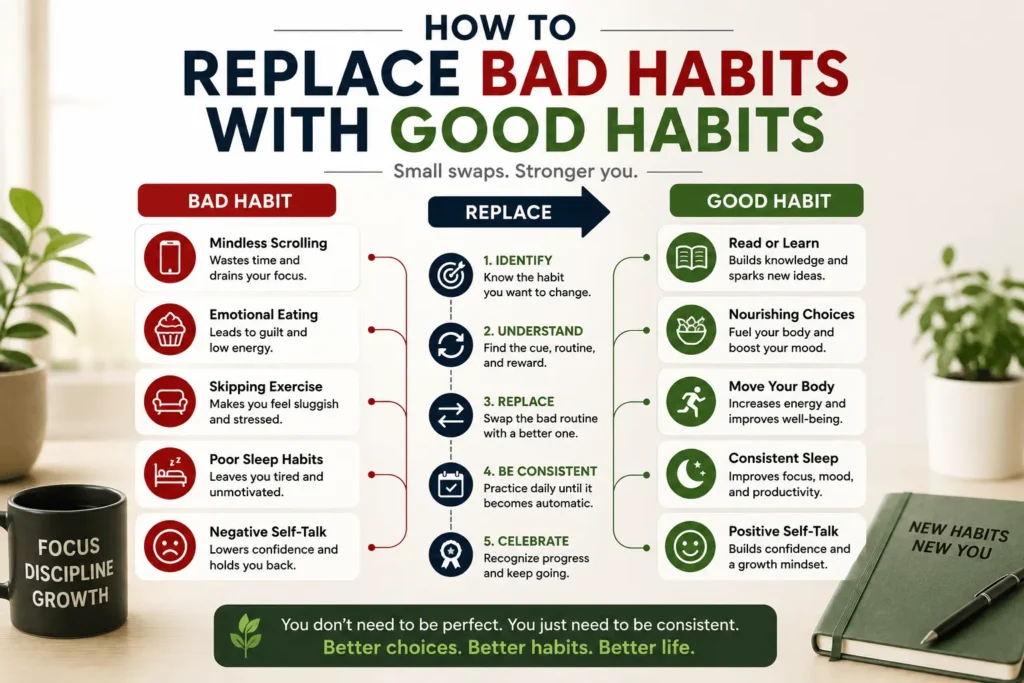
Replacement sounds straightforward in theory. In practice, it’s messier.
The new behavior rarely feels as satisfying at first. If you replace evening scrolling with reading, the first few nights might feel boring. Your brain misses the rapid stimulus. The book feels slow. You’ll be tempted to switch back.
This is normal. It doesn’t mean the replacement isn’t working. It means your brain is adjusting to a different reward profile.
What helped me was acknowledging this adjustment period upfront. I expected the first week of any habit replacement to feel somewhat unsatisfying. That expectation made it easier to push through. By week two or three, the new behavior started feeling more natural, and by week four or five, the old behavior lost some of its pull.
Not every replacement sticks on the first attempt. I tried replacing late-night snacking with tea about three times before it worked. The first two times, I’d have tea and then snack anyway. What finally worked was combining the tea with a different evening location. I’d make tea and go to a different room. The combination of replacement plus environment shift was more effective than either strategy alone.
If you’re trying to replace bad habits with good habits, start small. Replace one thing at a time. Expect the transition to feel awkward. And don’t be surprised if you need to adjust the replacement behavior a few times before it fits.
Why Some Good Habits Fail While Some Bad Habits Stick
There’s an asymmetry in habit formation that doesn’t get enough attention.
Bad habits often provide immediate rewards. Smoking relieves stress quickly. Scrolling delivers entertainment instantly. Eating junk food tastes good right away. The downside arrives later, sometimes much later, and it’s easy to ignore a cost you can’t feel yet.
Good habits often work in reverse. The effort is immediate. The reward is delayed. Exercise feels hard today. The results show up months from now. Saving money feels like deprivation. The security accumulates invisibly.
This timing difference explains a lot about why bad habits feel sticky and good habits feel slippery. It’s not a character flaw. It’s how human motivation evolved. We’re wired to prioritize immediate outcomes over future ones.
Understanding this helped me stop moralizing about habits and start being more strategic. If a good habit feels unrewarding, I try to build in some short-term satisfaction. Listening to a podcast I enjoy while exercising. Buying a small treat after a week of consistent savings. Making the behavior itself more pleasant rather than just waiting for distant results.
The flip side works too. If a bad habit is hard to quit, I try to make the negative consequences more immediate and tangible. Not in a punitive way. Just more visible. Tracking how much money a daily purchase actually costs over a month. Noticing how I feel after a night of poor sleep versus a rested morning. The more immediate the feedback, the easier it becomes to choose differently.
Healthy Habits vs Unhealthy Habits: The Gray Area Nobody Talks About
Some of the most confusing habits live in the space between healthy and unhealthy. They’re not obviously one or the other. They depend on dosage, intention, and what else is happening in your life.
Exercise is healthy until it becomes compulsive. Relaxing is healthy until it becomes chronic avoidance. Being informed is healthy until news consumption becomes doom-scrolling. Saving money is healthy until it becomes miserly anxiety about spending on things that genuinely matter.
This gray area is where a lot of people get stuck. They adopt a habit that’s supposed to be good, notice that it doesn’t feel good, and then blame themselves for not responding correctly to something that was supposed to help.
I went through this with productivity habits. I had elaborate systems. Time blocking. Task batching. Inbox zero. For a while it felt satisfying. Then it started feeling suffocating. I was optimizing my days so tightly that there was no room for spontaneity or rest. The habits themselves weren’t the problem. The rigid application of them was.
What I’ve learned is that healthy habits vs unhealthy habits isn’t always about the behavior itself. Sometimes it’s about the relationship you have with it. A healthy relationship with exercise means you can skip a workout without guilt when your body needs rest. An unhealthy relationship means you exercise regardless of injury, illness, or exhaustion because missing a day causes anxiety.
The same habit can be healthy in one season and unhealthy in another. During a period of grief or recovery, comfort habits that would normally be questionable might be exactly what you need. The context matters as much as the behavior.
Positive habits support your life. Negative habits constrict it. But which is which sometimes requires honest self-assessment rather than consulting a list someone else wrote.
Habit Change Strategies That Survive Real Life
Over the years I’ve tried a lot of approaches to changing habits. Most worked temporarily. A few lasted. Here’s what actually survived contact with real life.
Make one change at a time. I’ve tried the total lifestyle overhaul. It never works. The effort of maintaining multiple new behaviors simultaneously drains willpower faster than a single focus. Pick one habit. Stabilize it. Then add another.
Start smaller than you think is necessary. Whatever your initial plan is, cut it in half. Probably cut it in half again. The habit that survives is the one that’s too small to fail. Once it’s established, you can expand it. But you can’t expand something you’ve already abandoned.
Attach new habits to existing anchors. I mentioned this in the habits guide, but it bears repeating because it’s genuinely effective. Pick something you already do every day without fail. Attach the new behavior directly to it. After coffee. Before brushing teeth. Right after getting home. The anchor does the remembering for you.
Expect disruptions and plan for them. Travel, illness, holidays, busy periods. These things will happen. Having a minimum version of your habit that you can do under any circumstances keeps the thread from breaking entirely. Five minutes instead of thirty. One sentence instead of a page. Something instead of nothing.
Track only what’s useful. Habit tracking can help with awareness, but it can also become a source of stress. I track habits when I’m trying to establish them and stop tracking once they feel automatic. The tracker is a tool, not a permanent commitment.
Don’t treat lapses as failures. Missing a day or a week doesn’t erase your progress. It just means you missed some days. The danger is turning a lapse into a complete stop. Come back faster. That’s the skill that actually matters.
For a more detailed walk through of building habits that last, you can read the full guide on how to build good habits.
Frequently Asked Questions
What is the main difference between good habits and bad habits?
The main difference is direction over time. A good habit consistently moves you toward outcomes you genuinely want, whether that’s health, financial stability, stronger relationships, or personal growth. A bad habit consistently moves you away from those same outcomes. It’s about long-term trajectory, not moral judgment.
Can the same habit be good for one person and bad for another?
Absolutely. Context determines a lot. Waking up at 5 AM works well for someone with morning energy and a schedule that supports an early bedtime. For a night shift worker or someone with a sleep disorder, it might be actively harmful. A habit that supports one person’s goals can interfere with someone else’s. The value of a habit depends on what it’s doing for you specifically.
How long does it take to break a bad habit?
There’s no universal timeline. The 21-day myth is mostly wrong. Research suggests that replacement works better than pure elimination, and that the timeline depends on the complexity of the habit, how long you’ve had it, and what need it’s serving. Instead of counting days, pay attention to whether the old behavior is losing its automatic pull. When you no longer feel a strong urge at the usual cue, the habit is weakening.
Is it better to break a bad habit or replace it?
Replacement almost always works better. Removing a behavior without addressing the need it was meeting leaves a void. Your brain will eventually fill that void, often with the same behavior or something similar. Replacing the routine while keeping the cue and reward structure intact is more sustainable. If you smoke during work breaks for stress relief, keeping the break but doing something else during it tends to work better than trying to power through without any break at all.
What are the most common bad habits people struggle with?
The ones I see most often, both in myself and in conversations with others, are excessive phone use, procrastination, poor sleep habits, mindless eating, and avoiding difficult conversations. What these have in common is that they provide immediate relief or distraction while creating problems that only show up later. The delay between behavior and consequence makes them particularly sticky.
Can you build multiple good habits at the same time?
You can, but the failure rate goes up significantly. Most people do better focusing on one habit until it feels relatively automatic before adding another. The exception is when two habits naturally support each other, like starting to exercise and drinking more water. Those can often be built together because they complement rather than compete for attention.
Final Thoughts
The distinction between good habits and bad habits matters less than your honest assessment of what a behavior is doing in your life.
Some habits you’ll keep. Some you’ll change. Some you’ll keep despite knowing they’re not ideal, because the benefit they provide in this season outweighs the cost. That’s not failure. That’s being realistic about being human.
If you’re looking for one place to start, pick a single habit that’s been bothering you. Not the biggest one. Just one you notice regularly and wish was different. Get curious about when it happens and what need it’s meeting. Try a replacement that’s small and sustainable. See what happens.
You don’t need to overhaul your entire life. You just need to start somewhere and pay attention. The rest figures itself out over time.