

I spent most of my twenties convinced I wasn’t a creative person.
Not “I haven’t practiced creative skills.” Not “I haven’t found the right medium yet.” Just a flat statement of identity. I’m not creative. Other people are. I’m not.
The weird thing is, I never questioned it. It felt true in the way that obvious things feel true. The sky is blue. Water is wet. I’m not creative. Case closed.
It took me years to realize that belief wasn’t based on evidence. It was based on a few art projects in middle school that didn’t turn out well, plus a general sense that creative people were spontaneous and expressive and I was careful and reserved. That was the entire foundation. And I’d built two decades of avoidance on top of it.
This is what common limiting beliefs do. They operate in the background, masquerading as facts, quietly steering your decisions without ever announcing themselves. Carol Dweck, whose mindset research has been cited thousands of times across education and psychology, put it simply: “Becoming is better than being.” But most of us live as though being fixed, defined, already determined is the whole story.
Learning how to overcome these beliefs isn’t about positive affirmations or forced optimism. It’s about finally noticing the beliefs that have been running the show and deciding whether they actually hold up.
In This Guide You’ll Learn:
- What limiting beliefs are and where they come from
- Common examples across different areas of life
- Why limiting beliefs persist and how they affect behavior
- How to identify your own self-limiting beliefs
- Practical strategies for overcoming limiting beliefs
- Daily exercises to reinforce new thinking patterns
Key Takeaways:
- Limiting beliefs are learned assumptions, not permanent truths.
- Most limiting beliefs form in childhood or after single negative experiences and go unexamined for years.
- Beliefs shape behavior, and behavior generates evidence that reinforces the belief creating a self-sustaining cycle.
- Identifying a limiting belief is the hardest part; once named, it can be questioned and reframed.
- Lasting change comes from combining new thinking with repeated action, not from affirmations alone.
- Environment, stress, and emotional state influence how strongly limiting beliefs show up, so progress isn’t always linear.
What Are Limiting Beliefs?

Limiting beliefs are learned assumptions about yourself, other people, or the world that restrict your actions, confidence, and potential. Although they often feel like facts, they are usually interpretations shaped by past experiences rather than objective reality. The key thing to understand is that these beliefs can be questioned and changed.
Signs You Have Limiting Beliefs
Limiting beliefs don’t always announce themselves as thoughts. Sometimes they show up as patterns of behavior that repeat across different areas of life. Recognizing these signs is often easier than catching the belief itself.
Procrastination. Putting things off isn’t always laziness. Sometimes it’s a belief that you’re not capable of doing the thing well enough, so starting feels threatening. The delay protects you from facing the feared inadequacy.
Fear of success. This one surprises people. But success brings visibility, higher expectations, and new challenges. If part of you believes you’re not equipped to handle those things, you might sabotage progress right before a breakthrough.
Fear of criticism. If the thought of others judging your work feels unbearable, there’s probably a belief underneath about what criticism means maybe that it reveals something permanently wrong with you rather than something you can improve.
Overthinking. Replaying conversations, analyzing decisions from every angle, unable to settle on a course of action. Often this stems from a belief that making the wrong choice would be catastrophic.
Perfectionism. Nothing ever feels ready to ship. The standard keeps moving just out of reach. The underlying belief is usually something like “if it’s not perfect, I’ll be rejected” or “mistakes prove I’m incompetent.”
People pleasing. Saying yes when you want to say no. Avoiding conflict at all costs. The belief driving this is often “if I disappoint people, they’ll leave” or “my worth depends on being easy to deal with.”
Avoiding opportunities. Not applying for jobs unless you meet every qualification. Not speaking up in meetings. Not sharing your work publicly. The belief: “I’m not ready yet” or “I don’t belong there.”
Excessive comparison. Scrolling through other people’s achievements and feeling diminished. The belief is that their success reveals something about your inadequacy rather than simply reflecting their path and timing.
Self-sabotage. Quitting right before something takes off. Picking fights before a relationship gets serious. The pattern suggests a belief that you don’t deserve good things or that they’ll eventually be taken away anyway.
One or two of these signs might just be personality quirks. But when several show up together, there’s usually a self-limiting belief operating beneath the surface.
Limiting Beliefs vs Negative Thoughts
People often use these terms interchangeably, but they’re not the same thing. Understanding the difference helps you intervene at the right level.

A negative thought is a single mental event. It’s temporary. It comes and goes. “I did terribly on that presentation.” The thought might be true or false, but it’s a response to a specific situation.
A limiting belief is what happens when negative thoughts repeat, consolidate, and generalize into a stable assumption about how things are. The single thought “I did terribly on that presentation” becomes “I’m bad at public speaking” becomes “I’m not the kind of person who can communicate effectively.”
The progression looks like this:
Negative thought → repeated over time → becomes a belief → shapes behavior → behavior generates confirming evidence → belief strengthens → becomes part of identity
A negative thought you can dismiss or challenge in the moment. A limiting belief requires more work because it’s woven into your sense of self. It doesn’t just describe what happened. It predicts what will happen. And because it predicts, it shapes what you attempt which shapes what actually happens.
This is also why simply “thinking positive” doesn’t work for deep limiting beliefs. The belief isn’t just a thought. It’s a structure that includes thoughts, emotions, behavioral patterns, and identity. Changing it requires working at multiple levels, not just swapping one thought for another.
What Psychology Says About Limiting Beliefs
The idea that beliefs shape behavior has deep roots in clinical psychology. Several major figures have built frameworks around it, and their work gives the concept of limiting beliefs psychology a solid empirical foundation.
Aaron Beck, the founder of cognitive therapy, identified what he called cognitive distortions systematic errors in thinking that lead people to interpret reality in negative and self-defeating ways. His research, conducted at the University of Pennsylvania, showed that these distortions aren’t just symptoms of clinical depression. They’re patterns that show up in everyday thinking, often without awareness. Beck’s work became the basis for Cognitive Behavioral Therapy (CBT), which according to the American Psychological Association is among the most researched psychological treatments and has consistently demonstrated effectiveness across many mental health conditions.
Albert Ellis developed Rational Emotive Behavior Therapy (REBT), which focuses on identifying and disputing irrational beliefs. He captured the core idea memorably: “People are disturbed not by things, but by the view they take of them.” Change the belief, and the emotional response changes too.
Carol Dweck’s research at Stanford on fixed and growth mindsets demonstrated that beliefs about whether abilities can be developed directly affect academic performance, persistence, and willingness to take on challenges. A fixed mindset is essentially a collection of limiting beliefs about intelligence and talent. Her work has influenced education, leadership development, and organizational psychology worldwide.
Albert Bandura’s work on self-efficacy showed that the belief in your own ability to succeed in specific situations affects how you think, feel, and behave. People with low self-efficacy avoid challenges and give up quickly behaviors that look a lot like what happens when limiting beliefs are in charge.
Research from the National Institute of Mental Health has consistently shown that thinking patterns influence emotional well-being and behavior. More recent approaches like Acceptance and Commitment Therapy (ACT) add another layer, emphasizing psychological flexibility the ability to notice difficult thoughts without being controlled by them.
The common thread across all this research: beliefs are not neutral. They shape perception, motivation, and action. And because they’re learned rather than innate, they can be unlearned or replaced.
Where Limiting Beliefs Come From
Most limiting beliefs don’t arrive fully formed. They accumulate.
Some come from childhood experiences a teacher who made a comment about your abilities, a parent who wanted to protect you from disappointment, a peer group that defined what was cool and what wasn’t. The comment was probably minor. The teacher probably forgot about it by lunchtime. But a rule got built around it: “I’m not good at this kind of thing.”
Early experiences can shape beliefs without permanently determining adult behavior. The brain of a child is highly impressionable, and conclusions drawn at age eight or twelve often stick around long after they’ve outlived whatever usefulness they once had. The encouraging part is that the same neuroplasticity that allowed those beliefs to form also allows them to be reshaped.
Some limiting beliefs come from culture. Every society has scripts about what kinds of people do what kinds of things. These scripts are so embedded that they feel like natural law until you step outside them and realize they’re just stories people repeat.
Some come from a single failure that got generalized. You tried something once, it didn’t work, and instead of concluding “that approach didn’t work that time,” you concluded “I’m not capable of this.” One data point becomes a lifetime policy.
Others come from comparison. You look at someone who’s been practicing something for ten years, compare your day one to their year ten, and decide you don’t have what it takes. The comparison isn’t fair, but it feels fair in the moment.
The origin matters less than most people think. You don’t need to excavate your entire childhood to change a belief. What matters more is recognizing that the belief exists and that it’s a belief, not a fact.
How Beliefs Shape Your Life Without You Noticing
Beliefs are predictive. They don’t just describe reality they shape what you attempt and therefore what you experience.
If you believe you’re bad at social situations, you’ll avoid them. Because you avoid them, you won’t develop social skills. Because you haven’t developed social skills, you’ll feel awkward when you do end up in social situations. This confirms the original belief. The cycle closes.
The belief created the evidence that supports the belief.
This is how beliefs that hold you back maintain themselves over decades. They’re self-reinforcing systems. Every time you avoid something because of a limiting belief, you prevent yourself from getting evidence that would disprove it.
The same dynamic works in the other direction too. People who believe they can improve try things, fail, learn, and eventually improve. Their belief leads to behavior that generates confirming evidence. It’s the same mechanism, just pointing in a more useful direction.
Your beliefs about what you can and can’t do are often more predictive of your outcomes than your actual starting abilities. Not because beliefs are magic. Because beliefs determine behavior, and behavior determines results over time.
The flow works like this:
Negative Experience → Negative Interpretation → Limiting Belief → Avoidance → No Improvement → Belief Strengthens
Understanding this cycle is the first step to interrupting it.
How Limiting Beliefs Become Habits
There’s a feedback loop that turns a single belief into a stable pattern, and it’s worth understanding because it explains why willpower alone rarely fixes the problem.
It works like this:
Belief forms (I’m not good at this) → Avoid action (don’t try) → Brain gets relief (anxiety drops, feels safer) → Avoidance gets reinforced (brain learns that avoiding = feeling better) → Avoidance becomes habit (automatic, no conscious decision needed) → Habit strengthens belief (I never do this, so I must not be capable) → Identity solidifies (I’m just not that kind of person)
The avoidance provides immediate emotional relief, which is why the pattern is so sticky. The brain learns that not trying feels better than risking failure. Each repetition strengthens the neural pathway. After enough repetitions, the whole sequence runs automatically belief triggers avoidance, avoidance provides relief, relief reinforces belief.
Breaking the loop requires interrupting it at multiple points. You can’t just address the belief and expect the habit to vanish, because the habit has its own momentum. And you can’t just change the behavior without addressing the belief, because the belief will keep generating resistance.
This is why effective approaches combine cognitive work (examining and reframing the belief) with behavioral work (taking small actions that generate new evidence). Thought and action have to shift together.
How Neuroplasticity Helps Change Limiting Beliefs
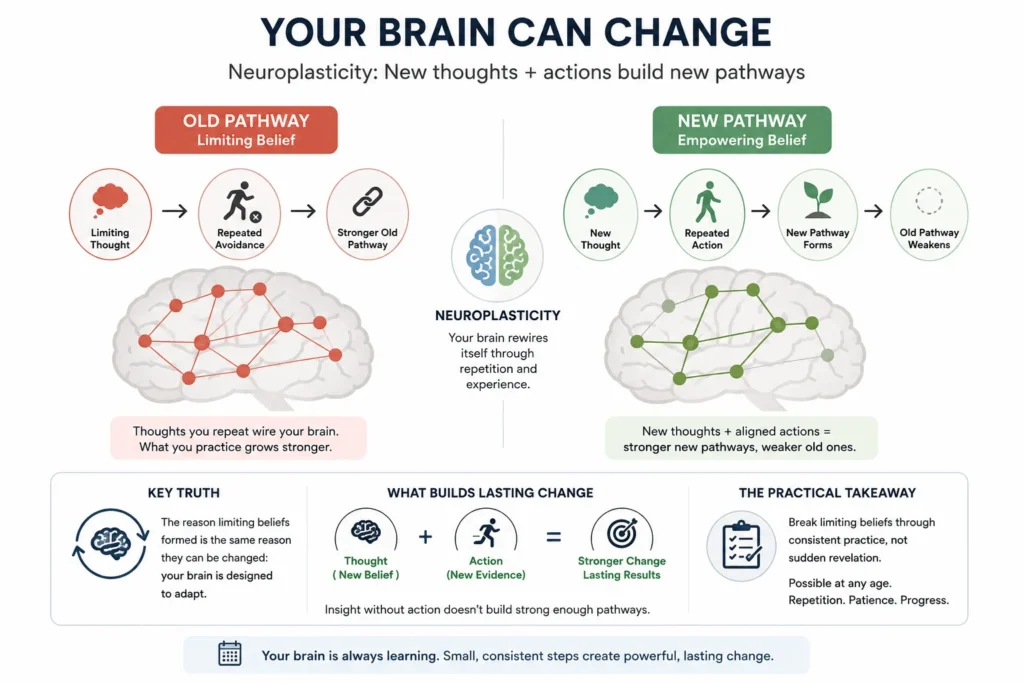
There’s a biological reason limiting beliefs can be changed, and it’s the same reason they formed in the first place.
Neuroplasticity is the brain’s ability to reorganize itself by forming new neural connections throughout life. Every thought you think, every behavior you repeat, strengthens certain neural pathways and weakens others. This is true for skills like playing an instrument, and it’s true for beliefs about yourself.
When a limiting belief has been running for years, the neural pathway supporting it is well-established. It fires automatically. The thought feels natural and true because the brain has practiced it thousands of times.
Old Pathway (Limiting Belief) → Repeated Avoidance → Stronger Old Pathway
Changing the belief means building a new pathway. At first, the new thought feels unnatural. It requires conscious effort. You don’t quite believe it. But each time you think the new thought or take an action aligned with it, the pathway strengthens slightly. Over time, the new pattern becomes more automatic and the old one fades from disuse.
New Thought → Repeated Action → New Pathway Forms → Old Pathway Weakens
Research confirms that neuroplasticity continues throughout adulthood, though the rate of change can vary with age. The brain remains adaptable across the lifespan. Simply repeating positive statements isn’t usually enough to create lasting change. The brain changes most effectively when thought and action work together when you think differently and then do something that generates new evidence. Insight without behavior doesn’t build strong enough pathways.
The practical takeaway: how to break limiting beliefs comes down to consistent practice, not sudden revelation. It’s possible at any age. But it requires repetition and patience, not just understanding.
25 Common Limiting Beliefs That Hold People Back
Some limiting beliefs are universal. They show up across different people, different contexts, different stages of life. Here are twenty-five of the most common ones, grouped by category.
About Yourself
- I’m not good enough.
- I’m not smart enough.
- I don’t deserve success.
- I’m too old to change.
- I’m too young to be taken seriously.
- I always fail at everything I try.
- Something is wrong with me.
- I’ll never change. This is just who I am.
About Work and Career
- I’m not qualified enough for that role.
- I’m not leadership material.
- If I speak up, people will think I’m stupid.
- Everyone else knows what they’re doing. I’m just figuring it out.
- I can’t ask for a raise. They’ll think I’m difficult.
About Money
- I’m just not good with money.
- Rich people are greedy.
- I’ll never be financially secure.
- Making money requires luck or connections I don’t have.
About Relationships
- I’m not the kind of person someone would want to be with.
- All the good ones are already taken.
- If I show how I really feel, they’ll leave.
About Learning and Growth
- I’m too old to learn something new.
- I was never good at school, so I’m not a learner.
- Some people are just naturally talented. I’m not.
About Health and Wellness
- I’ve tried to get in shape before and it never sticks.
- My body just isn’t meant to be fit.
Every single one of these is a belief, not a fact. And every single one can be questioned.
Common Limiting Beliefs in Everyday Life
Beyond the list, limiting beliefs attach to specific areas of life in predictable ways. Here’s how they tend to show up.
Career
- “I’m not qualified enough for that role.”
- “If I speak up in meetings, people will think I’m stupid.”
- “I can’t ask for a raise. They’ll think I’m difficult.”
- “Everyone else knows what they’re doing. I’m just figuring it out as I go.”
Money
- “I’m just not good with money.”
- “Rich people are greedy. I don’t want to be like that.”
- “I’ll never be financially secure. It’s just how things are.”
- “Making money requires luck or connections I don’t have.”
Relationships
- “I’m not the kind of person someone would want to be with.”
- “If I show how I really feel, they’ll leave.”
- “All the good ones are already taken.”
- “Conflict means the relationship is failing.”
Health
- “I’ve tried to get in shape before and it never sticks.”
- “I don’t have the willpower to eat healthy.”
- “My body just isn’t meant to be fit.”
- “It’s too late to fix my health now.”
Learning
- “I’m too old to learn something new.”
- “I was never good at school, so I’m not a learner.”
- “Some people are just naturally talented. I’m not.”
- “It would take too long to get good at this.”
Entrepreneurship
- “Most businesses fail. Mine probably would too.”
- “I don’t have what it takes to run a business.”
- “You need money to make money. I don’t have any.”
- “The market is already too crowded.”
Each of these beliefs has a reframe available. The first step is recognizing that they’re beliefs, not objective assessments of reality. The second is asking what evidence actually supports them and what evidence contradicts them.
Common Myths About Limiting Beliefs
Several misconceptions about limiting beliefs make them harder to address. Clearing these up helps.
Myth: Limiting beliefs disappear once you identify them.
Reality: Awareness is the first step, not the last. Beliefs that have been reinforced for years don’t vanish just because you noticed them. They require repeated practice and new behaviors to shift.
Myth: Positive thinking alone changes beliefs.
Reality: New beliefs strengthen through consistent behavior, not just mental rehearsal. Action generates evidence. Evidence changes beliefs. Thinking alone rarely does.
Myth: Limiting beliefs only affect confidence.
Reality: They influence relationships, career decisions, financial habits, health behaviors, and how you respond to opportunities. The effects ripple across every area of life.
Myth: Some people don’t have limiting beliefs.
Reality: Everyone has them. They’re a normal part of how human brains process experience. The difference is whether you notice them and challenge them or let them run unchallenged.
Myth: You need to eliminate all limiting beliefs to succeed.
Reality: The goal isn’t perfection. It’s developing the ability to recognize limiting beliefs when they show up and choose a different response. The old thoughts may still appear. They just stop controlling your decisions.
How Cognitive Distortions Reinforce Limiting Beliefs
Cognitive distortions are systematic thinking errors that make negative self beliefs feel more true than they actually are. Aaron Beck identified these patterns decades ago, and they remain central to understanding how unhelpful thinking maintains itself.
All-or-nothing thinking. Seeing things in black and white categories. “If I’m not the best, I’m a failure.” This distortion eliminates the vast middle ground where most real progress happens.
Catastrophizing. Assuming the worst possible outcome will occur. One mistake becomes a career-ending disaster in your mind. The belief feels urgent because the imagined consequences are so severe.
Overgeneralization. Taking one negative experience and applying it to everything. One rejection means “I’ll always be rejected.” One failure means “I fail at everything.”
Labeling. Attaching a global negative label to yourself instead of describing a specific behavior. Not “I made a mistake on that report” but “I’m incompetent.” The label becomes identity.
Mind reading. Assuming you know what others are thinking, and that they’re thinking something negative. “They probably think I don’t belong here.” You can’t actually know what others think, but the belief feels real enough to shape your behavior.
Emotional reasoning. Treating feelings as facts. “I feel inadequate, therefore I am inadequate.” Feelings are information, not evidence. They reflect your current state, not objective reality.
Recognizing these distortions is useful because it gives you something specific to look for. Instead of trying to catch vague “negative thoughts,” you can watch for patterns: Am I catastrophizing? Am I mind reading? Am I labeling myself? The distortion becomes visible, and once it’s visible, it’s easier to challenge.
The Link Between Limiting Beliefs and Fixed Mindset
Limiting beliefs and the fixed mindset are close cousins. In fact, most limiting beliefs are expressions of a fixed mindset.
A fixed mindset, as described in our guide to mindset types, is the belief that your abilities and traits are mostly static. You are how you are. A limiting belief is what that fixed mindset sounds like when it speaks: “I’m not good at this, therefore I never will be.”
The connection matters because it suggests a path forward. If you can shift from a fixed mindset to a growth mindset the belief that abilities can be developed many limiting beliefs start to dissolve on their own. “I’m not good at this” becomes “I’m not good at this yet.” The belief is still accurate about the present. But it no longer makes predictions about the future.
This is also why the most powerful mindset for success is fundamentally about growth. A growth oriented mindset doesn’t eliminate limiting beliefs entirely they still show up. But it gives you a framework for challenging them when they do.
How to Identify Your Own Limiting Beliefs
The hardest part of overcoming self-limiting beliefs is noticing them in the first place. They’re so familiar that they blend into the background. You don’t hear them as beliefs. You hear them as reality.
Here are some ways to surface them.
Listen for absolute language. Words like “always,” “never,” “can’t,” and “not the type” are often signals. “I always mess up presentations.” “I’ll never understand technology.” “I can’t handle conflict.” When you hear yourself use absolute language about yourself, pause and examine it.
Notice what you avoid. What are the things you consistently steer away from? Not the things you tried and genuinely don’t enjoy. The things you’ve never seriously attempted. Avoidance often has a belief hiding underneath it.
Look at your explanations for others’ success. When someone achieves something you want, what story do you tell yourself about why they could do it and you couldn’t? “They had connections.” “They’re naturally talented.” “They got lucky.” These explanations protect you from the uncomfortable possibility that you could do it too if you tried.
Examine your “realistic” assessments. The word “realistic” sometimes means “I’m afraid to hope.” If your realistic assessment of a situation always points toward not trying, it’s worth asking whether realism or fear is doing the talking.
Pay attention to physical reactions. Limiting beliefs sometimes show up in the body before they show up in conscious thought. A tightening in the chest when considering a risk. A sense of resignation when a certain topic comes up. The body often knows what the mind hasn’t articulated yet.
Writing thoughts down often reveals patterns that are difficult to notice in the moment. Not in a structured journaling way necessarily. Just capturing thoughts as they appear and reading them back later. Patterns emerge that were invisible while the thoughts were just passing through.
How to Overcome Limiting Beliefs: A Practical Framework
Identifying limiting beliefs is the first step. Actually changing them is the second. Here’s a framework that’s held up over time for how to change limiting beliefs.
1. Name the Belief Specifically
Vague beliefs are hard to challenge. “I’m not good enough” is too broad. Good enough for what, specifically? Under what conditions? By what standard?
Get precise. “I believe I’m not capable of leading a team because I’m introverted.” Now you have something you can actually examine.
2. Ask: Is This Actually True
This sounds obvious but it’s rarely done. Is the belief factually true? What’s the evidence? What’s the counter-evidence?
Most limiting beliefs crumble under this question, not because they’re completely false but because they’re overstated. “I’m not good at public speaking” might have some truth to it. “I’m incapable of ever becoming good at public speaking” is a different claim entirely, and probably false.
3. Ask: Where Did This Belief Come From
You don’t need a full psychological excavation. Just notice the origin. Did a specific experience create this belief? Did someone tell it to you? Did you generalize from one failure?
Understanding the source doesn’t automatically change the belief, but it helps you see it as something that happened to you rather than something that is you.
4. Ask: What Has This Belief Cost Me
This is the question that creates motivation for change. What opportunities have you avoided? What skills haven’t you developed? What relationships haven’t you pursued?
The cost is usually significant. Limiting beliefs are expensive in terms of life not lived.
5. Construct an Alternative Belief
Don’t jump to forced positivity. “I’m amazing at everything” isn’t believable and won’t stick.
Construct something more accurate and more useful. “I’m not good at this yet, but I can improve with practice.” “Some introverts are exceptional leaders. I can learn those skills.” “My last attempt didn’t work. That tells me something about my approach, not about my potential.”
The alternative should feel true enough to be adoptable but more expansive than the original.
6. Act as If the New Belief Is True
Beliefs change through behavior, not just thought. You can’t think your way into a new belief. You have to act your way into it.
If the old belief was “I’m not a public speaker,” sign up for a five-minute presentation. If the old belief was “I’m not creative,” spend twenty minutes on a creative project without judging the outcome.
The action generates evidence. The evidence strengthens the belief. This is the same cycle that created the limiting belief in the first place, just reversed.
7. Expect the Old Belief to Return
Limiting beliefs don’t disappear permanently. They show up again, especially during stress or after setbacks. This isn’t failure. It’s normal.
The goal isn’t to never have the old thought. It’s to recognize it faster and challenge it more quickly each time. Over years, the new belief becomes the default and the old one becomes something you notice and dismiss rather than something you automatically believe.
5-Minute Limiting Belief Exercise
This is a simple process you can do right now. Grab something to write with.
Step 1: Write one belief. Pick a single limiting belief that’s been showing up. Write it exactly as it sounds in your head. Don’t edit it.
Step 2: Find evidence for it. List everything that seems to support this belief. Specific experiences, things people have said, patterns you’ve noticed. Be honest.
Step 3: Find evidence against it. List everything that contradicts the belief. Times you succeeded despite it. Skills you’ve built. Feedback you’ve received that doesn’t match. This step is harder because your brain will want to dismiss the evidence. Write it down anyway.
Step 4: Rewrite it. Based on what you’ve listed, write a more balanced version of the original belief. Not forced positivity. Something accurate that leaves room for possibility.
Step 5: Take one action today. Identify one small thing you can do in the next 24 hours that the old belief would have prevented. Do it. The action doesn’t need to be big. It just needs to happen.
The exercise works because it forces you to treat the belief as a hypothesis rather than a fact. You’re gathering data instead of accepting the conclusion.
Reframing Limiting Beliefs: Before and After
Seeing the reframe makes the process more concrete. Here are limiting beliefs examples alongside more useful alternatives.
| Limiting Belief | The Reality | Empowering Belief |
|---|---|---|
| I’m not smart enough. | Intelligence develops with learning. | I can learn what I need to learn. |
| It’s too late for me. | Adults learn and grow throughout life. | Starting now is better than starting never. |
| I’m not a creative person. | Creativity is a skill, not a fixed trait. | I haven’t practiced creativity. I can start. |
| Failure means I’m not good enough. | Failure is feedback on strategy, not worth. | What can I learn from this? |
| I need to be perfect before I start. | Progress requires imperfection. | Done is better than perfect. I’ll improve as I go. |
| People like me don’t succeed. | Success comes from many backgrounds. | I can be one of the people who does. |
| I’m just not disciplined. | Discipline is contextual and buildable. | Discipline is a skill I can build. |
| I don’t have enough experience. | Experience comes from doing the thing. | I’ll start and learn as I go. |
| I’m too old to change. | The brain remains adaptable throughout life. | People learn at every age. I can too. |
| I’ll fail anyway. | Failure is a possibility, not a certainty. | Failure teaches better strategies. |
| I don’t deserve success. | Worth isn’t a prerequisite for achievement. | I’m capable of creating value for others. |
| Something is wrong with me. | Everyone struggles with something. | I’m not alone in this. I can grow. |
The reframes aren’t magic. Saying “I can learn what I need to learn” doesn’t instantly erase decades of feeling not smart enough. But repeated over time, backed by small actions, the reframe gradually replaces the old belief as the default assumption.
Daily Limiting Belief Reset
Small daily practices reinforce new thinking patterns more effectively than occasional big efforts. Here’s a simple reset routine that takes about five minutes.
- Notice one limiting thought that showed up today
- Write it down exactly as it sounded in your head
- Ask: Is this completely true?
- Identify which cognitive distortion might be at play (all-or-nothing, catastrophizing, labeling, etc.)
- Write a balanced alternative statement
- Identify one small action that challenges the old belief
You won’t do this perfectly every day. Some days you’ll forget entirely. That’s fine. The value is in the practice, not the perfection. Over weeks and months, the habit of noticing and questioning becomes more automatic.
Journaling Prompts for Limiting Beliefs
Writing creates distance from your thoughts. Instead of being inside them, you can look at them on the page. These prompts are starting points.
- Which belief has held me back the longest?
- Where did this belief come from? Can I trace it to a specific moment?
- What evidence actually supports this belief? What evidence contradicts it?
- What has this belief cost me over the years?
- Who would I be without this belief?
- What would I attempt if I no longer believed this about myself?
- What’s the smallest action I could take that this belief says I can’t?
Pick one prompt at a time. Spend ten minutes writing. Don’t edit. Don’t judge what comes out. The goal isn’t to produce something polished. It’s to see what’s actually there beneath the surface.
Mistakes People Make When Trying to Change Limiting Beliefs
The process is simple but not easy. Several common mistakes can slow progress or create the illusion of change without the substance.
Expecting overnight change. A belief you’ve held for twenty years won’t disappear in a week. Expecting quick transformation leads to discouragement when the old thought returns, which it will. Real change is gradual, measured in months and years, not days.
Replacing beliefs with unrealistic affirmations. Telling yourself “I’m incredibly confident and successful” when you don’t believe it creates internal resistance, not change. The reframe needs to be believable enough that your mind doesn’t reject it immediately. “I’m working on becoming more confident” is more useful than “I’m the most confident person alive.”
Ignoring behavior change. Insight without action doesn’t stick. You can understand a limiting belief intellectually and still be controlled by it if you never do anything differently. New beliefs need new behaviors to solidify.
Seeking perfection in the process. You won’t catch every limiting belief. You won’t reframe every thought perfectly. You’ll have days where old patterns run unchecked. This is normal. Treating lapses as evidence that the process isn’t working is itself a form of all-or-nothing thinking.
Avoiding discomfort. Examining limiting beliefs is uncomfortable. It means facing fears and acknowledging wasted time and missed opportunities. The temptation is to avoid the discomfort by staying busy with surface-level self-improvement. Real change usually involves sitting with some difficult feelings.
What Happens When You Don’t Address Limiting Beliefs
Limiting beliefs don’t stay contained. They spread.
A belief about your creative abilities doesn’t just affect whether you paint or write. It affects whether you contribute ideas in meetings, whether you solve problems at home, whether you see yourself as someone who can build things rather than just consume them. The belief occupies more territory over time.
Unaddressed limiting beliefs also tend to intensify. Each avoided challenge becomes additional evidence for the belief. “See? I didn’t even try that, which proves I couldn’t have done it.” The logic is circular but it feels convincing from the inside.
Eventually, these beliefs that limit success become part of your identity. You stop seeing them as beliefs at all. They’re just who you are. At that point, even considering alternatives feels threatening, because it threatens your understanding of yourself.
This is why people often resist examining their limiting beliefs. It’s not just about fear of failure. It’s about the discomfort of realizing that the story you’ve been telling yourself about who you are might not be accurate.
Subconscious Limiting Beliefs: The Ones You Don’t See
Some limiting beliefs operate below conscious awareness. You don’t hear them as thoughts. You just feel an automatic resistance to certain situations or a sense of resignation about certain outcomes.
These subconscious limiting beliefs are harder to identify because there’s no obvious internal dialogue to notice. Instead, you have to work backward from behavior.
If you consistently avoid something without a clear reason, there’s probably a subconscious belief underneath. If you feel disproportionately anxious about a particular situation, some assumption is driving that anxiety. If you’ve never even considered certain paths, it might be because subconscious beliefs ruled them out before they reached conscious awareness.
Journaling can help surface these. Writing freely about a topic without editing often reveals assumptions you didn’t know you held. Talking to someone who knows you well can also help they sometimes see your patterns more clearly than you do.
The process is slower with subconscious beliefs because you’re working with indirect evidence. But the same reframing framework applies once you’ve identified the belief.
For years, networking felt fake and transactional. Socializing was fine, but the specific activity of “networking” triggered avoidance. The subconscious belief turned out to be “if I have to ask for help, it means I’m not capable enough on my own.” That belief was never articulated. It just sat there, running in the background, shaping behavior without announcing itself.
Confidence Limiting Beliefs and Where They Lead
Confidence limiting beliefs form a subset worth examining separately. They’re beliefs about your ability to handle situations, perform under pressure, or present yourself effectively.
Common ones include:
- “I’m not confident enough to lead.”
- “I get too nervous to speak in public.”
- “I’m not assertive like successful people.”
- “I don’t have the presence for that role.”
What’s interesting about confidence beliefs is that they’re often treated as fixed traits. People talk about confidence as something you either have or don’t. But confidence is usually a byproduct of competence plus experience. People become confident in specific domains after they’ve put in the work and seen results.
The reframe for confidence beliefs isn’t “I’m secretly confident.” It’s “confidence comes from doing the thing. I can do the thing badly at first and build confidence over time.”
This connects back to the growth mindset. If you believe abilities are fixed, lack of confidence feels permanent. If you believe abilities develop, lack of confidence is just the starting point normal, expected, and temporary.
What Actually Changes When You Overcome Limiting Beliefs
People sometimes talk about mindset transformation as if it’s a dramatic before-and-after moment. A revelation. A breakthrough. That’s not how it works, at least in my experience.
What actually changes is quieter than that.
You start noticing thoughts you used to accept without question. A limiting belief appears and instead of automatically believing it, you pause. You recognize it as a belief rather than a fact. You choose a different interpretation. Then you take a small action that the old belief would have prevented.
At first, this process is slow and deliberate. You catch one belief out of ten. The other nine slip through unchallenged. That’s fine. Over time, you catch two. Then three. The gap between the old thought and the new response shrinks.
Eventually, the new belief becomes the default. You don’t have to consciously reframe anymore because you genuinely see the situation differently. The old belief still surfaces occasionally usually when you’re tired or stressed but it no longer carries the same weight.
Looking back, none of my limiting beliefs disappeared because I discovered a perfect quote or affirmation. They changed because I kept collecting evidence that they weren’t completely true. One small action at a time. One moment of noticing the old thought and choosing something different. Over years, those moments added up.
This is the actual texture of mindset change. It’s not a seminar or an epiphany. It’s hundreds of small moments over years, each one a choice to believe something slightly more true and slightly more useful than what you believed before.
The complete guide to the most powerful mindset for success covers this process in more detail, including how to combine mindset work with deliberate practice and environmental support.
When It’s Harder Than Expected
Some beliefs are stubborn. They’ve been around for decades. They’re tied to genuine painful experiences. They’re reinforced by your environment or the people around you.
In these cases, the practical framework still applies, but it takes longer and requires more patience. You might reframe a belief and feel better for a week, then have it come roaring back after a setback. That’s not failure. That’s how deep beliefs work.
There are also situations where the limiting belief contains a partial truth. Maybe you genuinely are below average at something right now. The reframe isn’t to pretend otherwise. It’s to acknowledge the current reality while opening the possibility of change: “I’m below average at this right now. That’s where everyone starts. I can improve.”
Modern psychological research emphasizes that lasting change comes from combining new thinking with repeated behavior. Approaches like CBT focus on cognitive restructuring identifying and changing unhelpful thought patterns. ACT adds an emphasis on psychological flexibility learning to notice difficult thoughts without being controlled by them. Kristin Neff’s research on self-compassion, conducted at the University of Texas at Austin, shows that treating yourself with kindness during struggle actually increases motivation and resilience more than self-criticism does.
If a belief is tied to trauma or deeply rooted in adverse experiences, working with a therapist is probably more useful than trying to reframe it alone. There’s no shame in that. Some beliefs need more than a framework.
Frequently Asked Questions
What are limiting beliefs?
Limiting beliefs are learned assumptions about yourself, other people, or the world that restrict your actions, confidence, and potential. Although they often feel like facts, they are usually interpretations shaped by past experiences rather than objective reality. These beliefs can be questioned and changed through awareness and practice.
What are some common limiting beliefs?
Common limiting beliefs include “I’m not good enough,” “I’m not smart enough,” “It’s too late for me,” “I’m not the type of person who succeeds at this,” “Failure means I’m a failure,” “I need to be perfect before I start,” and “People like me don’t do this kind of thing.”
How do I identify my limiting beliefs?
Listen for absolute language like “always,” “never,” and “can’t.” Notice what you consistently avoid. Examine the stories you tell about why others succeeded where you haven’t tried. Pay attention to physical reactions when considering risks. Writing thoughts down and reviewing them later helps reveal patterns.
How can I overcome limiting beliefs?
The most effective approach combines awareness with action. Name the belief specifically, examine whether it’s actually true, understand where it came from, assess what it’s cost you, construct a more accurate alternative belief, and take small actions that align with the new belief to generate new evidence.
Are limiting beliefs subconscious?
Many limiting beliefs operate below conscious awareness. They manifest as automatic resistance, anxiety, or avoidance rather than as explicit thoughts. These subconscious beliefs can be surfaced through journaling, talking with trusted people, and working backward from behavioral patterns.
Can limiting beliefs affect relationships?
Yes. Limiting beliefs about self-worth, vulnerability, or conflict can significantly impact relationships. Beliefs like “I’m not the kind of person someone would want” or “if I show how I really feel, they’ll leave” shape how you connect with others, often creating the very outcomes you fear.
How are limiting beliefs connected to mindset?
Limiting beliefs are expressions of a fixed mindset the belief that abilities are static. Shifting toward a growth mindset, which holds that abilities can be developed, naturally undermines many limiting beliefs by reframing current limitations as starting points rather than permanent conditions.
Can limiting beliefs be permanently removed?
Limiting beliefs rarely disappear forever. They tend to resurface during stress or after setbacks. The goal isn’t permanent removal. It’s developing the ability to recognize them faster and challenge them more effectively, so they no longer control your decisions.
References
- American Psychological Association. “What Is Cognitive Behavioral Therapy?” APA.org.
- National Institute of Mental Health. “Psychotherapies.” NIMH.NIH.gov.
- Dweck, C. S. (2006). Mindset: The New Psychology of Success. Random House.
- Beck, A. T. (1979). Cognitive Therapy and the Emotional Disorders. Penguin.
- Ellis, A. (1962). Reason and Emotion in Psychotherapy. Lyle Stuart.
- Bandura, A. (1997). Self-Efficacy: The Exercise of Control. W.H. Freeman.
- Neff, K. (2011). Self-Compassion: The Proven Power of Being Kind to Yourself. William Morrow.
Every lasting change begins with a single question: “What if this belief
isn’t the whole truth?”
The answer won’t appear overnight. It rarely does. But every small action that challenges an old belief gives your brain new evidence to build a different story. You don’t need to change your entire life today. You don’t need to fix every limiting belief at once. That approach usually collapses under its own weight.
Change one belief. Take one step that the old belief said you couldn’t take. Let that action generate new evidence. Then do it again. Over time, the accumulation of small actions reshapes the way you see yourself not through willpower or forced positivity, but through the slow, consistent work of proving your old assumptions wrong.
If you’re starting from scratch, pick one belief from the list of common limiting beliefs. Just one. Notice when it shows up. Ask if it’s true. Take one action that challenges it. That’s enough to start. Every meaningful change begins when you stop treating a limiting belief as a fact and start testing it like a hypothesis. One small action today can become the first piece of evidence that your old story no longer defines your future.
Written by Bilal Shah — a mindset and personal development writer at Grow Daily Life who focuses on growth mindset, limiting beliefs, confidence, resilience, and behavior change. His work combines psychological research with practical, evidence-informed strategies to help readers develop healthier thinking patterns, overcome mental barriers, and create lasting personal growth.