
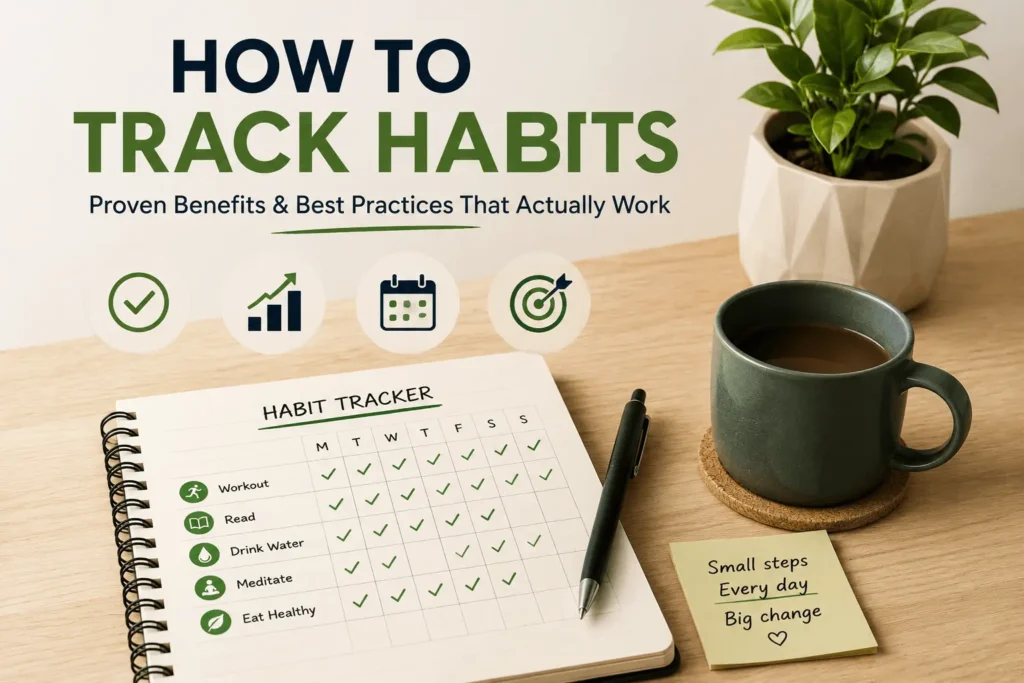
I bought a habit tracker journal once and abandoned it after three weeks.
The first few days felt great. I filled in every box. The grid looked perfect. Then I missed a day, which felt worse than it should have. Then I missed two more. The empty boxes stared at me every time I opened the journal, so I stopped opening it. The tracker that was supposed to help me build habits ended up making me feel like a failure.
I didn’t try tracking again for almost a year. When I finally did, I used a different approach entirely. Smaller. Simpler. Less precious about perfection. That time it stuck.
Learning how to track habits isn’t just about finding the right app or printable template. It’s about understanding what tracking can actually do, what it can’t do, and whether it’s even the right tool for you in the first place.
Habit tracking is the process of recording whether you complete a specific behavior each day. It helps build awareness, reinforce consistency, and identify patterns that make habits easier, or harder, to maintain. Self-monitoring is one of the most consistently effective behavior-change techniques identified across decades of behavioral psychology research, especially when combined with clear goals and environmental cues.
What Habit Tracking Actually Is
Habit tracking is straightforward. You pick a behavior you want to do consistently. You record whether you did it each day. That’s it.
The format doesn’t matter much. A notebook. A spreadsheet. An app on your phone. A wall calendar where you mark an X each day. The mechanism is the same. You’re creating a visual record of consistency.
What makes tracking different from just trying to remember whether you exercised this week is that it removes ambiguity. Memory is unreliable. You might think you worked out three times this week when it was actually two. You might forget that you skipped meditation four days in a row. A tracker doesn’t let you forget. It shows you exactly what happened.
This can be motivating or discouraging depending on your personality and how you use it. More on that later.
At its simplest, a habit tracker is just a list of habits down the left side of a page and a row of boxes for each day of the month. You check the box when you do the habit. That’s the whole system. Everything else, apps, templates, streak counters, reminders, is just decoration around that core idea.
It’s also worth remembering that many people build lasting habits without ever using a tracker. Tracking is helpful, but it isn’t a requirement for successful habit formation. Some of the most consistent people I know have never filled in a single box. They just do the thing. The tracker is a support tool, not a prerequisite.
Why Track Habits at All
There are a few reasons habit tracking became so popular.
First, it provides immediate visual feedback. You can see your progress at a glance. A row of checked boxes feels satisfying in a way that an abstract sense of consistency doesn’t. That small satisfaction can be enough to keep you going on days when motivation is absent.
Second, it creates awareness. Most people have a vague sense of how consistent they are. The sense is usually wrong. We overestimate how often we do good habits and underestimate how often we slip into bad ones. Tracking removes the guesswork. You can’t pretend you’ve been consistent if the tracker says otherwise.
Third, it reinforces the habit loop. When you check a box after completing a behavior, that small act of completion functions as a reward. The cue-routine-reward cycle gets strengthened. The guide on how habits are formed explains the neuroscience behind this, but the short version is that your brain learns to associate the behavior with a positive feeling, even if the feeling is just the satisfaction of marking something done.
Habit tracking benefits also include helping you notice patterns. Maybe you consistently miss workouts on Wednesdays. Maybe your meditation habit falls apart whenever you travel. Maybe your sleep quality correlates with whether you exercised that day. A tracker makes these patterns visible so you can address them instead of wondering why some weeks feel harder than others.
When Habit Tracking Works and When It Doesn’t
This is the part that took me years to figure out.
Habit tracking works best when you’re trying to establish a new behavior and need awareness of whether you’re actually doing it. During the first month or two, before the habit feels automatic, tracking provides structure. It reminds you that the habit exists. It holds you accountable. It gives you a small reward each time you complete it.
Habit tracking works less well when the tracking itself becomes the goal. Looking back, I caught myself doing a habit just to check the box, without any real engagement. I was going through the motions of meditation so I could mark it complete, not because I was actually meditating. The box got filled. The habit didn’t deepen. That’s checking a box, not building a habit.
Tracking also backfires for some personality types. If you’re prone to perfectionism or all-or-nothing thinking, a tracker can become a source of stress. Missing a day feels like failure. A broken streak feels like proof that you can’t stick with anything. Instead of motivating consistency, the tracker triggers shame, and shame almost always leads to avoidance.
The guide on why habit building fails explores this pattern in more detail. The short version is that tracking is a tool. Like any tool, it helps some people and hurts others. The question isn’t whether habit tracking works universally. It’s whether it works for you, right now, for this specific habit.
Tracking seems to work better for some types of habits than others. Behaviors with clear yes-or-no completion, like “did I floss today?”, are easy to track. Behaviors with varying quality, like “did I have a productive work session?”, are harder to track meaningfully. A checked box tells you the habit happened. It doesn’t tell you whether it was done well.
How to Track Habits Without Losing Your Mind
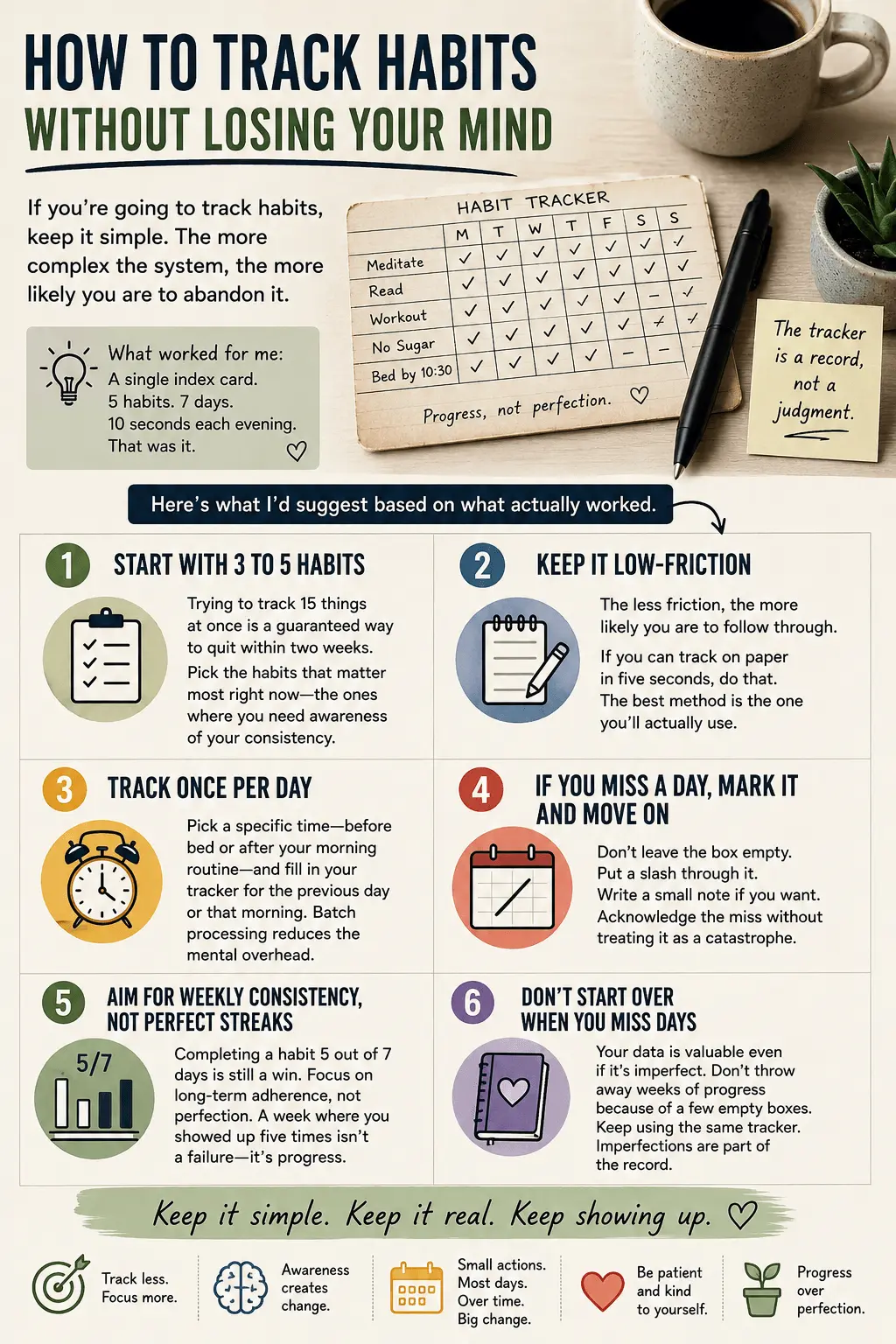
If you’re going to track habits, keep it simple. The more complex the system, the more likely you are to abandon it.
I kept making the same mistake for years. Elaborate tracking setups. Multiple apps. Color-coded spreadsheets. Journals with different symbols for different types of habits. None of them lasted more than a few weeks. What did last was a single index card with five habits listed down the side and seven columns for the days of the week. I checked boxes with a pen. It took ten seconds each evening. That was it.
I still have that index card somewhere. The paper is worn at the edges.
Here’s what I’d suggest based on what actually worked.
Start with no more than three to five habits. Trying to track fifteen things simultaneously is a guaranteed way to abandon the tracker within two weeks. Pick the habits that matter most right now. The ones where you genuinely need awareness of whether you’re being consistent.
Keep the tracking method as low-friction as possible. If you have to open an app, navigate to the right screen, find the habit, and tap a button, that friction adds up. If you can track on paper in five seconds, do that. The best habit tracking method is the one you’ll actually use.
Track once per day, not throughout the day. Set a specific time, maybe right before bed or right after your morning routine, to fill in the tracker for the previous day or that morning. Batch processing reduces the mental overhead.
If you miss a day, mark it and move on. Don’t leave the box empty as if it didn’t happen. Put a slash through it. Write a small note if you want. Acknowledge the miss without treating it as a catastrophe. The tracker is a record, not a judgment.
Rather than aiming for a perfect streak, many people benefit from tracking their weekly consistency rate, for example completing a habit five out of seven days. That focuses attention on long-term adherence instead of perfection. A week where you showed up five times isn’t a failure. It’s a week where you were consistent most days.
Don’t start a new tracker just because you missed a few days. For a while, I kept doing this. I’d abandon a tracker with two weeks of data because the empty boxes made it feel ruined. I’d start a fresh one. Feel better temporarily. Repeat the cycle. The data you already have is valuable even if it’s imperfect. Keep using the same tracker. The imperfections are part of the record.
Different Habit Tracking Methods
There’s no best method. There’s only what fits your life.
Here’s a quick overview of the main options:
| Tracking Style | Best For |
|---|---|
| Paper | Simplicity, less screen time |
| App | Reminders and automation |
| Spreadsheet | Customization and analysis |
| Bullet Journal | People who already journal |
| Notion | Existing Notion users |
Paper tracking is the simplest. A notebook, a printed template, a wall calendar, an index card. You check boxes with a pen. There’s no app to open, no notification to dismiss, no screen to stare at. The downside is that paper trackers can’t send reminders or generate charts. If you need those features, paper won’t work. Printable habit tracker templates are easy to find online, and a simple monthly habit tracker drawn by hand takes about two minutes to create. If you’re the kind of person who enjoys physical notebooks and the tactile feeling of crossing things off, paper will probably feel more satisfying than any app.
Habit tracking apps add convenience at the cost of screen time. They send reminders, track streaks automatically, and generate visual reports of your progress. Popular options include Habitica, Streaks, and Loop Habit Tracker. A digital habit tracker lives on your phone, which is also where distractions live. Opening your habit tracker can easily turn into checking notifications or scrolling. If you already spend too much time on your phone, adding another app might create more problems than it solves.
Spreadsheet tracking using Excel or Google Sheets works well if you want customization without an app. You can build exactly the layout you want, add formulas to calculate consistency rates, and access your tracker from any device. The initial setup takes some time, but once it’s built, it’s reusable. Some people love this approach. Others find it feels too much like work.
Notion habit trackers have become popular because Notion is already where many people manage their tasks and projects. Adding habit tracking to an existing Notion setup reduces the friction of using a separate tool. The flexibility is high. You can create database views, calendar views, and progress bars. The learning curve is also higher than a paper tracker.
Bullet journal habit tracking integrates habit tracking into a larger journaling practice. If you already use a bullet journal for planning and reflection, adding a habit tracker to your monthly spread takes almost no extra effort. The tracker lives alongside your other pages, which makes it harder to forget about.
I’ve used all of these at different points. Paper works best for me because there’s no screen involved and the physical act of checking a box feels more satisfying than tapping a button. This won’t work for everyone. The only wrong choice is the one you won’t use.
Common Habit Tracking Mistakes
I’ve made all of these.
Tracking too many habits at once. The enthusiasm of a new tracking system makes everything seem trackable. By day four, filling in fifteen boxes feels like a chore. By day seven, the tracker is abandoned. Three to five habits is plenty.
Focusing on streaks over consistency. Streaks are motivating when intact and crushing when broken. If you miss a day and the streak resets to zero, the temptation to quit entirely is strong. I’ve abandoned habits because the number going back to zero felt like losing all my progress. The streak was never the point. The consistency was. The guide on why consistency matters more than motivation covers this distinction in detail. Tracking should measure whether you’re showing up regularly, not whether you’ve been perfect.
Using the tracker as a substitute for actually caring about the habit. Checking a box feels productive even when the underlying behavior is hollow. I eventually noticed I was going through the motions of habits I didn’t care about just to fill in a square. The habit didn’t stick. The box did. That’s not the goal.
Never reviewing the data. Tracking creates information. Information is only useful if you look at it. Once a week or once a month, look back at your tracker and notice patterns. Which habits are consistently green? Which ones have gaps? What was happening during the weeks when everything fell apart? The tracker tells a story. Reading it is how you learn what to adjust.
Switching methods constantly. New app. New template. New system. Every switch resets your data and your momentum. Pick a method and stick with it for at least a month before deciding whether to change. The grass is always greener in the other app store.
Habit Tracking Myths Worth Ignoring
A few ideas about habit tracking get repeated so often that people assume they’re true. They’re not.
You need to maintain a perfect streak. Streaks are motivating when they work and punishing when they break. A perfect streak isn’t the goal. Consistent behavior over time is the goal. Missing a day doesn’t erase your progress. It just means you missed a day.
More tracked habits means more progress. Tracking fifteen habits doesn’t make you fifteen times more productive. It usually just makes you overwhelmed. The number of habits you track should reflect what you can realistically maintain, not what you wish you were doing.
Apps are automatically better than paper. Apps offer features. Paper offers simplicity. Neither is universally superior. The best method is the one that fits your preferences and that you’ll actually use. Plenty of consistent people have never opened a habit tracking app.
Missing one day means you’ve failed. One missed day is one missed day. It doesn’t erase the weeks of consistency that came before it. The danger isn’t the miss itself. It’s the emotional reaction, guilt, frustration, self-criticism, that turns one missed day into a complete stop.
A tracker will fix your motivation problem. A tracker is a tool, not a solution. It can help you see patterns and stay aware of your consistency. It can’t make you care about a habit you don’t actually want to build. If the underlying motivation isn’t there, no tracker will create it.
How to Build Habits With Tracking
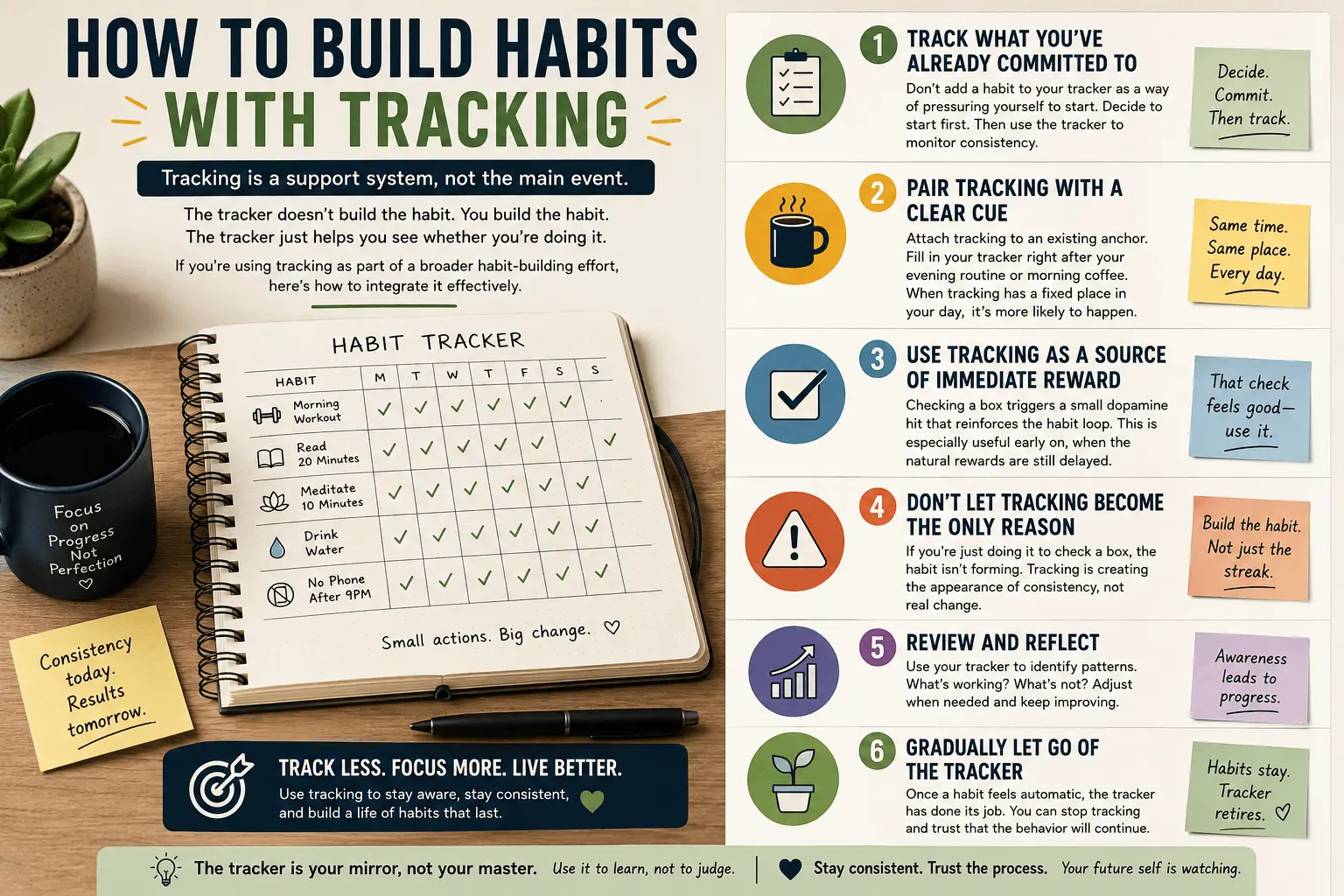
Tracking is a support system, not the main event.
The tracker doesn’t build the habit. You build the habit. The tracker just helps you see whether you’re doing it.
If you’re using tracking as part of a broader habit-building effort, here’s how to integrate it effectively.
Start by tracking only the habits you’ve already committed to. Don’t add a habit to your tracker as a way of pressuring yourself to start. Decide to start first. Then use the tracker to monitor consistency.
Pair tracking with a clear cue. The guide on what habits are and how they work explains the cue-routine-reward loop. The tracker works best when it’s attached to an existing anchor. Fill in your tracker right after your evening routine. Or right after your morning coffee. When tracking has a fixed place in your day, it’s more likely to happen.
Use tracking as a source of immediate reward. The act of checking a box triggers a small release of dopamine that reinforces the habit loop. This is especially useful during the early stages when the natural rewards of the habit are still delayed. If you’re building an exercise habit and the physical results won’t show up for weeks, the checked box gives your brain something positive right now.
Don’t let tracking become the only reason you do the habit. If you find yourself going through the motions just to check a box, the habit isn’t forming. The tracking is just creating the appearance of consistency. The guide on how to build good habits covers how to build genuine engagement rather than just going through motions.
Eventually, tracking becomes less necessary. Once a habit feels automatic, once you do it without deliberation, the tracker has done its job. You can stop tracking and trust that the behavior will continue.
When to Stop Tracking
Tracking isn’t meant to be permanent.
A habit tracker is scaffolding. It supports the building process. Once the structure is stable, you remove the scaffolding.
I stop tracking a habit when I notice that I’m doing it consistently without needing the reminder. If I haven’t looked at the tracker in a week and I still did the habit every day, the tracker is no longer serving its purpose. The behavior has become automatic enough to survive on its own.
I also stop tracking when the tracker starts causing stress. If I’m anxious about maintaining a streak. If I’m doing the habit resentfully just to fill a box. If blank spaces make me feel guilty. Those are signs that tracking has become counterproductive. The tool is working against me instead of for me.
The guide on why consistency matters more than motivation covers the broader principle. The goal is consistent behavior, not a perfect tracking record. If tracking helps you stay consistent, use it. If tracking is undermining your consistency by making you feel like a failure every time you miss, stop tracking and focus on the behavior itself.
Some people track habits indefinitely and find it helpful. Some people track for a few months and move on. Neither approach is wrong. The only mistake is continuing to use a tool that stopped helping a long time ago.
Building healthy habits is part of a larger picture. The guide on wellness habits explores how individual habits fit into a broader approach to well-being. And if your mindset around habits feels rigid or punitive, the guide on how to change your mindset might be useful.
What Recent Research Suggests (Updated 2026)
The core findings around habit tracking haven’t changed dramatically in recent years, but the emphasis has shifted in ways worth noting.
Systematic reviews and behavioral research available through 2026 continue to support self-monitoring as a useful behavior-change technique, particularly when paired with implementation intentions and environmental design. Tracking works best when it supports awareness rather than perfection. The goal is to see what’s happening, not to maintain a flawless record.
Long-term consistency matters more than maintaining an unbroken streak. Research on habit formation, including the work of Phillippa Lally on automaticity and Wendy Wood on context stability, consistently finds that the people who sustain habits over time aren’t the ones who never miss. They’re the ones who miss and come back quickly. A tracker that helps you recover faster after a lapse is more valuable than a tracker that makes you feel terrible about the lapse itself.
The psychology of habit tracking also reinforces what many people learn through experience. Tracking provides a small immediate reward that bridges the gap between effort and delayed results. It creates awareness that helps identify patterns. And it works best when kept simple. The people who stick with tracking long-term tend to use simpler systems, not more elaborate ones. These observations line up closely with what researchers continue to find. My experience isn’t scientific evidence, but it’s reassuring that the broader research points in the same direction.
Current evidence still does not support the popular “21-day habit rule.” Habit formation timelines vary widely between individuals and behaviors, with the original research by Lally and colleagues showing an average of 66 days and a range from 18 to 254 days. Tracking can help you understand your own timeline rather than comparing yourself to an arbitrary standard.
Frequently Asked Questions
What is the best habit tracking method for beginners?
The simplest method you’ll actually use. For habit tracking for beginners, that’s usually either a paper tracker with three to five habits or a free app with a clean interface. Don’t overcomplicate it. The goal is to build the tracking habit first, not to design the perfect system. A single index card with checkboxes works better than an elaborate setup you abandon after a week.
How many habits should I track at once?
Three to five is a good range. Fewer is fine. More than five or six almost always leads to tracking fatigue. If you have ten habits you want to build, pick the three that matter most right now and track those. You can add more later once the first set feels stable.
Do I need to track habits forever?
No. Tracking is scaffolding. Once a habit feels automatic and you’re doing it consistently without needing reminders, you can stop tracking it. Some people prefer to track indefinitely, especially for habits that tend to slip. But tracking is a tool, not a lifetime commitment. Use it while it helps. Stop when it doesn’t.
What should I do when I miss a day on my habit tracker?
Mark the miss and keep going. Put a slash through the box instead of leaving it empty. Write a brief note if you want. Don’t treat a missed day as a reason to abandon the tracker. Don’t start a fresh tracker just because the current one isn’t perfect. The record is more useful when it reflects reality, including the imperfect days.
Are habit tracking apps better than paper trackers?
Neither is objectively better. Apps offer reminders, streak counting, and visual reports. Paper offers simplicity, no screen time, and the tactile satisfaction of physically checking a box. The best method is the one that fits your preferences and that you’ll actually use consistently. Try both for a week each and see which one feels more natural. If you tend to get distracted by your phone, paper is probably the safer choice. If you need reminders to remember habits exist, an app might serve you better.
Can habit tracking make things worse?
Yes, for some people. If you’re prone to perfectionism or all-or-nothing thinking, a tracker can become a source of stress. Missed days feel like failures. Broken streaks trigger guilt. The tracker, which is supposed to help, becomes another thing to feel bad about. If tracking is making you feel worse rather than better, stop. The behavior matters more than the documentation.
Final Thoughts
Habit tracking is a tool. Nothing more.
It helps some people stay consistent. It helps some people see patterns they’d otherwise miss. It gives some people the small daily reward that keeps them going through the hard middle phase of habit formation.
It also frustrates some people. It triggers perfectionism in some people. It becomes a hollow performance for some people who fill boxes without building real habits.
Learning how to track habits isn’t about finding the perfect app or template. It’s about creating a simple system that helps you stay consistent long enough for the habit to become part of your routine. If tracking helps you do that, use it. If it doesn’t, let it go. The habit itself is what matters.
The tracker is not the habit. The habit is the habit. Don’t confuse the two.