
I used to think habits formed through repetition alone. Do something enough times and eventually it sticks. That was the extent of my understanding.
Then I tried to build a flossing habit and failed repeatedly despite doing it every day for three weeks. Meanwhile, I developed a habit of checking my phone first thing in the morning without any effort at all. I never set out to create that one. It just appeared.
The asymmetry bothered me. Why did some behaviors become automatic almost instantly while others never seemed to stick no matter how many times I did them?
I ended up reading a lot about the science of habit formation. Research papers, books, articles. Some of it was dense. Some of it contradicted things I’d believed for years. But the more I understood, the more my failures started to make sense. I wasn’t undisciplined. I was just working against the mechanics without knowing it.
This article covers what I learned. Not the textbook version. The version that actually helped me make sense of my own behavior.
How Habits Are Formed in the Brain
The brain is always looking for ways to save energy.
Every decision you make consciously costs mental resources. What to eat. Which route to drive. Whether to exercise or skip it. These small choices add up, and the brain can only handle so many deliberate decisions in a day before fatigue sets in.
I noticed this pattern in myself long before I understood the neuroscience behind it. On days when I’d made a lot of decisions by noon, I’d find myself eating whatever was easiest and avoiding anything that required mental effort. I thought I was just tired. Turns out my brain was conserving resources.
Habits are the brain’s solution to this problem. When a behavior repeats often enough in a stable context, the brain starts to automate it. The behavior gets handed off from the prefrontal cortex, which handles conscious decision-making, to the basal ganglia, a deeper brain structure that manages automatic behaviors and procedural learning.
This process is called chunking. The brain groups sequences of actions into a single unit that can be triggered automatically. Driving is the example everyone uses because it’s so clear. When I first learned, every action required focus. Steering. Mirrors. Pedals. Speed. Now I can drive across town while thinking about something else entirely. The basal ganglia runs the driving program while my conscious mind is free to wander.
That’s how habits are formed in the brain. Not through willpower or motivation, but through a physical restructuring of neural pathways that makes repeated behaviors increasingly automatic. Wendy Wood, a researcher at the University of Southern California who has studied habits for decades, estimates that around 43% of daily behaviors are performed habitually, happening without conscious deliberation. We’re running on autopilot nearly half the time, whether we realize it or not.
The trade-off is that the brain doesn’t distinguish between helpful and harmful behaviors when it does this. The same mechanism that makes exercise feel automatic also makes smoking feel automatic. The process is morally neutral. It just optimizes for whatever gets repeated.
For a deeper look at the underlying psychology and the broader mechanics, the guide on what habits are and how they work covers the full picture.
The Habit Loop Explained
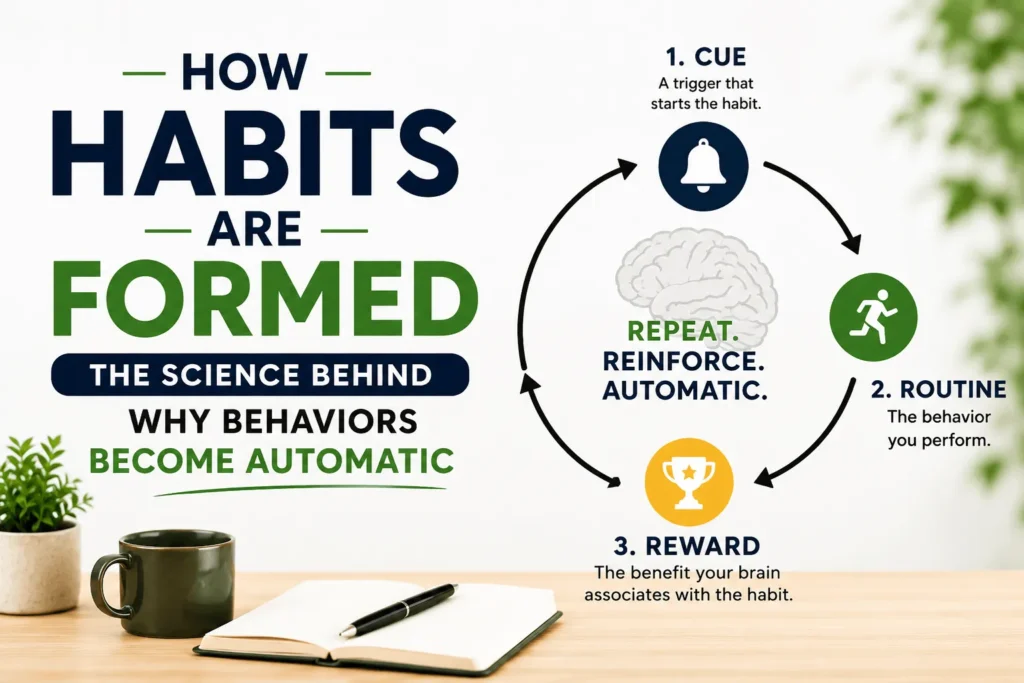
The core mechanism behind every habit is something researchers call the habit loop. It has three components: cue, routine, and reward.
The cue is the trigger that tells your brain to initiate a behavior. It can be a time of day, a location, an emotional state, a preceding action, or the presence of certain people. The brain notices the cue and, based on past experience, predicts what behavior will lead to a reward.
The routine is the behavior itself. The action you take. It can be physical, mental, or emotional.
The reward is what your brain gets from completing the routine. Sometimes it’s tangible, like food or a notification. Often it’s chemical, a small release of dopamine that tells your brain this sequence is worth remembering.
I started noticing this loop in my own life once I knew what to look for.
Every afternoon around 3 PM, I’d find myself in the kitchen looking for a snack. The cue was the time of day combined with a natural energy dip. The routine was eating something, usually something sweet. The reward was a temporary energy boost and a brief break from work.
I wasn’t hungry. My body didn’t need food. My brain had just learned that at 3 PM, snacking led to a pleasant outcome, so it kept prompting the behavior automatically.
The habit loop runs largely beneath conscious awareness. You don’t decide to crave a snack at 3 PM. The craving just appears. That’s what makes understanding the loop so useful. Once you can see the components, you can start to intervene. Peter Gollwitzer’s research on implementation intentions, often called “if-then plans,” shows that people who specify exactly when and where they’ll perform a behavior are significantly more likely to follow through. The formula is straightforward: “If [cue] happens, then I will do [routine].” Over time, the brain automates the connection.
How Long It Really Takes to Form a Habit
The 21-day rule is everywhere. I heard it repeated so many times over the years that I assumed it must be true. I’d start a habit, hit day 21, and feel confused when it still required effort. Something must be wrong with me.
Turns out the 21-day idea traces back to a plastic surgeon named Maxwell Maltz, who noticed in the 1950s that his patients took about 21 days to adjust to changes in their appearance. Somewhere along the way, that observation got generalized to all habit formation, and it stuck.
The actual research tells a different story. A study by Phillippa Lally and colleagues at University College London, published in the European Journal of Social Psychology in 2009, tracked participants as they tried to form a new habit. The average time to reach automaticity, the point where the behavior felt automatic rather than effortful, was 66 days.
But the range was enormous. Some participants formed habits in as few as 18 days. Others took as long as 254 days. The variation depended on the complexity of the behavior, the consistency of the cue, and individual differences between people.
What this means in practice is that counting days is probably the wrong approach. A better question is whether the behavior is starting to feel automatic. Do you have to talk yourself into it, or does it just happen? When you miss a day, does it feel like something is off? Those are better indicators than any calendar.
I’ve had habits that felt automatic within two weeks. I’ve had others that still required effort after three months. The ones that formed fastest were always the simplest, attached to the most consistent cues, and rewarded most immediately. The ones that took longest were complex, cued inconsistently, or had rewards that were too delayed.
Why Some Habits Form Faster Than Others
Not all behaviors are equally easy to automate. I learned this the hard way by trying to build several habits simultaneously and watching most of them fail while one or two stuck without much effort.
Complexity matters a lot. A simple behavior like drinking a glass of water after waking up forms faster than a complex behavior like going to the gym, which involves changing clothes, traveling, exercising, showering, and returning. Each additional step adds friction and makes automation harder.
Immediacy of reward matters even more. Behaviors that deliver instant gratification wire into the brain faster. This is why bad habits often form effortlessly. The reward is immediate. The cost is delayed. Good habits often work in reverse. The effort is immediate. The reward is delayed. That timing difference explains a lot about why positive habits feel harder to establish.
I noticed this pattern with exercise. The workout itself felt hard. The results showed up weeks later. My brain got no immediate payoff, so it kept resisting. What eventually helped was pairing exercise with something immediately enjoyable, like listening to a podcast I only allowed myself during workouts. That small shift gave my brain a reason to look forward to the behavior instead of dreading it.
Consistency of context also plays a role. If the cue is stable and predictable, the brain can link it to the behavior more easily. If the cue varies, the association takes longer to solidify. This is why habits tied to fixed anchors like “after brushing teeth” form faster than habits tied to variable anchors like “when I have time.” Lally’s research confirmed this. Participants who attached their new habit to a consistent daily cue reached automaticity faster than those whose cues fluctuated.
One thing that surprised me was how much individual variation exists. Some people seem to form habits quickly regardless of the behavior. Others struggle even with simple changes. The Lally study found this variation even in a controlled research setting. It’s not just about strategy. Some of it is just how your particular brain works, and that’s worth accepting rather than fighting.
How Habits Develop Over Time
Habit formation isn’t a switch that flips. It’s a gradual process where a behavior moves along a spectrum from deliberate to automatic.
In the beginning, every repetition requires conscious effort. You have to remember to do it. You have to decide to do it. You have to push through resistance. This is the phase where most attempts fail, because the effort feels disproportionate to the reward. I’ve abandoned more habits at this stage than I can count.
After enough repetitions in a stable context, the behavior starts to feel easier. You still have to initiate it consciously, but the friction decreases. The behavior begins to feel like part of your routine rather than an interruption. This middle phase is deceptive. The novelty has worn off, but the behavior hasn’t become fully automatic yet. It’s easy to lose momentum here if you’re not paying attention.
Eventually, the behavior becomes automatic. The cue triggers the behavior without conscious deliberation. You find yourself doing it without having decided to. Missing it feels noticeable, sometimes uncomfortable.
There’s also a phenomenon I learned about the hard way. Habits can become fragile even after they feel established. I had a writing habit that felt automatic for two years. Then I moved apartments and the new environment disrupted my cues. The habit didn’t survive the transition. I had to rebuild it almost from scratch. Wood’s research on habit discontinuity highlights this pattern. Major life changes, moving, starting a new job, having a child, disrupt the stable contexts that habits depend on. Interestingly, these disruption windows also create opportunities. Old habits are more malleable during transitions, which means they’re also easier to change.
This is where people often get stuck. They assume that once a habit is formed, it’s permanent. But habits depend on stable cues. Change the environment and you change the cues. The behavior doesn’t necessarily follow.
The practical takeaway is that habit maintenance matters as much as habit formation. When life changes, check whether your cues are still intact. If they’re not, you might need to deliberately rebuild the association before the behavior erodes.
Keystone Habits and Why Some Behaviors Matter More
Not all habits are equal. Some behaviors create ripple effects that make other positive changes easier. These are sometimes called keystone habits.
The idea is that certain habits shift your self-perception or restructure your environment in ways that cascade into other areas. Exercise is the classic example. People who start exercising regularly often find themselves eating better, sleeping more consistently, and drinking less, even without deliberately trying to change those other behaviors.
I experienced this with sleep. When I started prioritizing a consistent bedtime, other habits fell into place without much effort. I had more energy for morning exercise. I made better food choices. I was more patient with people. The sleep habit wasn’t just one habit among many. It was a foundation that made everything else easier.
I also tried making my bed every morning for a while, which gets cited as a keystone habit in a lot of books. For me, it didn’t create any cascading effects. A made bed was just a made bed. That’s the thing about keystone habits. What creates ripple effects for one person might not for another.
At least in my experience, the habits that function as keystones tend to share certain qualities. They happen early in the day, so the ripple effect has time to spread. They involve a clear before-and-after difference that’s easy to notice. And they tend to be behaviors that carry identity significance, meaning they affect how you see yourself.
If you’re trying to figure out where to start with habit change, experimenting with potential keystone habits is worth the effort. For more practical guidance on choosing and establishing those first habits, the guide on how to build good habits walks through the process.
How to Form Good Habits Using What We Know
Understanding the science is useful, but only if it translates into something practical. Here’s what actually worked for me, based on everything I learned about habit formation.
First, pick a specific cue. Vague intentions like “I’ll exercise more” don’t give your brain a clear trigger. I tried that approach for years. It never worked. What did work was attaching the behavior to something already automatic. “After I put my coffee on, I’ll do five pushups.” The existing routine of making coffee became the anchor for the new behavior. Gollwitzer’s implementation intention research backs this up. The specificity of “when situation X arises, I will perform response Y” roughly doubles the likelihood of follow-through compared to vague goals.
Second, start smaller than seems reasonable. The behavior needs to be so simple that your brain doesn’t resist it. The goal in the early phase isn’t results. It’s repetition. Each time you complete the cue-routine-reward loop, you’re strengthening the neural pathway. The size of the routine matters less than the consistency of the repetition. I wasted a lot of time starting too big and quitting after a week.
Third, build in an immediate reward. If the natural reward of the behavior is delayed, which it often is for positive habits, create an artificial one. Track the behavior and enjoy checking it off. Listen to music you like during the activity. Pair the habit with something pleasant so your brain gets a dopamine signal that reinforces the loop.
Fourth, maintain a stable environment. Keep the cues consistent. If you always exercise right after waking, but then you travel and the morning looks different, have a plan for how you’ll maintain the cue or create a temporary substitute.
Fifth, expect the middle period to feel harder. The initial novelty wears off before the behavior becomes automatic. That gap is where most habits die. Knowing it’s coming helps you push through. I’ve lost count of how many habits I abandoned in week three or four because the excitement faded and the automaticity hadn’t kicked in yet.
Finally, don’t treat missed days as failures. Missing a day doesn’t erase the neural pathways you’ve built. It just means you missed a day. Resume the next day. The habit formation process can survive interruptions as long as the interruptions don’t become the new pattern.
Why Breaking Bad Habits Is Harder Than Starting Good Ones
There’s an asymmetry between building and breaking that I didn’t appreciate for a long time.
When you build a good habit, you’re creating new neural pathways. When you break a bad habit, you’re trying to weaken pathways that already exist and have been reinforced potentially for years. Those pathways don’t disappear. They persist, and the old cue still triggers them.
This is why quitting something often feels harder than starting something. You’re not just building a new pattern. You’re also fighting an old one that your brain keeps offering as an option.
I struggled with this for years with late-night snacking. The cue was evening relaxation. The routine was eating. The reward was comfort. Telling myself to stop never worked because the cue still fired and my brain still wanted the reward.
The most effective approach I’ve found, and the one supported by the research, is to keep the cue and the reward while changing only the routine. Instead of snacking at night, I started making tea. Same cue. Similar comfort. Different routine. Eventually my brain accepted the substitution.
This works because you’re not trying to dismantle the entire loop. You’re just redirecting the middle step. The existing neural infrastructure gets repurposed rather than fought against. Wood’s research emphasizes this point. Habit change is rarely about erasing old patterns. It’s about building new ones that compete with and eventually override the old ones through repetition in the same context.
The distinction between good habits and bad habits matters less here than understanding the loop. For more on how to think about the difference and apply replacement strategies, the guide on good habits vs bad habits goes deeper into the practical distinctions.
One thing I’ve noticed is that environment changes make habit replacement dramatically easier. When I moved my phone charger to another room, the old cue of lying in bed was still there, but the routine of reaching for the phone became impossible. My brain eventually stopped offering the behavior because it was no longer available. I didn’t have to be stronger. I just had to change the environment.
Common Mistakes That Prevent Habit Formation
Most habit attempts fail for the same handful of reasons. I’ve made all of these mistakes multiple times.
Trying to change too many things at once. The enthusiasm of starting something new makes multiple changes feel possible. I’d decide to exercise daily, eat better, wake up earlier, and read more, all starting Monday. By Wednesday I’d be exhausted and by Friday I’d have abandoned everything. One habit at a time is almost always the better approach.
Starting too big. If the behavior requires significant effort or time, the odds of maintaining it through the pre-automatic phase drop dramatically. The smaller the initial version, the more likely it survives. I’ve learned this lesson repeatedly and still sometimes catch myself designing habits that are too ambitious.
Relying on motivation instead of environment. Motivation fluctuates. Some days you’ll feel driven. Some days you won’t. If the habit requires feeling motivated to happen, it’s not a habit yet. Design your environment so the behavior is the path of least resistance regardless of how you feel.
Not having a clear cue. “Sometime today” is not a cue. Your brain can’t latch onto that. The more specific the trigger, the faster the association forms. I’ve abandoned habits simply because I never decided when they were supposed to happen.
Ignoring the reward. If the behavior feels punishing with no payoff, your brain won’t prioritize it. Build in something immediately satisfying, even if it’s small.
Treating lapses as complete failures. Missing a day feels like proof that you can’t do it. It’s not. It’s just a missed day. The people who succeed at habit formation are usually not the ones who never miss. They’re the ones who miss and come back quickly.
Habit Tracking and Daily Habit Formation
Habit tracking occupies an interesting middle ground. It’s not necessary for habit formation, but it can help during the early stages when the behavior doesn’t yet feel automatic.
The benefit of tracking is that it provides an immediate visual reward. Checking a box or filling a cell gives you a small dopamine hit that reinforces the behavior. It also creates awareness. You can’t pretend you’ve been consistent if the tracker shows otherwise.
I’ve used habit trackers on and off for years. They help most during the first month or two of a new habit. Once the behavior feels automatic, the tracker becomes less useful and I usually stop using it.
I bought a habit tracker journal once and abandoned it after about three weeks. The tracking itself started feeling like an additional chore. Now I just use a simple note on my phone for the habits I’m actively working on. Less friction.
The risk with tracking is that the external reward of checking the box can replace the intrinsic reward of the behavior itself. When that happens, stopping the tracker can cause the habit to collapse because the primary source of satisfaction disappears. This has happened to me. I tracked a reading habit for two months, filled every box, felt great about it. Then I stopped tracking and the reading dropped off within a week. I’d been reading to check the box, not because reading itself felt rewarding.
For daily habit formation, tracking is a tool, not a requirement. Use it if it helps. Don’t if it doesn’t. And if you find yourself obsessing over streaks, consider whether the tracker is serving you or you’re serving the tracker.
How Habits Work in Everyday Life
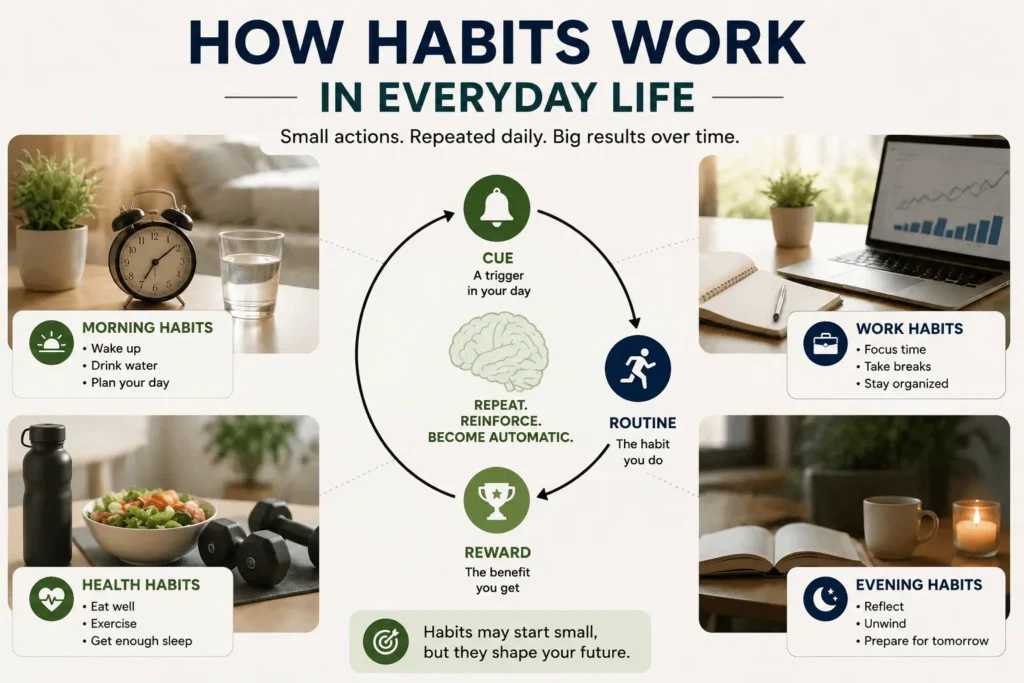
The theory is clean. The application is messy.
Most of what I’ve described works differently depending on what else is happening in your life. Habits that thrive during calm periods often collapse during stress. Habits that seem solid can vanish after a vacation or a move. The science explains the mechanism, but real life introduces variables that no study fully accounts for.
I had a meditation habit that felt unshakeable for six months. Then I went through a stressful period at work and it disappeared within a week. The cue was still there. The routine was still available. But my mental capacity was so depleted that even a simple habit felt like too much.
Something I’ve come to accept is that habit formation is never truly finished. Behaviors require maintenance. Cues shift. Rewards lose their appeal. Life reorganizes itself and your habits reorganize along with it, whether you want them to or not.
The people I know who maintain positive habits long-term aren’t the ones with the most discipline. They’re the ones who pay attention. They notice when a habit starts slipping and intervene early. They adjust the cue when the old one stops working. They find new rewards when the old ones stop motivating. They treat habit formation as an ongoing process rather than a one-time achievement.
This isn’t discouraging. It’s actually freeing. You don’t have to get it right once and maintain it forever. You just have to keep paying attention and making adjustments. The science gives you a framework for understanding what’s happening. The rest is just practice.
Frequently Asked Questions
How long does it really take to form a habit?
Research by Phillippa Lally and colleagues suggests an average of 66 days to reach automaticity, but the range is wide, from 18 to 254 days depending on the person and the complexity of the behavior. Simple habits form faster. Complex ones take longer. Rather than counting days, pay attention to whether the behavior is starting to feel automatic and whether missing it feels noticeable.
What is the habit loop and why does it matter?
The habit loop is a three-part neurological pattern consisting of a cue, a routine, and a reward. The cue triggers the brain to initiate a behavior. The routine is the behavior itself. The reward reinforces the loop so the brain remembers it for next time. Understanding your habit loops is the foundation of both building new habits and changing existing ones.
Can habits really become fully automatic?
Yes, but to varying degrees. Simple motor habits like tying shoes or driving a familiar route can become almost entirely unconscious. More complex habits like exercise or writing may become semi-automatic, where the initiation feels automatic but the execution still requires some conscious engagement. The key shift is that the decision to do the behavior stops requiring deliberation.
Why do bad habits form more easily than good ones?
Bad habits often provide immediate rewards. The dopamine hit from scrolling social media, eating sugar, or smoking arrives within seconds. Good habits often have delayed rewards. Exercise feels effortful now. The benefit arrives later. The brain prioritizes immediate over delayed rewards, which gives bad habits a natural advantage in the formation process.
What are keystone habits?
Keystone habits are behaviors that create positive ripple effects across other areas of life. When you establish a keystone habit, related behaviors often improve without deliberate effort. Common examples include regular exercise, consistent sleep, and daily planning or journaling. The specific habits that function as keystones vary by person.
Can you form multiple habits at the same time?
You can, but the failure rate increases. Most people have better results focusing on one habit until it feels relatively stable before adding another. The exception is when two habits naturally complement each other, like starting to exercise and drinking more water, which can often be built concurrently without additional strain.
Final Thoughts
How habits are formed isn’t a mystery. It’s a specific biological process that follows predictable rules. Cue, routine, reward. Repetition in a stable context. Gradual automation through changes in the basal ganglia.
Knowing the science doesn’t make habit change easy. I still fail at building habits. I still fall back into old patterns. I still have weeks where everything I know about habit formation doesn’t seem to help.
But understanding the mechanics has made the process less frustrating. I stop blaming myself for lacking willpower when I know my brain is just following patterns it was designed to follow. I stop expecting habits to form in 21 days. I stop trying to eliminate bad habits through sheer force when I know replacement works better.
Habits don’t become automatic because you’re disciplined. They become automatic because your brain learns what you repeat. Change the repetitions, and over time you change the default.
If you want to understand how all of this connects to actually building habits that last, start with the guide on what habits are and how they work. If you’re ready to apply what you’ve learned, the guide on how to build good habits walks through the practical steps.