
Most wellness plans fail within the first month. Not because people lack motivation. Not because they do not care about their health. They fail because the plans are too ambitious, too rigid, or too disconnected from how life actually works.
I have created more wellness plans than I can count. Some lasted two weeks. Some lasted until the first business trip. A few actually stuck around long enough to make a difference. The ones that worked were never the most impressive on paper. They were the ones that could bend without breaking.
A good wellness plan is not a declaration of who you want to become starting Monday. It is a flexible framework that guides your daily choices without making you feel like a failure when life gets in the way. Building a healthy wellness routine means creating something that fits your life, not someone else’s ideal.
Before diving into the steps, it helps to understand what wellness actually means. Wellness is not just exercise and nutrition. It includes physical health, mental well-being, emotional balance, social connection, and more. A wellness plan that only addresses one dimension will leave gaps.
This guide walks through how to create a personal wellness plan step by step. The practical version that survives a bad week, a busy month, or a period where your main accomplishment is just getting through the day.
Why Most Wellness Plans Do Not Last
The cycle is predictable. You feel motivated. Maybe it is January, or maybe it is a random Tuesday when you decide things need to change. You write down an ambitious wellness plan. Wake up at five. Exercise every day. No more sugar. Meditate for twenty minutes. Journal every evening.
For about ten days you follow it. You feel great. You tell a friend about it. Then something happens. A late work night. A family obligation. A cold that knocks you out for a week. The personal wellness plan breaks. And because the plan was too rigid, one break feels like total failure. You abandon the whole thing.
This is where people often get stuck. The real issue is not willpower. The real issue is that the health and wellness plan was designed for ideal conditions. And ideal conditions account for maybe twenty percent of actual life.
What helped most was shifting from a performance mindset to a direction mindset. A performance mindset asks whether you followed the plan perfectly. A direction mindset asks whether you are moving generally toward better health. The second question is more forgiving and more useful.
What a Wellness Plan Actually Is
Your wellness plan is not a contract. It is not a set of rules you must follow perfectly or else you have failed. Think of it more like a map. It shows you where you are, where you want to go, and some possible routes to get there. If you take a detour, the map is still useful. You just find another way.
A health and wellness plan serves a few purposes. It clarifies what matters to you. It translates vague intentions into specific actions. It helps you notice when things are slipping so you can adjust before they fall apart completely. And it gives you something to return to after disruption.
The best wellness plans are living documents. They change as your life changes. What worked before you had kids might not work after. What worked at twenty-five might not fit at forty-five. Personalized wellness strategies matter because no two lives are the same.
According to current wellness research and behavior change principles, the most effective plans are those that include both daily maintenance activities and early warning signs that indicate when you need to increase support. This dual focus makes the plan proactive rather than just reactive.
The benefits of wellness compound over time. When you understand why these habits matter, staying consistent becomes easier.
Step 1: Assess Where You Are Right Now
Before you can create a wellness plan that moves you forward, you need an honest picture of where you are starting from. Not where you wish you were. Not where you think you should be. Where you actually are.
This step is uncomfortable for a lot of people. It is easier to skip straight to setting goals. But wellness goals without a baseline are just guesses.
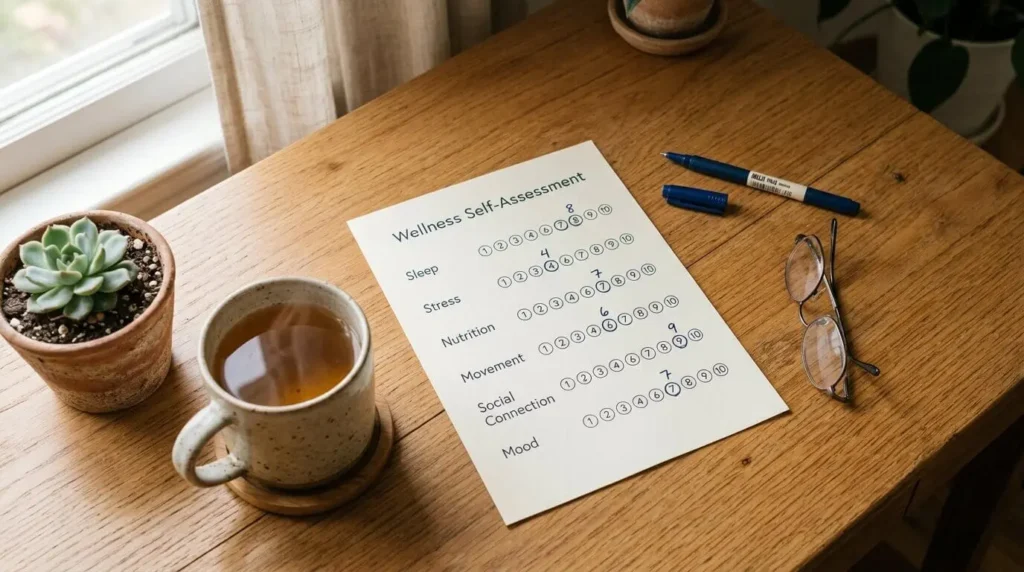
A simple self-assessment covers the major areas of well-being. The dimensions of wellness provide a useful framework here. Physical health, mental and emotional well-being, social connection, sleep, nutrition, movement, stress management, and sense of purpose all matter.
For each area, ask yourself two questions. First, how satisfied am I with this area right now? Second, how much is this area affecting my daily life? The areas with low satisfaction and high impact are where you will want to focus first.
You can do this assessment in a notebook using a simple rating scale from one to ten. The format matters less than the honesty. If your sleep is terrible and it is affecting your mood and energy, write that down. If you have not spoken to a friend in three weeks, note that too.
I did this assessment a few years ago and realized I was doing well physically but poorly socially. I was exercising regularly and eating well, but I had let friendships atrophy. My wellness plan at the time had nothing about social connection. The assessment showed me what I was missing.
Step 2: Choose Your Focus Areas
After your self-assessment, you will probably have several areas that could use attention. The temptation is to fix everything at once. That is a mistake.
Most people can realistically work on one or two areas at a time. Maybe three if the changes are very small. Trying to overhaul your entire life simultaneously spreads your attention too thin. When stress hits, all the new wellness habits collapse together.
Pick one or two focus areas that will give you the most return on your effort. Often this means starting with fundamentals. According to the CDC, adults who consistently get adequate sleep show better cognitive performance, emotional regulation, and physical recovery. Sleep is a common starting point because poor sleep makes everything else harder. If you are sleep-deprived, your willpower drops, your cravings increase, and your motivation for exercise disappears. Fixing sleep first makes other changes easier.
Another approach is to pick the area causing you the most distress. If your stress levels are through the roof and it is affecting your relationships and work, start with stress management. The relief from addressing your biggest pain point creates momentum for tackling other areas.
Wellness planning for beginners works best when the focus is narrow. Pick one thing. Get it stable. Then add the next thing. I learned this the hard way after multiple failed attempts to change everything at once.
Step 3: Set Realistic Wellness Goals
Once you have chosen your focus areas, the next step is setting specific wellness goals within those areas. This is where a lot of wellness plans go wrong. People set goals that are too big, too vague, or too dependent on ideal conditions.
Good wellness goals are specific, realistic, and flexible. Specific means there is a clear action attached. Vague goals like “get healthier” do not work because your brain does not know what to do. Clear goals like “walk for fifteen minutes after lunch on weekdays” tell you exactly what to do and when.
Realistic means the goal fits into your actual life. If you have never exercised before, a goal of working out six days a week is not realistic. The WHO physical activity guidelines recommend at least 150 minutes of moderate activity per week, but they also emphasize that any movement is better than none. A goal of walking three days a week might be the right starting point. The goal should stretch you slightly without breaking.
Flexible means the goal has a backup plan for bad days. If your goal is to meditate for ten minutes daily, what happens on days when ten minutes is impossible? Can you do two minutes instead? Having a minimum viable version keeps the habit alive when conditions are not ideal.
For more guidance on setting goals that stick, the article on how habits are formed explains the psychology behind why some behaviors become automatic. Understanding that process helps you design wellness goals that work with your brain’s natural tendencies.
Setting realistic wellness goals is not about lowering your standards. It is about creating goals that you can actually reach, which builds confidence and momentum. Success breeds more success. The wellness goals article covers more examples of goals that actually work in real life.
Step 4: Build Your Daily Wellness Routine

Goals give you direction. A daily wellness routine is how you actually get there. The routine consists of the specific daily habits for long-term wellness that move you toward your goals.
The key to building a sustainable routine is starting smaller than you think you need to. If your goal is to exercise regularly, start with something so easy it barely counts. Ten minutes of walking. Five minutes of stretching. In practice, the point in the beginning is not to get fit. The point is to establish the pattern.
Once the pattern exists, you can increase the difficulty. A ten-minute walk becomes a twenty-minute walk. Stretching becomes a yoga class. The progression happens naturally over time. But the foundation needs to be solid before you build on it.
Anchoring new habits to existing ones makes them easier to remember. If you already brush your teeth every morning, add one minute of stretching right after. If you already make coffee every day, do a brief breathing exercise while it brews. The existing habit serves as a trigger for the new one.
My daily wellness routine started with just two things. A consistent bedtime and a morning walk. That was it. After a month of consistency, I added a third thing. The routine grew organically rather than being imposed all at once.
The how to build good habits guide covers more strategies for making habits stick. The short version is that environment design, consistency, and self-compassion matter more than willpower.
Step 5: Plan for Disruption Before It Happens

This is the step most wellness plans skip. People create plans for ideal conditions and then act surprised when life interrupts them. Disruption is not the exception. It is part of the pattern.
A good health and wellness plan includes a disruption strategy. What will you do when you travel? When you get sick? When work gets intense? When you have visitors? When you just do not feel like it?
The strategy does not need to be elaborate. It can be as simple as identifying the minimum viable version of each habit. If you normally exercise for forty-five minutes, the minimum might be a ten-minute walk. If you normally cook dinner at home, the minimum might be ordering takeout but adding a side salad. The minimum keeps the thread intact even when the full habit is not possible.
I bought a habit tracker and forgot about it after a month. The issue was not the tracker itself. The issue was that tracking became its own task, and during a busy period at work it was the first thing I dropped. Now I use a simpler method. A checkmark on a paper calendar. That is it. Less friction means more consistency when life gets chaotic.
Daily habits for long-term wellness need to be portable and adaptable. The habits that survive are the ones that can shift shape when circumstances change. Rigid habits break. Flexible habits bend and recover.
Improving physical and mental well-being is not about perfect consistency. It is about maintaining connection to your habits even when you cannot do them fully. A two-minute meditation is not a failed ten-minute meditation. It is a successful two-minute meditation that kept the practice alive for another day.
A Simple Wellness Plan Template
Here is a basic wellness plan template you can adapt. Creating a personal wellness plan should not feel like homework. Start basic and add only what actually helps.
The overall flow of creating your wellness plan looks like this:
Assess Where You Are
      ↓
Choose Focus Areas
      ↓
Set Small Goals
      ↓
Build Daily Routine
      ↓
Plan for Disruptions
      ↓
Review and Adjust Monthly
Now here is the template itself:
Current Assessment
Rate each area from 1 to 10. Physical health. Sleep. Nutrition. Movement. Stress. Social connection. Purpose and meaning. Note which areas need the most attention.
Focus Areas for This Month
Pick one or two. Write them down.
Specific Wellness Goals
For each focus area, write one clear goal. Include the minimum version for difficult days.
Example:
Focus Area: Sleep
Goal: Go to bed by 10:30 PM on weeknights.
Minimum: Go to bed by 11:30 PM on rough nights. No phone after 10 PM regardless.
Daily Wellness Routine
List specific habits. Keep them simple.
Example:
Morning: Five-minute stretch after brushing teeth
Afternoon: Ten-minute walk after lunch
Evening: No phone after 10 PM
Disruption Plan
For each habit, note the travel or bad-day version.
Example:
Habit: Evening walk
Disruption version: Five minutes of stretching indoors, or walk around the hotel lobby if traveling.
Tracking Method
Decide how you will track. A checkmark on a calendar works. So does a simple notebook entry. Keep it easy.
Review Date
Set a date to review and adjust. Monthly works well. Put it on your calendar.
This wellness plan template is intentionally simple. You can add more structure if you want, but complexity tends to reduce follow-through. The best personal wellness plan is the one you will actually use.
Common Mistakes to Avoid
Even with good intentions, certain patterns tend to sabotage wellness plans. Recognizing these mistakes in advance helps you avoid them.
Here is a quick comparison of what separates plans that work from plans that do not:
| Weak Wellness Plan | Strong Wellness Plan |
|---|---|
| Change everything at once | Focus on one area |
| Demands perfect routine | Allows flexible routine |
| No backup plan | Includes bad-day version |
| Relies on motivation | Built on systems |
| Vague goals like “get healthy” | Specific goals like “walk 15 minutes after lunch” |
| Abandoned after one missed day | Shrinks to minimum version and continues |
Making the plan too ambitious is probably the most common error. People try to change their sleep, diet, exercise, and stress management all at once. It feels productive in the moment but collapses under real-world pressure.
Making goals too vague is another frequent issue. “Eat better” gives your brain nothing to act on. “Add one vegetable to dinner” is clear and doable. Specificity drives action.
Not planning for disruption leaves the plan vulnerable to real life. Travel, illness, busy periods, and low-motivation days are not exceptions. They are part of the pattern.
Comparing your plan to other people’s plans creates unnecessary pressure. Social media shows highlight reels of wellness perfection. Real life is messier. Your wellness plan needs to work for your life, not someone else’s.
Giving up after a lapse is perhaps the most damaging pattern. Missing one day is irrelevant. Missing one day and then abandoning the whole plan is the real issue. Return rate matters more than perfect adherence.
According to the Harvard Study of Adult Development, which has tracked participants for over eighty years, the factors that most strongly predict long-term well-being are not perfection or intensity but consistent, moderate practices maintained over time. Small actions repeated consistently outperform occasional extreme efforts.
For more on overcoming these patterns, the article on how to change your mindset explores how shifting your thinking can make behavior change easier. Often the biggest obstacle to a successful wellness plan is not external circumstances but internal expectations.
Frequently Asked Questions
What is a personal wellness plan?
A personal wellness plan is a flexible framework that outlines your health and well-being goals, the daily habits you will practice to reach them, and how you will handle disruptions. It covers multiple dimensions of wellness including physical health, mental well-being, social connection, and stress management. Unlike rigid programs, a wellness plan adapts to your changing life circumstances.
How do I start creating a wellness plan for beginners?
Start with a simple self-assessment to identify which areas of wellness need the most attention. Pick one or two focus areas. Set specific, realistic goals that are small enough to achieve consistently. Build a daily wellness routine around those goals. Plan for disruptions. Review and adjust monthly. Wellness planning for beginners should be simple and forgiving rather than elaborate and rigid.
What should a wellness plan template include?
A useful wellness plan template includes a current assessment of your well-being, focus areas for improvement, specific and realistic goals, a daily routine with clear habits, a disruption plan for when normal conditions are not possible, a simple tracking method, and a scheduled review date. The template should be adaptable to your individual needs.
How often should I update my wellness plan?
Review your wellness plan monthly and make adjustments as needed. Major life changes such as a new job, a move, or a change in family circumstances may require a more comprehensive update. A wellness plan should evolve as your life evolves. If you have not updated your plan in six months, it probably no longer reflects your current reality.
Can a wellness plan help with mental health?
Yes. A health and wellness plan that includes mental and emotional well-being practices can support mental health by establishing routines around stress management, social connection, sleep, and self-care. However, a wellness plan is not a substitute for professional mental health treatment. If you are experiencing significant mental health challenges, consult a qualified healthcare provider.
What is the difference between a wellness plan and a wellness routine?
A wellness plan is the broader framework that includes your goals, focus areas, and strategies. A daily wellness routine is the set of specific habits you practice day to day that move you toward those goals. The plan provides direction. The routine provides action. Both are necessary for sustained well-being.