
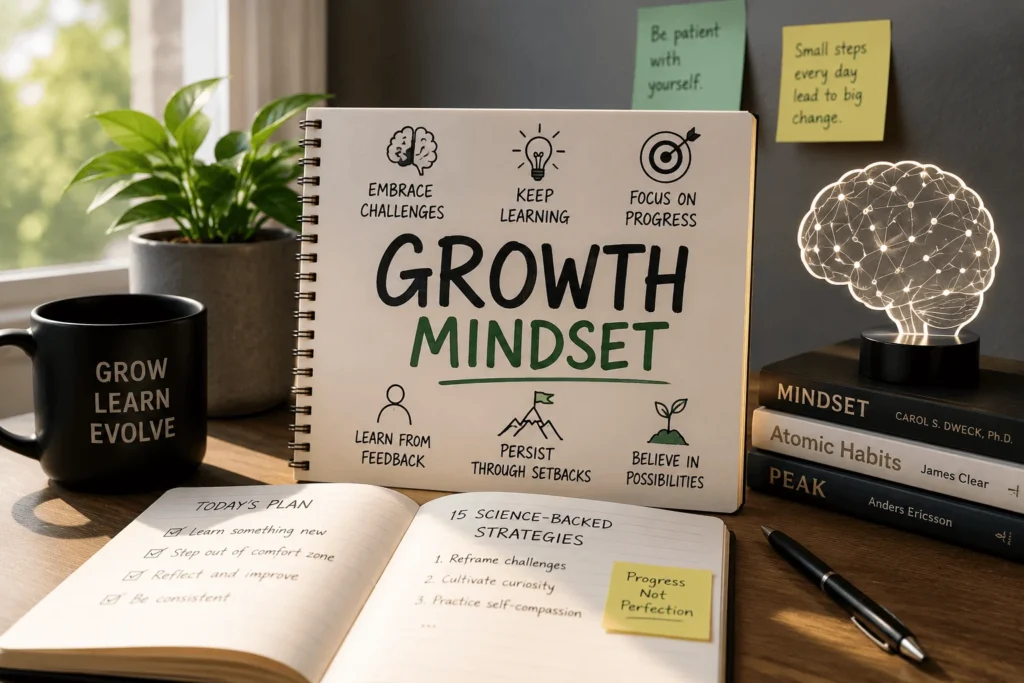
I used to think mindset change was about wanting it badly enough.
If I could just get motivated, I’d think differently. So I’d read a book, feel inspired for a week, and then slip right back into old patterns the moment something went wrong.
The problem wasn’t the desire. It was the approach. Wanting a growth mindset and actually building one are two different things. The first is a wish. The second is a practice.
The concept of the growth mindset, introduced by Stanford psychologist Carol Dweck, suggests that abilities can be developed through effective effort, learning, and persistence. It’s not a feel-good slogan. It’s a specific way of interpreting your own potential that shapes what you attempt and how you respond when things get difficult.
I remember opening an email once that contained detailed critical feedback on a project I’d spent weeks on. My first reaction wasn’t curiosity or gratitude. It was defensiveness a surge of irritation and the immediate urge to explain why the feedback was wrong. That moment showed me something uncomfortable: I still had a fixed mindset in areas I thought I’d already overcome.
Learning how to develop a growth mindset isn’t about one big insight. It’s about small, consistent shifts in how you interpret challenges, respond to setbacks, and talk to yourself when things get difficult. It’s less about changing who you are and more about changing what you do.
Here are fifteen strategies that have held up over time backed by research and tested the hard way.
Growth Mindset Definition
A growth mindset is the belief that abilities, intelligence, and skills can improve through learning, practice, feedback, and persistence. The concept was introduced by Stanford psychologist Carol Dweck after decades of research on why some people thrive through challenge while others give up.
Who This Guide Is For
This guide is especially useful if you:
- often give up after failure
- avoid difficult challenges
- struggle with criticism
- want to build lasting confidence
- want to become a lifelong learner
- feel stuck in a fixed way of thinking
The 15 Strategies at a Glance
- Learn to recognize your fixed mindset voice
- Add “yet” to your self-talk
- Reframe failure as information
- Separate your identity from your outcomes
- Set learning goals, not just performance goals
- Change how you talk about effort
- Seek out challenges intentionally
- Practice receiving feedback without defensiveness
- Surround yourself with growth-minded people
- Study the stories behind success
- Use the WOOP framework for goal setting
- Practice self-compassion after setbacks
- Track your learning, not just your results
- Use habit stacking to reinforce new patterns
- Be patient with the process
How to Develop a Growth Mindset: 15 Strategies

These strategies aren’t sequential. Pick one or two to start with. Add more as those become more natural.
Expert Tip
If you only implement one strategy this week, start by adding “yet” to your internal dialogue. It’s the smallest change with one of the biggest long-term effects.
1. Learn to Recognize Your Fixed Mindset Voice
Before you can change anything, you need to hear what’s already there.
The fixed mindset has a voice. It says things like “You’re not good at this,” “You’ll probably fail,” “It’s too late to learn that.” For most people, this voice is so constant and familiar that it fades into the background. You don’t notice it. You just feel its effects.
Spend a week just listening. When you face a challenge, what does the voice say? When you make a mistake, what does it tell you? Write down the specific phrases. The goal at this stage isn’t to change anything. It’s to map the territory.
This is the foundation of changing your mindset. You can’t shift what you can’t see.
2. Add “Yet” to Your Self-Talk
This is the simplest technique from Carol Dweck’s research, and it actually works.
“Becoming is better than being.” — Carol Dweck
“I’m not good at this” becomes “I’m not good at this yet.”
“I can’t do this” becomes “I can’t do this yet.”
“I don’t understand this” becomes “I don’t understand this yet.”
The word changes the statement from a permanent verdict to a temporary state. It doesn’t deny the current difficulty. It just refuses to let the difficulty be the end of the sentence.
This is one of the simplest growth mindset techniques because it requires no preparation, no journal, no routine. Just a word. But that word signals to your brain that the current state isn’t permanent.
According to Carol Dweck’s research, praising effective strategies rather than innate intelligence encourages greater persistence and long-term learning. Adding “yet” is one practical way to reinforce that belief.
3. Reframe Failure as Information
Failure is uncomfortable. Nobody’s suggesting you pretend it feels good. But failure contains useful information if you’re willing to look at it.
When something doesn’t work, ask: What specifically went wrong? What could I try differently next time? What did I learn that I didn’t know before?
These questions shift failure from an endpoint to a data point. The experience is the same. The interpretation changes.
A student who fails a math exam might think “I’m just not a math person” and give up. Another student with the same result thinks “I need a different study strategy” and improves steadily over the semester. The difference isn’t talent. It’s interpretation.
For a deeper dive into this, our guide on common limiting beliefs walks through how to identify and reframe the thoughts that hold you back.
4. Separate Your Identity from Your Outcomes
One of the most common ways to develop a growth mindset is learning to distinguish between “I failed” and “I am a failure.”
When your performance is your identity, every mistake becomes a threat to who you are. You can’t learn from criticism because criticism feels like an attack on your worth.
The reframe: your performance is temporary. Your identity doesn’t have to be tied to it. You can do something poorly without being a poor person. You can fail at something without being a failure.
This distinction creates the psychological safety needed to take risks and learn from mistakes.
5. Set Learning Goals, Not Just Performance Goals
Performance goals are about outcomes: get the promotion, hit the revenue target, lose the weight. Learning goals are about growth: develop a new skill, understand a topic deeply, become better at the process.
Performance goals aren’t bad. But if they’re the only kind you set, every setback becomes a verdict. Learning goals give you something to work toward even when the outcome isn’t what you wanted.
This is one of the core growth mindset skills because it shifts your focus from proving yourself to improving yourself. The goal isn’t to look smart. It’s to get better.
Expert Tip
When setting goals for the week, ask yourself: “What do I want to learn?” before asking “What do I want to achieve?” The order matters.
6. Change How You Talk About Effort
People with a fixed mindset often treat effort as evidence of inadequacy. If you have to try this hard, you must not be talented.
The reframe: effort isn’t a sign of weakness. It’s the mechanism of growth. Every expert was once a beginner who kept showing up. Talent might give someone a head start, but effort determines where they finish.
“The passion for stretching yourself and sticking to it, even when it’s not going well, is the hallmark of the growth mindset.” — Carol Dweck
This connects to the research on building good habits. The people who sustain progress over long periods tend to focus on the process rather than fixating on results.
7. Seek Out Challenges Intentionally
This one is uncomfortable. Most people naturally gravitate toward things they’re already good at because it feels nice to succeed.
Building a growth mindset means deliberately spending time in situations where you might struggle or look incompetent. Not all the time. Just regularly enough that you get practice being a beginner.
Pick something small. A language you don’t speak. An instrument you can’t play. A skill you’ve avoided because you assumed you’d be bad at it. The goal isn’t mastery. It’s the experience of starting from zero and watching yourself improve.
Someone who’s always avoided public speaking volunteers for a short presentation at work. The first one is rough. The third one is better. By the tenth, they’re not terrified anymore. The skill improved because they were willing to be bad at it first.
This is one of the most effective growth mindset exercises because it generates direct evidence that abilities can be developed.
8. Practice Receiving Feedback Without Defensiveness
Feedback is information. But for many people, it feels like attack. The instinct is to defend, explain, or dismiss.
The practice: when someone offers criticism, your only job is to listen and say “thank you.” You can evaluate the feedback later. You don’t have to accept all of it. But you can’t extract the useful parts if you’re busy defending yourself.
Over time, this becomes easier. The feedback stops feeling personal and starts feeling useful.
Expert Tip
Next time someone gives you feedback, try responding with only two words: “Thank you.” Then pause. See what happens when you don’t fill the silence with defensiveness.
9. Surround Yourself with Growth-Minded People
Mindsets are contagious. The people you spend time with shape your sense of what’s normal.
If everyone around you talks about abilities as fixed and complains about circumstances without doing anything to change them, that becomes your baseline. Seek out people who challenge themselves, who talk about what they’re learning, who respond to setbacks with curiosity rather than defeat.
This is one of the principles behind building a supportive environment for growth. Your surroundings shape your defaults in ways you don’t always notice.
10. Study the Stories Behind Success
We tend to see the finished product the championship, the bestselling book, the thriving business without seeing the years of struggle behind it.
Deliberately study the full stories of people you admire. You’ll find that almost universally, their paths included significant setbacks, failures, and periods of doubt. This normalizes struggle and reinforces the growth mindset premise that achievement comes through persistence, not innate talent.
11. Use the WOOP Framework for Goal Setting
Gabriele Oettingen’s research on mental contrasting found that simply visualizing success can reduce motivation. People who fantasize about achieving their goals actually exert less effort.
The WOOP framework combines positive visualization with realistic obstacle planning:
- Wish: Identify a meaningful goal.
- Outcome: Visualize the best possible result.
- Obstacle: Identify the main internal obstacle.
- Plan: Create an if-then plan for when you encounter it.
This is one of the more structured growth mindset strategies because it pairs optimism with preparation.
12. Practice Self-Compassion After Setbacks
This might seem unrelated to mindset change, but it’s actually central. If you beat yourself up every time you have a fixed mindset thought, you’re reinforcing the pattern you’re trying to change.
Kristin Neff’s research has shown that self-compassion treating yourself with kindness during difficulty improves motivation and resilience more than self-criticism. The daily practice: when you make a mistake, talk to yourself the way you’d talk to a friend who made the same mistake.
13. Track Your Learning, Not Just Your Results
Keep a simple record of what you’re learning. Not what you achieved. What you learned.
A note on your phone at the end of the day. One thing you understand better than you did yesterday. One skill that’s slightly improved. One insight from something that didn’t go well.
The practice trains your attention on growth rather than outcomes. Over time, the accumulated evidence of your own development becomes hard to dismiss.
14. Use Habit Stacking to Reinforce New Patterns
Habit stacking, a technique from BJ Fogg’s work, means attaching a new behavior to something you already do.
After I pour my morning coffee, I’ll identify one learning goal for the day.
After I brush my teeth at night, I’ll write down one thing I learned.
The existing habit becomes the cue for the new one. You don’t have to remember. It’s attached to something automatic. This is one of the most practical growth mindset daily habits because it removes the need for willpower.
15. Be Patient with the Process
Real mindset change takes time. Not days or weeks. Months and years.
The patterns you’re working to change were built over decades. They won’t be replaced in a few weeks of practice. This isn’t discouraging. It’s just accurate. If you know the timeline is long, you don’t panic when you’re not transformed after a month.
The work compounds. Each time you notice an old thought and choose a new one, you’re strengthening a pathway. Each time feels small. The sum, over years, is significant.
Expert Tip
Don’t measure your progress day to day. Measure it month to month. The daily changes are invisible. The cumulative shift is unmistakable.
Growth Mindset Language: Replace This with This
Small shifts in language reinforce the underlying belief that abilities can develop.
| Instead of… | Try… |
|---|---|
| I’m not good at this. | I’m not good at this yet. |
| I made a mistake. I’m terrible. | I made a mistake. What can I learn? |
| This is too hard. | This is challenging, which means I’m growing. |
| They’re so talented. | They’ve worked hard to get there. |
| I’ll never be able to do this. | I can’t do this yet, but I can learn. |
| I failed. | I found a way that doesn’t work. |
| I’m not a math person. | I’m still developing my math skills. |
| That’s good enough. | Is there a way I can improve this? |
| I can’t handle criticism. | Feedback helps me get better. |
| I should stick to what I know. | Trying new things builds new skills. |
What Changed My Own Mindset

I wish I could tell you it was one breakthrough moment. A single insight that rewired everything. It wasn’t.
What actually changed me was accumulating small pieces of evidence that my old beliefs were wrong. The first time I learned something I’d assumed was beyond me. The first time I watched someone I’d written off as “untalented” surpass people with more natural ability through sheer persistence. The first time I failed at something important and realized I was fine disappointed, but fine.
I remember opening an email containing detailed critical feedback on something I’d worked on for days. My first reaction wasn’t curiosity it was defensiveness. That moment showed me I still had a fixed mindset in areas I thought I’d already mastered. The gap between the mindset I thought I had and the one that showed up under pressure was humbling.
The strategy that helped most in the beginning was simply noticing my fixed mindset voice. For weeks, I didn’t try to change it. I just wrote down what it said. Reading those notes back was uncomfortable. The voice was harsher than I’d realized. But seeing it on paper made it feel less like truth and more like a habit I’d developed.
What didn’t work was trying to overhaul everything at once. I’d read a book, get inspired, and attempt to think differently about every area of my life simultaneously. By day four, I was exhausted. By day seven, I’d forgotten I was even trying.
What did work was picking one area just one and practicing one strategy until it felt more natural. For me, that area was receiving feedback. I started by simply saying “thank you” when someone offered criticism, even when I felt defensive. No arguing. No explaining. Just listening. After a few months, I noticed I was actually looking forward to feedback instead of dreading it. That single shift gave me confidence that other shifts were possible.
What Recent Research Says About Building a Growth Mindset
The conversation around mindset has evolved since Dweck’s early work. Here’s what current research emphasizes.
AI makes lifelong learning more important. As artificial intelligence reshapes industries, the ability to learn new skills continuously has become more valuable than static expertise. According to the World Economic Forum’s Future of Jobs Report 2025, adaptability, resilience, curiosity, and lifelong learning are among the fastest-growing workplace skills. A growth mindset directly supports all four.
Employers value adaptability over credentials. The LinkedIn Workplace Learning Report 2025 found that skill sets for jobs have changed by about 25% since 2015, with that number expected to double by 2030. Organizations increasingly prioritize learning ability and adaptability over specific degrees or past experience.
Deliberate practice plus feedback outperforms positive thinking alone. Current research emphasizes that mindset works best when combined with effective learning strategies. Believing you can improve creates the willingness to engage in deliberate practice. But the practice itself needs structure and feedback to produce results.
Mindset works best in context. Researchers now emphasize that mindset isn’t a standalone solution. It’s most effective when combined with quality instruction, supportive environments, and practical skill development. The belief opens the door. The environment determines what happens after you walk through.
Neuroscience continues to support lifelong brain plasticity. Recent reviews from the National Institutes of Health confirm that the brain remains adaptable throughout adulthood. The biological capacity for change exists at any age. The American Psychological Association recognizes that beliefs about learning influence motivation and resilience two key factors in long-term achievement.
Growth Mindset Before vs After
| Fixed Mindset Response | Growth Mindset Response |
|---|---|
| I can’t do this. | I can’t do this yet. |
| I’m bad at math. | I’m still learning math. |
| I failed. | I learned what doesn’t work. |
| This is too difficult. | This is worth practicing. |
| They’re naturally talented. | They’ve practiced more than I have. |
| Criticism means I’m not good enough. | What can I learn from this feedback? |
| I’ll never change. | I’ve changed before. I can do it again. |
| I should stick to what I know. | Growth happens outside my comfort zone. |
Daily Growth Mindset Routine
A simple framework for integrating growth mindset practices into your day.
Morning: Learning Goal
Set one learning goal for the day. Not a performance goal. Something you want to understand better or get better at. Example: “Today I’ll learn one new thing about how to structure a presentation.”
Afternoon: Deliberate Challenge
Take on one task that stretches you slightly beyond your current ability. Something that feels uncomfortable but not overwhelming. The goal is the attempt, not the outcome.
Evening: Reflection
Spend five minutes reflecting. What went well today? What was difficult? What did I learn? Where did I notice fixed mindset thoughts? The reflection builds awareness, which fuels the whole process.
30-Day Growth Mindset Challenge
A structured month of practice to build momentum.
Week 1: Awareness
- Day 1–3: Notice your fixed mindset voice without trying to change it. Write down what it says.
- Day 4–5: Identify your most common fixed mindset triggers. When does the voice get loudest?
- Day 6–7: Pick one trigger to focus on for the rest of the month.
Week 2: Reframing
- Day 8–10: Practice adding “yet” to fixed mindset statements. “I can’t do this yet.”
- Day 11–12: When something goes wrong, ask “What can I learn from this?” Write down the answer.
- Day 13–14: Separate one outcome from your identity. Describe a failure in behavioral terms.
Week 3: Action
- Day 15–17: Take on one deliberate challenge. Something you’re not good at. Do it anyway.
- Day 18–19: Ask someone for feedback. Listen without defending. Say “thank you.”
- Day 20–21: Set one learning goal and work toward it. Track effort, not results.
Week 4: Integration
- Day 22–24: Practice self-compassion after a setback. Talk to yourself like a friend.
- Day 25–27: Notice how your responses to difficulty have shifted since day one.
- Day 28–30: Reflect on the month. What’s different? What still needs work? Plan your next focus.
Growth Mindset Journal Prompts
Use these prompts for daily or weekly reflection.
- What mistake taught me something valuable today?
- What challenge did I avoid today, and why?
- What did I improve at this week, even slightly?
- When did I feel defensive, and what was I protecting?
- What would I try if I believed I couldn’t fail?
- What feedback have I received recently, and what can I learn from it?
- Where am I using fixed mindset language in my self-talk?
- What skill am I currently developing that I once thought was beyond me?
- What small win this week deserves acknowledgment?
- Who modeled a growth mindset for me recently, and what did I observe?
Growth Mindset Myths
Myth 1: A growth mindset means anyone can do anything.
Reality: A growth mindset means anyone can improve through deliberate learning not that everyone will achieve identical outcomes. Starting points, opportunities, and resources vary. Mindset is one factor among many.
Myth 2: Positive thinking equals a growth mindset.
Reality: A growth mindset is about learning behaviors, not forced optimism. You can acknowledge difficulty and still believe improvement is possible. Forced positivity can actually undermine growth by discouraging honest assessment.
Myth 3: Failure automatically builds growth.
Reality: Only reflection plus adjustment leads to growth. Failing without learning is just failing. The growth comes from what you do with the information failure provides.
Myth 4: You either have a growth mindset or you don’t.
Reality: Everyone operates from both mindsets depending on the situation. You might have a growth mindset about learning languages but a fixed mindset about your ability to become more organized. The goal is expanding the areas where growth mindset operates.
Myth 5: Growth mindset means praising effort regardless of outcome.
Reality: Carol Dweck specifically corrected this misinterpretation. The goal is to praise effective effort and strategy, not just trying hard in ineffective ways. Process praise should be tied to learning and improvement.
How to Build a Growth Mindset in Different Areas of Life
The strategies apply universally, but the application varies by context.
For Students
Students with a growth mindset see difficult courses as opportunities rather than threats. Practical tips include praising effort and strategy rather than grades alone, normalizing mistakes as part of learning, and encouraging students to add “yet” to statements about what they can’t do. Teachers can support this by providing feedback that focuses on process rather than person “you used a strong problem-solving approach here” rather than “you’re so smart.”
A student struggling with algebra begins practicing 20 minutes daily. Six months later, they earn one of the highest grades in class not because they suddenly became “good at math,” but because consistent practice changed both skill and confidence.
For Parents
Children learn mindset primarily through modeled behavior. Parents can support a growth mindset by praising effort and strategy rather than innate ability, sharing their own learning struggles and how they worked through them, responding to children’s failures with curiosity rather than judgment, and using growth-oriented language at home. When a child says “I’m bad at this,” responding with “you haven’t mastered it yet” reinforces the belief that abilities can develop. See our guide on common limiting beliefs for more on how these patterns form in childhood.
For the Workplace
In professional settings, a growth mindset shows up as willingness to take on stretch assignments, openness to feedback, and persistence through setbacks. Leaders can model this by admitting their own mistakes publicly, celebrating learning and improvement rather than just results, and hiring for learning potential rather than just current credentials. Companies with growth mindset cultures tend to have more collaboration and innovation because employees feel safe taking risks.
A junior developer volunteers for a project using technology they’ve never touched. The first month is a struggle. By month six, they’ve become the team’s go-to person for that technology. The growth came from being willing to look incompetent temporarily.
For Career Changers
Transitioning to a new field requires a growth mindset at its core. The belief that you can develop new skills makes the uncertainty of career change navigable. Focus on transferable skills, treat early failures as expected parts of the learning curve, and seek out mentors who made similar transitions.
For Retirees and Older Adults
Neuroplasticity continues throughout life, making growth mindset just as relevant in later years. Learning new skills languages, instruments, technologies keeps the brain active and builds confidence. The belief that you’re “too old to learn” is itself a fixed mindset thought that can be examined and challenged.
The Science Behind Mindset Change
Understanding why these strategies work makes them easier to stick with.
The growth mindset theory, developed by Carol Dweck at Stanford, rests on a simple premise: your beliefs about your abilities shape your behavior. If you believe intelligence is fixed, challenges threaten your self-image. If you believe it can be developed, challenges become opportunities.
These beliefs operate through specific mechanisms. Neuroplasticity is the biological foundation the brain’s ability to form new neural connections throughout life. Every time you practice a new response, you strengthen the pathways that support it. The brain changes through repetition, not insight.
The habit loop cue, routine, reward explains why consistency matters. New thinking patterns become automatic the same way any habit does: through repeated practice in a stable context. This connects to how habits are formed.
Cognitive restructuring, a technique from Cognitive Behavioral Therapy, involves identifying and challenging unhelpful thought patterns. This is the mechanism behind many of the strategies above. Notice the thought. Examine it. Replace it with something more accurate.
Self-efficacy, a concept from Albert Bandura, grows through mastery experiences actually doing the thing you didn’t think you could do. Each small success builds evidence that you’re capable of more than you assumed.
These mechanisms work together. The belief that change is possible makes the effort logical. The effort produces results. The results strengthen the belief. It’s a self-reinforcing cycle.
For a deeper look at the psychology, see our complete guide on what a growth mindset is.
Common Mistakes When Developing a Growth Mindset
Confusing a growth mindset with blind positivity. Believing you can improve doesn’t mean pretending everything is fine. You can acknowledge difficulty and still believe your efforts matter. The balanced approach acknowledges difficulty while maintaining hope.
Praising effort without strategy. Dweck specifically corrected this misinterpretation. Telling someone “good effort” when they failed isn’t helpful if the effort wasn’t effective. The point is to praise effort plus strategy adjustment.
Thinking you either have it or you don’t. Nobody has a pure growth mindset. Everyone has triggers that send them into fixed mindset thinking. The goal is catching yourself faster and recovering more smoothly.
Trying to change everything at once. Pick one or two strategies. Practice them for a few weeks before adding more. Overhauling your entire thinking style simultaneously is a recipe for burnout.
Avoiding the discomfort of being a beginner. A growth mindset requires spending time in situations where you’re not yet competent. If you avoid that discomfort, you avoid the experiences that build the mindset.
2026 Update: Why This Matters More Than Ever
As AI continues to reshape work and education, adaptability, continuous learning, and resilience have become even more valuable. Developing a growth mindset is increasingly recognized as one of the most important long-term career skills.
The World Economic Forum’s Future of Jobs Report 2025 identified analytical thinking, resilience, flexibility, and curiosity as core skills for the modern workforce. The LinkedIn Workplace Learning Report 2025 confirmed that skill requirements are shifting faster than ever, making the ability to learn continuously a professional necessity rather than a nice-to-have.
In education, researchers continue to refine the application of growth mindset principles. Current best practices emphasize combining mindset interventions with concrete learning strategies, quality feedback, and supportive environments. The consensus is clear: mindset matters, but it works best as part of a broader approach to learning and development.
The neuroscience continues to support what Dweck proposed decades ago: the brain changes through effort. The question isn’t whether you can develop a growth mindset. It’s whether you’ll commit to the practice.
Frequently Asked Questions
How long does it take to develop a growth mindset?
Some shifts become noticeable within a few weeks of consistent practice. Deeper changes typically take months. The patterns you’re working to change were built over years they won’t be replaced overnight. Consistency matters more than intensity.
Can adults develop a growth mindset?
Yes. Neuroplasticity continues throughout life. Adults can shift from fixed to growth mindset beliefs through awareness and consistent practice, though it may take more deliberate effort than for children.
What’s the first step to developing a growth mindset?
Start by noticing your current mindset. Spend a week observing your automatic thoughts when you face challenges, make mistakes, or receive criticism. Write down what you hear. Awareness is the foundation for everything that follows.
Is a growth mindset the same as positive thinking?
No. Positive thinking is about expecting good outcomes. Growth mindset is about believing abilities can improve. You can have a growth mindset while being realistic about challenges.
What’s the difference between a fixed mindset and a growth mindset?
A fixed mindset assumes abilities are static. A growth mindset assumes they can be developed. This single difference affects how people respond to challenges, effort, criticism, and others’ success. For a detailed comparison, see our guide on fixed vs growth mindset.
Can a growth mindset be harmful?
When misunderstood, yes. Overusing effort without adjusting strategy, ignoring burnout, or using growth mindset to justify hustle culture can be harmful. A healthy growth mindset includes self-compassion, strategic thinking, and respect for limits.
Can parents teach children a growth mindset?
Yes. Children learn mindset largely through modeled behavior. Praising effort and strategy rather than innate intelligence, normalizing mistakes as part of learning, and showing children how you handle your own setbacks all contribute to developing a growth mindset in children.
Can a growth mindset improve mental health?
A growth mindset can support mental health by fostering hope, motivation, and resilience. Believing that change is possible is a protective factor against hopelessness. However, mindset work is not a substitute for professional mental health treatment when that’s needed.
Key Takeaways
- A growth mindset is built through consistent practice, not sudden insight.
- The simplest starting point is noticing your fixed mindset voice without trying to change it.
- Adding “yet” to self-limiting statements creates space for growth.
- Failure is information, not identity. The interpretation matters more than the event.
- Deliberate practice, quality feedback, and supportive environments accelerate mindset change.
- Progress is gradual. Small daily repetitions compound into significant shifts over time.
Growth Mindset Checklist
Daily Practices
- ☐ I notice when my fixed mindset voice shows up
- ☐ I add “yet” to self-limiting statements
- ☐ I set at least one learning goal
- ☐ I take on one small challenge outside my comfort zone
- ☐ I reflect on what I learned today
Weekly Practices
- ☐ I ask for feedback and listen without defending
- ☐ I reframe one recent failure as a learning experience
- ☐ I practice self-compassion after a setback
- ☐ I spend time with people who challenge my thinking
- ☐ I acknowledge one small win from the week
Monthly Review
- ☐ I review what I’ve learned this month
- ☐ I notice which fixed mindset patterns have weakened
- ☐ I identify one new growth mindset strategy to practice
- ☐ I reflect on where I’ve grown and what still needs work
References
- Dweck, C. S. (2006). Mindset: The New Psychology of Success. Random House.
- Stanford University. Growth Mindset Research. Stanford.edu.
- American Psychological Association. Resources on resilience and learning. APA.org.
- World Economic Forum. (2025). Future of Jobs Report.
- LinkedIn. (2025). Workplace Learning Report.
- Neff, K. (2011). Self-Compassion: The Proven Power of Being Kind to Yourself. William Morrow.
- Oettingen, G. (2014). Rethinking Positive Thinking: Inside the New Science of Motivation. Current.
- National Institutes of Health. Neuroplasticity research and resources. NIH.gov.
If you’re starting from scratch, pick one strategy from the list. Not the one that seems most impressive. The one that feels most doable. Practice it for two weeks. Notice what happens. Then add another.
The people who successfully develop a growth mindset aren’t the ones who read the most books about it. They’re the ones who practice the small daily repetitions that build new neural pathways over time. The work is simple. It’s just not easy. But it works if you keep showing up.
Written by Bilal Shah — a mindset and personal development writer at Grow Daily Life who focuses on growth mindset, limiting beliefs, confidence, resilience, and behavior change. His work combines psychological research with practical, evidence-informed strategies to help readers develop healthier thinking patterns, overcome mental barriers, and create lasting personal growth.