
I spent most of my twenties believing I was just “not a math person.” That one belief quietly shut doors for me. I avoided data-heavy projects, passed on opportunities that required basic analytics, and let other people handle the numbers. It wasn’t until years later that I realized I’d built my entire career around avoiding something I’d decided I couldn’t do.
The funny thing is, I wasn’t bad at math. I just believed I was. And that belief became a self-fulfilling prophecy.
That experience is what got me asking: what is mindset, exactly? And why does it have such a powerful grip on how our lives turn out?
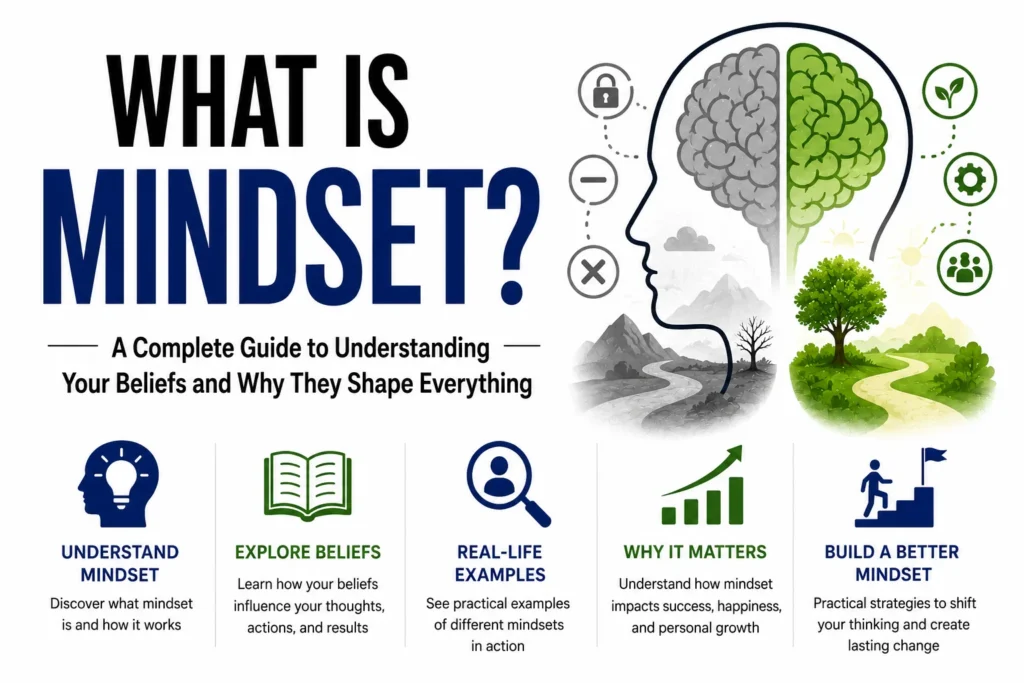
At its core, mindset is the collection of beliefs and attitudes that shape how we interpret situations and respond to them. It’s not just abstract psychology. It’s the reason some people bounce back from failure while others collapse. It’s why two people can face the same setback and have completely different outcomes.
What Is Mindset? A Clear Definition
To understand what is mindset, you have to look at it as the mental filter through which you see yourself, other people, and the world around you. Your mindset is the collection of beliefs, attitudes, and assumptions that shape how you think, learn, and respond to challenges. It influences your behavior, decision-making, resilience, and ability to grow over time.
When people ask “what is mindset,” I tell them it’s the story you tell yourself about who you are and what you’re capable of. That story then determines what you try, what you avoid, and how far you ultimately go.
What Is Mindset, Really?
At its simplest, mindset is the set of beliefs you hold about yourself and your most basic qualities: your intelligence, your talents, your personality.
Here’s something I’ve noticed over the years. Most people think they have one overarching mindset. But we actually have collections of beliefs, many of which contradict each other, shaped by different contexts and situations. I can have a growth mindset at work, embracing new challenges and learning from feedback, but a fixed mindset when it comes to relationships or creative projects.
The dictionary defines mindset as a fixed mental attitude that predetermines how you interpret and respond to situations. That’s accurate as far as it goes. But it misses the nuance. Mindset isn’t fixed. It shifts depending on whether you’re fatigued, overwhelmed, traveling, or with different groups of people.
Over time, I’ve come to understand that mindset operates on multiple levels at once. There’s the conscious layer, the thoughts you’re aware of. Then there’s the deeper stuff: your assumptions, your physical feelings, your emotions about your emotions. Stanford professor Jean Gomes describes this as a layered system of affect, emotion, meta-emotion, assumptions, beliefs, perception, and consciousness.
The tricky part is that most of these layers operate automatically. You don’t consciously decide to believe you’re not good at something. You just feel it. And that feeling drives your behavior without you even realizing it.
So when someone asks “what is mindset,” the honest answer is that it’s far more complicated than a simple definition suggests. It’s a living, breathing system of beliefs that operates beneath the surface of your awareness.
The Two Mindsets That Shape Everything
Stanford psychologist Carol Dweck spent decades researching achievement and success, and she landed on a surprisingly simple framework. People tend to fall into one of two basic mindsets: fixed or growth.
Understanding what is mindset becomes much clearer when you look at these two distinct ways of thinking.
The Fixed Mindset
If you have a fixed mindset, you believe your intelligence, talents, and abilities are essentially static traits. You’re born with a certain amount, and that’s that. You can’t really change it.
I see this play out all the time. People with a fixed mindset tend to:
- Avoid challenges because failure would prove they’re not capable
- Give up easily when things get hard
- See effort as a bad sign. If you have to try, you must lack natural talent
- Ignore feedback that suggests they need to improve
- Feel threatened by other people’s success
Dweck’s research found that people with a fixed mindset spend their time documenting their intelligence rather than developing it. They’re constantly trying to prove they have enough of the right qualities, and every situation becomes a test. Will I succeed or fail? Will I look smart or dumb? Will I be accepted or rejected?
What surprised me most when I first encountered this research was the brain activity part. Dweck and her colleagues examined people’s brains while they answered questions. Those with a fixed mindset showed high brain activity when they were told whether their answers were right or wrong. They cared deeply about the outcome. But when researchers offered to help them learn from their mistakes, their brains showed zero interest. They didn’t believe they could improve, so they didn’t even try.
The Growth Mindset
The growth mindset is the belief that your abilities can be developed through effort, good strategies, and input from others. You might not be good at something now, but you can get better. Brains and talent are starting points, not endpoints.
People with a growth mindset tend to:
- Embrace challenges as learning opportunities
- Persist when things get difficult
- See effort as the path to mastery
- Learn from criticism and feedback
- Find inspiration in other people’s success
In Dweck’s lab, children with a growth mindset looked at challenging math problems and their internal reaction was basically “bring it on”. They valued the learning process itself, not just the outcome. The fixed mindset kids, on the other hand, wanted to avoid anything that might expose their limitations.
What’s interesting is that the growth mindset isn’t about believing you can be literally anything you want, that you could become Einstein or Michael Jordan just by trying hard enough. Dweck is careful to clarify this. It’s about believing that your potential is unknown and unknowable, that you can accomplish more than you currently think is possible through years of effort and learning.
Why Mindset Matters More Than You Think
For a long time I thought mindset was just about feeling better about yourself. But the research suggests it affects pretty much everything. Once you understand what is mindset at a deeper level, you start seeing its fingerprints everywhere.
Health and Wellbeing
Positive mindsets have measurable effects on physical health. Studies show they can lower cardiovascular disease risk, improve surgical outcomes, extend life expectancy, and reduce symptoms of anxiety and depression.
The mechanism isn’t mysterious. When you believe you can cope with stress, your body responds differently. When you see setbacks as temporary rather than permanent, you don’t spiral into helplessness. Your biological systems reflect what you believe about yourself and your situation.
Developing a positive mindset isn’t about ignoring negative emotions. It’s about building habits that support optimism: practicing gratitude, reframing difficult situations, surrounding yourself with supportive people. These habits compound over time.
Career and Achievement
In the workplace, the difference between fixed and growth mindsets is stark.
People with a fixed mindset want to look competent, so they stick to what they already know. They avoid challenges that might expose their weaknesses. They get defensive when given feedback. And they plateau early.
People with a growth mindset actively seek out challenges. They volunteer for difficult projects. They ask for honest feedback. They treat setbacks as data. And over time, they outpace their fixed-minded peers.
Dweck’s research shows that it’s not always the people who start out the smartest who end up the smartest. It’s the ones who engage purposefully, who put in the effort, who keep learning.
Relationships and Personal Development
This is where I’ve seen the biggest impact in my own life. The growth mindset doesn’t just apply to academics or career. It applies to how you approach relationships, hobbies, health habits, everything.
If you believe you’re “not good at relationships,” you’ll avoid the uncomfortable conversations that might actually improve them. If you believe you’re “just not a morning person,” you’ll never try building a morning routine. If you believe you’re “bad at saving money,” you won’t even look at your bank account.
At least in my experience, the belief comes first, and the behavior follows. And the behavior confirms the belief. It’s a cycle.
The Problem With Mindset
Here’s something I wish someone had told me earlier. Mindset isn’t a light switch. You can’t just decide to have a growth mindset and suddenly everything changes.
The growth mindset idea was so popular and intuitive that schools around the world rushed to implement it. Teachers showed students pictures comparing fixed and growth mindsets, encouraged them to adopt the growth mindset, and expected results. The results were mixed.
One major meta-analysis of 400,000 students found that classroom mindset training had only a weak effect on performance. A detailed study replicating Dweck’s methods failed to show that interventions led to significant improvement. The idea made sense, but the execution often didn’t work.
Why? Because a growth mindset isn’t something you can just learn intellectually. It needs to be internalized. It needs to become part of how you operate at an instinctive level. As one researcher put it, many “teachers approach it like a quadratic equation. You can’t just think of it as a regular thing to teach, because the internalization of it is so important.”
The trap is thinking that understanding the concept of a growth mindset is the same as having one. I’ve done this myself. I’ve read books, nodded along, felt enlightened, and then immediately reverted to my old patterns when things got hard.
This is where self-awareness comes in. As Gomes explains, mindset development requires something called metacognition: the ability to think about how you think and feel. It’s not just having the right beliefs. It’s paying attention to your interior world, noticing when your fixed mindset voice shows up, and choosing a different response.
How to Actually Shift Your Mindset
Dweck’s research outlines a straightforward process for shifting your mindset. It’s simple, but it’s not easy. Here’s what it looks like in practice.
Step 1: Listen to Your Fixed Mindset Voice
The first step is awareness. Start paying attention to the voice that shows up when you face a challenge or a setback.
For me, it usually sounds like: “I’m not sure I can do this. I don’t have the experience. What if I fail and people notice?”
Dweck calls this the fixed mindset voice. It’s the part of you that wants to play it safe, avoid risk, and protect your image. The key is to recognize that this voice is a habit, not the truth. It’s not your “real” self speaking. It’s an old pattern.
Step 2: Recognize That You Have a Choice
Once you notice the fixed mindset voice, you have to remember that you don’t have to follow it. You have a choice in how you interpret challenges, setbacks, and criticism.
This is where people often get stuck. We’re so used to listening to that inner critic that we don’t even realize we could do something else. The choice exists, but you have to consciously claim it.
Step 3: Respond With Your Growth Mindset Voice
When the fixed mindset voice says “You can’t do this,” counter it with a growth mindset response. “I can’t do this yet, but I can learn.”
When it says “You’ll probably fail,” try “What if I succeed? Or what if I learn something valuable even if I don’t succeed?”
The language shift matters. Changing “I’m bad at this” to “I’m not good at this yet” is a small adjustment that changes the entire trajectory. It shifts from a dead end to a path forward.
Step 4: Act in Alignment With Your Growth Mindset
The final step is action. You have to actually do the thing you’re afraid of. You have to tackle the difficult task, ask for feedback, persist through obstacles.
This is often where lasting change begins. You can tell yourself you have a growth mindset all day long, but until you actually try something hard, fail at it, and keep going, you haven’t really shifted anything.
The Power of “Yet”
This is a small concept that I’ve found surprisingly useful: the word “yet.”
Dweck writes about how adding “yet” to statements can shift you from a fixed to a growth mindset. “I’m not good at this” becomes “I’m not good at this yet.” “I don’t understand” becomes “I don’t understand yet.” “I can’t do it” becomes “I can’t do it yet.”
It sounds almost too simple to matter. But there’s something about that word that changes the shape of the sentence. It moves from a closed door to an open one.
I’ve used this with my own kids. When they say “I can’t do this,” I add “yet.” It’s not a magic fix, but it opens up a different conversation. Instead of “I can’t,” it becomes “I’m in the process of learning.”
What Recent Research Says About Mindset
The growth mindset concept has evolved since Dweck’s early work. More recent studies have added important nuance.
The meta-analysis of 400,000 students showed that teaching the growth mindset alone isn’t enough. For mindset interventions to stick, the environment needs to support challenge-seeking. Students who learn about the growth mindset but return to classrooms where teachers praise natural ability and avoid challenge don’t experience lasting change.
Research also shows that:
- Feedback quality matters. Generic praise like “great effort” isn’t helpful if the effort wasn’t effective. Specific, actionable feedback is what drives improvement.
- Deliberate practice is essential. The growth mindset opens the door, but you still need structured practice to get better.
- Support systems matter. Peers and mentors who model growth-oriented behavior make it easier to sustain your own mindset shift.
This doesn’t undermine Dweck’s original findings. It just shows that mindset development is more complex than we initially thought. It’s not a solo journey. Environment, feedback, and practice all play a role.
What a Growth Mindset Looks Like in Practice
I think examples help more than theory. Here’s what a growth mindset actually looks like in day-to-day life.
When you fail a test:
- Fixed mindset: “I’m just not good at this subject.”
- Growth mindset: “I need to change my study strategy and put in more practice.”
When you get critical feedback at work:
- Fixed mindset: “My boss doesn’t think I’m capable.”
- Growth mindset: “This feedback will help me improve my work.”
When you see a colleague succeed:
- Fixed mindset: “They got ahead because they’re more talented than me. I’ll never catch up.”
- Growth mindset: “What can I learn from how they did that?”
When something is difficult:
- Fixed mindset: “This is too hard. I should quit.”
- Growth mindset: “This is stretching me. I’m growing.”
Dweck and her team developed a simple framework comparing fixed and growth mindset across key dimensions:
| Aspect | Fixed Mindset | Growth Mindset |
|---|---|---|
| Goal | Look smart at all costs | Emphasize learning at all costs |
| Effort | Perceive effort as bad because it means you’re not a natural | Understand that effort is the key to getting smarter |
| Setbacks | Hide mistakes and avoid challenges | Realize that mistakes are good and to be learned from |
Common Misconceptions About Mindset
As this concept has spread, a few misunderstandings have taken hold.
Misconception 1: Growth Mindset Means Believing You Can Do Anything
The growth mindset doesn’t mean you can become Einstein or Beyoncé just by trying hard. It means your potential is unknown. It means you can improve. It means you can become better than you are now.
Misconception 2: It’s All About Effort
Dweck has pushed back on this herself. It’s not just about trying harder. It’s about using effective strategies, seeking feedback, and learning from others. Effort alone isn’t enough. Effective effort is what matters.
Misconception 3: You Either Have It or You Don’t
Everyone is a mix of fixed and growth mindset depending on the situation. You might have a growth mindset about your career but a fixed one about your relationships, or vice versa. The goal isn’t to become perfect. It’s to notice when you’re defaulting to a fixed mindset and choose a different response.
Misconception 4: You Just Need to Stay Positive
This is toxic positivity, and it’s not helpful. A growth mindset isn’t about ignoring your negative feelings or pretending everything is fine. It’s about acknowledging difficulty while also believing you can work through it.
FAQs
What is mindset?
Mindset is the collection of beliefs, attitudes, and assumptions that shape how you think, learn, and respond to challenges. It influences your behavior, decision-making, resilience, and ability to grow over time. Understanding what is mindset is the first step toward changing it.
Why is mindset important?
Your mindset affects how you approach challenges, respond to failure, take feedback, and view other people’s success. These factors strongly influence long-term achievement, health, relationships, and overall wellbeing.
Can mindset be changed?
Yes. The brain is capable of neuroplasticity. It can form new connections throughout life. Changing your mindset requires self-awareness, practice, and intentionally choosing different responses to challenges and setbacks.
What is a growth mindset?
A growth mindset is the belief that your abilities can be developed through effort, good strategies, and learning from others. People with a growth mindset embrace challenges, persist through setbacks, and see effort as the path to mastery.
What is a fixed mindset?
A fixed mindset is the belief that your intelligence, talents, and abilities are static traits. People with a fixed mindset tend to avoid challenges, give up easily, ignore useful feedback, and feel threatened by others’ success.
Does a growth mindset guarantee success?
No. The growth mindset is one factor among many. It opens the door to improvement, but you still need effective strategies, consistent effort, good feedback, and supportive environments to achieve your goals.
Sources
- Dweck, C. S. (2006). Mindset: The New Psychology of Success. Random House.
- Dweck, C. S. (2016). What Having a “Growth Mindset” Actually Means. Harvard Business Review.
- Sisk, V. F., Burgoyne, A. P., Sun, J., Butler, J. L., & Macnamara, B. N. (2018). To what extent and under which circumstances are growth mind-sets important to academic achievement? Psychological Science.
- Gomes, J. (2020). The layers of self-awareness that comprise mindset.
Final Thoughts
If I could go back and tell my younger self one thing, it would be this: your beliefs about what you can and can’t do are not facts. They’re just beliefs. And they can change.
The shift from a fixed to a growth mindset isn’t about positive thinking or believing you can be anything. It’s about recognizing that your abilities are not fixed ceilings. It’s about seeing effort as something that works, not as proof of deficiency. It’s about learning to find lessons in failure instead of just feeling defeated.
The research is clear. Mindset matters. It matters for your health, your career, your relationships, and your overall sense of how your life is going. It matters in education and in the workplace. It matters across cultures and contexts.
But you can’t just adopt it intellectually. You have to work at it. You have to notice your patterns, choose different responses, and act in alignment with those choices. It takes time. It’s not always comfortable. And you’ll probably slip back into old patterns when you’re tired or stressed.
I still have to catch myself falling into fixed mindset thinking. I still have to practice. And I expect I always will.
The difference is that now I know what’s happening. I can see the thought for what it is. Not the truth, just a habit. And I can choose something else.