
Most wellness goals fail before they even get started. Not because people lack motivation. Not because they do not care about their health. They fail because the goals are too big, too vague, or too disconnected from how life actually works.
I have set dozens of wellness goals over the years. Some lasted a week. Some lasted a month. A few actually stuck and changed things for the better. The difference was never about how badly I wanted the result. It was always about how the goal was designed and whether it could survive a bad week.
The problem with most health and wellness goals is that they assume ideal conditions. They assume you will have energy, time, willpower, and no unexpected disruptions. That is not how life works. Life includes late nights, stressful weeks, family obligations, and periods where your main accomplishment is just getting through the day.
Good personal wellness goals account for that reality. They are flexible enough to bend without breaking. They focus on direction more than perfection. They are less impressive to announce at a party but far more likely to still be part of your life six months later.
This article covers 10 wellness goals that fit into actual human lives. Not optimized lives. Not influencer lives. Regular lives with responsibilities, interruptions, and limited bandwidth. These wellness goals examples include physical wellness goals, mental wellness goals, and emotional wellness goals that beginners can realistically follow. Along the way I will share what worked for me, what did not work, and why some of the most common health and wellness goals you hear about are actually setting people up to fail.
Why Most Wellness Goals Do Not Survive January
The gym parking lot in February tells the story. In January it is packed. By the third week of February there are spots available again. By March you can park wherever you want.
This is not because people are lazy. It is because most personal wellness goals are designed to fail from the beginning.
The typical approach goes something like this. You feel motivated. You decide this time will be different. You set a goal that sounds impressive. Wake up at 5 AM every day. Exercise six times a week. Cut out sugar completely. Meditate for thirty minutes daily. Meal prep every Sunday.
For about two weeks you do it. It feels great. You tell people about it. Then life happens. You stay late at work one night and miss the morning workout. You go to a birthday party and eat cake. You skip meditation because you are exhausted. One missed day becomes two. Two becomes a week. The whole thing collapses.
The problem was not motivation. The problem was that the goal was too fragile. It required perfect conditions to survive. A single disruption was enough to crack the foundation.
Setting realistic wellness goals means building in the assumption that disruption will happen. Travel will happen. Bad days will happen. Low energy will happen. A goal that cannot survive those things is not a goal. It is a performance that only works during good weeks.
What I eventually learned was that the most effective wellness goals are boring. They are small. They are flexible. They are designed to be maintained during hard periods, not just during easy ones. They focus on small steps toward better health rather than dramatic transformations. The best examples of wellness goals do not make for exciting social media content. They just work.
What Makes a Wellness Goal Actually Achievable
Before getting into the specific wellness goals examples, it helps to understand what separates goals that stick from goals that fade. Whether you are setting short term wellness goals for the next month or long term wellness goals for the next decade, the principles are similar.
The research on goal setting and behavior change points toward a few consistent principles.
Specificity matters more than ambition. A goal like “eat healthier” is almost useless because there is no clear action. A goal like “add one vegetable to lunch and dinner” tells you exactly what to do. The brain needs clarity to act.
Smaller is better at the beginning. The first few weeks of a new goal are about establishing the pattern, not optimizing the outcome. Once the pattern exists, you can increase the difficulty. Starting too hard makes the pattern fragile. This is especially true for wellness goals for beginners.
Flexibility extends lifespan. Rigid goals break. Flexible goals bend. A wellness goal that has a backup plan for bad days will outlast one that demands perfection every time.
Identity matters more than outcomes. Goals focused on who you want to become tend to last longer than goals focused on specific metrics. “I am someone who moves daily” sustains behavior better than “I want to lose fifteen pounds.” This insight connects to the psychology covered in our article on the most powerful mindset for success, which explores how identity-based thinking shapes long-term results.
These principles show up repeatedly in the healthy lifestyle goals that actually work long-term. The specifics vary from person to person, but the structure underneath is the same. Understanding what wellness actually means helps clarify why these principles matter in the first place.
10 Realistic Wellness Goals for a Healthier Life
The following wellness goals are not flashy. They will not impress anyone at a dinner party. But they are achievable, sustainable, and actually improve physical and mental well-being when practiced consistently. These health and wellness goals cover physical wellness goals, mental wellness goals, and emotional wellness goals. Each one includes examples drawn from real experience, both mine and people I have watched navigate the same struggles.
Goal 1: Protect Your Sleep: One of the Most Important Physical Wellness Goals
Almost every other wellness goal becomes harder when you are sleep deprived. Willpower drops. Cravings increase. Motivation disappears. Exercise feels terrible. Making good decisions requires energy that a tired brain does not have.
Protecting sleep is the foundation that makes everything else possible. It is probably the single most important of all daily wellness goals you can set. According to the National Sleep Foundation, most adults need between seven and nine hours of sleep per night for optimal health and functioning.
The goal is simple. Pick a bedtime and a wake time that allow for seven to eight hours of sleep. Stick to them most nights. That is it.
The tricky part is that life resists consistent sleep. Social events run late. Work projects spill into the evening. The temptation to scroll on your phone at midnight is real. Protecting sleep requires boundaries, and boundaries are uncomfortable to enforce.
For a long time I treated sleep as the flexible variable in my schedule. Everything else got priority. Work, exercise, socializing, entertainment. Sleep got whatever time was left over. I was chronically tired and did not understand why my other wellness efforts were not working.
When I finally set a consistent bedtime and treated it as non-negotiable most nights, everything else became easier. I had more energy for exercise. I made better food choices without as much effort. My mood improved. The change was not dramatic on day one, but over weeks it compounded.
A practical starting point for building healthy habits for long-term wellness is to set a bedtime alarm rather than just a wake-up alarm. The wake-up alarm tells you when to get up. The bedtime alarm tells you when to start winding down. Most people need both.
This does not mean you can never stay up late. It means late nights become the exception rather than the default. If you protect sleep 80 percent of the time, the other 20 percent takes care of itself.
Goal 2: Move Your Body in Ways You Actually Enjoy

Exercise goals usually focus on outcomes. Lose weight. Build muscle. Run faster. Look different. The problem is that outcomes take time, and motivation based on outcomes tends to fade before the results arrive.
A better wellness goal focuses on the experience of movement itself. Find physical activities that feel good in the moment. Do them regularly. Let the outcomes take care of themselves. This is one of those physical wellness goals that shifts the entire relationship with exercise.
The World Health Organization recommends that adults get at least 150 to 300 minutes of moderate physical activity per week. But the WHO also emphasizes that any movement is better than none, and enjoyment is a key predictor of long-term adherence.
This shifts the question from “what workout is most effective” to “what movement would I actually look forward to doing.” The answer might be walking. It might be dancing in your kitchen. It might be a recreational sport. It might be yoga. It might be lifting weights. The best exercise is the one you will do consistently.
My neighbor spent years forcing himself to run because he thought running was what healthy people did. He hated every minute of it. He would stick with it for a few months, then quit for six months, then start again out of guilt. Eventually he tried swimming. Turned out he loved swimming. Now he goes three or four times a week without needing to force himself. The shift was finding movement that felt like recreation rather than punishment.
One of the most effective wellness goals examples I have seen is simply committing to some form of daily movement for at least ten minutes. On good days it might be an hour at the gym. On bad days it might be a short walk around the block. The consistency matters more than the intensity.
This approach to health and wellness goals works because it removes the all-or-nothing thinking that kills most exercise routines. A ten-minute walk is not a failure. It is a success. It keeps the habit alive for another day.
Goal 3: Eat Like You Care About the Long Game
Nutrition goals tend to swing between extremes. Either people set no goals at all and eat whatever is convenient, or they set impossibly restrictive goals that eliminate entire categories of food. Neither approach works well for very long.
A sustainable nutrition goal focuses on what to add rather than what to remove. According to the Harvard T.H. Chan School of Public health, diets rich in vegetables, fruits, whole grains, and healthy proteins are consistently associated with better long-term health outcomes. Most people benefit from eating more vegetables, more protein, more fiber, and more whole foods. If you focus on adding those things, there is naturally less room for the things you might want to eat less of.
The goal could be something like add one serving of vegetables to lunch and dinner. Or eat protein at every meal. Or cook at home four nights a week. These are specific, achievable, and flexible.
I went through a phase where I tracked every calorie and macronutrient. It worked for a while. I got lean. I also got obsessive. I would stress about restaurant meals and avoid social events that involved food. Eventually the tracking became unsustainable and I abandoned it completely. What worked better was simplifying. I stopped tracking and started following basic guidelines. Protein at every meal. Vegetables most meals. Mostly whole foods. Treats without guilt when I actually wanted them.
This is one of those wellness goals that looks too simple to be effective. But simplicity is the point. Complicated nutrition plans require constant attention and decision-making. Simple guidelines become automatic over time.
The goal is not perfect eating. The goal is eating well enough, most of the time, without making yourself miserable. Creating a balanced wellness routine around food means finding the middle ground between restriction and chaos.
Goal 4: Drink Water Like a Normal Person
Hydration has become unnecessarily complicated. People carry gallon jugs with time markers. They track ounces in apps. They force themselves to drink on a schedule whether they are thirsty or not.
For most people, a reasonable hydration goal is much simpler. Drink water when you are thirsty. Drink enough that your urine is light yellow. Have water available so that drinking it is convenient.
That is pretty much it.
The eight glasses a day rule has no strong scientific basis. Individual fluid needs vary widely based on body size, activity, climate, and diet. Thirst is a reliable signal for most healthy people. Overriding it with external rules trains you to ignore your body.
I bought one of those giant motivational water bottles a few years ago. You know the kind with times printed on the side telling you how much to drink by 9 AM, by 11 AM, by 1 PM. I used it for a few months. I was constantly running to the bathroom and felt bloated most afternoons. I gave it away and went back to drinking water from a regular glass when I felt like it. Much better.
This qualifies as one of those daily wellness goals that is almost too simple to take seriously. But sometimes the simplest goals make the biggest difference. Have water nearby. Drink it when thirsty. Move on with your life.
Goal 5: Manage Stress: A Mental Wellness Goal That Changes Everything

Stress is not just unpleasant. Chronic stress changes your physiology. It disrupts sleep, alters appetite, impairs immune function, and contributes to a long list of health problems. Managing stress is not a luxury. It is a core wellness practice and one of the most overlooked mental wellness goals.
The challenge is that most stress management advice assumes you have time and space you probably do not have. Hour-long meditation sessions. Spa days. Long baths with candles. Those things are nice when they are possible. They are not reliable strategies for busy people.
A more practical personal wellness goal is to build small stress management practices into your existing day. One minute of deep breathing before you check your phone in the morning. A five-minute walk between meetings. Two minutes of quiet sitting before bed. These micro-practices do not require schedule changes or special equipment.
What surprised me was how much difference tiny practices made. I started doing three rounds of slow breathing before getting out of my car after my commute. It took maybe ninety seconds. But it created a buffer between the stress of driving and the transition into home life. Small thing. Noticeable impact.
Other options include keeping a simple journal where you write three things that went okay each day, taking short breaks to step outside during the workday, or doing a quick body scan while waiting for coffee to brew. The specific practice matters less than the consistency.
These small steps toward better health fit into the cracks of a busy day. They do not require blocking off large chunks of time or adding more to your to-do list. That is what makes them sustainable as personal wellness goals rather than occasional indulgences. For many people, these mental wellness goals become the foundation that makes everything else possible.
Goal 6: Build Social Connection Into Your Week
Wellness culture tends to be individualistic. Your workout. Your diet. Your sleep. Your meditation. Everything is about personal optimization.
But the research on longevity and happiness tells a different story. The Harvard Study of Adult Development, which has tracked participants for nearly ninety years, continues to find that close relationships are the strongest predictor of a long, happy life. Stronger than diet. Stronger than exercise. Stronger than genetics. The U.S. Surgeon General’s advisory on loneliness highlights that social disconnection carries health risks comparable to smoking.
Yet social connection rarely appears on lists of wellness goals examples. It gets treated as separate from health when it might be one of the most important health behaviors there is.
A practical social wellness goal could be scheduling one meaningful social interaction per week. Coffee with a friend. A phone call with family. A shared meal with people you care about. The key word is meaningful. Social media scrolling does not count. Group chats do not count. The goal is real connection where you actually feel seen and heard.
One of the dimensions of wellness that gets overlooked most often is social wellness. It does not have a supplement industry behind it. There is no expensive equipment to buy. But it matters as much as anything else on this list.
If you want to set health and wellness goals that actually improve your life, make sure at least one of them involves other people. Social wellness goals might be the most undervalued category in the entire wellness space.
Goal 7: Schedule Rest With the Same Respect You Give Work
Rest is not laziness. Rest is a biological requirement. Sleep is part of it, but rest extends beyond sleep. Rest includes downtime, leisure, play, and periods where you are not being productive or trying to improve yourself.
Most people are terrible at resting. They feel guilty when they are not accomplishing something. They fill every spare moment with stimulation. They treat rest as a reward that must be earned through exhaustion.
A realistic wellness goal is to schedule one period of genuine rest per week. Not a workout. Not a self-improvement activity. Not catching up on errands. Actual rest. Reading a book for pleasure. Lying in a hammock. Watching a movie without also scrolling your phone. Sitting outside with no agenda.
The goal is to practice being rather than doing, for at least a little while.
This was hard for me. I spent years treating rest as wasted time. I would relax for twenty minutes and then feel guilty and get up to do something productive. It took conscious effort to learn that rest is productive in its own way. It restores energy, improves mood, and prevents burnout. The benefits of wellness include better recovery and resilience, not just better performance.
Part of creating a balanced wellness routine means giving rest the same priority you give to activity. The two are complementary, not opposites. This is one of those physical wellness goals that also supports mental and emotional wellness goals simultaneously.
Goal 8: Reduce Screen Time Without Becoming a Hermit
Screen time goals often take an all-or-nothing approach. Delete all social media. No phone after 6 PM. Digital detox for a month. These are hard to sustain and often unnecessary.
A more practical goal targets the specific screen habits that cause problems rather than trying to eliminate screens entirely. Maybe it is no phone for the first thirty minutes after waking up. Maybe it is no screens in the bedroom. Maybe it is deleting the one app that makes you feel terrible after using it.
The goal is intentionality. Use screens for what you want to use them for, not out of habit or compulsion.
I noticed that my evening phone use was the biggest problem. I would scroll for an hour before bed and then wonder why my sleep was poor. Putting my phone in another room before bedtime helped more than any elaborate digital detox plan ever did. Simple change. Big impact.
This qualifies as one of those daily wellness goals that is easy to underestimate. Small changes in screen habits can create noticeable improvements in sleep, mood, and available time. It is a mental wellness goal disguised as a technology habit.
Goal 9: Get Your Annual Checkups and Know Your Numbers
Some people optimize their wellness endlessly based on how they feel without ever getting objective medical data. Feeling good is not the same as being healthy. Many conditions have no symptoms in early stages.
A simple but important personal wellness goal is staying current with preventive care. Annual physical. Age-appropriate screenings. Dental cleanings. Eye exams. Blood work to track markers like cholesterol, blood sugar, and vitamin levels.
This is not the most exciting wellness goal. It does not have the appeal of a new workout program or diet. But knowing your numbers gives you a baseline. It catches problems early. It tells you whether your other wellness efforts are actually working or just making you feel productive.
I skipped blood work for several years during a period when I felt great. When I finally went, I had low vitamin D and borderline high cholesterol. Both were easy to address once I knew about them. But I would not have known without the test.
Setting realistic wellness goals means including the boring medical stuff alongside the more engaging lifestyle changes. Preventive care might be the least glamorous aspect of wellness. It is also one of the most important long term wellness goals you can set.
Goal 10: Make Peace With Doing Less
Wellness culture constantly pushes the message that more is better. More exercise. More supplements. More optimization. More productivity. The underlying assumption is that you are not doing enough and need to add more things to your routine.
Sometimes the healthiest thing you can do is subtract.
This goal is about recognizing that wellness includes knowing when to stop. When to say no. When to let something go. When to accept that you are doing enough even if social media suggests otherwise. This is one of the most overlooked emotional wellness goals.
The pursuit of health can become unhealthy when it turns into an endless list of things to optimize. At some point, adding more practices creates more stress than it relieves. The goal becomes part of the problem.
Making peace with doing less means accepting that you do not need to maximize every dimension of health simultaneously. It means recognizing that good enough is actually good enough. It means trusting that consistent basics matter more than occasional extremes.
This is a personal wellness goal that looks different for everyone. For some people it means accepting that they will never love exercise and that walking is sufficient. For others it means letting go of dietary rules that create more anxiety than health. The common thread is releasing the pressure to optimize everything. Emotional wellness goals like this one protect mental health in a culture that often prioritizes physical achievement over psychological peace.
Short-Term and Long-Term Wellness Goals: How to Think About Both
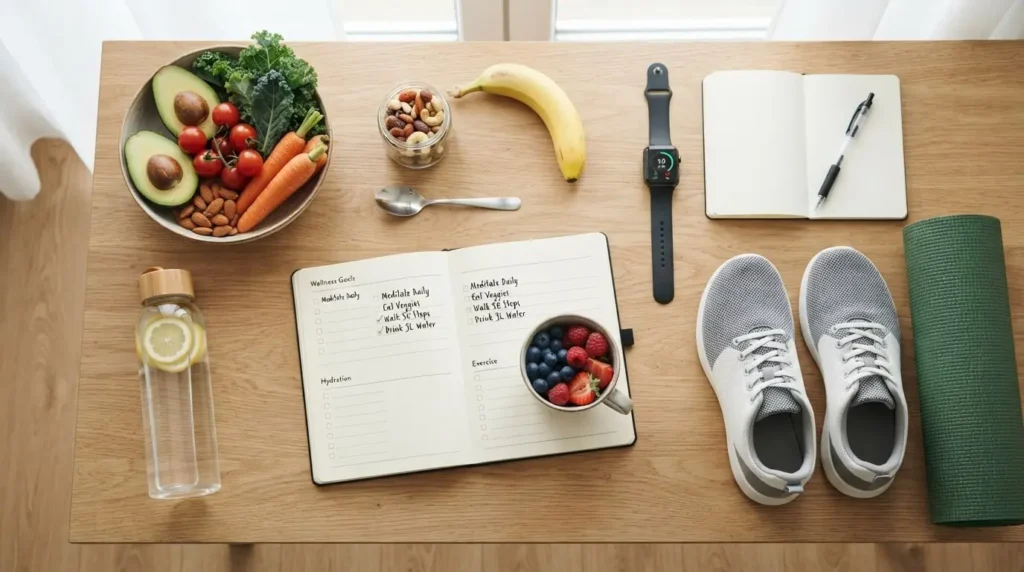
Most wellness conversations focus on long-term outcomes. Lose thirty pounds. Run a marathon. Reverse a health condition. Those are long term wellness goals, and they have their place. But they take months or years to achieve, and motivation based on distant outcomes tends to fade.
Short term wellness goals serve a different purpose. They provide immediate feedback. They create momentum. They give you something to feel good about today rather than something to hope for next year.
A short term goal might be to walk for ten minutes every day this week. Or to eat vegetables with lunch for the next seven days. Or to go to bed by 10:30 PM for five nights in a row. The timeline is close enough to see the finish line from the starting line.
Long term goals provide direction. Short term goals provide momentum. You need both.
The relationship works best when short term goals feed into long term goals. If your long term goal is to improve cardiovascular fitness, your short term goal might be to complete three walks this week. The short term goal is achievable now. The long term goal gives it context and meaning.
Wellness goals for beginners often work better when they start with short term goals exclusively. Build some wins. Establish some patterns. Then gradually extend the timeline as confidence and capability grow.
How to Build a Personal Wellness Improvement Plan
Having a list of wellness goals is one thing. Turning them into a sustainable personal wellness improvement plan is another. The gap between knowing what to do and actually doing it is where most people get stuck.
The most effective approach I have found is to pick one goal at a time and give it a month before adding anything else.
It sounds too slow. Most people want to change everything at once. But trying to overhaul your entire lifestyle simultaneously spreads your attention too thin. When life gets stressful, which it will, all the new habits collapse together.
One goal. One month. That is enough.
During that month, track how it goes. Not with elaborate spreadsheets or apps. Just notice. Did you do the thing? How did it feel? What got in the way? What made it easier? These observations inform how you adjust going forward.
At the end of the month, decide whether the goal feels solid enough to add something else, or whether it needs more time. Some goals integrate quickly. Others take longer. Neither is a failure.
This approach to building healthy habits for long-term wellness is not flashy. It will not produce dramatic before-and-after photos in six weeks. But it produces changes that last for years, which is the actual point.
If you want to go deeper on the mechanics of making changes stick, our guide on how habits are formed covers the psychology behind why some behaviors become automatic while others never do. Understanding that process helps you design personal wellness goals that work with your brain rather than against it.
The Difference Between Wellness Goals and Wellness Rules
There is a subtle but important distinction between goals and rules. Goals are directions. They are things you are working toward. Rules are rigid. They are things you are supposed to follow perfectly, and breaking them feels like failure.
Most people set wellness rules and call them goals.
A goal says “I want to move my body most days.” A rule says “I must exercise for forty-five minutes five days a week.” When life disrupts the rule, there is no graceful way to recover. You either followed the rule or you broke it.
A goal is more forgiving. If you miss a day, the goal is still there. You can pick it up tomorrow. The direction has not changed. Only the timing has shifted.
Rules create guilt. Goals create flexibility. Rules are fragile. Goals are resilient.
This is one of the reasons many health and wellness goals fail. They were never actually goals. They were rules disguised as goals. And rules break under pressure.
When you are setting wellness goals, check whether they leave room for real life. If missing one day feels like total failure, the goal is probably too rigid. If you can miss a few days and still feel like you are moving in the right direction, you have probably found something sustainable. The best examples of wellness goals survive imperfection because they were designed to.
How to Recover When Your Wellness Goals Fall Apart
Every wellness goal will eventually encounter a rough period. Travel, illness, work deadlines, family emergencies, or just a stretch of low motivation. The goal will slip. Days will pass without doing the thing.
This is normal. It happens to everyone. The difference between people who sustain wellness long-term and people who cycle between extremes is not whether they fall off track. It is what they do next.
The most common response to a lapse is guilt. I messed up. I failed. I might as well give up and start over next month. Guilt turns a small gap into a long break. A few missed days become a few missed weeks, because restarting feels harder the longer you have been away.
The alternative is to shrink the goal temporarily.
If you cannot do your full workout, do five minutes. If you cannot do five minutes, do one stretch before bed. If your nutrition has fallen apart, just add one vegetable to your next meal. The point is not to maintain performance. The point is to maintain connection to the habit.
This is where small steps toward better health prove their value. When the goal is already small, there is room to shrink it further without losing it entirely. A ten-minute walk is easy to maintain. An hour-long workout is easy to abandon.
Recovery is about lowering the bar until you can step over it, then gradually raising it again when your capacity returns. This approach preserves momentum. It keeps you in the game. Daily wellness goals that can flex are the ones that survive.
Frequently Asked Questions
What are the most important wellness goals to start with?
Sleep, basic nutrition, and some form of regular movement are the foundation. If those three areas are in reasonable shape, other goals become easier. If they are not, start there before adding anything more complex. Most personal wellness goals should address fundamentals before optimization.
How many wellness goals should I work on at once?
One is ideal, especially at the beginning. Adding more than two new goals at once usually leads to all of them failing when life gets busy. Focus on one goal for a few weeks until it feels automatic, then add another. Patience with health and wellness goals produces better results than ambition.
How do I set wellness goals that I will actually stick with?
Make them specific, small at first, flexible enough to survive disruption, and connected to identity rather than just outcomes. Vague goals like “get healthier” do not work. Clear goals like “add vegetables to lunch and dinner” give your brain something concrete to act on. Wellness goals examples that meet these criteria tend to last longer.
What is the difference between a wellness goal and a wellness routine?
A wellness goal is the direction you are heading toward. A wellness routine is the set of daily or weekly practices that move you in that direction. Goals give you something to aim for. Routines are how you actually get there. Daily wellness goals often function as the bridge between intention and routine.
Can wellness goals change over time?
They should change over time. As your life circumstances shift, your goals need to shift with them. A goal that worked before you had kids might not work after. A goal that worked when you were twenty-five might not fit at forty-five. Regular reassessment keeps personal wellness goals relevant to your actual life.
Why do I keep abandoning my wellness goals after a few weeks?
Most likely the goals are too big, too rigid, or both. Overly ambitious goals feel exciting at first but become exhausting to maintain. Rigid goals break the first time life interrupts them. Try making the goal smaller and building in flexibility for bad days. This is one of the most common patterns people encounter with health and wellness goals.
Where to Go From Here
If you are starting from scratch, pick one goal from the list above. Just one. Make it small enough that skipping it feels harder than doing it. Give it a month before you evaluate whether it is working.
If you already have wellness goals but they keep falling apart, look at whether they are actually rules disguised as goals. Try adding flexibility. Try shrinking them temporarily when life gets hard. See if that changes the pattern.
If you are doing well in some areas but neglecting others, consider which of the dimensions of wellness might need attention. Physical health gets most of the focus, but social, emotional, and mental wellness matter just as much for overall well-being.
Understanding what wellness actually means helps clarify why you are doing any of this in the first place. The benefits of wellness show up gradually, which is why consistency matters more than intensity.
For most people, the missing piece is not more information. It is not more motivation. It is permission to set smaller goals, to be flexible, and to keep going after imperfect days. Lifestyle changes for overall wellness happen through accumulation, not transformation.
Pick one thing. Make it small. Start today.
About the Author
Hussnain Ali is a wellness and healthy habits writer focused on behavior change, sustainable routines, and evidence-based lifestyle improvements. His work combines research-backed wellness principles with practical everyday strategies drawn from years of testing what actually works in real life.