

I’ve started more morning routines than I can count.
Some were elaborate. Wake up at 5 AM. Meditate for twenty minutes. Journal three pages. Exercise for an hour. Read something educational. Drink a green smoothie. No phone until 9 AM. The whole thing took about two and a half hours and made me feel like I was living someone else’s life.
The routine collapsed, predictably, the first time I had to catch an early flight. Then I felt guilty for failing at a routine that was never realistic for me in the first place.
What eventually worked was something much simpler. Not a routine I admired. A routine I could actually do. Small habits stacked together loosely. Flexible enough to survive travel, bad nights, and mornings when I didn’t feel like doing anything at all.
A success morning routine isn’t about impressing anyone. It’s about starting the day with a little momentum. That’s it. Everything else is decoration.
Why Most Morning Routines Fail
Most morning routines fail for the same reason most habits fail. They’re designed for ideal conditions instead of real life.
The typical advice goes like this. Wake up early. Follow this specific sequence. Do each thing for a set amount of time. Protect your morning from interruptions. Be consistent every single day.
Real mornings don’t work like that.
Sometimes you sleep poorly. Sometimes a kid wakes you up at 3 AM. Sometimes you have an early meeting that shifts everything forward. Sometimes you’re traveling and your usual space doesn’t exist. The routine that looked perfect on paper falls apart the moment something unexpected happens.
I abandoned more morning routines than I can count because I missed one day and felt like the whole thing was ruined. The all-or-nothing mindset is especially destructive with morning routines because mornings are inherently variable. No two are exactly the same.
The guide on why habit building fails covers this pattern in detail. The short version is that a morning routine needs to be flexible enough to survive disruption. If it requires perfect conditions, it won’t last.
Another thing worth mentioning is that most morning routine advice comes from people with unusual levels of control over their schedules. Entrepreneurs. Authors. People without young children or shift work or long commutes. What works for them might not work for you, not because you’re less disciplined, but because your mornings look different.
What a Success Morning Routine Actually Looks Like
A success morning routine isn’t a specific set of activities. It’s a specific outcome.
The outcome is momentum. Starting the day having already done something intentional. That could be almost anything. Making your bed. Drinking a glass of water. Writing one sentence. Stretching for two minutes. Reading one page of a book.
The content matters less than the fact that you did something you decided to do. That small win, minor as it feels, sets a tone. You started the day as the kind of person who follows through. The rest of the day tends to follow that lead.
Small daily habits create lasting success not because any individual action is significant, but because the accumulation of small wins builds a self-perception that makes larger wins possible. You’re not just doing a morning routine. You’re becoming someone who keeps commitments.
A productive morning routine doesn’t need to be long. It doesn’t need to be impressive. It doesn’t need to look like what successful people supposedly do. It just needs to happen most mornings.
At least in my experience, the routines that last are the ones that take less than fifteen minutes and have built-in flexibility. Some days I do the full version. Some days I do the two-minute version. Both count. Both preserve the momentum.
Small Daily Habits That Create Big Results Over Time
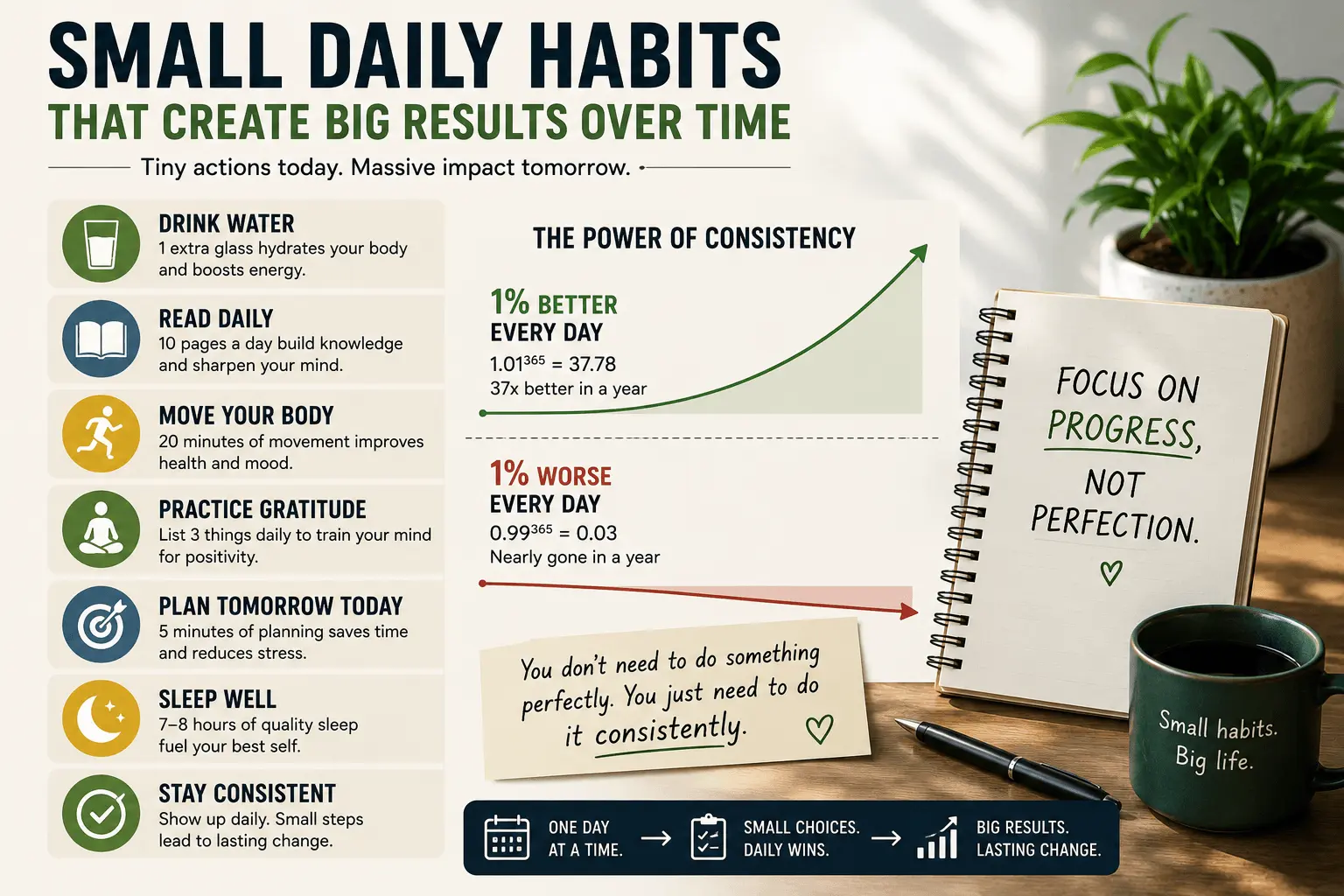
The habits that changed my mornings the most weren’t the ones I expected.
I used to think a success morning routine required meditation and journaling and exercise and reading. All the things successful people supposedly do. What I eventually realized is that the most impactful habits were much smaller.
Drinking a glass of water first thing. That single habit, which takes thirty seconds, made me feel more awake than any complicated routine ever did. I was dehydrated after sleeping. The water fixed that. Simple.
Not looking at my phone for the first ten minutes. This one took forever to stick. I kept reaching for it automatically. What finally worked was charging my phone in another room entirely. The friction of getting up to check it was usually enough to stop me. Those first ten minutes without input from the outside world feel different. Quieter. More mine.
Writing down one thing I want to get done that day. Not a full to-do list. Not a planning session. Just one thing. The act of identifying a single priority before the day’s chaos begins makes it more likely that the priority actually happens.
Moving my body for a few minutes. Not a full workout. Just stretching or walking or doing a few pushups. Something that tells my body the day has started. On good days this becomes a longer workout. On hard days it’s two minutes of stretching. Both versions count.
These habits share a common quality. They’re small enough that skipping them feels harder than doing them. A full workout is easy to skip when you’re tired. Two minutes of stretching is not. A full journaling session requires mental energy. Writing one sentence does not. The smaller the habit, the more likely it survives.
The guide on how to build good habits covers this principle in more detail. Small habits are the foundation. Big results come later.
How to Build a Morning Routine You Can Actually Keep
Building a morning routine that lasts requires a different approach than building one that looks good on paper.
Start with one habit. Not five. Not a complete overhaul. One thing you’ll do every morning after waking up. Maybe it’s drinking water. Maybe it’s making your bed. Maybe it’s stepping outside for sixty seconds. Pick the one that feels easiest. Do it for two weeks before adding anything else.
This is where people usually struggle. The enthusiasm of starting fresh makes multiple changes feel possible. You want to fix everything at once. Become a completely different person by Tuesday. That impulse is normal. It’s also the reason most morning routines don’t survive their first disruption.
I’ve learned to build routines gradually. One habit. Stabilize it. Add another. Stabilize that. The process takes months instead of days, but the results actually last.
The guide on how habits are formed explains why this works. Habits become automatic through repetition in a stable context. Each repetition strengthens the neural pathway. Adding one habit at a time allows each one to stabilize before introducing something new. Adding five at once means none of them stabilize, and all of them collapse together.
Another thing that helps is having a minimum version of your routine for difficult mornings. Travel days. Sick days. Days when you’re exhausted and everything feels harder than it should. The minimum version might be one habit that takes sixty seconds. Doing the minimum preserves the pattern. The pattern is what matters.
Habit Stacking Makes Morning Routines Easier
Habit stacking is the simplest way to build a morning routine that actually flows.
The idea is to attach a new habit to something you already do automatically. Instead of trying to remember to meditate at some point in the morning, you meditate right after you brush your teeth. The existing habit becomes the trigger for the new one.
My current morning routine is a chain of small habits linked together. Wake up. Drink water while the coffee brews. Stretch for two minutes while the coffee cools. Write one sentence while drinking the coffee. Each habit triggers the next. The coffee maker is the anchor that holds everything together.
The guide on what habits are and how they work explains the cue-routine-reward loop that makes stacking effective. The existing habit provides the cue. The new habit becomes the routine. The satisfaction of completing the chain is the reward.
Habit stacking works because it removes the need to remember. You don’t have to decide to meditate. You just do it after brushing your teeth because that’s what you do after brushing your teeth. The decision is already made. The sequence is already set.
The tricky part is being honest about what you actually do every morning, not what you wish you did. I don’t always journal, but I always make coffee. So coffee is the anchor, not journaling. Build your stack around the habits that are already automatic, not the ones you hope will become automatic someday.
Common Morning Routine Mistakes
I’ve made all of these.
Trying to copy someone else’s routine. Reading about what successful people do in the morning can be interesting. Trying to replicate it usually fails. Their life isn’t your life. Their preferences aren’t your preferences. Their schedule isn’t your schedule. Build a routine that fits your actual mornings, not someone else’s.
Starting too big. A two-hour morning routine sounds inspiring. It’s also unsustainable for most people. Start with something that takes less than five minutes. You can always expand later. You can’t expand something you’ve already abandoned.
Having no flexibility. If your routine requires things to go perfectly, it won’t survive. Build in flexibility. Have a full version and a minimum version. Accept that some mornings will be abbreviated and that abbreviated still counts.
Focusing on the wrong things. A success morning routine isn’t about productivity. It’s about starting the day with intention. If your routine feels like a second job, you’re doing it wrong. The best morning habits are the ones you actually want to do, not the ones you think you should do.
Waiting for the right time to start. There’s never a perfect time. Next week won’t be less busy than this week. Start now with something small. One habit. Tomorrow morning. Adjust as you go.
Morning Routine Examples That Survive Real Life
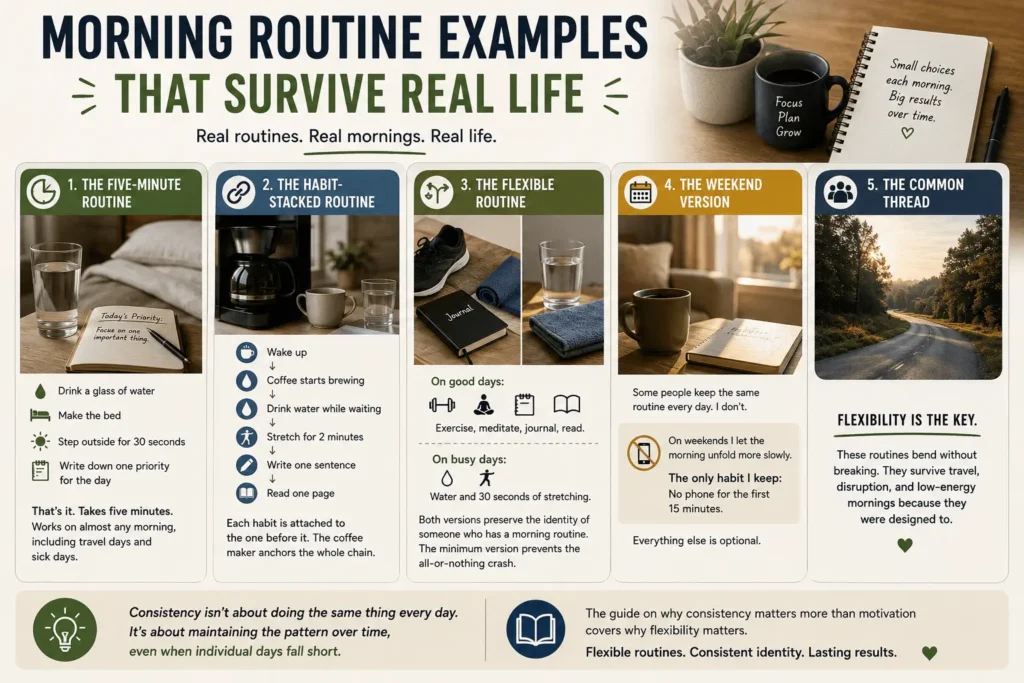
I’ve tried enough variations to know that examples are more useful when they’re realistic. Here are a few that have actually worked for me or people I know.
The five-minute routine. Wake up. Drink a glass of water. Make the bed. Step outside for thirty seconds. Write down one priority for the day. That’s it. Takes five minutes. Works on almost any morning, including travel days and sick days.
The habit-stacked routine. Wake up. Coffee starts brewing. Drink water while waiting. Stretch for two minutes. Write one sentence. Read one page. Each habit is attached to the one before it. The coffee maker anchors the whole chain.
The flexible routine. On good days, do the full version. Exercise, meditate, journal, read. On busy days, do the minimum version. Water and thirty seconds of stretching. Both versions preserve the identity of someone who has a morning routine. The minimum version prevents the all-or-nothing crash.
The weekend version. Some people keep the same routine every day. I don’t. On weekends I let the morning unfold more slowly. The only habit I keep is not checking my phone for the first fifteen minutes. Everything else is optional.
The common thread is flexibility. These routines bend without breaking. They survive travel, disruption, and low-energy mornings because they were designed to.
The guide on why consistency matters more than motivation covers why flexibility matters. Consistency isn’t about doing the same thing every day. It’s about maintaining the pattern over time, even when individual days fall short.
How Successful People Actually Approach Their Mornings
Most of what you read about successful people’s morning routines is filtered through survivorship bias and PR.
The stories tend to emphasize the dramatic. Waking up at 4 AM. Meditating for an hour. Working out before sunrise. What they leave out is that these people often have staff. They have flexible schedules. They have control over their time that most people don’t.
What I’ve noticed, from reading about this stuff for years and talking to people who’ve actually built things, is that successful morning habits share a few qualities that have nothing to do with specific activities.
They’re consistent without being rigid. The routine happens most days, but it adapts when necessary. Missing a day doesn’t trigger a crisis.
They’re front-loaded with small wins. Making the bed. Drinking water. Something that provides a quick sense of accomplishment before the day’s demands begin.
They protect the first part of the morning from external input. No email. No social media. No news. Just a few minutes of directed attention before the world starts making requests.
They reflect the person’s actual priorities, not someone else’s idea of what a productive person should do. One person’s morning writing session is another person’s morning run. The activity matters less than the fact that it matters to the person doing it.
The guide on the most powerful mindset for success explores the mental frameworks that underlie consistent habits. The morning routine is just the visible part. The mindset is what keeps it going.
Building a success morning routine is part of a broader approach to well-being. The guide on how to improve your overall well-being covers the foundational health habits that give you the energy to show up consistently in the morning and throughout the day.
Frequently Asked Questions
What is the best morning routine for success?
There’s no universal best routine. The best morning routine is the one you’ll actually do consistently. For most people, that means starting with one or two small habits that take less than five minutes total. Drinking water, making the bed, writing down a priority, or stepping outside briefly. The content matters less than the consistency.
How long should a morning routine be?
As long as it needs to be and as short as it can be on difficult days. A five-minute routine that happens every day is better than a two-hour routine that happens twice a week. Most sustainable routines fall somewhere between five and thirty minutes, with built-in flexibility to shrink when necessary.
Do I need to wake up early to have a successful morning routine?
No. Early waking works for some people and not for others. The quality of your morning routine depends on what you do with the time you have, not on what time you wake up. A night shift worker can have a meaningful routine at 2 PM. The principle is the same. Start the day with intention.
How do I stick to my morning routine when I travel?
Have a minimum version that works anywhere. A glass of water. A few minutes of stretching. One sentence written in a phone note. The location changes but the pattern stays intact. Don’t expect to maintain the full routine while traveling. Maintaining the minimum is enough.
What if I miss a day of my morning routine?
Do the minimum version the next day. Don’t try to make up for the missed day by doing extra. Don’t declare the routine dead and wait for Monday to restart. One missed morning is one missed morning. It doesn’t erase the pattern. Come back the next day and continue.
Can I have different morning routines for different days?
Yes, and that approach often works better than forcing the same routine every day. A weekday routine might be more structured. A weekend routine might be more relaxed. The key is that both versions include at least one intentional habit that starts the day with purpose.
Final Thoughts
A success morning routine isn’t about waking up at a certain time or following a specific sequence of activities.
It’s about starting the day with one small win. Something you decided to do that you actually did. That’s the whole foundation. Everything else builds from there.
Pick one thing. Make it small enough that skipping it feels harder than doing it. Do it tomorrow morning. Then do it again the next day. Add more when the first habit feels automatic. Let the routine bend when life gets messy.
The goal isn’t a perfect morning. It’s a morning where you showed up for yourself before the world started asking for things. That’s enough. That’s the whole thing.