
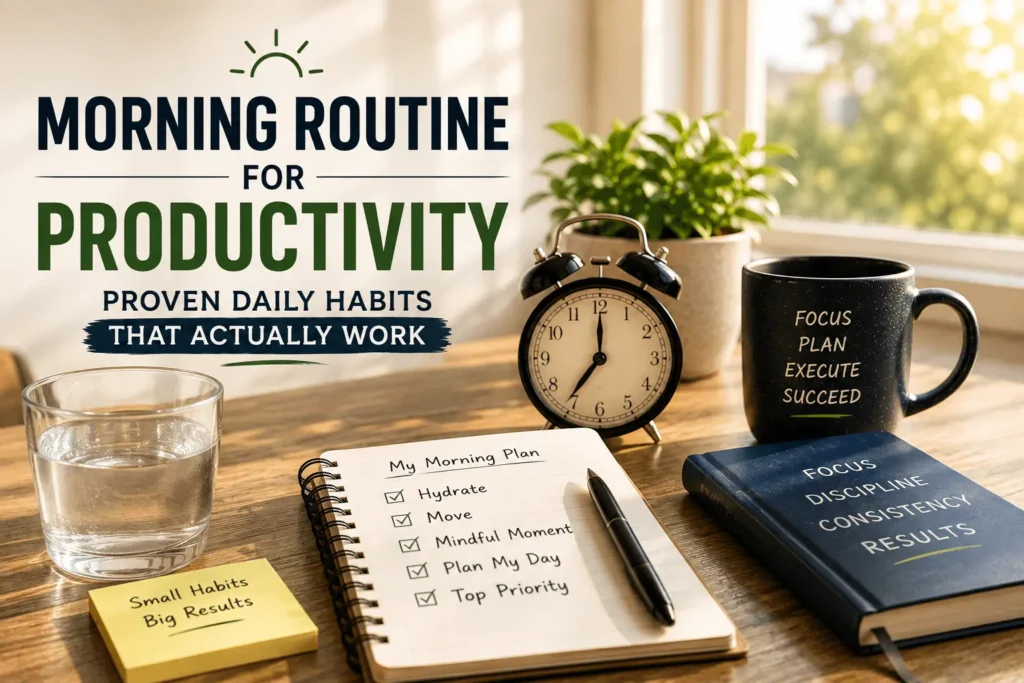
I used to think a productive morning meant doing as much as possible before 9 AM.
Wake up early. Answer emails. Plan the entire day. Exercise. Meditate. Read. Journal. The routine took two hours and left me exhausted before I’d done any actual work. The productivity I was chasing in the morning was stealing the productivity I needed for the rest of the day.
The breakthrough came when I stopped trying to do everything and started asking what actually helped me focus. Not what looked impressive. What worked.
A morning routine for productivity isn’t about how much you do. It’s about doing a few specific things that set your brain up to focus, make decisions, and sustain attention once the real work begins.
Not an impressive morning. An intentional one.
Research Snapshot: Research from Phillippa Lally and colleagues found that habit formation averaged about 66 days, though the range varied widely from 18 to 254 days depending on the person and the complexity of the behavior. The routines that last aren’t the ones that look good on paper. They’re the ones you can sustain.
Productive Morning Routine Checklist:
- ✓ Drink water first thing
- ✓ Avoid phone for 20–30 minutes
- ✓ Move your body briefly
- ✓ Write down one priority
- ✓ Get natural light early
What a Productive Morning Routine Actually Means
A morning routine for productivity isn’t about doing more things. It’s about creating the conditions that make focused work possible later.
Some people hear “productive morning” and imagine crushing a workout, clearing their inbox, and planning every hour of the day before 8 AM. That’s not productivity. That’s just moving tasks to the morning. The real question is whether your morning makes the rest of your day better or just makes you tired.
From what I’ve noticed, the best morning routines for productivity do three things. They reduce decision fatigue by removing unnecessary choices early in the day. They create a small sense of momentum that carries into the first real task. And they protect attention by delaying reactive activities like email and social media.
The guide on building a morning routine for success covers the broader principles. Productivity is one piece of that. The habits that improve focus and output overlap a lot with the habits that improve well-being in general.
A productive morning routine also doesn’t need to start at 5 AM. Shift workers. Parents. People with chronic illness. The principle is the same regardless of when you wake up. Do a few intentional things before the day’s demands begin. That’s the whole foundation.
Benefits of a Productive Morning Routine
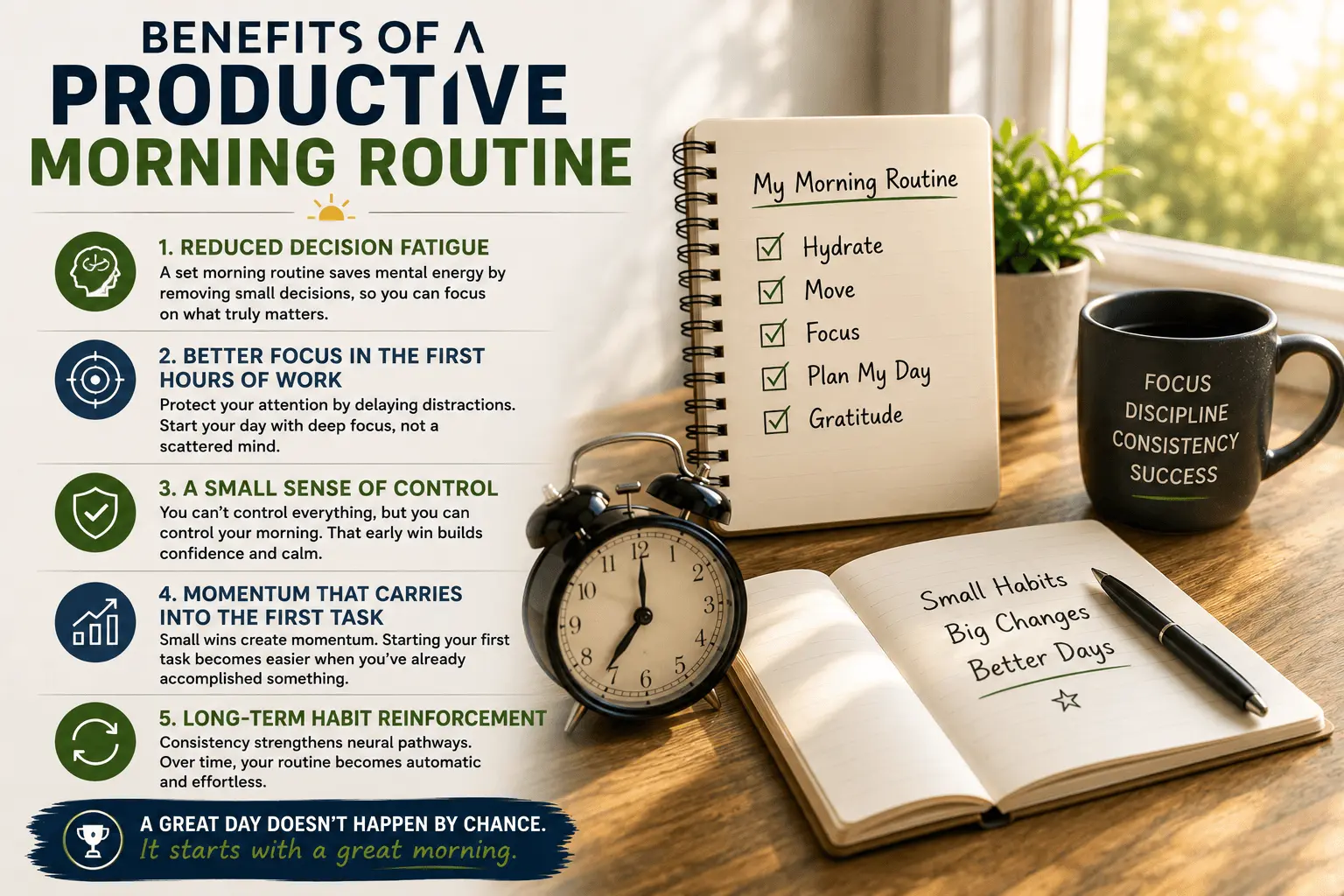
A consistent morning routine doesn’t just help you get more done. It affects how you feel while you’re working.
Reduced decision fatigue. When your morning follows a set sequence, you’re not spending mental energy deciding what to do next. That preserved energy is available for the decisions that actually matter later in the day.
Better focus in the first hours of work. Protecting your attention in the morning, by delaying email, messages, and social media, means you start your workday with a full tank of focus rather than a fragmented one. The first few hours after waking are when many people do their best thinking. A good routine protects that window.
A small sense of control before the day gets chaotic. You can’t control what meetings get scheduled or what emergencies arise. But you can control the first ten to twenty minutes of your day. That small act of agency, doing what you decided to do before the world started making demands, creates a psychological foundation that makes the rest of the day feel more manageable.
Momentum that carries into the first task. Completing a few small habits gives you a quick win. That win makes starting the first real task feel easier. You’re not beginning from zero. You’re continuing a chain of completed actions.
Long-term habit reinforcement. Each time you complete your morning routine, you’re strengthening the neural pathways that make the behavior automatic. Over time, the routine stops feeling like effort and starts feeling like the natural way you begin your day.
Why Most Productivity Morning Routines Fail
Most productivity advice comes from people who already have unusual control over their time.
Entrepreneurs who don’t take meetings until noon. Authors with no commute. Content creators who set their own schedules. Their routines sound impressive because their circumstances allow for impressive routines. For everyone else, those routines collapse the moment life intervenes.
The guide on why habit building fails covers this pattern in detail. The short version is that routines fail when they’re designed for ideal conditions. Real mornings include disrupted sleep, early meetings, family obligations, and days when you just don’t feel like it.
Another reason these routines fail is that they’re too long. A two-hour morning routine might work during a calm period. It won’t survive a busy week. A short routine, ten to twenty minutes, is more resilient. It can bend without breaking.
What surprised me most was that shorter routines often improved my productivity more than longer ones. Not because the habits themselves were better. Because I actually did them consistently. A routine that happens every day beats a routine that happens twice a week.
Here’s a comparison of what tends to fail versus what tends to last:
| Unrealistic Routine | Sustainable Routine |
|---|---|
| Wake at 5 AM sharp | Wake at your consistent time |
| 2-hour routine | 10–20 minute routine |
| 10 new habits at once | 1–2 habits at a time |
| Requires daily motivation | Built on repetition and cues |
| No flexibility for disruptions | Minimum version for busy days |
| Copying someone else’s schedule | Fits your actual life |
The Morning Habits That Actually Improve Focus
After years of experimenting, the habits that made the biggest difference to my focus weren’t the ones I expected.
Not checking my phone for the first thirty minutes. This single change had more impact than anything else I tried. When I start the morning reacting to messages and notifications, my attention stays fragmented for hours. When I delay that input, I start the day with my own priorities instead of other people’s. The guide on daily habits that improve your mindset has more on how this small shift affects mental clarity.
I left my phone on the nightstand one morning by accident. Checked it within two minutes of waking. Spent the next hour feeling scattered, responding to things that didn’t matter, and never quite recovered my focus. One slip. Back to the old pattern.
Writing down one priority for the day. Not a to-do list. One thing. The single task that, if completed, would make the day feel productive regardless of what else happens. This takes about ninety seconds and reduces the mental load of deciding what to work on first.
Moving my body for a few minutes. Not a full workout. Stretching. Walking. A few pushups. Physical movement signals alertness. It tells your brain the day has started and reduces the grogginess that clings to the first hour after waking.
Drinking water before caffeine. Dehydration after sleep contributes to fatigue and brain fog. Water takes thirty seconds and makes a noticeable difference. Coffee can come after.
Getting natural light early. Sunlight helps regulate circadian rhythm and improves alertness. Even a few minutes outside or near a bright window makes a difference. If you can step outside, great. If not, open the blinds and face the window. Current public health guidance continues to emphasize consistent sleep schedules over arbitrary wake-up times, which matters more for long-term productivity than forcing yourself out of bed before you’re ready.
These habits share a quality. They’re small enough to do even when you’re tired or rushed. And they protect or improve your ability to focus rather than draining it before the day begins.
How to Build a Morning Routine for Productivity
Building a routine that lasts means starting smaller than you think you need to.
Pick one habit. Not five. One thing you’ll do tomorrow morning. Maybe it’s not checking your phone for the first ten minutes. Maybe it’s writing down one priority. Pick the one that feels easiest. Do it for two weeks before adding anything else.
This is where people usually struggle. The impulse to fix everything at once is strong. You want to wake up tomorrow as a completely different person. That impulse is normal. It’s also why most routines don’t survive their first disruption.
The guide on how to build good habits covers the mechanics of starting small and scaling up. The short version is that consistency matters more than intensity. One habit done every day beats five habits done twice a week.
Have a minimum version of your routine for chaotic mornings. Travel. Illness. Deadlines. The minimum version might be one habit that takes sixty seconds. Water and one deep breath. Write one word. The minimum preserves the pattern. The pattern is what matters.
The guide on how habits are formed explains why context stability matters. Habits form through repetition in a consistent environment. When the environment changes, the habit weakens. A minimum version bridges the gap until you’re back to normal.
Habit Stacking for a Productive Morning
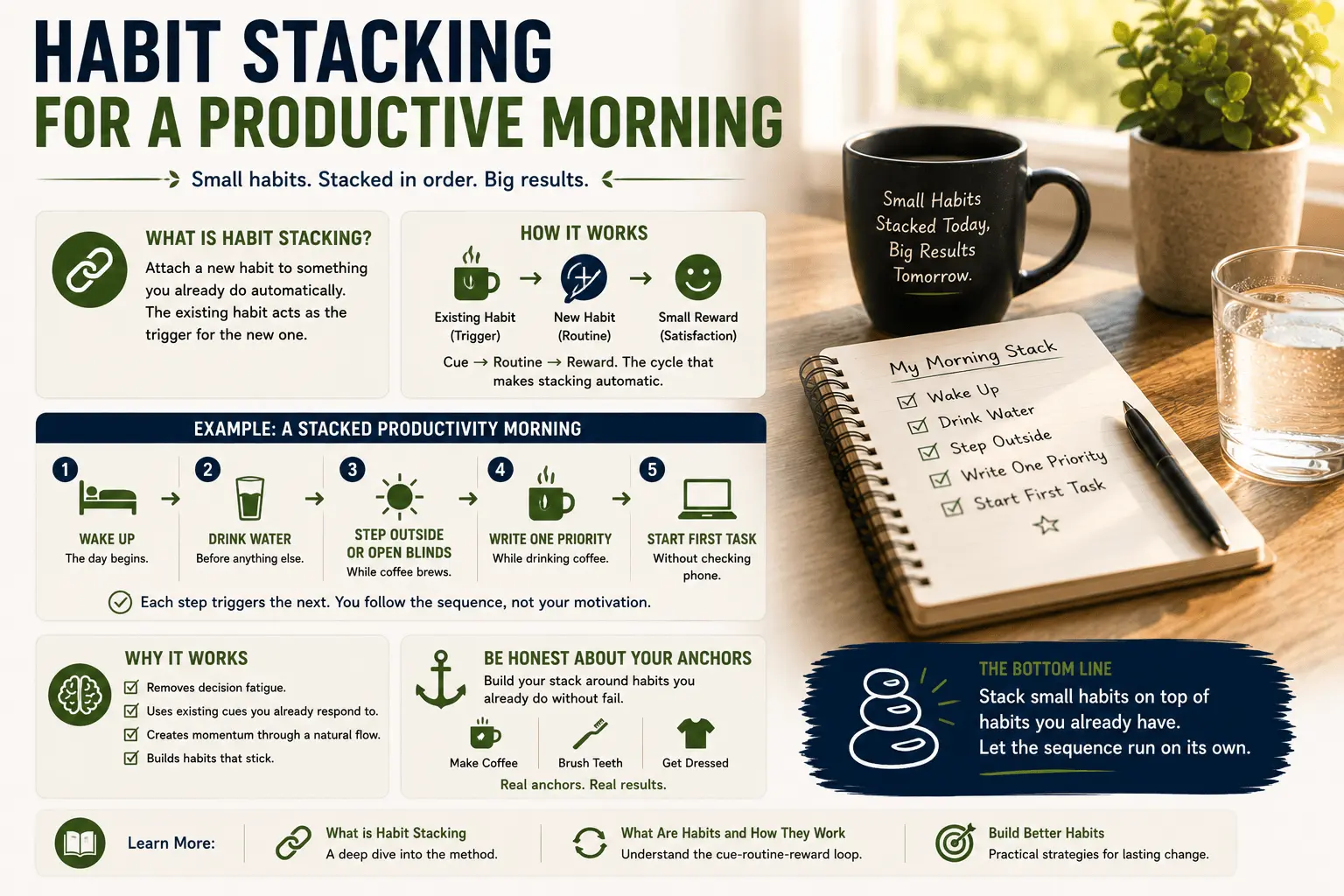
Habit stacking is the simplest way to build a morning routine that actually flows.
The idea is to attach a new habit to something you already do automatically. After I make coffee, I write down one priority. After I finish my water, I step outside for two minutes. The existing habit acts as the trigger for the new one.
The guide on what is habit stacking explains the method in detail. The short version is that stacking removes the need to remember. The coffee maker triggers the priority. The empty glass triggers the walk. The sequence runs on its own.
A stacked version of a productivity morning might look like this:
- Wake Up
- Drink Water (before anything else)
- Step Outside or Open Blinds (while coffee brews)
- Write One Priority (while drinking coffee)
- Start First Task (without checking phone)
Each step triggers the next. You’re not deciding what to do. You’re following a sequence that’s already set.
The guide on what habits are and how they work explains the cue-routine-reward loop that makes stacking effective. The existing habit provides the cue. The new habit becomes the routine. The small satisfaction of completing the chain is the reward.
The key is being honest about what you already do consistently. Don’t build a stack around “after I meditate” if you don’t actually meditate every day. Build around coffee. Brushing teeth. Getting dressed. Things that happen without fail.
What to Avoid in the Morning
What you don’t do in the morning matters as much as what you do.
Checking email and messages immediately. This is probably the single biggest productivity killer in the morning. Email is a list of other people’s priorities. Starting your day with it means starting your day reacting instead of acting. Even ten minutes of delay makes a difference.
Making unnecessary decisions. Decision fatigue is real. Every choice you make depletes a limited resource. The more decisions you make in the morning about things that don’t matter, what to wear, what to eat, what to work on first, the less capacity you have for decisions that do matter. Simplify morning choices wherever possible.
Consuming information before creating anything. Reading news. Scrolling social media. Watching videos. All of these fill your head with other people’s thoughts before you’ve had a chance to think your own. If you want to produce something during the day, protect at least the first hour from consumption.
Starting the day with meetings. If you have control over your schedule, avoid scheduling meetings first thing. Once you’re in a meeting, your attention belongs to the room. Any focused work you might have done in that time is lost. Protect the first block of your day for your most important task.
Hitting snooze repeatedly. Snoozing fragments the last bit of sleep without providing real rest. It also starts the day with a small failure. You set an intention to wake up and then immediately broke it. That tiny erosion of self-trust matters more than people think.
How to Keep Your Routine Going When Work Gets Chaotic
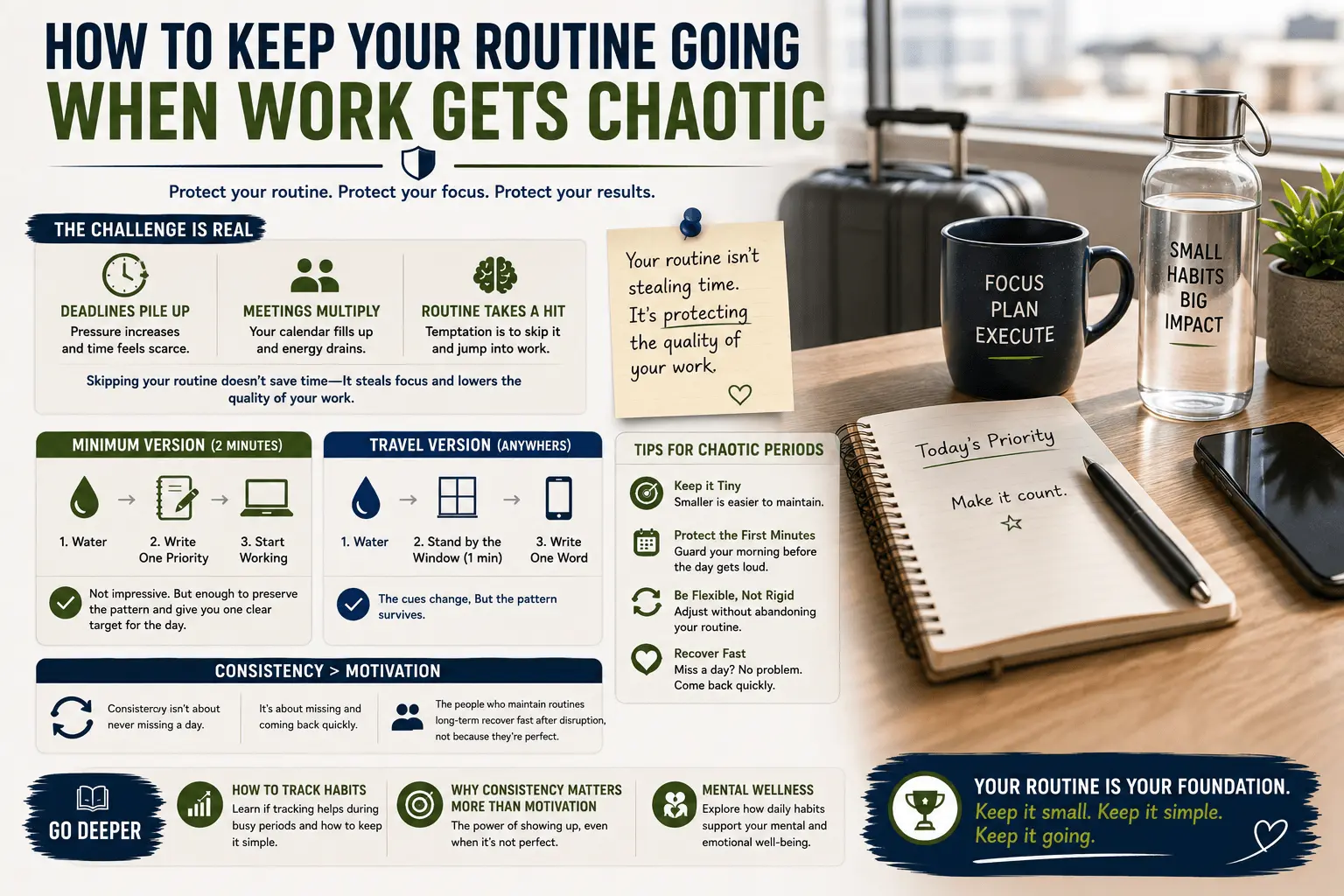
The busiest periods are when a morning routine matters most. They’re also when it’s hardest to maintain.
Deadlines pile up. Meetings multiply. The temptation is to skip the routine and jump straight into work. I’ve done this. Every time, my focus suffered and my productivity dropped. The routine wasn’t stealing time from work. It was protecting the quality of the work.
What finally stuck during chaotic periods was the minimum version. Water. Write one priority. Start working. Two minutes total. Not impressive. But enough to preserve the pattern and give me one clear target for the day.
Travel disrupts routines too. Different time zone. Unfamiliar space. No coffee maker where you expect it to be. My travel version is even simpler. Water. Stand by the window for a minute. Write one word on my phone. The cues change but the pattern survives.
The guide on how to track habits covers whether tracking helps during busy periods. For some people, a simple tracker provides enough accountability to stay consistent. For others, it adds stress. Use it if it helps. Skip it if it doesn’t.
The guide on why consistency matters more than motivation covers the broader principle. Consistency isn’t about never missing a day. It’s about missing and coming back quickly. The people who maintain routines long-term aren’t the ones with perfect streaks. They’re the ones who recover fast after disruption.
Productivity habits support mental wellness, but they’re not the whole picture. The guide on mental wellness explores how daily habits connect to broader psychological health.
Frequently Asked Questions
What is the best morning routine for productivity?
The best routine is the one you’ll actually do consistently. For most people, that means a short routine with three to five habits. Write down one priority. Move your body for a few minutes. Delay checking your phone. Get natural light. Drink water. The whole thing takes ten to fifteen minutes. Start there. Adjust based on what works for you.
Is a morning routine really necessary?
No, but it helps. Plenty of productive people don’t have a formal morning routine. What matters isn’t the routine itself. It’s whether you’re protecting your ability to focus during your most productive hours. A routine is one way to do that. It’s not the only way.
How long should a morning routine be?
Short enough to survive disruption. A ten to twenty-minute routine that happens every day produces better results than a two-hour routine that happens twice a week. Most sustainable routines fall between ten and thirty minutes, with a built-in minimum version for chaotic mornings.
Do I need to wake up early to be productive?
No. Productivity depends on what you do with your time, not on what time you wake up. The principle is the same whether you wake up at 5 AM or noon. Start the day with a few intentional habits that protect your focus. The clock doesn’t matter.
What if I can’t avoid checking my phone in the morning?
Charge your phone in another room. If you need it for an alarm, buy a separate alarm clock. Physical distance works better than willpower. If you must check your phone, set a specific time limit, five minutes maximum, and stick to it.
How do I stay consistent when I travel or have early meetings?
Have a minimum version of your routine that takes two minutes or less. Water. Write one priority. Done. The minimum preserves the pattern when time is tight. You can always do the full version on calmer days.
What’s the one morning habit that makes the biggest difference for focus?
Delaying phone use for the first twenty to thirty minutes after waking. This single change protects your attention from immediate fragmentation and gives you a brief period of self-directed focus before the day’s demands begin. It’s simple but surprisingly difficult, and the impact is larger than most people expect.
Final Thoughts
A morning routine for productivity isn’t about doing more before 9 AM. It’s about doing a few specific things that protect your ability to focus once the real work begins.
Don’t check your phone immediately. Write down one priority. Move your body for a few minutes. Get some light. Drink water. That’s pretty much it. The whole thing takes ten to fifteen minutes.
The routine isn’t the productivity. The routine creates the conditions where productivity becomes possible. Protecting attention. Reducing decision fatigue. Building a small sense of momentum that carries into the first real task.
Start with one habit tomorrow. Make it small enough that skipping it feels harder than doing it. Add more when the first habit feels automatic. Let the routine bend when life gets messy. Come back to it when you can.