
I used to forget to take my vitamins almost every day.
The bottle was in the cabinet. The cabinet was above the sink. I’d walk past it every morning, think about taking them, and then get distracted by something else. By the time I remembered again, it was usually bedtime and I’d tell myself I’d start tomorrow.
Then I moved the vitamins next to the coffee maker.
I never forget to make coffee. It’s the first thing I do every morning, without thinking, without deciding, without needing to remember. The coffee happens automatically. Putting the vitamins next to the coffee maker meant I saw them at the exact moment I was already doing something else. I started taking them every day. Not because I became more disciplined. Because I attached a habit I wanted to a habit I already had.
That’s habit stacking. And it’s one of the simplest habit-building methods I’ve personally used.
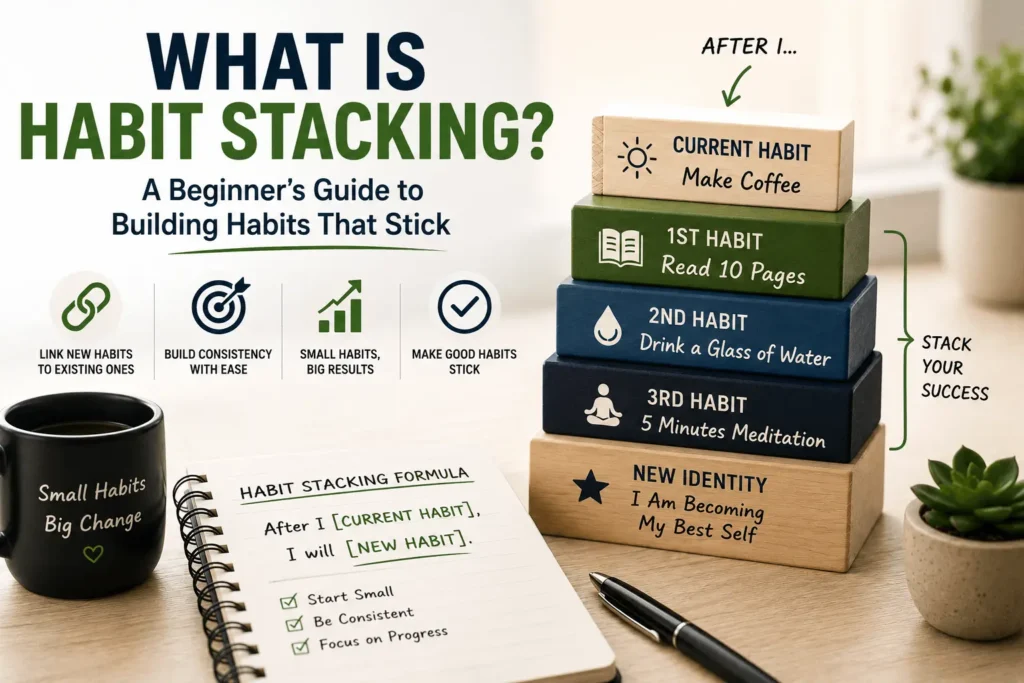
Habit stacking is a habit-building technique where you attach a new habit to an existing routine so the existing behavior becomes the cue for the new one. Instead of relying on motivation or reminders, you link behaviors together so the new one rides along with the old one.
Habit Stacking at a Glance:
- Attach one new habit to an existing habit.
- Use the formula: After I [existing habit], I will [new habit].
- Start with one tiny habit.
- Repeat daily until it becomes automatic.
What Is Habit Stacking and How Does It Work
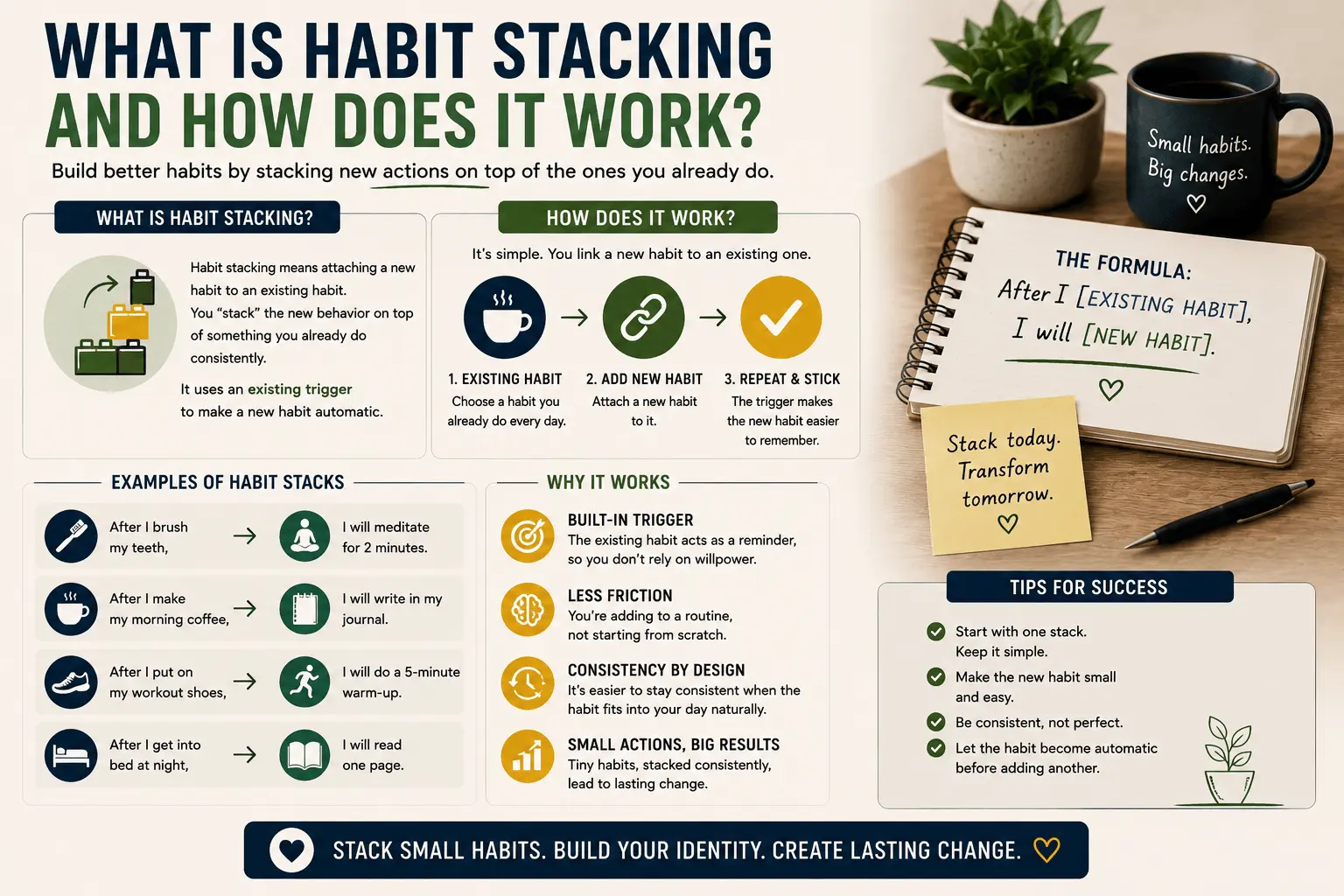
The basic idea behind what is habit stacking is straightforward.
You take a new habit you want to build and attach it to an existing habit you already do automatically. The existing habit becomes the trigger for the new one. Instead of trying to remember to do something at some vague time during the day, you do it right after something you already never forget to do.
The formula is simple. After I do [existing habit], I will do [new habit].
After I pour my morning coffee, I will take my vitamins. After I brush my teeth, I will floss. After I get into bed, I will read one page of a book. After I finish lunch, I will walk for five minutes.
The existing habit does the remembering for you. You don’t need a reminder app or a notification or a burst of motivation. You just need to notice that you’re already doing the existing habit and add one small thing to the end of it.
Many people discover this approach naturally without knowing what is habit stacking called. I thought I was just being practical. Turns out there’s a whole method behind it, popularized by BJ Fogg’s Tiny Habits research at Stanford and later picked up by pretty much every habit writer. The name doesn’t matter much. The approach does.
At its core, habit stacking works because it solves the biggest problem in habit formation: knowing when to act. Most people know what they want to do. They just don’t have a clear moment to do it. Stacking gives you that moment. It turns “sometime today” into “right after this thing I’m already doing.”
Why Habit Stacking Works
The biggest change for me wasn’t motivation. It was finally having a reliable cue.
Every habit needs a trigger. Something that tells your brain it’s time to do the behavior. Without a clear cue, habits float around in your day unattached to anything specific. “I’ll meditate at some point” almost always means you won’t meditate. “I’ll meditate right after I brush my teeth” gives your brain a clear signal. The guide to understanding what habits are and how they work explains the cue-routine-reward loop that makes this work.
Another reason stacking works is that it reduces decision fatigue. You don’t have to decide when to do the new habit. The decision is already made. After X comes Y. No deliberation required. The less you have to think about a habit, the more likely you are to do it.
It also borrows existing automaticity. The existing habit is already wired into your brain. It happens without effort. By attaching a new behavior to that automatic sequence, you’re piggybacking on neural pathways that already exist. The new habit gets a free ride on infrastructure that’s already built.
BJ Fogg’s research on behavior change, which forms the foundation of the Tiny Habits method, shows that behavior happens when motivation, ability, and a prompt converge at the same moment. Habit stacking addresses the prompt by anchoring the new behavior to an existing reliable trigger. It also indirectly helps with ability because the new habit is typically small enough that the ability requirement stays low.
At least in my experience, habits built through stacking form faster than habits I try to do at arbitrary times. The cue is consistent. The context is stable. The repetition happens without much thought. That’s exactly what the brain needs to automate a behavior.
The guide on how habits are formed in the brain goes deeper into the neuroscience of automaticity. The short version is that repetition in a stable context is what turns deliberate behaviors into automatic ones. Habit stacking creates stable context by design.
Benefits of Habit Stacking
Habit stacking helps in several practical ways.
- Easier to remember new habits. The existing habit acts as a built-in reminder. You don’t need to set alarms or rely on notifications.
- Reduces decision fatigue. You’re not deciding when to do the habit. The sequence is already set. After X comes Y.
- Builds consistency naturally. Because the anchor habit happens every day, the new habit gets daily repetition without extra effort.
- Uses routines you already have. You’re not creating a new structure from scratch. You’re adding to something that already works.
- Requires little motivation. The trigger is external. You don’t need to feel inspired. You just need to follow the chain.
- Works across different areas of life. Morning routines, workday habits, evening wind-downs, exercise, and mindset practices can all be built through stacking.
The Simple Formula for Habit Stacking
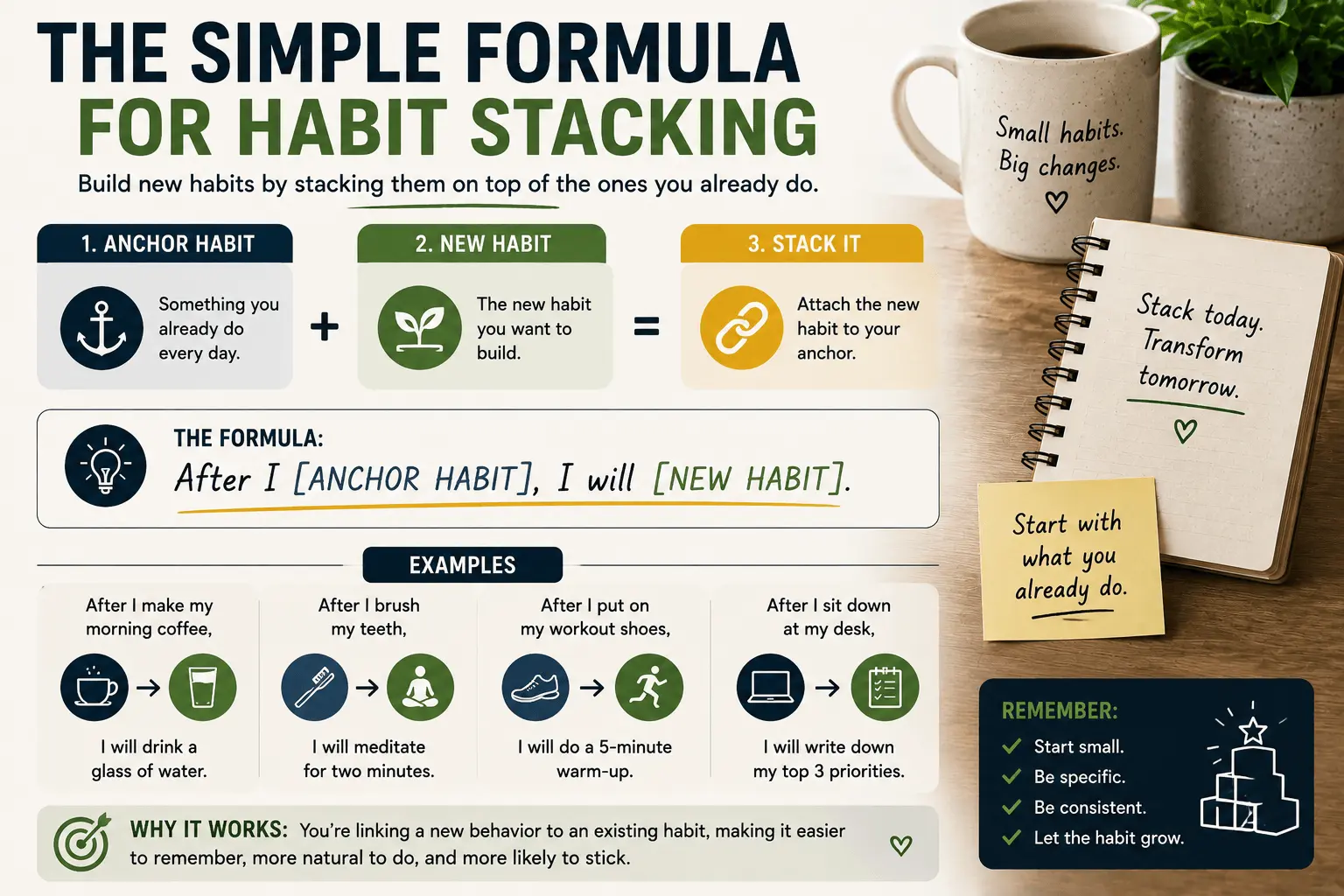
The basic habit stacking formula is straightforward.
After I [existing habit], I will [new habit].
That’s it. That’s the whole method.
The key is choosing the right existing habit. It needs to be something you do consistently, every day, without fail. Not something you wish you did consistently. Something you actually do.
Good anchors include brushing your teeth, making coffee, getting into bed, starting your car, sitting down at your desk, feeding a pet, taking a shower, opening your laptop, coming home from work. These are things that happen reliably, in the same context, every day. They’re already automatic. That makes them reliable triggers.
The new habit should be specific and small. “I’ll exercise” is too vague. “I’ll do five pushups” is clear. “I’ll read more” is fuzzy. “I’ll read one page” is precise. The more specific the behavior, the easier it is for your brain to execute it without deliberation.
Habit Stacking Checklist:
- Choose one existing habit as your anchor.
- Pick one new habit that’s small and specific.
- Write down your stack using the formula.
- Do the stack at the same time every day.
- Keep it going for at least two weeks before judging.
A written checklist can help during the first week or two, but the goal is for the stack to become automatic enough that you don’t need the checklist anymore. The existing habit triggers the new one. The sequence runs on its own.
The guide to building good habits that actually stick covers the specifics of starting small and scaling up over time. The stacking formula works best when the new habit is small enough that resistance is minimal.
Habit Stacking Examples for Everyday Life
Here are some habit stacking examples that have actually worked for me or people I know.
Morning stacks. After I pour my coffee, I will drink a glass of water. After I drink water, I will stretch for two minutes. After I stretch, I will write one sentence in my journal. Each habit triggers the next. The coffee maker anchors the entire chain.
Evening stacks. After I brush my teeth, I will floss. After I floss, I will wash my face. After I get into bed, I will read one page. After I read, I will close my eyes and take three deep breaths. The bathroom routine anchors the stack.
Workday stacks. After I sit down at my desk, I will write down my top priority for the day. After I finish lunch, I will walk for five minutes. After I close my laptop for the day, I will clear my desk. Small actions attached to existing work routines.
Exercise stacks. After I put on my running shoes, I will do five squats. After I finish my workout, I will drink a full glass of water. After I shower, I will lay out my clothes for the next day.
Mindset stacks. After I get into the car, I will think of one thing I’m looking forward to. After I check my phone in the morning, I will put it facedown for ten minutes. After I feel stressed, I will take three slow breaths.
In practice, stacks sometimes break. Many people find that a travel disruption or a busy week can interrupt the chain. The existing habit still happens, but the new one stops following automatically. The fix is usually simple. Rebuild the stack by doing it deliberately for a few days until the automatic connection reforms.
The guide on daily habits that improve your mindset has more examples of small mental habits that compound over time.
The stacking possibilities are endless. The only constraint is honesty about what you already do consistently. Build stacks around real routines, not idealized ones.
How to Build Your Own Habit Stack
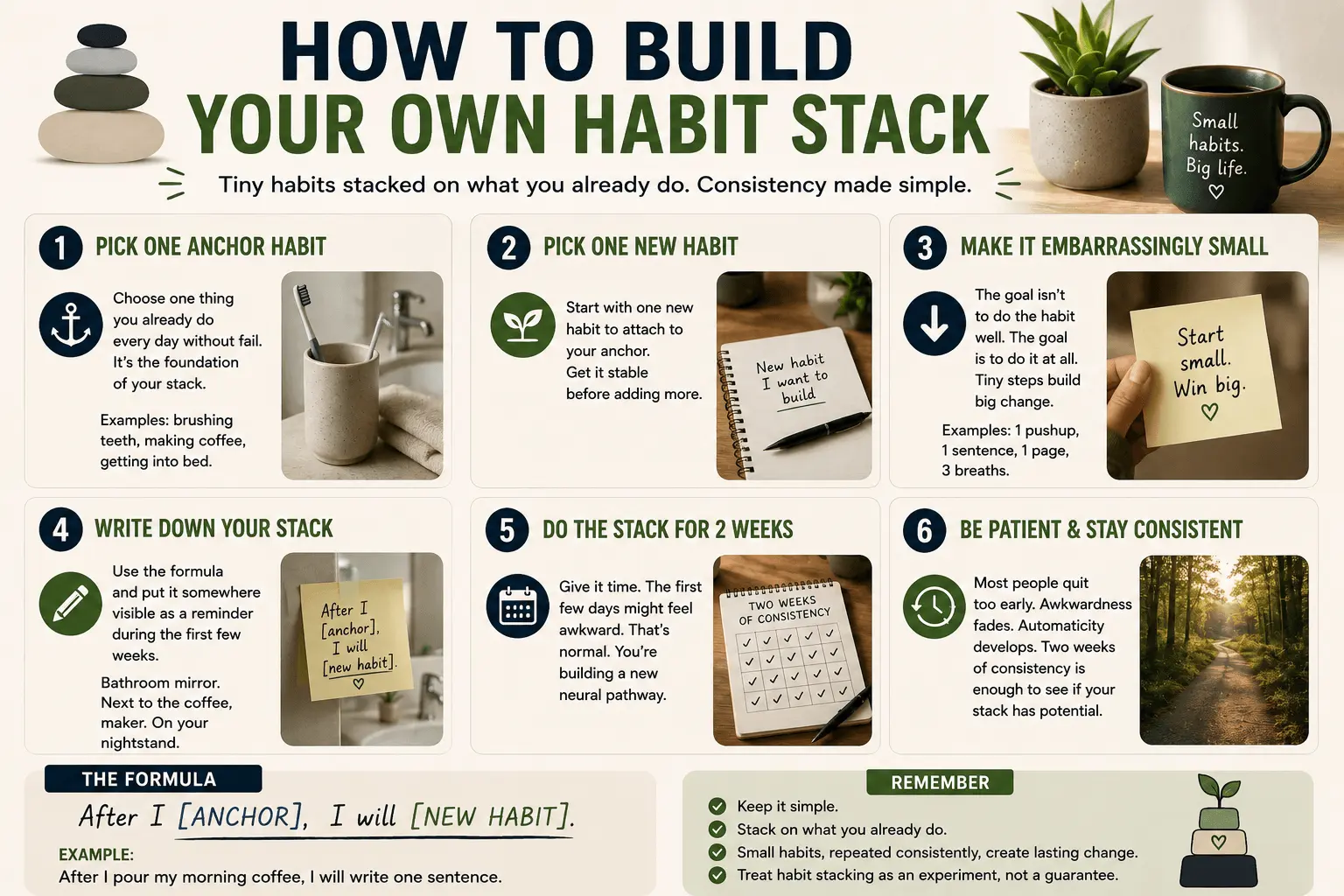
Building a habit stack is simple, but there are a few things that make the difference between stacks that work and stacks that fall apart.
Pick one existing habit as your anchor. Not three. Not five. One thing you do every day without fail. Brushing your teeth is the classic example because almost everyone does it and the context is identical every time. Making coffee works. Getting into bed works. Pick something reliable.
Pick one new habit to attach to it. Start with one. Adding multiple new habits to a single anchor can work eventually, but during the first week or two, simpler is better. Get one new habit stable before adding more.
Make the new habit embarrassingly small. The goal isn’t to do the habit well. The goal is to do it at all. One pushup. One sentence. One page. Three breaths. The smaller the habit, the less resistance you’ll feel, and the more likely you’ll actually do it.
Write down your stack using the formula. After I [anchor], I will [new habit]. Put the note somewhere visible. On the bathroom mirror. Next to the coffee maker. On your nightstand. The physical reminder helps during the first few weeks before the stack becomes automatic.
Do the stack for at least two weeks before evaluating whether it’s working. The first few days might feel awkward. That’s normal. You’re building a new neural pathway. Awkwardness isn’t a sign of failure. It’s a sign that the behavior hasn’t become automatic yet.
This is where people usually struggle. They try a stack for three days, it feels unnatural, and they abandon it. Give it time. The awkwardness fades. The automaticity develops. Two weeks of consistent practice is usually enough to tell whether the stack has potential. Different habits and different people respond differently, so treat habit stacking as an experiment rather than a guarantee.
Common Habit Stacking Mistakes
I’ve made all of these.
Choosing an anchor that isn’t actually consistent. In practice, many people try to stack a habit onto something like “after I finish my morning routine.” The problem is that morning routines vary wildly from day to day. The anchor wasn’t stable, so the new habit never found its footing. Pick something that happens the same way every day.
Trying to stack too many habits at once. The enthusiasm of a new system makes everything feel possible. After I brush my teeth, I will floss, and wash my face, and meditate, and stretch, and journal. By day three, the stack takes twenty minutes and feels like a chore. Start with one new habit. Add more slowly.
Making the new habit too big. After I get into bed, I will read for thirty minutes. That’s a significant time commitment. On tired nights, you’ll skip it. After I get into bed, I will read one page. That’s almost impossible to skip. Start small. Expand later.
Not writing down the stack. Many people find that stacks work beautifully for weeks and then fall apart after a vacation or a busy period. When they come back, they can’t remember the exact sequence. Writing it down creates a record you can return to when life disrupts the pattern.
Giving up too soon. Habit stacking feels deliberate at first. That deliberate feeling can be misinterpreted as “this isn’t working.” But deliberate is normal in the early stages. Automaticity takes time. The guide on why habit building fails for most people covers the timeline in more detail.
Habit Stacking vs Habit Tracking
These two methods often get mentioned together, but they serve different purposes.
| Habit Stacking | Habit Tracking |
|---|---|
| Builds habits | Measures progress |
| Uses existing cues as triggers | Uses logs and checklists |
| Best for starting new habits | Best for maintaining awareness |
| Reduces friction at the moment of action | Increases visibility over time |
| Doesn’t require ongoing documentation | Often uses streaks and visual records |
Habit stacking is about building the behavior. It answers the question “when will I do this new habit?” by attaching it to an existing routine. The goal is to make the behavior easier to remember and easier to start.
Habit tracking is about monitoring the behavior. It answers the question “am I actually doing this habit consistently?” by creating a visual record. The goal is awareness and accountability.
They work well together. You might use stacking to build a flossing habit by attaching it to brushing your teeth. Then you might use tracking to monitor whether you’re actually flossing each day during the first month while the habit is forming.
But they don’t depend on each other. You can stack habits without tracking them. You can track habits without stacking them. Stacking is about reducing friction at the moment of action. Tracking is about creating visibility over time.
The guide to using habit tracking effectively covers when tracking helps and when it doesn’t. If you’re using both methods, keep them simple. A stack written on a note card. A tracker with three to five habits. The tools should support the behavior, not become the main event.
Morning Habit Stacking
Morning routines are where habit stacking shines because mornings are full of automatic behaviors that can serve as anchors.
Waking up. Using the bathroom. Brushing teeth. Making coffee. Taking a shower. Getting dressed. Each of these is a potential trigger for a new habit.
A simple morning habit stacking routine might look like this. After I wake up, I will drink a glass of water. After I make coffee, I will stretch for two minutes. After I finish my coffee, I will write one sentence about what I want to get done today.
The stack flows naturally from one action to the next. Each existing habit triggers the new one. No alarms. No reminders. No motivation required.
The guide on building a success morning routine that works covers this in more detail, with specific examples of morning stacks that survive real life.
What I’ve noticed about morning stacks specifically is that they benefit from being front-loaded with the simplest possible actions. Drinking water takes ten seconds. Stretching takes two minutes. Writing one sentence takes thirty seconds. The stack feels easy because each individual action is easy. The cumulative effect, starting the day with three small wins before breakfast, is significant.
I could be wrong, but I think morning stacks work better than evening stacks for most people because willpower is higher in the morning. By evening, decision fatigue has accumulated, and adding new behaviors to an evening routine can feel harder. Morning stacks capitalize on fresh energy and stable routines.
How Habit Stacking Fits Into the Bigger Picture
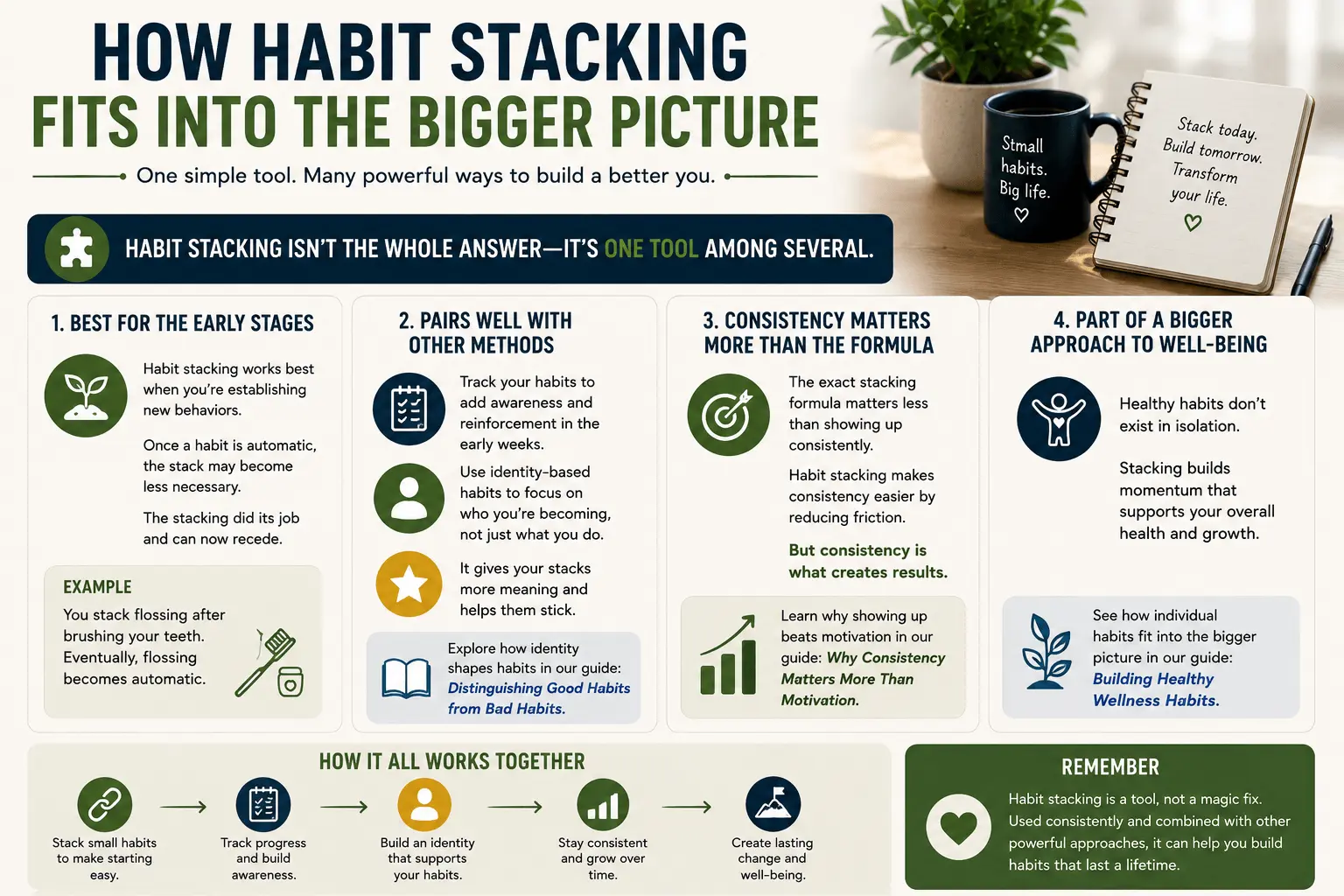
Habit stacking isn’t the whole answer to building habits. It’s one tool among several.
It works best for establishing new behaviors in the early stages before they become automatic. Once a habit is fully formed, the stack might become less relevant. You don’t need a trigger to take your vitamins anymore because your brain just knows to take them. The stacking did its job and can now recede.
Habit stacking pairs well with other methods. Tracking your habits while you stack them can provide additional reinforcement during the early weeks. Identity-based habits, where you focus on who you’re becoming rather than what you’re doing, can give stacking more meaning. The guide on distinguishing good habits from bad habits explores how identity shapes which behaviors stick.
Consistency matters more than the specific stacking formula you use. The guide on why consistency matters more than motivation explains why showing up matters more than feeling inspired. Habit stacking helps with consistency by making showing up easier, but the consistency itself is what produces results.
Building healthy habits through stacking is part of a broader approach to well-being. The guide to building healthy wellness habits covers how individual habits fit into a larger picture of health and growth.
What Research Says About Habit Stacking (Updated 2026)
The core ideas behind habit stacking have held up well as behavioral science has advanced. Reviews published through 2026 continue to support self-monitoring and implementation intentions as effective behavior-change strategies. Most evidence still comes from long-term behavioral psychology studies rather than entirely new discoveries, but the consensus has strengthened around several key points.
Researchers generally agree that habits become easier when they’re tied to stable environmental cues. Whether it’s called habit stacking, implementation intentions, or Tiny Habits, the principle is the same: reduce friction and repeat the behavior in a consistent context.
BJ Fogg’s Tiny Habits research, which popularized the idea of attaching small new behaviors to existing routines, continues to influence how researchers think about habit formation. The underlying principle, that behavior is most likely to occur when motivation, ability, and a prompt converge at the same moment, remains a foundational concept in behavior change.
Phillippa Lally’s research on automaticity, first published in 2009 and widely cited since, found that habit formation averages 66 days with wide individual variation. This reinforces the practical advice to stick with a habit stack for at least a few weeks before judging whether it’s working. The awkwardness of a new stack isn’t a sign of failure. It’s a predictable phase before automaticity develops.
Key Statistic: Research by Phillippa Lally found that habit formation takes 66 days on average, though timelines vary widely depending on the person and the behavior, ranging from 18 to 254 days.
Wendy Wood’s work on context stability and habitual behavior supports the stacking approach from a different angle. Her research finds that stable environmental cues are among the strongest predictors of whether a behavior becomes habitual. Habit stacking creates stable cues by design. Each new habit is anchored to an existing routine that happens in the same context every day.
Implementation intention research, led originally by Peter Gollwitzer, also aligns with habit stacking. Implementation intentions specify exactly when and where a behavior will occur using the format “If situation X occurs, I will perform response Y.” Habit stacking uses a similar structure. “After I do X, I will do Y.” The specificity bridges the gap between intention and action.
These observations line up closely with what researchers continue to find. James Clear’s popular writing on identity-based habits aligns with these research findings, even though his work is synthesis rather than primary research. While my own experience is anecdotal, it aligns with findings from behavioral psychology on cues, repetition, and stable routines. Stacking works because it addresses multiple barriers to behavior change simultaneously, reducing friction, creating clear cues, and borrowing existing automaticity.
Frequently Asked Questions About Habit Stacking
What is habit stacking in simple terms?
What is habit stacking? It’s attaching a new habit you want to build to an existing habit you already do automatically. You use the existing habit as a trigger for the new one. After I brush my teeth, I will floss. The existing habit does the remembering for you.
Is habit stacking backed by science?
Yes. The method draws on several established areas of behavioral psychology. BJ Fogg’s Tiny Habits research demonstrates that behaviors are most likely to occur when a prompt is linked to an existing routine. Implementation intention research by Peter Gollwitzer shows that specifying when and where you’ll act significantly increases follow-through. Wendy Wood’s work on context stability finds that consistent environmental cues are strong predictors of habit formation. While no single study uses the exact term “habit stacking,” the underlying principles are well-supported.
What is the best first habit to stack?
The best first habit is something so small it feels almost ridiculous. Drinking a glass of water after waking up. Doing one pushup after using the bathroom. Writing one sentence after making coffee. The key is picking something that takes less than two minutes and attaching it to an anchor that happens every day without fail. Success with one tiny stack builds confidence for adding more.
How many habits can I stack at once?
Start with one new habit attached to one anchor. Once that feels automatic, usually after a few weeks, you can add another habit to the chain. Trying to stack five new habits onto a single anchor almost always fails because the stack becomes too long and overwhelming.
What are the best anchor habits for stacking?
The best anchors are things you do every day without fail, in the same context. Brushing teeth, making coffee, getting into bed, starting your car, sitting at your desk, taking a shower. The key is consistency. If the anchor happens at the same time and place every day, it’s a good candidate.
How long does it take for a habit stack to become automatic?
There’s no fixed timeline. Simple stacks can feel automatic within two or three weeks. More complex stacks might take a couple of months. Research by Phillippa Lally suggests habits take an average of 66 days to become automatic, but the range is wide. Pay attention to whether the behavior feels natural rather than counting days.
Can I use habit stacking to break bad habits?
Yes, though it works slightly differently. Instead of stacking a new habit after an existing one, you can use stacking to replace a bad habit with a better one. After I feel the urge to scroll social media, I will read one page of a book instead. The cue is the urge. The new routine replaces the old one.
Does habit stacking work for evening routines?
Yes, though evening stacks can be harder to maintain because willpower tends to be lower at the end of the day. The key is keeping evening stacks extremely simple. After I get into bed, I will read one page. After I turn off the light, I will take three deep breaths. Small, low-effort actions work best in the evening.
Final Thoughts
Habit stacking is simple because it doesn’t ask you to be more disciplined or motivated or organized. It just asks you to notice what you already do and attach one small thing to it.
After I pour my coffee, I take my vitamins. That’s the whole method in a single sentence. Everything else is refinement.
If you’re starting from scratch, pick one anchor habit that happens every day. Pick one new habit small enough that skipping it would feel ridiculous. Write down the stack. Do it tomorrow. Then do it again the next day. Add more when the first stack feels automatic.
The complexity can come later. Right now, the goal is just to start.