

I used to think mindfulness meant sitting still for thirty minutes with an empty mind.
Every attempt went the same way. I’d sit down, close my eyes, and immediately notice how busy my head was. Thoughts about work. Things I forgot to do. Whether I was meditating correctly. The whole thing felt like failing at relaxation.
What eventually changed wasn’t a better meditation technique. It was realizing that mindfulness doesn’t require an empty mind. It’s about noticing what’s actually happening, including the noise, without getting completely carried away by it.
A mindfulness morning routine doesn’t need to look like a meditation retreat. It can be as simple as taking three deliberate breaths before checking your phone. Drinking your coffee without scrolling. Stepping outside and actually feeling the air for a minute. Noticing one thing you’d normally rush past.
This is what actually worked for me. A realistic version, not a zen ideal.
What a Mindfulness Morning Routine Actually Means
A mindfulness morning routine isn’t about achieving a particular state of mind. It’s about starting the day with a little more awareness and a little less autopilot.
Most mornings, most people wake up and immediately get pulled into input. Phone. Messages. News. Social media. The mental noise starts before your feet hit the floor. By the time you’re actually awake, your attention is already scattered across a dozen things that probably don’t matter.
A mindful morning routine is the opposite of that. It’s a few minutes of deliberate attention before the day’s demands take over. Just a small pause between waking up and getting swept away.
At least in my experience, the goal isn’t to feel peaceful every morning. It’s to notice what’s actually happening in your mind and body instead of reacting to it automatically. Some mornings that feels calm. Some mornings it just feels less chaotic. Both are worth it.
The guide on what habits are and how they work explains the cue-routine-reward loop that makes this kind of practice stick. The short version is that a consistent trigger, a simple behavior, and a small sense of completion are enough to build a habit.
Why Most People Struggle to Build a Morning Mindfulness Habit
A common reason morning mindfulness routines fail is that people make them too big.
They decide to meditate for twenty minutes every morning. Maybe journal three pages. Practice gratitude. Do breathing exercises. The whole thing takes forty-five minutes and feels like a chore by day three. Then life interrupts, they miss a morning, and the whole practice collapses.
The guide on why habit building fails covers this pattern in detail. Habits often fail because they’re too big and too rigid to survive real life.
Another reason people struggle is that they expect mindfulness to feel good immediately. They sit down, notice their thoughts racing, and conclude they’re doing it wrong. But noticing a racing mind isn’t failure. Noticing that you’ve become distracted is part of the mindfulness practice; you can then gently bring your attention back.
The tricky part is that mindfulness doesn’t produce obvious results right away. It’s cumulative. Five minutes of awareness today doesn’t feel like much. Five minutes most days for six months changes how you relate to your thoughts. The effects can be subtle, and they may become more noticeable with regular practice.
7 Mindfulness Morning Habits for Mental Clarity
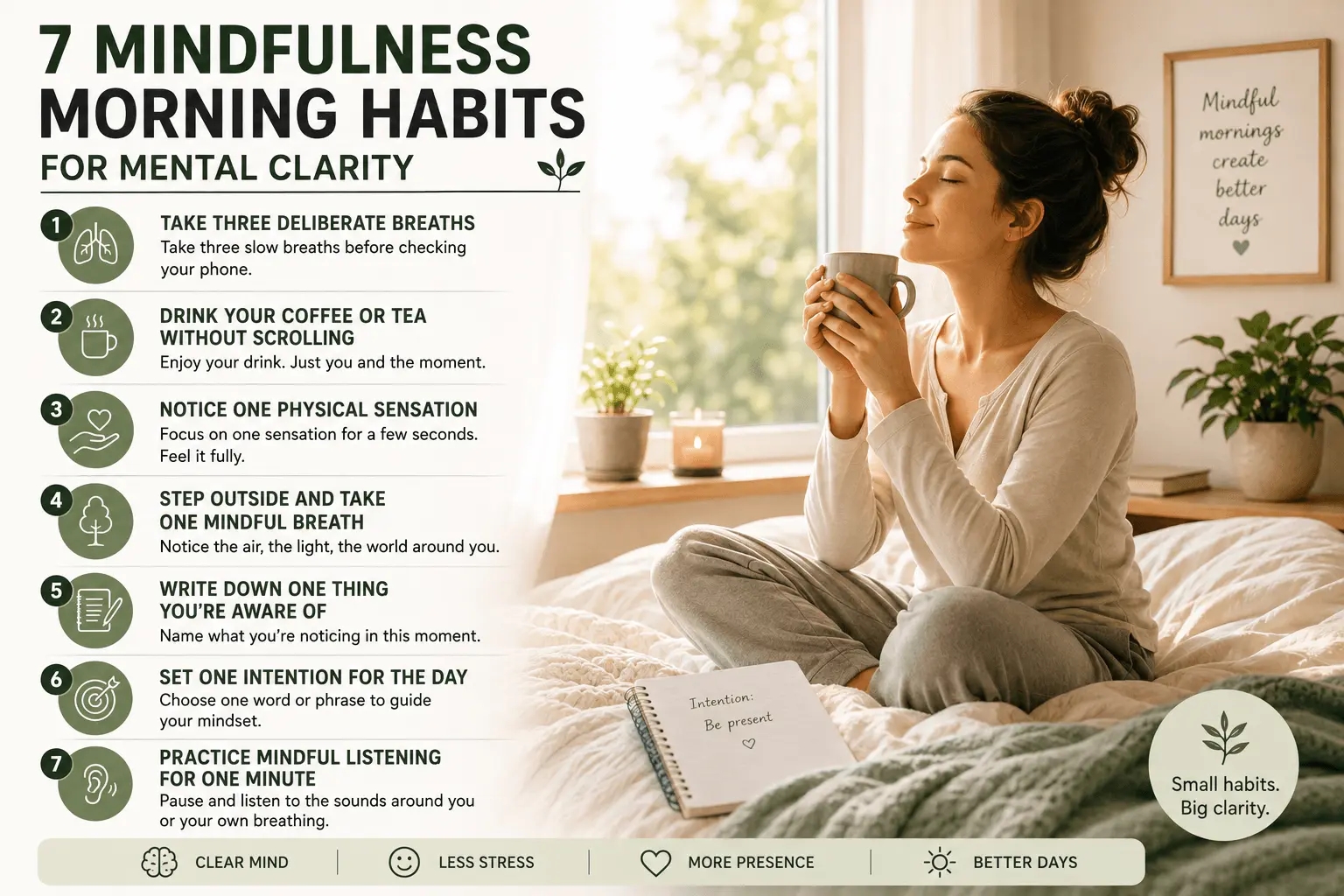
These seven habits form a simple mindfulness morning routine that you can adapt to your schedule. None of them require special training. None of them take more than a few minutes.
1. Take three deliberate breaths before checking your phone. This is the simplest mindfulness practice I know. Before you reach for your phone, take three slow breaths. Feel the air moving. Notice your body. That’s it. Thirty seconds of awareness before the input begins.
2. Drink your coffee or tea without scrolling. This one was harder than it sounds. The habit of drinking coffee while scrolling was deeply wired. What helped was leaving my phone in another room and just sitting with the mug. The first few mornings felt strange. Eventually it became one of the calmest parts of my day.
3. Notice one physical sensation. This could be the warmth of the shower. The texture of your clothes. The feeling of your feet on the floor. Pick one sensation and actually pay attention to it for a few seconds. It sounds trivial, but it pulls you out of your head and into your body.
4. Step outside and take one mindful breath. You don’t need a meditation cushion. Stand outside for sixty seconds. Notice the temperature. The light. The air. If you can’t get outside, stand by a window. The point is to connect with something real instead of starting the day entirely inside your head.
5. Write down one thing you’re aware of. Just one sentence about what you’re noticing. It could be something you’re feeling, something you’re thinking, or something in your environment. The act of naming your experience creates a small gap between you and your thoughts.
6. Set one intention for the day. How do you want to show up today? Patient. Focused. Kind. Present. Pick one word or phrase. Return to it during the day when you feel scattered.
7. Practice mindful listening for one minute. During breakfast or while getting ready, pause and just listen. The traffic outside. The birds. The hum of the refrigerator. Your own breathing. Most people go through entire mornings without actually hearing anything. One minute of listening reconnects you to the present.
For more on how these habits fit into a broader approach, see our guide to building healthy daily habits.
A Simple 10-Minute Mindfulness Morning Routine
Here’s a simple routine that takes about ten minutes and covers the basics. You don’t need to follow it exactly. Think of it as a starting point.
| Time | Practice | Purpose |
|---|---|---|
| 0–1 min | Three deliberate breaths | Pause before checking your phone |
| 1–3 min | Drink water or tea mindfully | Connect with a simple physical sensation |
| 3–5 min | Step outside or look out a window | Notice the environment without distraction |
| 5–7 min | Write one sentence of awareness | Name what you’re noticing |
| 7–9 min | Set one intention | Give the day a direction |
| 9–10 min | Mindful listening | Reconnect with the present moment |
Because every step is short, you can scale it down when the morning gets messy—on travel days, after poor sleep, or when you’re running late.
How to Build a Routine That Survives Real Life
Building a mindfulness routine that lasts requires a different approach than building one that looks good on paper.
Start with one habit. Not seven. One thing you’ll do tomorrow morning. Maybe it’s three breaths before checking your phone. Maybe it’s drinking coffee without scrolling. Pick the easiest one. Do it for a week before adding anything else.
The impulse to transform your entire morning is strong. You want to become a completely different person by Tuesday. That impulse is normal. It’s also why most routines don’t survive their first disruption.
For a detailed breakdown of this gradual approach, see how to build good habits that actually stick. The short version is that consistency matters more than completeness. One habit done every day beats seven habits done once.
Have a minimum version of your routine for chaotic mornings. Travel. Early meetings. Bad sleep. The minimum version might be one deliberate breath. That’s it. The minimum preserves the pattern. The pattern is what matters.
Learn how habits are formed and why context matters. When the context changes, the habit weakens. A minimum version bridges the gap.
Habit stacking makes a mindfulness routine even easier. We’ve explained the method in detail in what is habit stacking. The short version is that you attach each new habit to something you already do automatically. After I wake up, I take three breaths. After I make coffee, I drink it without my phone. The existing habit triggers the new one.
Common Mistakes When Starting a Morning Mindfulness Practice
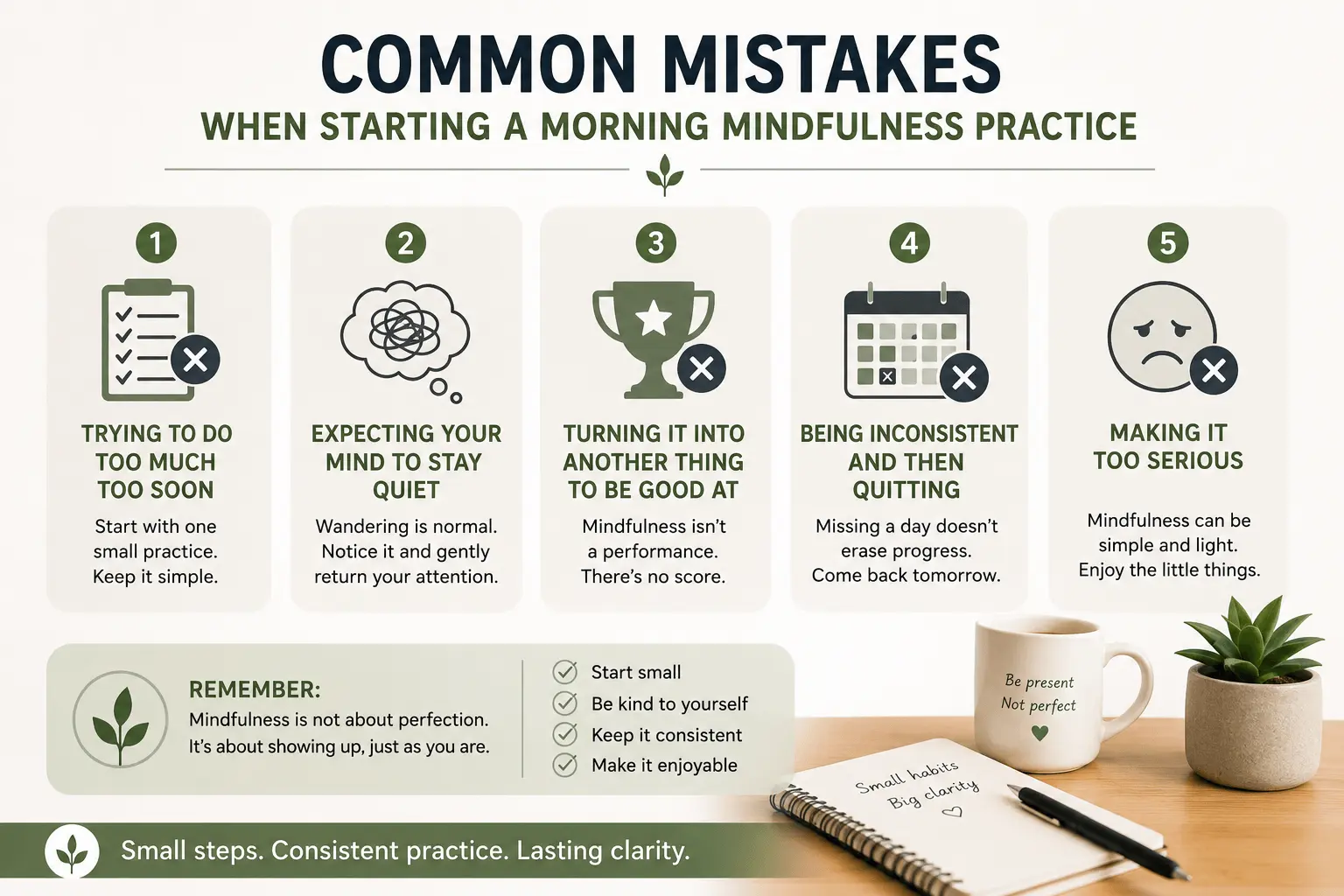
These are some of the mistakes that can derail a new mindfulness practice.
Trying to do too much too soon. Twenty minutes of meditation, journaling, gratitude practice, breathing exercises, all before breakfast. It’s too much. Start with one small practice.
Expecting your mind to stay quiet. Mindfulness doesn’t require a quiet mind. The practice is noticing when your mind wanders and gently returning your attention. The wandering isn’t failure. It’s the whole point.
Turning it into another thing to be good at. Mindfulness isn’t a performance. There’s no score. If you spend your practice judging whether you’re doing it right, you’re just thinking about mindfulness instead of practicing it.
Being inconsistent and then quitting. Miss a day and decide the whole thing is dead. Missing a day doesn’t erase the pattern. Come back tomorrow.
Making it too serious. Mindfulness can be light. Noticing your coffee. Feeling the air. Listening to birds. It doesn’t need to be solemn. The lightness is often what makes it sustainable.
For more on the mindset that makes this process easier, see why consistency matters more than motivation.
How to Practice Mindfulness Without Meditating
You don’t need to meditate to be mindful.
Meditation is a formal practice. Mindfulness is a quality of attention you can bring to anything. Drinking coffee. Walking to the car. Washing dishes. Brushing your teeth. Any activity can become a mindfulness practice if you do it with full attention instead of doing it while thinking about something else.
The phone is probably the biggest obstacle. It’s always there, offering an escape from the present moment. The habit of reaching for it is automatic. Breaking that autopilot doesn’t require meditation. It just requires noticing the impulse to reach for the phone and sometimes choosing not to.
I left my phone in another room during breakfast for a week. The first few mornings felt genuinely uncomfortable. My hand kept reaching for a pocket that wasn’t there. By the end of the week, the discomfort faded, and I started noticing things I’d been missing. The way the light hit the kitchen. The sound of the neighborhood waking up. The quiet.
For more on improving your mental health through daily habits, see improve mental health. The guide on mental health in the workplace covers how mindfulness practices carry into the workday.
Evidence & Sources: This article was reviewed in August 2026. It draws on general principles from mindfulness research and current mental well-being guidance from the National Institutes of Health (NIH) and the National Center for Complementary and Integrative Health (NCCIH). Mindfulness practices are associated with improvements in attention, stress management, and emotional regulation for many people, though individual responses vary. The recommendations here are intended as practical wellness habits, not as treatment for anxiety, depression, or other mental health conditions. If you’re experiencing persistent or severe symptoms, consider talking with a qualified healthcare professional.
Primary sources:
Frequently Asked Questions
What is the best mindfulness morning routine for beginners?
The simplest one. Three deliberate breaths before checking your phone. That’s it. Do that for a week before adding anything else. If that goes well, add one more small practice, like drinking your coffee without scrolling or stepping outside for a minute. The key is to keep each addition small enough that it doesn’t feel like a burden. A routine that takes two minutes and happens every day is more valuable than a thirty-minute routine that happens twice a week and then gets abandoned. If you miss a day, don’t start over or declare the whole thing a failure. Just return to the practice the next morning. The pattern matters more than any individual day.
Do I need to meditate to practice mindfulness?
No. Meditation is one form of mindfulness practice, but it’s not the only one. You can practice mindfulness while drinking coffee, walking to your car, washing dishes, or brushing your teeth. The key is bringing deliberate attention to whatever you’re already doing instead of doing it while your mind is somewhere else. If you enjoy formal meditation, it can be a useful part of a mindfulness morning routine. But if sitting still feels uncomfortable or impractical, you can still build meaningful awareness through everyday activities. Mindfulness is about how you pay attention, not about sitting in a particular posture.
How long should a mindfulness morning routine take?
It can take as little as one minute. Three deliberate breaths before checking your phone is a complete practice. One mindful sip of coffee counts. The length matters less than the consistency. A one-minute practice that happens every morning will do more over time than a twenty-minute practice that only happens when conditions are perfect. If you have more time, the ten-minute routine in this article is a good option. If you’re rushed, scale it down to thirty seconds. The goal isn’t to complete a checklist. It’s to create a small pause between waking up and getting swept into the day.
What if my mind keeps wandering during mindfulness practice?
That’s normal. That’s actually the practice. Noticing that your mind wandered and gently bringing your attention back is mindfulness. The mind wanders constantly. That’s what minds do. The practice isn’t about stopping the wandering. It’s about catching it sooner and returning your attention without self-criticism. Every time you notice you’ve drifted and come back, you’re strengthening the capacity for awareness. This is why people say mindfulness is like a muscle. You’re not failing when your mind wanders. You’re practicing.
Can mindfulness help with morning anxiety?
Many people find that mindfulness practices help reduce the intensity of anxious thoughts by creating some distance between themselves and their worries. Instead of being completely caught up in anxious thinking, you learn to notice it as an experience that comes and goes. This can make morning anxiety feel more manageable. However, mindfulness is not a treatment for anxiety disorders. If your anxiety is persistent, severe, or significantly affecting your daily life, consider talking with a healthcare professional. A mindfulness morning routine can be a helpful daily practice, but it works best alongside appropriate professional support when needed.
How do I practice mindfulness when I’m always rushed in the morning?
Have a minimum version that takes thirty seconds or less. One deliberate breath before you start the day is enough. You can also attach mindfulness to something you already do, like noticing the feeling of water on your hands while washing your face or paying attention to the first sip of coffee. The goal isn’t to add time to a rushed morning. It’s to bring awareness to moments that already exist. If you have more time on some mornings, do more. If you don’t, do the minimum. The pattern matters more than the duration.
Final Thoughts
A mindfulness morning routine isn’t about becoming a different person. It’s about starting the day with a little more awareness and a little less autopilot.
You don’t need to meditate for thirty minutes or journal three pages or create the perfect zen morning. You just need a few small moments of deliberate attention before the day’s demands take over. Three breaths before checking your phone. Coffee without scrolling. One physical sensation noticed. One sentence about what you’re aware of. One intention for how you want to show up.
Start small. Pick the easiest practice from this article and do it tomorrow morning. Let it become a habit before adding more. Have a minimum version for the days when everything feels rushed and chaotic. Missing a day doesn’t mean the practice is over. It just means you come back the next morning.
The goal isn’t a perfectly peaceful mind. It’s a mind that’s a little more aware of itself. A mind that notices when it’s spinning and can sometimes step back instead of getting completely carried away. That small shift, repeated most mornings over months and years, changes how you experience your days.
That’s enough. Start with one breath.