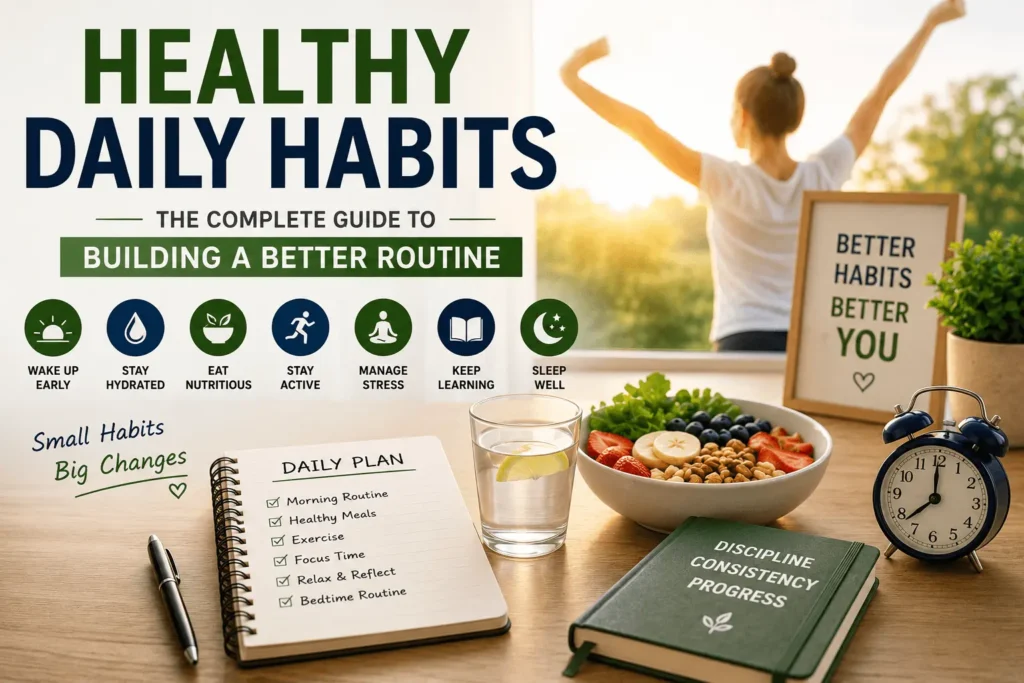
I’ve started more morning routines than I can count.
Some were elaborate. Wake up at 5 AM. Exercise for an hour. Meditate. Journal. Drink a green smoothie. The whole thing took two hours and made me feel like I was playing a character in someone else’s life. The routine collapsed the first time I had to catch an early flight. Then I felt guilty for weeks.
What eventually worked wasn’t a routine I admired. It was a routine I could actually do. Small things. Water first thing. A short walk at lunch. Going to bed at roughly the same time. Nothing impressive. Nothing Instagram-worthy. Just small, repeatable actions that fit into my actual life.
Healthy daily habits aren’t about optimizing every hour of your day. They’re about finding a handful of small behaviors that make you feel slightly better, physically and mentally, and doing them consistently enough that they become part of who you are.
This guide covers what I’ve learned from years of trying, failing, adjusting, and gradually improving. Not the perfect routine. The real one.
What Healthy Daily Habits Actually Are
Healthy daily habits are small behaviors repeated consistently that improve your physical or mental well-being over time.
Not elaborate routines. Not productivity systems. Not the optimized morning of a CEO with a personal chef and no commute. Just small things. Drinking water when you wake up. Moving your body for a few minutes. Going to bed at a consistent time. Eating something green. Stepping outside during the day. Putting your phone away before sleep.
What makes a habit healthy isn’t the activity itself. It’s the direction it moves you over time. A habit that improves your health, energy, mood, or capacity to handle stress is a healthy habit. A habit that depletes those things is not. The same behavior can be healthy for one person and neutral for another depending on context.
The guide on what habits are and how they work explains the mechanics behind why repeated behaviors become automatic. The short version is that your brain automates what you repeat in a stable context. Healthy daily habits are just the ones worth automating.
At least in my experience, the habits that actually last are rarely the ones that sound impressive. They’re the boring ones. The ones so small you barely notice them. Those are the ones that compound into something meaningful over months and years.
Why Most People Struggle to Build Healthy Habits
Most people don’t fail at building healthy habits because they’re lazy. They fail because they try to change too much at once.
A burst of motivation hits. Maybe it’s January. Maybe it’s a health scare. Maybe it’s just a random Tuesday when you decide things need to be different. You create an ambitious plan. Exercise six days a week. No more sugar. Wake up at 5 AM. Meditate daily. Journal every night.
The first week feels great. The second week feels harder. By week three, life has intervened. You miss a workout. You eat something you weren’t supposed to. You feel like you’ve failed. So you quit entirely and wait for the next burst of motivation.
This cycle is so common it’s almost universal. The guide on why habit building fails covers this pattern in detail. The short version is that most approaches to building habits rely on a level of motivation and consistency that real life doesn’t support.
Another reason people struggle is that they compare their routine to someone else’s. What works for a fitness influencer with no kids and a flexible schedule probably won’t work for a parent working two jobs. Context matters. The best routine is the one that fits your actual life, not someone else’s highlight reel.
The guide on understanding wellness explains how health habits fit into a broader picture of well-being that includes physical health, mental health, social connection, and purpose. Healthy habits support all of these. But they don’t need to address all of them at once.
The Foundation: Sleep, Movement, and Food
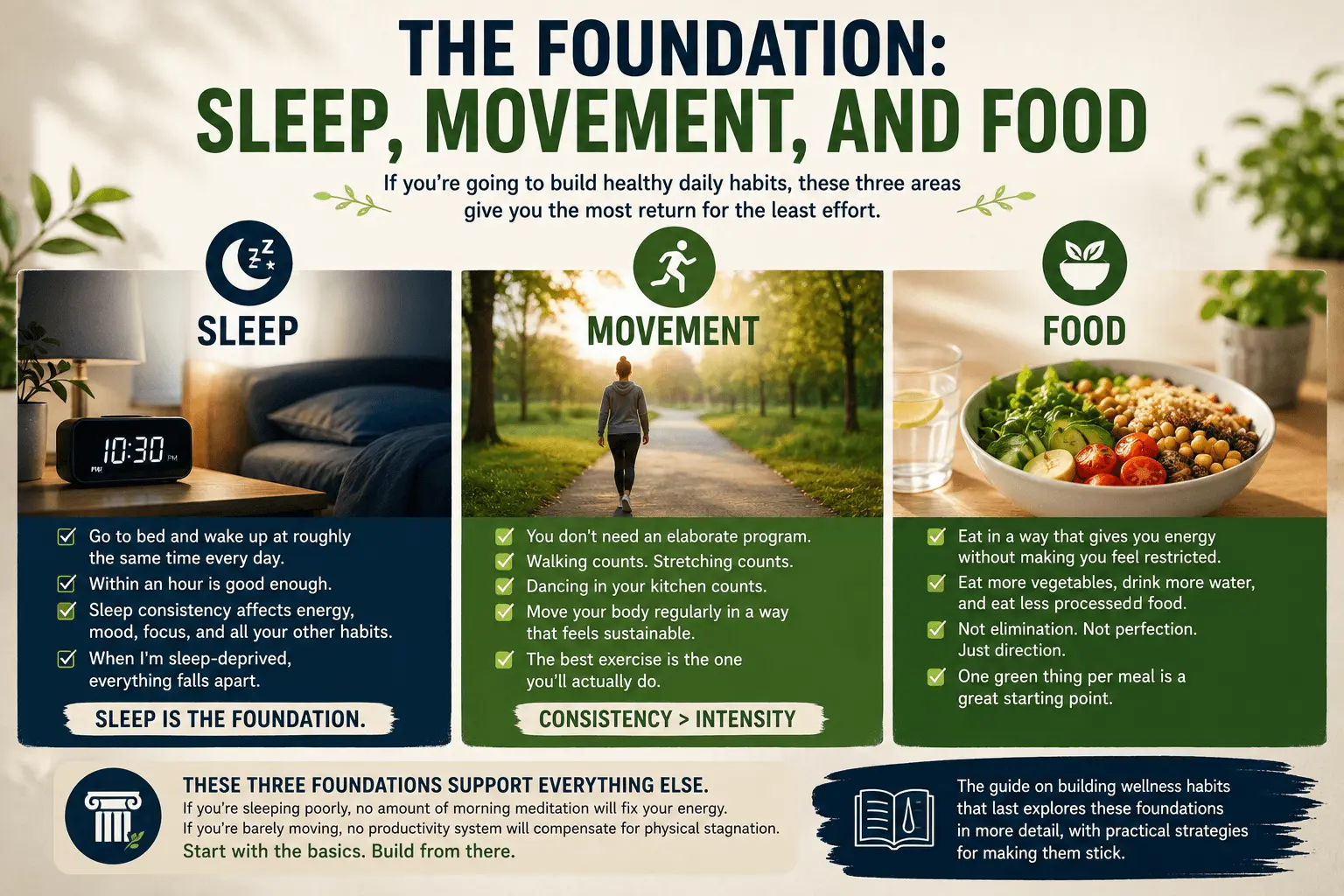
If you’re going to build healthy daily habits, these three areas give you the most return for the least effort.
Sleep. Going to bed and waking up at roughly the same time every day. Not exactly the same time down to the minute. Roughly. Within an hour. Sleep consistency affects energy, mood, cognitive function, and the ability to maintain other habits. When I’m sleep-deprived, everything else falls apart. My workouts suffer. My food choices worsen. My patience thins. Sleep is the foundation.
Movement. You don’t need an elaborate exercise program. Walking counts. Stretching counts. Dancing in your kitchen counts. The goal is to move your body regularly in a way that feels sustainable. The best form of exercise is the one you’ll actually do. For me, that’s walking. I’ve tried running. I’ve tried gym memberships. None of it stuck. Walking stuck.
Food. Eating in a way that gives you energy without making you feel restricted. For most people, this means eating more vegetables, drinking more water, and eating less processed food. Not elimination. Not perfection. Just direction. One green thing per meal is a good starting point.
These three foundations support everything else. If you’re sleeping poorly, no amount of morning meditation will fix your energy. If you’re barely moving, no productivity system will compensate for the physical stagnation. Start with the basics. Build from there.
The guide on building wellness habits that last explores these foundations in more detail, with practical strategies for making them stick.
Morning Habits That Start the Day Well
Morning habits set the tone. Not because mornings are magical. Because starting the day with a small win makes the next win slightly easier.
Drinking a glass of water first thing. You’re dehydrated after sleeping. Water takes thirty seconds and makes a noticeable difference in how you feel.
Not looking at your phone for the first ten minutes. This one took me years to figure out. I kept reaching for my phone automatically. What finally worked was charging it in another room. The friction of getting up to check it was usually enough to stop me. Those first ten minutes without external input feel different. Quieter.
Moving your body. Not a full workout. Just something. Stretching. A short walk. A few pushups. Something that tells your body the day has started.
Writing down one priority. Not a full to-do list. Just one thing you want to get done. The act of identifying a priority before the chaos begins makes it more likely to happen.
The guide on building a success morning routine covers morning habits in more depth, with specific examples of routines that survive real life.
What I’ve noticed is that the best morning habits are the ones that take less than five minutes and don’t require perfect conditions. They survive travel, disrupted sleep, and mornings when you’re running late. The minimum viable morning routine is better than the perfect one you never do.
Evening Habits That Improve Sleep and Recovery
Evening habits are underrated.
Most habit advice focuses on mornings. But what you do in the evening determines how you feel the next morning. Poor sleep undermines everything else.
Going to bed at a consistent time is the most impactful evening habit I’ve found. Not a strict bedtime enforced with military precision. Just a rough window. My body started getting tired at the same time every night without me having to force it.
Putting my phone away thirty minutes before bed. I charge it in another room now. The temptation to scroll isn’t there because the phone isn’t there. I read instead. Sometimes just a page. Sometimes more. The reading itself matters less than the absence of the phone.
Creating a short wind-down routine. Brushing teeth. Washing face. Reading a few pages. Taking three deep breaths. The sequence signals to my brain that the day is ending. Over time, the routine itself became the cue for sleepiness.
Keeping the room cool and dark. This isn’t a habit exactly. It’s environment design. But it makes all the other evening habits easier to maintain.
The tricky part with evening habits is that willpower is lower at the end of the day. Decision fatigue has accumulated. The key is keeping evening habits extremely simple and low-effort. One page of reading. Three deep breaths. The smaller the habit, the more likely it survives.
Healthy Mindset Habits
Physical health gets most of the attention in habit discussions. Mental habits matter just as much.
Noticing what went well. At the end of the day, thinking of one thing that went okay. Not a gratitude journal with three pages of reflection. Just one thing. This small practice shifts attention toward what’s working rather than what isn’t.
Taking breaks from input. Your brain needs time without new information. No podcasts. No music. No scrolling. Just quiet. Even five minutes makes a difference. I take a walk most days without headphones. The silence feels uncomfortable at first. Then it feels restorative.
Moving on from bad moments faster. A bad meeting. A frustrating interaction. A mistake. These things happen. The habit isn’t preventing them. It’s recovering from them more quickly. Noticing when you’re ruminating and deliberately shifting your attention to something else.
The guide on understanding mindset explores how mental frameworks shape behavior and how to shift them over time. Mindset habits work the same way as physical habits. Small repetitions. Stable context. Gradual change.
The guide on daily habits that improve your mindset has more specific examples of mental habits that compound.
How to Build Healthy Habits Without Relying on Willpower
Willpower is unreliable. It fluctuates. It depletes. If your habit strategy depends on feeling motivated every day, it will eventually fail.
What works instead is designing your environment so the healthy behavior is the easiest option.
Put a water bottle on your desk. You’ll drink more water without thinking about it. Put your running shoes by the door. You’re more likely to walk. Put fruit on the counter and snacks in a high cabinet. You’ll eat more fruit and fewer snacks. Charge your phone in another room. You’ll scroll less at night.
Environment design works because it doesn’t ask you to be disciplined. It asks you to be honest about what you’ll actually do when you’re tired, distracted, or unmotivated, and then set things up so even that version of you can follow through.
The guide on how to build good habits that stick covers environment design and other practical strategies in detail.
Start small. Make the habit so tiny that skipping it feels harder than doing it. One pushup. One page. One glass of water. The size of the habit matters less than the consistency. Once the pattern is established, you can expand it. But you can’t expand something you’ve already abandoned.
Habit Stacking for a Healthy Daily Routine
Habit stacking is the simplest method I’ve found for building multiple healthy habits without getting overwhelmed.
The idea is to attach a new habit to something you already do automatically. After I make coffee, I drink a glass of water. After I brush my teeth, I floss. After I get into bed, I read one page. The existing habit becomes the trigger for the new one.
The guide on what is habit stacking explains the method in detail with examples and a step-by-step guide.
A healthy daily routine built through stacking might look like this. After I wake up, I drink water. After I make coffee, I stretch for two minutes. After I finish lunch, I walk for five minutes. After I brush my teeth at night, I wash my face. After I get into bed, I read one page.
Each habit triggers the next. The chain flows naturally. You’re not trying to remember to do five different things at five different times. You’re just following the sequence.
The stacking possibilities are endless. The only constraint is honesty about what you already do consistently. Build stacks around real routines, not idealized ones.
Tracking Healthy Habits
Habit tracking can help during the early stages of building a new routine. It provides visual feedback. It creates awareness. It gives you a small reward each time you check a box.
The guide on how to track habits covers when tracking helps, when it doesn’t, and which methods work best.
Tracking works best when kept simple. A few habits on an index card. A checkmark each day. Nothing elaborate. The more complex the tracking system, the more likely you are to abandon it.
Tracking works less well when it becomes the goal. Checking a box feels productive even when the underlying behavior is hollow. The point isn’t the tracker. The point is the habit.
I track habits when I’m establishing them and stop once they feel automatic. For some people, tracking indefinitely is helpful. For others, it creates stress. There’s no right answer. Use tracking if it helps. Stop if it doesn’t.
Common Mistakes When Building Healthy Habits
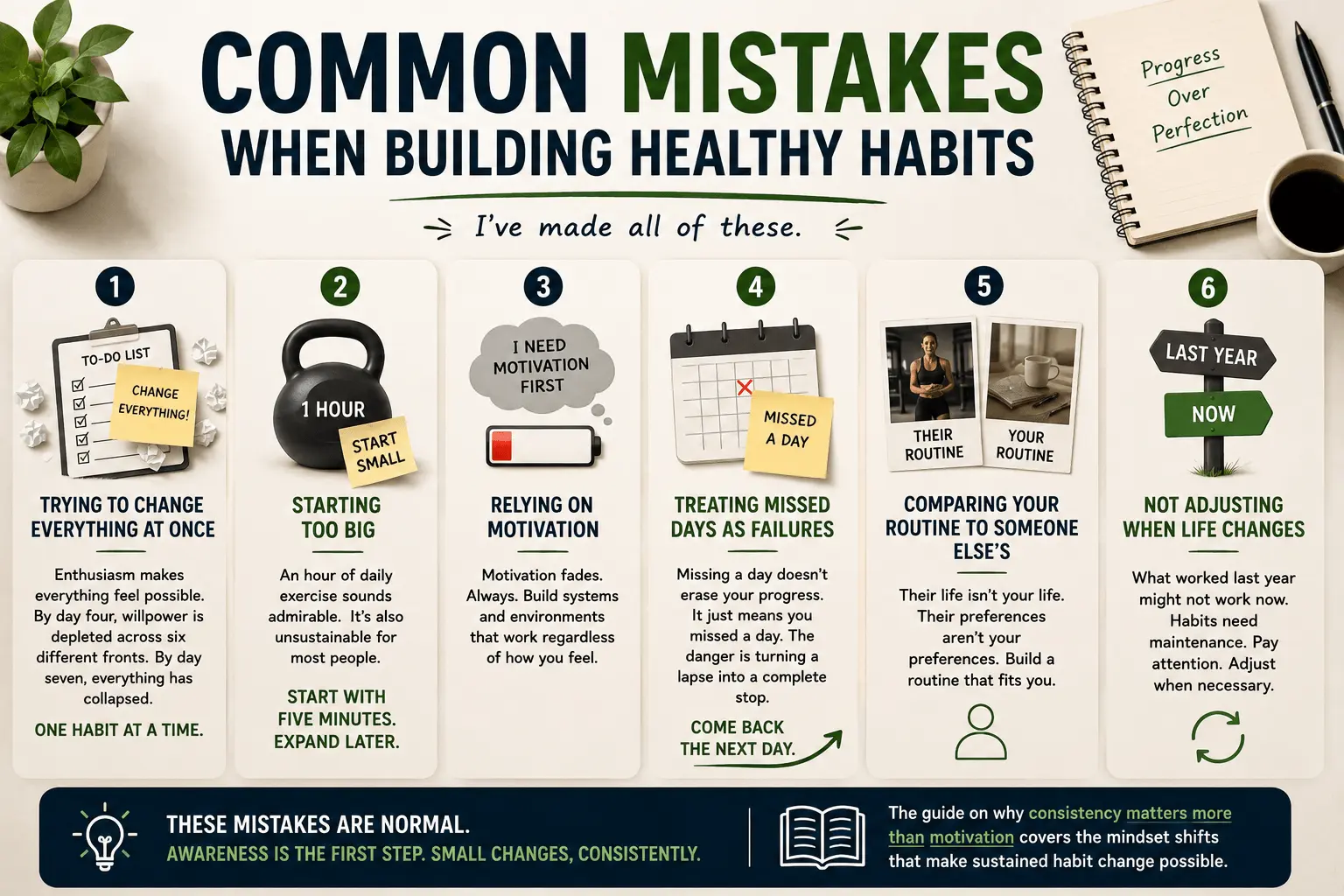
I’ve made all of these.
Trying to change everything at once. Enthusiasm makes everything feel possible. By day four, willpower is depleted across six different fronts. By day seven, everything has collapsed. One habit at a time.
Starting too big. An hour of daily exercise sounds admirable. It’s also unsustainable for most people. Start with five minutes. Expand later.
Relying on motivation. Motivation fades. Always. Build systems and environments that work regardless of how you feel.
Treating missed days as failures. Missing a day doesn’t erase your progress. It just means you missed a day. The danger is turning a lapse into a complete stop. Come back the next day.
Comparing your routine to someone else’s. Their life isn’t your life. Their preferences aren’t your preferences. Build a routine that fits you.
Not adjusting when life changes. What worked last year might not work now. Habits need maintenance. Pay attention. Adjust when necessary.
The guide on why consistency matters more than motivation covers the mindset shifts that make sustained habit change possible.
Sample Healthy Daily Routine
This isn’t a prescription. It’s an example of what a flexible, realistic routine might look like. Take what fits. Ignore the rest.
Morning. Wake up. Drink a glass of water. Make coffee. Stretch for two minutes while it brews. Write down one priority for the day. No phone for the first ten minutes.
Throughout the day. Walk at lunch, even for five minutes. Keep a water bottle visible. Eat something green with at least one meal. Stand up and move every hour.
Evening. Put phone away thirty minutes before bed. Brush teeth and wash face. Read one page. Take three deep breaths. Lights out around the same time each night.
That’s it. Nothing extreme. Nothing that requires perfect conditions. Just small, repeatable actions that compound over time.
Frequently Asked Questions
What are the most important healthy daily habits?
Sleep consistency, regular movement, and eating in a way that gives you energy. These three foundations support everything else. If you’re sleeping poorly, barely moving, and eating mostly processed food, no amount of morning meditation or productivity techniques will compensate. Start with the basics.
How long does it take to build a healthy habit?
There’s no fixed timeline. Research by Phillippa Lally suggests an average of 66 days, but the range is wide. Simple habits form faster. Complex ones take longer. Rather than counting days, pay attention to whether the behavior is starting to feel automatic. When you don’t have to talk yourself into it, the habit is probably formed.
How many healthy habits should I build at once?
One. Maybe two if they’re very small and naturally complementary. More than that almost always fails because willpower gets divided too thin. Get one habit stable before adding another.
What if I keep failing at the same habit?
The habit is probably too big, too vague, or attached to the wrong cue. Make it smaller. Make it more specific. Attach it to something you already do consistently. And consider whether you actually want the habit or just feel like you should want it.
Do I need to follow the same routine every day?
No. Flexibility is more sustainable than rigidity. Have a full version for good days and a minimum version for hard days. Both versions preserve the pattern. The pattern is what matters.
Can I build healthy habits without tracking them?
Yes. Many people build lasting habits without ever using a tracker. Tracking is a tool, not a requirement. If it helps, use it. If it creates stress, skip it. The behavior matters more than the documentation.
Final Thoughts
Healthy daily habits aren’t about perfection. They’re about direction.
You don’t need to wake up at 5 AM, exercise for an hour, meditate, journal, drink a green smoothie, and read thirty pages before breakfast. You need to find a few small things that make you feel slightly better and do them most days.
Pick one thing. Make it small enough that skipping it feels harder than doing it. Do it tomorrow. Then do it again. Add more when the first habit feels automatic. Let the routine bend when life gets messy.
The goal isn’t a perfect routine. It’s a routine that’s yours.