
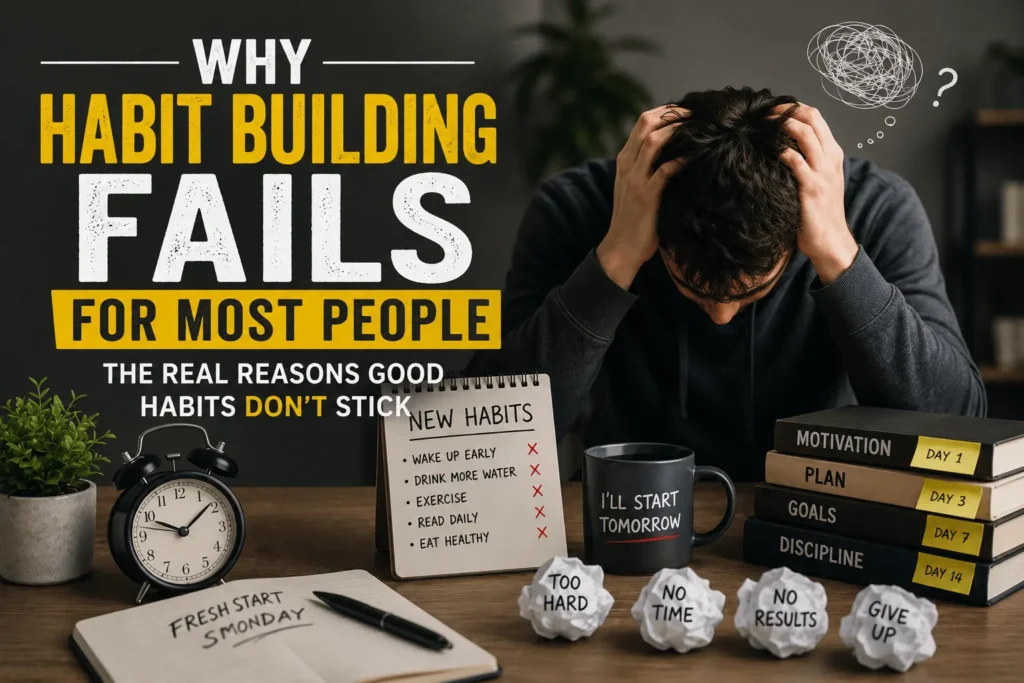
Why habit building fails for most people: Most habits fail because they’re too large, rely on motivation instead of systems, lack consistent cues, don’t provide immediate rewards, and aren’t designed to survive real-life interruptions. The good news is that each of these problems has a fix.
Most habits don’t fail because people are lazy. They fail because life gets in the way.
I’ve abandoned more habits than I’ve kept. Morning routines that lasted three days. Exercise plans that survived two weeks. Journaling streaks that ended the moment my schedule got busy. For a long time I assumed each failure meant something about me. That I lacked discipline. That I didn’t want it enough.
Eventually I started paying attention to the patterns. Why did some habits collapse while others, sometimes the ones I cared about less, managed to survive? The more I looked, the more I realized that most habit-building failures follow the same few scripts. The problem wasn’t me. The problem was how I was approaching the whole thing.
Why habit building fails for most people isn’t some mystery. It comes down to a handful of predictable mistakes that almost everyone makes at some point. Once you see them, you can’t unsee them. And once you understand them, you can finally do something different.
This article is about what I’ve learned from all those failures. Not the motivational version. The honest one.
Why Most Habit-Building Advice Misses the Point
Most advice about building habits assumes life stays predictable. Wake up at the same time every day. Follow the same routine. Protect your schedule. Stay consistent.
Real life doesn’t work like that.
You get sick. Work gets chaotic. Family needs you. You travel. You have a bad week where just getting through the day feels like enough. The perfectly designed routine that looked so good on paper collapses the moment something unexpected happens.
What I’ve noticed is that the people who successfully build habits aren’t the ones with the most elegant systems. They’re the ones whose habits are flexible enough to survive disruption. They have a version of the habit for good days and a smaller version for hard days. They miss a workout and come back the next day instead of waiting until Monday. They’ve accepted that consistency doesn’t mean perfection.
The reason habit building fails for so many people isn’t that they don’t care enough. It’s that they’re trying to build habits designed for a life that doesn’t exist. A life with no interruptions, no low-energy days, and no competing priorities. When reality collides with that ideal, the habit usually loses.
Understanding the science behind why habits work and how they form helps. The guide on how habits are formed walks through the underlying mechanics in detail, including how the habit loop works and why automaticity matters. But knowing the mechanics isn’t enough if you keep falling into the same traps. Let me walk through the most common ones.
Why Motivation Isn’t Enough to Build Lasting Habits

For years I thought motivation was the problem.
If I could just want it badly enough. If I could just find the right video or quote or burst of inspiration. Then I’d finally stick with it.
The problem with motivation is that it’s temporary. It shows up unpredictably and leaves without warning. Some mornings you wake up ready to conquer the day. Some mornings you can barely get out of bed. If your habit only happens on the motivated mornings, it’s not a habit. It’s a mood-dependent activity.
Motivation gets you started. Systems keep you going. That’s not just a catchy phrase. It’s the single most important distinction I’ve learned about habit building, and it’s backed by a growing body of behavioral research. Recent systematic reviews on habit formation, including studies published through 2025, continue to find that environmental design and stable cues predict long-term adherence better than motivation alone. Researchers still debate exactly why self-control fluctuates from day to day, but the practical takeaway is consistent. Willpower is unreliable as a primary strategy.
A system is something that works regardless of how you feel. It doesn’t require you to be inspired or energized or optimistic. It just requires you to follow the structure you’ve already put in place. The structure does the heavy lifting. You just show up.
The tricky part is that building a system feels less exciting than riding a wave of motivation. Systems are boring. They don’t give you that rush of “this time everything will be different.” But they’re also reliable in a way that motivation never is.
This is where people often get stuck. They keep trying to solve a systems problem with more motivation. But motivation is a feeling. Feelings change. Systems are a structure. Structures remain.
The Habit Is Too Big From the Start
I’ve done this more times than I can count.
Decide to start exercising. Create a plan that involves six days a week, an hour per session. Buy new equipment. Feel amazing for the first few days. Then miss a day because I’m exhausted. Then feel guilty. Then miss another day. Then quit entirely.
The habit didn’t fail because exercise is impossible. It failed because I started with a version that required more willpower than I had available.
When a habit feels overwhelming, your brain resists it. Every time you think about doing the thing, there’s a small moment of dread. Over time, that dread accumulates. Eventually you start finding reasons to skip. Not because you’re lazy, but because the emotional cost of doing the habit has become higher than the perceived benefit.
The fix is embarrassingly simple. Make the habit so small that it feels almost ridiculous. One pushup instead of fifty. One sentence instead of a page. Sixty seconds of meditation instead of twenty minutes.
BJ Fogg’s research on Tiny Habits, which I encountered years after I’d already started experimenting with this approach, formalizes what I’d stumbled onto through trial and error. Behavior happens when motivation, ability, and a prompt converge. If a behavior feels too hard, motivation alone usually can’t compensate. The solution is to make the behavior so small that the ability requirement drops to nearly zero. One pushup requires almost no ability. Fifty requires a lot. The smaller version actually gets done.
This sounds like it shouldn’t work. But the point isn’t the one pushup. The point is showing up. Each time you complete the behavior, you’re reinforcing the identity of someone who does the thing. The neural pathway strengthens. The resistance decreases. Once the habit is established, you can expand it. But you can’t expand something you already abandoned.
I wish I’d learned this earlier. I wasted years starting too big and quitting. The habits that actually stuck were the ones I started small enough that failure felt harder than success.
You Never Defined a Clear Cue
Vague intentions are habit killers.
“I’ll exercise more.” When? Where? Triggered by what?
“I’ll read every day.” At what time? In what location? After what existing habit?
Without a specific cue, the behavior has nothing to anchor to. Your brain doesn’t know when to initiate the routine, so it doesn’t. The habit exists as a wish rather than a plan.
Cues trigger habitual behavior. That’s how the habit loop works. The guide on what habits are and how they work explains the full cue-routine-reward structure, but the short version is this: if you don’t know exactly when and where a habit will happen, it probably won’t.
Peter Gollwitzer’s work on implementation intentions shows this clearly. People who specify exactly when and where they’ll perform a behavior are significantly more likely to follow through than those with vague goals. The formula is simple: “If [cue] happens, then I will do [behavior].” That specificity turns a wish into a plan.
The habits that formed fastest in my life all had obvious triggers. I take vitamins because they’re next to the coffee maker. I floss because the floss is visible next to my toothbrush. I walk at lunch because the clock hits noon and my body knows that means go outside.
The trick is attaching the new behavior to something you already do consistently. Not something you wish you did consistently. Something you actually do every day without fail. Brushing teeth. Making coffee. Getting into bed. Those are reliable anchors. “When I have time” is not.
Habit stacking techniques work because they borrow the automaticity of an existing habit and attach a new behavior to it. The existing habit becomes the cue. No need to remember. No need to decide. The trigger is already there.
The Reward Is Too Delayed or Missing Entirely
Good habits often have a timing problem.
The effort is immediate. The reward is delayed. Exercise feels hard today. The results show up weeks or months from now. Saving money feels like deprivation. The security accumulates invisibly.
Bad habits work in reverse. The reward is immediate. The cost is delayed. Scrolling feels good right now. The lost sleep and scattered attention show up tomorrow. Junk food tastes great in the moment. The health consequences arrive years later.
Your brain is wired to prioritize immediate rewards over delayed ones. This isn’t a character flaw. It’s how the dopamine system works. If a behavior doesn’t produce some kind of satisfying outcome relatively quickly, your brain is less likely to encode it as worth repeating.
Rewards reinforce habits. Without a reward, the cue-routine loop doesn’t close. The brain has no reason to remember the sequence as something worth repeating. The behavior stays effortful forever instead of becoming automatic.
This is why so many positive habits fail. You’re asking your brain to do something effortful with no immediate payoff and a promise that maybe in six months you’ll feel better. That’s a hard sell.
What helped me was building artificial rewards into the process. Listening to a podcast I enjoy only while exercising. Checking off a box after completing the habit and enjoying that small sense of completion. Making the behavior itself more pleasant rather than waiting for distant results.
For a deeper look at how to structure habits so they actually stick, the guide on how to build good habits covers the practical side in more detail.
Why Habit Building Fails for Most People: Trying to Change Too Much at Once
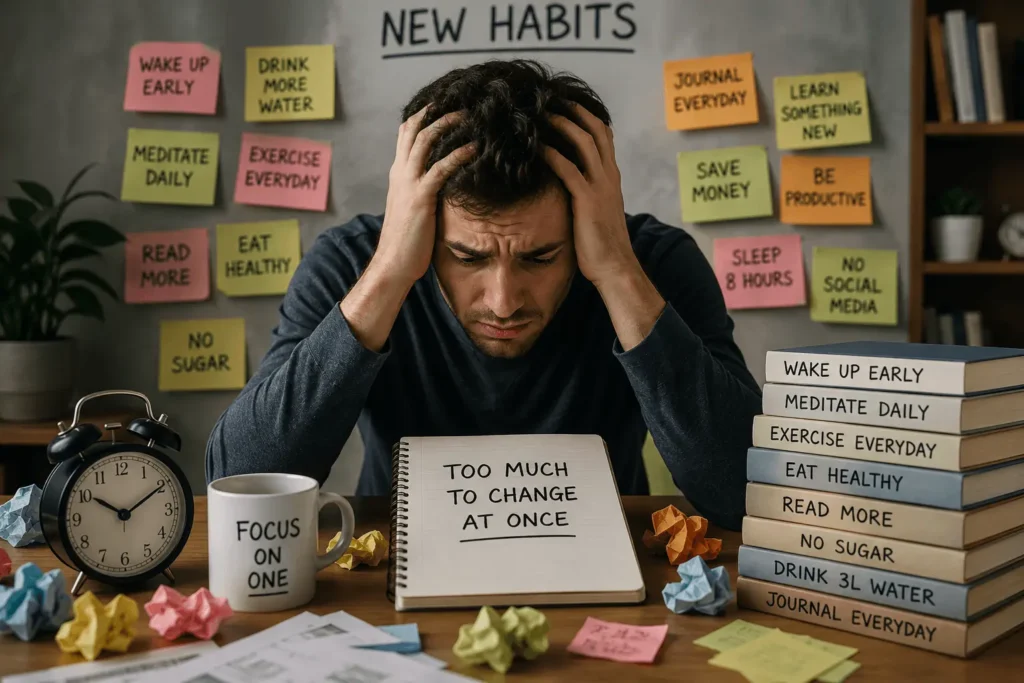
This might be the most common reason habits fail, and I’ve fallen into it more times than I can count.
Something triggers a burst of motivation. Maybe it’s January. Maybe I just read a good book. Suddenly I want to fix everything. Exercise daily. Eat perfectly. Wake up at 5 AM. Meditate. Journal. Read more. Stop scrolling. Call my parents more often. Learn a language.
The first few days feel incredible. I’m finally becoming the person I want to be. Then Wednesday arrives. I’m exhausted. My willpower is depleted across six different fronts. By Friday I’ve dropped everything and feel worse than before I started.
The problem isn’t that any individual change was too hard. It’s that willpower is a limited resource, and spreading it across multiple new behaviors simultaneously guarantees that something will break. Usually everything breaks.
Build one habit at a time. That’s the advice I ignored for years because it felt too slow. I wanted transformation. I wanted to wake up as a completely different person. But slow and steady actually works, while fast and ambitious usually doesn’t. This is one of the most consistent findings in behavior change psychology. Long-term habit success comes from accumulation, not from dramatic overhauls.
I still catch myself wanting to overhaul everything at once. The impulse never fully goes away. The difference now is that I recognize it as a warning sign rather than a sign of commitment. Real change happens through accumulation, not revolution.
Unrealistic Expectations Make People Quit Early
This one doesn’t get talked about enough.
People expect to feel different after two weeks. They expect visible results after a month. They expect the habit to feel automatic after twenty-one days. When none of those things happen, they conclude it’s not working and quit.
I’ve done this. Started a workout routine, looked in the mirror after two weeks, saw no difference, and felt like an idiot for trying. The rational part of me knew that physical changes take months. But the emotional part wanted proof that the effort was worth it. When the proof didn’t arrive on my timeline, I stopped.
The gap between expectation and reality is where a lot of habits die. Phillippa Lally’s widely cited study found that habit formation averaged 66 days, but the range was enormous, from 18 to 254 days. The 21-day myth, which traces back to a plastic surgeon’s observations in the 1950s, has nothing to do with how long habits actually take to form. Yet people internalize that number and feel like failures when they still need effort on day 22.
Wendy Wood’s research at USC estimates that about 43% of daily behaviors are performed habitually. The other 57% require some degree of conscious effort. Even after a habit becomes relatively automatic, it still requires maintenance. It’s not a finish line you cross. It’s a behavior you sustain.
Expecting a habit to feel effortless after a few weeks is like expecting to speak a new language fluently after a few lessons. The timeline is wrong. Adjusting expectations doesn’t make the process easier, but it does make you less likely to quit when the process takes longer than you hoped.
You Treat Lapses Like Complete Failures
Missing a day feels like proof that you can’t do it.
I’ve abandoned habits simply because I missed two days in a row and the streak was broken. The number going back to zero felt like a judgment. If I couldn’t be perfect, what was the point?
This is where people usually struggle. The all-or-nothing mindset turns a small lapse into a complete stop. Miss one workout and you’ve “fallen off the wagon.” Miss three days of journaling and the habit feels dead. The clean streak is gone, so you might as well give up entirely.
But streaks don’t matter. What matters is whether you come back.
Consistency is more important than perfection. That sounds like a platitude, but it’s actually the most practical habit-building advice I know. Missing a day doesn’t erase the neural pathways you’ve built. It doesn’t undo the weeks or months of previous effort. It just means you missed a day. The habit isn’t gone. It’s just waiting for you to resume.
The people who successfully build habits aren’t the ones who never miss. They’re the ones who miss and come back quickly. They treat a lapse as a single data point rather than a permanent verdict on their character.
I’ve learned to expect lapses now. They’re not a sign that something is wrong. They’re a normal part of having a life that doesn’t always cooperate with my intentions. The only real failure is deciding that one missed day means the whole thing is over.
Self-Compassion: Why Recovery Matters More Than Perfection
Here’s something that took me a surprisingly long time to figure out.
People don’t quit because they miss a day. They quit because of how they feel about missing a day. The guilt. The frustration. The inner voice that says “see, you can’t even do this.” That emotional reaction is often more damaging than the missed day itself.
I’ve noticed this pattern in myself and in conversations with friends. Someone misses a workout and spends the rest of the day feeling guilty. The guilt drains energy. The next day, they still feel bad, so they skip again. By day three, the habit feels tainted. By day four, they’ve decided to “start over next week.” The missed day wasn’t the problem. The self-judgment was.
Research on behavior change increasingly supports what psychologists call self-compassion in habit formation. People who respond to lapses with curiosity rather than criticism, asking “what happened?” instead of “what’s wrong with me?”, are significantly more likely to resume the behavior. Recovery speed matters more than perfect consistency.
This isn’t about letting yourself off the hook. It’s about recognizing that berating yourself doesn’t improve outcomes. It just makes the process more painful than it needs to be. The goal isn’t to never miss. The goal is to miss less often over time and to come back faster when you do.
For a broader look at how perfectionism undermines healthy routines, the guide on common wellness mistakes explores how all-or-nothing thinking creates cycles people get stuck in for years.
Your Environment Works Against You
I used to think willpower was the answer to everything.
If I couldn’t stick with a habit, I just needed more discipline. Try harder. Be stronger. Resist more.
What I didn’t appreciate was how much my environment was shaping my behavior without me noticing. The phone on the nightstand. The snacks on the counter. The TV remote in arm’s reach. Every object in my physical space was either making good habits easier or harder, and I wasn’t paying attention to any of it.
Environment shapes your habits more than motivation ever will. If your surroundings are set up for the behaviors you don’t want, you’re going to keep doing those behaviors regardless of how motivated you feel. The cues are too strong. The friction is too low. The path of least resistance leads exactly where you don’t want to go.
The fix is to remove friction from good habits and increase friction for bad habits. Make the behaviors you want so easy they’re almost automatic. Make the behaviors you don’t want inconvenient enough that they require a deliberate decision.
I moved my phone charger to the other side of the bedroom. That single change reduced my nighttime scrolling more than any amount of self-discipline ever did. The phone still worked. I could still scroll if I wanted to. But now it required getting out of bed, and most nights I’d rather just stay under the covers.
Behavioral intervention research published in recent years has strengthened the case for environmental design. Implementation intentions and choice architecture, structuring the environment so the desired behavior is the default option, consistently outperform approaches that depend primarily on motivation or willpower. The evidence isn’t settled on every mechanism, and different strategies work better for different people. But the general direction is clear. Changing your surroundings is often more effective than trying to change yourself directly.
This also applies to digital environments. Notification settings, app placement on your home screen, and whether your phone is visible while you work all affect behavior in ways that feel invisible until you change them. The notifications you never turned off are an environment problem, not a willpower problem.
Your Identity Hasn’t Shifted Yet
This is the one that took me the longest to understand.
When a habit is just something you’re “trying to do,” it lives in the part of your brain that requires conscious effort. You have to decide every day whether you’ll do it. You have to weigh the pros and cons. You have to overcome resistance.
When a habit becomes part of your identity, the decision disappears. You don’t decide to brush your teeth. You just do it because you’re someone who brushes their teeth. The behavior flows from who you believe you are.
Identity-based habit change works differently than behavior-based change. Instead of focusing on what you want to achieve, you focus on who you want to become. Not “I want to write a book” but “I’m the kind of person who writes.” Not “I want to run a marathon” but “I’m a runner.” The behavior becomes evidence for the identity rather than a chore you’re supposed to do. This cycle, identity leading to behavior leading to evidence that reinforces identity, is what makes the approach sustainable.
Most habit-building efforts stay in the “trying” phase. I’m trying to exercise more. I’m trying to read more. I’m trying to eat better. The language itself keeps the behavior optional. It’s something you’re attempting rather than something you are.
The shift happens gradually. Every time you do the habit, you’re casting a vote for that identity. Every time you skip, you’re casting a vote against it. You don’t need to win every vote. You just need to win enough of them that the identity tips.
Eventually “I’m trying to exercise” becomes “I’m someone who works out.” The difference isn’t semantic. It’s neurological. The behavior moves from the prefrontal cortex to the basal ganglia. From deliberate to automatic. From effortful to effortless.
For more on how to think about the difference between helpful and harmful patterns, the guide on good habits vs bad habits explores how identity shapes which behaviors stick and how to align your habits with who you actually want to become.
Why Positive Habits Often Die After a Disruption
I left a book on my nightstand for three months once. It was part of my evening reading habit. Every night before bed I’d read a chapter. Then I went on a trip, came back, and the book just sat there. I walked past it every evening. I noticed it every time. I never picked it up.
The habit didn’t die because I stopped caring about reading. It died because the disruption broke the cue. The trip interrupted my evening routine, and when I returned, the automatic connection between getting into bed and reaching for the book had weakened. Rebuilding it required a deliberate decision, and by that point the friction felt higher than the reward.
This happens all the time. Vacation disrupts exercise habits. A busy month at work kills journaling. A new baby rearranges everything and multiple habits disappear overnight. The habits weren’t weak. The context that supported them changed.
Understanding the habit formation process helps here. Habits live in the connection between cue and routine. When the cue disappears, the behavior doesn’t automatically transfer to a new context. You have to rebuild it. Research on automaticity shows that context stability is one of the strongest predictors of whether a behavior becomes automatic. When the context changes, the behavior often needs to be re-learned in the new environment. That’s not a personal failing. It’s a predictable feature of how the brain forms associations.
What I do now is plan for disruptions in advance. Before a trip, I decide what the minimum version of my habit will look like while I’m away. When I return, I have a specific restart protocol. Shoes by the door. Notebook on the desk. Whatever physical cue I need to reestablish the connection. And I start with the smallest version of the habit for the first few days back, just to reestablish the pattern.
I bought a habit tracker and forgot about it after a month. The disruption wasn’t dramatic. I just got busy and stopped filling it in. By the time I remembered, the blank pages felt like an accusation, so I put the tracker in a drawer and never opened it again.
This won’t work for everyone, but having a restart plan has made a noticeable difference for me. The habit isn’t dead just because it got interrupted. It’s just dormant. The question is whether you’ll wake it back up.
Why Habits Feel Stuck Even When You’re Consistent
There’s a phase that doesn’t get enough attention.
You’ve been showing up for weeks. Maybe months. The initial resistance faded. The behavior feels somewhat automatic. But the results you expected haven’t arrived. Progress has slowed. The excitement that carried you through the first month is gone, replaced by a flat feeling of going through the motions.
This is the habit plateau, and it’s where a surprising number of habits quietly die.
When people hit a plateau, they often assume something has gone wrong. The habit must not be working. The strategy needs to change. Maybe this whole approach was misguided. But plateaus aren’t a sign of failure. They’re a normal part of how the brain adapts to repeated behaviors. Early progress feels dramatic because you’re starting from zero. Later progress is incremental. The changes are still happening. They’re just harder to notice.
I hit this with a running habit a few years ago. The first six weeks felt great. Times improved. Distances increased. Then everything flattened. Same pace. Same effort. No visible improvement for nearly two months. I almost quit, convinced I’d reached some kind of limit. But I kept showing up, mostly because I’d already invested enough time that stopping felt wasteful, and eventually the plateau broke. Not because I changed anything dramatic. Just because I kept going.
I could be wrong, but I’ve noticed this pattern across different types of habits. Writing. Exercise. Learning. The plateau phase arrives somewhere between the initial enthusiasm and the long-term results. People who expect the plateau and recognize it as normal tend to push through. People who interpret it as failure tend to quit.
What Behavioral Science Agrees On
After years of reading research and experimenting on myself, I’ve noticed that the findings tend to converge around a few core ideas. Different researchers use different language. Different books emphasize different angles. But the underlying principles are remarkably consistent.
Habits rely on repetition in stable contexts. The brain automates behaviors that repeat predictably. There’s no shortcut around this. Wanting something badly doesn’t accelerate the process.
Context matters more than motivation. Cues in your environment trigger behaviors more reliably than internal drive. Change the environment and you change the behavior, often without needing to change how you feel.
Motivation fluctuates and that’s normal. No one maintains peak motivation indefinitely. Systems and environmental design bridge the gap between motivated periods.
Identity strengthens consistency. When a behavior becomes part of who you believe you are, it stops requiring daily negotiation. The behavior flows from the identity rather than the other way around.
Recovery speed predicts long-term success. The people who maintain habits for years aren’t the ones who never miss. They’re the ones who miss and come back quickly without spiraling into guilt or self-criticism.
Small changes accumulate. Dramatic transformations are usually the result of small, consistent actions compounded over time. The behaviors that look impressive from the outside feel ordinary from the inside.
This article reflects peer-reviewed behavioral psychology research available through mid-2026. Key sources include the work of Phillippa Lally on habit formation timelines, Wendy Wood on habitual behavior and context stability, Peter Gollwitzer on implementation intentions, and BJ Fogg on the Tiny Habits framework. Recommendations will be updated as new evidence emerges. While habit science changes slowly, this article is reviewed regularly to reflect new systematic reviews and consensus findings.
How to Build Habits That Actually Last
After all the failures, here’s what I’ve landed on.
Build one habit at a time. Not five. Not a complete lifestyle overhaul. One thing. Make it small enough that it feels almost too easy. Attach it to something you already do every day without fail. Make sure there’s some kind of immediate satisfaction built in, even if it’s small. Design your environment so the behavior is the path of least resistance. Expect disruptions and have a plan for what you’ll do when they happen. When you miss a day, come back the next day without drama. And when that voice in your head starts criticizing you for missing, notice it and return to the habit anyway.
That’s the practical side. Here’s the same ideas in a simpler format:
Your Habit Action Plan
- Choose one habit. Only one.
- Make it take under two minutes.
- Attach it to an existing routine.
- Prepare for disruptions in advance.
- Restart after lapses without guilt.
The deeper side is paying attention to what the habit means about who you are. Not what you’re doing. Who you’re becoming. The behaviors that last are the ones that get woven into your sense of self. Everything else eventually falls away when life gets difficult.
Here’s a quick comparison of what tends to fail versus what tends to last:
| Habit That Fails | Habit That Lasts |
|---|---|
| Depends on motivation | Depends on systems |
| Starts too big | Starts small |
| Vague cue | Clear cue |
| Delayed reward only | Immediate reward |
| Perfection mindset | Recovery mindset |
| Outcome focused | Identity focused |
| No disruption plan | Restart protocol |
Repetition strengthens habits. There’s no shortcut around this. The neural pathways that make behaviors automatic don’t form because you wanted it badly enough. They form because you repeated the behavior enough times in a consistent context that your brain decided this was worth automating. Show up. Do the thing. Do it again. That’s the whole formula.
I still fail at building habits. I still start things and abandon them. The difference now is that I don’t treat each failure as evidence of something wrong with me. I treat it as information. What went wrong? Was the habit too big? Was the cue inconsistent? Was the reward missing? Did life disrupt things before the behavior became automatic?
Most failures have an explanation that isn’t “I’m lazy.” Finding that explanation is more useful than blaming yourself. Once you see the pattern, you can adjust. The next attempt lasts a little longer. Then a little longer. That’s how it goes.
Frequently Asked Questions
Why do I keep failing to build habits?
Repeated failure usually points to one of a few predictable problems. The habit might be too large, so willpower runs out before automaticity kicks in. The cue might be inconsistent or missing entirely, so the behavior has nothing to anchor to. The reward might be too delayed, so your brain has no reason to prioritize the behavior. Or you might be trying to change too many things at once and exhausting your limited self-control. Identifying which pattern applies to your situation is the first step toward fixing it.
Why do habits disappear after vacation?
Habits depend on stable cues. When you travel, the context that triggers your routines, the time, the location, the sequence of preceding actions, changes. The cue weakens or disappears, and the behavior doesn’t automatically transfer to the new environment. When you return home, the old cues are still there but the automatic connection has weakened. Rebuilding it takes deliberate effort for the first few days. A restart protocol, starting with the smallest version of the habit, helps bridge the gap.
Is motivation or discipline more important for habits?
Neither is sufficient on its own. Motivation fluctuates. Discipline, if defined as pure willpower, depletes. What works better than either is designing systems and environments that make the desired behavior the path of least resistance regardless of how you feel. Motivation gets you started. Systems keep you going. The people who maintain habits long-term have usually stopped relying on feeling inspired and started relying on structures that work even when they’re tired.
Can you build more than one habit at a time?
You can, but the failure rate goes up significantly. One habit at a time is the safer approach for most people. Two can work if the habits are very small or naturally complementary, like drinking more water and taking a short walk. Three or more almost always fails because willpower gets spread too thin. The impulse to change everything at once is common and understandable, but it’s one of the most reliable predictors of quitting.
Why do habits feel easy at first but harder later?
New habits benefit from novelty. The first week or two feel exciting because the behavior is fresh and you’re seeing quick initial progress. Then the novelty wears off, but the behavior hasn’t become automatic yet. This middle period, after enthusiasm fades but before automaticity arrives, is where most habits die. Knowing this gap exists and expecting it helps you push through rather than interpret the difficulty as a sign that something is wrong.
Does missing one day ruin a habit?
No. Missing one day doesn’t erase the neural pathways you’ve built. It doesn’t undo previous weeks or months of effort. It just means you missed a day. The real risk isn’t the missed day itself. It’s the emotional reaction, guilt, frustration, self-criticism, that turns one missed day into two, then three, then abandonment. The people who maintain habits long-term aren’t the ones who never miss. They’re the ones who miss and come back quickly without drama.
Final Thoughts
If habit building keeps failing for you, it’s probably not because you’re undisciplined or unmotivated or fundamentally incapable of change.
It’s probably because the habit was designed for ideal conditions instead of real life. Too big. Too vague. Too dependent on feeling inspired. Too fragile to survive the first disruption.
The fix isn’t to try harder. It’s to try smaller. Make the habit so easy you can’t fail. Attach it to something you already do. Build in a reason to feel good right away. Design your environment so the behavior is easier to do than to skip. Expect to miss days and decide in advance that missing days isn’t the same as quitting.
Small daily actions create lasting habits. Not dramatic transformations. Not overnight reinventions. Just small, repeated behaviors that accumulate into something that looks like transformation from the outside and feels like showing up from the inside.
You don’t need a perfect streak. You just need to keep coming back.