
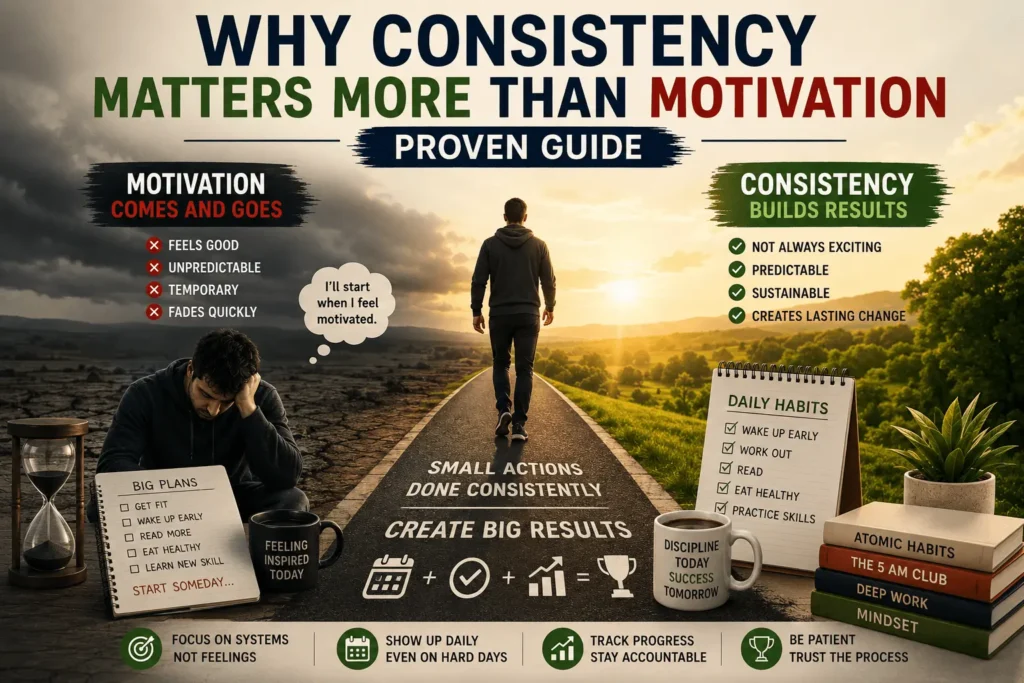
For years I thought motivation was the problem.
If I could just find the right video, the right quote, the right burst of inspiration, I’d finally stick with the habits I kept abandoning. I’d wake up early every day. Exercise consistently. Eat better. Write more. Become the person I kept imagining I could be.
Some weeks it worked. I’d feel unstoppable. Then the feeling would fade, as feelings always do, and I’d find myself back where I started. Waiting for the next wave of motivation to carry me forward again.
What I eventually realized is that motivation is a terrible foundation for anything that matters. It shows up unpredictably and leaves without warning. It’s exciting when it’s there and useless when it’s not. The people who actually build lasting habits and meaningful progress aren’t the ones who feel motivated all the time. They’re the ones who figured out how to keep going when motivation disappears.
Why consistency matters more than motivation isn’t just a catchy phrase. It’s probably the single most important thing I’ve learned about building habits that actually last.
Motivation Comes and Goes. Consistency Doesn’t Have To.
Motivation is a feeling. Feelings change.
You wake up some mornings ready to conquer the day. Other mornings you can barely get out of bed. If your habits depend on which version of you shows up, they’re not habits. They’re mood-dependent activities.
Consistency is different. Consistency means showing up regardless of how you feel. Not with the same intensity every day. Not with the same energy. Just showing up. Doing something. Keeping the thread intact.
I’ve had days where the only exercise I managed was a five-minute walk around the block. Objectively almost nothing. But it kept the streak alive. It told my brain that I’m still someone who moves my body, even on days when moving feels hard. The next day was usually easier. Not because motivation returned, but because I hadn’t broken the chain.
Motivation fades but habits remain. That’s not just wordplay. It’s the fundamental difference between approaches that work and approaches that don’t. The guide on why habit building fails covers this pattern in more detail, but the short version is that relying on motivation is one of the most common reasons people quit.
Consistency doesn’t require feeling inspired. It just requires showing up.
Why Motivation Is Unreliable by Design
Motivation isn’t broken. It’s working exactly as it evolved to work.
The brain’s motivation system is designed for short-term bursts, not sustained effort. It spikes in response to novelty, urgency, or immediate rewards. Then it returns to baseline. This isn’t a flaw. It’s energy efficiency. Your brain can’t maintain peak motivation indefinitely any more than it can maintain peak physical exertion.
The psychology of motivation is pretty clear on this point. Motivation fluctuates based on sleep, stress, mood, hormones, environment, and a dozen other variables you can’t fully control. Some days you’ll feel driven. Some days you won’t. The ratio varies by person, but nobody feels motivated all the time.
The problem isn’t that motivation disappears. The problem is building a strategy that requires motivation to be present.
When people talk about motivation vs consistency, what they’re really comparing is an emotional state against a behavioral pattern. Emotional states are temporary by nature. Behavioral patterns can persist indefinitely if they’re designed well.
Decision fatigue also plays a role here. Every time you decide whether to do a habit, you spend mental energy. After enough decisions, your capacity to choose the harder path diminishes. This is why people often abandon good habits in the evening after a full day of decision-making. The motivation isn’t gone. The mental bandwidth to act on it is depleted.
This is where people often get stuck. They assume that when motivation disappears, something has gone wrong. But motivation disappearing is normal. It’s supposed to happen. The question is what you do when it’s gone.
What Consistency Actually Looks Like in Real Life
Most depictions of consistency are unrealistic.
They show someone waking up at 5 AM every day, crushing workouts, eating perfectly, and maintaining the same routine for years without interruption. That’s not consistency. That’s a fantasy.
Real consistency is messier.
It looks like exercising three times a week instead of the five you planned, but still exercising. It looks like writing two sentences on a day when you wanted to write two pages. It looks like meditating for three minutes when twenty felt impossible. It looks like missing a day, feeling guilty, and coming back the next day instead of waiting until Monday.
I missed workouts during a busy month last year. Not one or two. Most of them. The old me would have declared the habit dead and waited for a fresh start. Instead, I did what I could. A few pushups here. A short walk there. When the busy period ended, the habit was still there. Weakened, but alive. Rebuilding took a week instead of months.
Consistency over motivation means accepting that some repetitions will be small, some will feel pointless, and some days you’ll fall short entirely. The only thing that matters is that you don’t stop permanently.
Here’s a comparison of what most people think consistency looks like versus what it actually looks like:
| What People Imagine | What Actually Works |
|---|---|
| Perfect streaks | Showing up most days |
| Same intensity every time | Intensity varies, frequency doesn’t |
| Never missing a day | Missing sometimes, coming back fast |
| Feeling motivated to keep going | Systems that work without motivation |
| Linear progress | Plateaus, setbacks, gradual growth |
Daily consistency leads to long-term success, but daily doesn’t mean perfect. It means most days. It means more days than not. It means the pattern holds even when individual days fail.
Why Consistency Matters More Than Motivation for Long-Term Growth
There’s a simple reason consistency beats motivation over time.
Motivation produces bursts. Consistency produces accumulation.
A motivated workout might burn 500 calories. A consistent habit of walking every day burns 150. After one day, motivation wins. After one month, consistency is ahead. After one year, there’s no comparison. The consistent person has logged hundreds of hours. The motivated person is still waiting for the next burst of inspiration.
Small actions repeated every day compound in ways that feel invisible in the moment. You don’t notice the individual deposits. You only notice the balance months later when it’s grown into something substantial. That’s how consistency builds lasting habits.
The tricky part is that this process is boring. Consistency doesn’t make for good stories. Nobody posts about their 847th consecutive day of doing the same unremarkable thing. They post about breakthroughs and milestones. But breakthroughs are almost always the result of consistent work that looked unremarkable from the outside.
For a deeper look at how repeated behaviors become automatic, the guide on how habits are formed explains the neuroscience behind why consistency literally rewires your brain in ways that motivation never can.
Consistency is more powerful than motivation because it works when motivation is absent. And motivation is absent a lot.
How to Stay Consistent When You Don’t Feel Like It
This is the practical question underneath everything else.
How do you keep showing up when motivation is gone and the behavior feels pointless and you’d rather do literally anything else?
I’ve tried a lot of approaches. Most didn’t work. Here’s what did.
Lower the bar until it’s almost impossible to fail. On days when the full habit feels overwhelming, do the smallest version that still counts. One pushup. One sentence. Sixty seconds of meditation. The point isn’t the output. The point is maintaining the pattern.
Separate the decision from the feeling. Decide in advance what you’ll do and when. Don’t renegotiate in the moment. The moment is when your brain will offer compelling reasons to skip. The decision was already made. You’re just executing it.
Use structure instead of willpower. Put your running shoes by the bed. Charge your phone in another room. Set a recurring alarm. Make the behavior easier to do than to skip. Willpower fluctuates. Structure doesn’t.
Track only what’s useful. Some people benefit from habit tracking. Some find it creates pressure that backfires. Habit tracking helps most when you’re establishing a new behavior and need awareness of whether you’re actually doing it. It helps least when the tracking itself becomes a source of stress, when a broken streak triggers guilt rather than a quick return to the habit, or when you find yourself doing the behavior only to fill a box rather than because the behavior itself matters. I track habits when I’m establishing them and stop once they feel automatic. If tracking helps, use it. If it becomes a source of stress, drop it.
Expect the middle to feel hard. The initial novelty wears off before the behavior becomes automatic. That gap, usually somewhere between week three and week eight, is where most habits die. Knowing it’s coming makes it easier to push through.
The guide on how to build good habits goes deeper into these strategies with specific examples and frameworks you can apply immediately.
Building Consistent Habits Without Relying on Willpower
Willpower is a limited resource. This isn’t a metaphor.
Research on self-control suggests it functions like a muscle. It gets tired with use. Every decision you make, every temptation you resist, every impulse you override, draws from the same limited pool. By the end of a demanding day, your willpower is depleted. If your habit strategy requires willpower at the exact moment it’s least available, you’re going to lose.
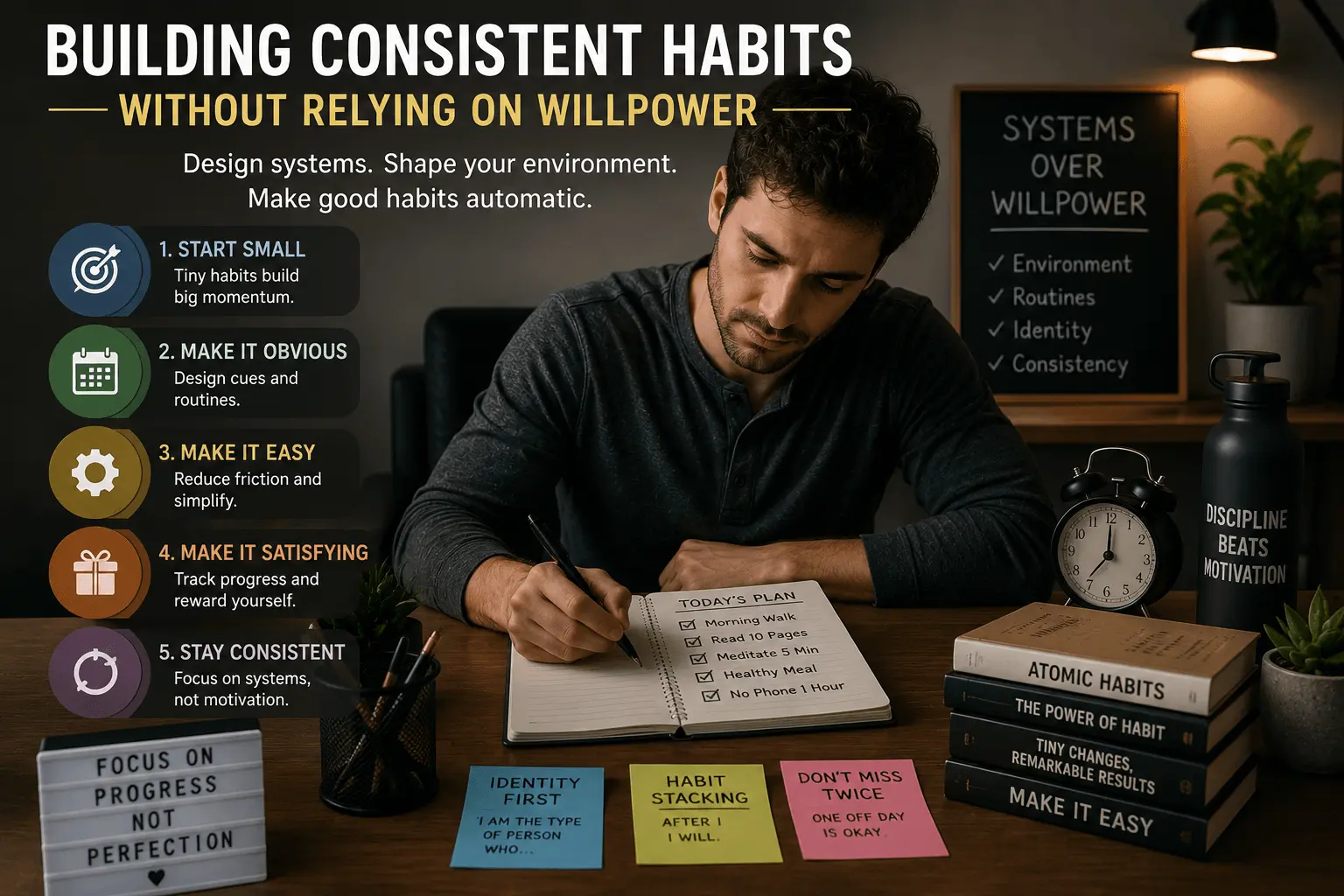
Building consistent habits without relying on willpower means designing your life so the right behaviors happen automatically.
Environment design is the most reliable approach. Make the behaviors you want as easy as possible and the behaviors you don’t want as inconvenient as possible. If you want to read more, put a book on your pillow. If you want to stop scrolling at night, charge your phone in another room. You don’t need more discipline. You need less friction between you and the behavior you want.
Habit stacking is another method that reduces the need for willpower. Attach a new habit to something you already do automatically. After coffee. Before brushing teeth. Right after getting home. The existing habit becomes the cue. The new behavior follows without requiring a separate decision.
Systems outperform goals. A goal is “I want to exercise more.” A system is “I exercise every Monday, Wednesday, and Friday at 7 AM, and I lay out my clothes the night before.” The goal depends on motivation. The system runs regardless.
The guide on what habits are and how they work explains the cue-routine-reward loop that makes automatic behavior possible.
Keystone habits are worth mentioning here. These are habits that, once established, create positive ripple effects across other areas of life. Exercise is the classic example. People who start exercising consistently often find themselves eating better, sleeping more, and managing stress more effectively without deliberately targeting those behaviors. When you identify and protect a keystone habit, consistency in that one area can make consistency elsewhere feel easier.
The Identity Shift That Makes Consistency Easier
At some point, consistency stops being something you force and becomes something you are.
This is the identity shift, and it’s the closest thing to a permanent solution I’ve found.
When you’re “trying to exercise,” every workout requires a decision. Should I go? Do I have time? Am I too tired? The deliberation itself drains willpower. When you’re “someone who exercises,” the decision disappears. You exercise because that’s what people like you do.
Identity-based habits work differently than behavior-based habits. Instead of focusing on what you want to achieve, you focus on who you want to become. The behavior becomes evidence for the identity. Every time you show up, you’re casting a vote for the kind of person you are.
The shift happens gradually. You don’t wake up one day with a new identity. You accumulate evidence over weeks and months until the identity tips. Eventually “I’m trying to be consistent” becomes “I’m someone who shows up.” The difference isn’t semantic. It’s the difference between effortful and automatic.
Identity drives consistent behavior because it removes the daily negotiation. The question isn’t “do I feel like doing this today?” The question is “what does someone like me do in this situation?” The answer is usually obvious.
For more on how identity shapes which behaviors stick, the guide on good habits vs bad habits explores the connection between self-perception and sustained behavior change.
Common Consistency Mistakes People Make
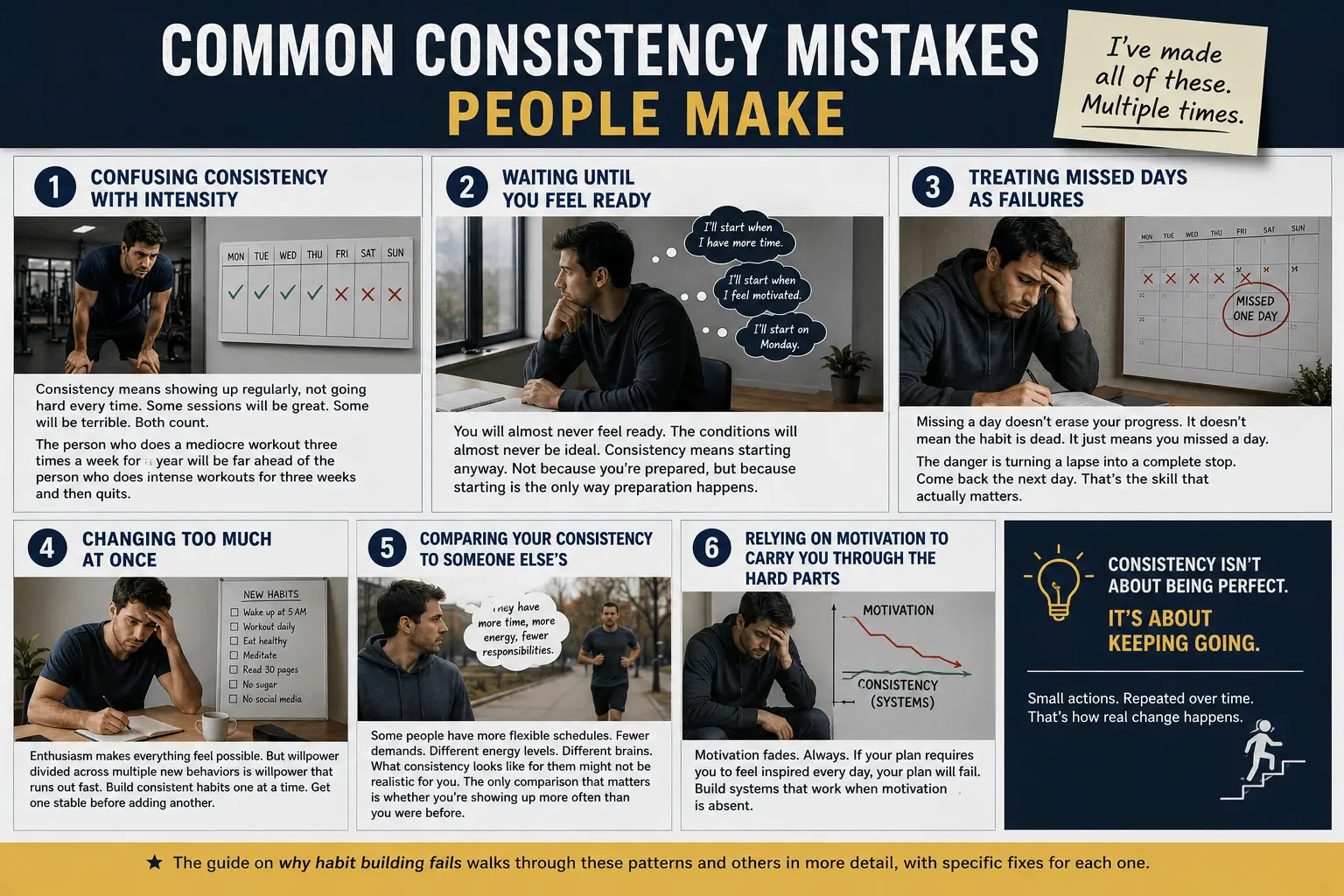
I’ve made all of these. Multiple times.
Confusing consistency with intensity. Consistency means showing up regularly, not going hard every time. Some sessions will be great. Some will be terrible. Both count. The person who does a mediocre workout three times a week for a year will be far ahead of the person who does intense workouts for three weeks and then quits.
Waiting until you feel ready. You will almost never feel ready. The conditions will almost never be ideal. Consistency means starting anyway. Not because you’re prepared, but because starting is the only way preparation happens.
Treating missed days as failures. Missing a day doesn’t erase your progress. It doesn’t mean the habit is dead. It just means you missed a day. The danger is turning a lapse into a complete stop. Come back the next day. That’s the skill that actually matters.
Changing too much at once. Enthusiasm makes everything feel possible. But willpower divided across multiple new behaviors is willpower that runs out fast. Build consistent habits one at a time. Get one stable before adding another.
Comparing your consistency to someone else’s. Some people have more flexible schedules. Fewer demands. Different energy levels. Different brains. What consistency looks like for them might not be realistic for you. The only comparison that matters is whether you’re showing up more often than you were before.
Relying on motivation to carry you through the hard parts. Motivation fades. Always. If your plan requires you to feel inspired every day, your plan will fail. Build systems that work when motivation is absent.
The guide on why habit building fails walks through these patterns and others in more detail, with specific fixes for each one.
The Intention-Action Gap: Why Wanting It Isn’t Enough
There’s a concept in behavioral science called the intention-action gap. It refers to the space between wanting to do something and actually doing it.
Most people assume that wanting something badly enough will close that gap. If the goal matters, follow-through should happen naturally. But research consistently shows that intention alone is a weak predictor of behavior. People genuinely intend to exercise, save money, eat better, and be more present with their families. The intention is real. The action still doesn’t happen.
What closes the intention-action gap isn’t more motivation. It’s reducing the friction between intention and action. Implementation intentions, specific plans for when and where you’ll act, are one of the most researched and effective methods. “I’ll exercise” is an intention. “I’ll walk for ten minutes right after lunch” is a plan. The plan bridges the gap.
Accountability can help, but it works unevenly. Some people thrive with an accountability partner. Others find external pressure creates resentment or anxiety that undermines the habit. If accountability works for you, use it. If it doesn’t, environment design and clear cues often work just as well without the social pressure.
The intention-action gap doesn’t mean you lack willpower. It means you’re human. The fix isn’t wanting it more. It’s making the action easier to take.
How Consistency and Success Are Actually Connected
The connection between consistency and success is both simpler and less glamorous than most people want it to be.
Success, in almost any domain, is the result of accumulated small actions over extended periods. Not talent. Not luck. Not bursts of heroic effort. Just showing up. Doing the work. Doing it again. The people who seem to achieve remarkable things are usually the people who kept going long after everyone else stopped.
This is frustrating because it means there’s no shortcut. You can’t skip the accumulation phase. You can’t get the results without logging the repetitions. The math is boring and unforgiving and true.
But there’s also something freeing about it. If success is mostly about consistency, then it’s available to anyone who can figure out how to keep showing up. You don’t need to be exceptional. You don’t need to feel motivated. You just need to find a way to maintain the pattern.
Consistent effort produces lasting results. Not because any single effort is significant, but because enough efforts over enough time become significant automatically. The compounding curve is slow at first. Then it bends upward. Most people quit before the bend.
The guide on the most powerful mindset for success explores the mental frameworks that make sustained effort possible, even when progress feels invisible.
Research Behind This Guide
To write this guide, I reviewed research from behavioral psychology, habit formation, implementation intentions, automaticity, Tiny Habits, identity-based behavior change, and systematic reviews available through July 2026. Where evidence is mixed, I’ve tried to reflect current scientific consensus instead of repeating popular myths.
Current evidence still does not support the popular “21-day habit rule.” Research by Phillippa Lally and colleagues found that habit formation averaged 66 days, with individual timelines ranging from 18 to 254 days depending on the person and the complexity of the behavior. As of 2026, researchers generally agree that automaticity develops gradually and varies widely between individuals rather than following a fixed timeline.
Key sources include the work of Wendy Wood on habitual behavior and context stability, Peter Gollwitzer on implementation intentions, BJ Fogg on the Tiny Habits framework, and Phillippa Lally on habit formation timelines. While many core findings remain stable, recommendations in this guide have been reviewed to reflect current evidence rather than outdated assumptions.
Frequently Asked Questions
Why is consistency more important than motivation?
Motivation is temporary by design. It fluctuates based on factors you can’t fully control. Consistency is a behavioral pattern that can persist regardless of how you feel. Over time, consistent small actions produce far more results than occasional bursts of motivated effort. Motivation gets you started. Consistency keeps you going long enough for the results to actually compound.
How do I stay consistent when I don’t feel motivated?
Lower the bar to the smallest version of the habit that still counts. Separate the decision from the feeling by deciding in advance. Use environment design so the behavior requires less willpower. Expect difficult days and plan for them. And remember that consistency doesn’t mean perfect. It means showing up more often than not and coming back quickly when you miss.
What’s the difference between motivation and discipline?
Motivation is an emotional state. It’s the desire or enthusiasm to do something. Discipline is the ability to do something regardless of how you feel. Motivation comes and goes. Discipline can be strengthened over time through repeated practice. In the long run, discipline and systems outperform motivation because they don’t depend on your emotional state.
Can you build consistency without discipline?
Yes, and that’s often the better approach. Environment design, habit stacking, and reducing friction for desired behaviors can make consistency easier without requiring significant discipline. The less you need to rely on willpower, the more likely your habits are to survive difficult periods. Systems and structure can do a lot of the work that people usually attribute to discipline.
How long does it take to become consistent?
There’s no fixed timeline. Consistency isn’t a finish line. It’s a practice. Some people find a rhythm within a few weeks. Others take months. The key variable is usually how well the habit is designed. Simple habits with clear cues, immediate rewards, and low friction become consistent faster than complex habits that require significant effort or planning.
Does consistency mean doing something every single day?
Not necessarily. Consistency means doing something regularly enough that the pattern holds. For some habits, that might be daily. For others, three or four times a week is plenty. The right frequency depends on the habit and your life. What matters is that the behavior happens predictably over time, not that it happens every day without exception.
Final Thoughts
If you’ve been waiting to feel motivated before you start, you might be waiting a long time.
Motivation is wonderful when it shows up, but it’s not a strategy. It’s a bonus. The real work happens on the days when you don’t feel like it. Those are the days that determine whether a habit sticks or fades.
The good news is that consistency gets easier with practice. Each time you show up, you’re strengthening the pattern. Each time you come back after missing a day, you’re proving to yourself that lapses aren’t failures. Over time, the behavior becomes part of who you are. Not something you force. Something you just do.
Start small. Make it easy. Show up whether you feel like it or not. The results will take care of themselves.
Your overall well-being, your energy, your ability to sustain effort, affects how consistent you can be. The guide on how to improve your overall well-being covers the foundational health habits that make everything else easier.