

For years I thought feeling tired in the morning was just how mornings worked.
I’d wake up groggy. Reach for my phone. Scroll for ten minutes while my brain slowly came online. Then I’d drag myself to the kitchen, make coffee, and wait for the caffeine to do its job. Some mornings the fog lifted by 9 AM. Some mornings it never really did.
I tried elaborate routines. Wake up at 5 AM. Exercise for an hour. Meditate. Journal. The whole thing felt like a part-time job I hadn’t applied for. It collapsed the first time I had to catch an early flight, and I felt guilty for weeks.
What eventually worked was much simpler. Not a routine I admired. A routine I could actually do. Small things. Water first. A few minutes of movement. Some natural light. Nothing impressive. Just repeatable actions that fit into my actual life.
A morning routine for energy doesn’t require waking up at 5 AM or doing anything extreme. It’s mostly about removing the things that make mornings harder and adding a few small habits that support alertness. The goal isn’t to create instant energy. It’s to make the transition from sleep to wakefulness easier.
Why Most People Feel Tired in the Morning
Morning grogginess has a name. Sleep inertia.
It’s the period after waking when your brain is transitioning from sleep to full alertness. During sleep inertia, alertness and cognitive performance can temporarily be reduced. The effects vary depending on sleep duration, sleep stage, and individual factors. Sleep inertia usually improves as your brain and body transition into wakefulness, but the duration varies from person to person.
Some things you do immediately after waking can make the morning feel more difficult, even if they aren’t the cause of sleep inertia itself.
The bigger problem isn’t the phone screen itself. It’s the flood of messages, headlines, and notifications. Within minutes, your attention is somewhere else before you’ve even decided what you want from the morning. You start the day reacting instead of acting.
After several hours without drinking, some people may wake up somewhat dehydrated, particularly after sweating, sleeping in a warm environment, or simply going a long time without fluids. Drinking water can address thirst and hydration needs, particularly if you wake up thirsty or mildly dehydrated.
And then there’s the transition from being still to getting your body moving. After several hours of sleep, a few minutes of gentle movement can be an easy way to start transitioning into the day. For me, staying in bed scrolling or repeatedly hitting snooze made the transition feel even slower.
It’s easy to try to fix your mornings by adding more—exercise, meditation, journaling—without first removing the things that are making mornings harder. A good morning routine for energy starts with subtraction. For more on this, see why habit building fails and how to make your routine easier to maintain.
A Simple 10-Minute Morning Routine
Here’s a simple routine that takes about ten minutes and covers the basics. You don’t need to follow it exactly. The 10-minute routine uses five of the seven habits as a quick-start version. The remaining habits can be added according to your schedule and preferences. Think of the seven habits below as a menu: choose the ones that fit your life.
| Time | Habit | Purpose |
|---|---|---|
| 0–1 min | Drink some water | Address thirst and hydration needs |
| 1–3 min | Get natural light | Support wakefulness and circadian timing |
| 3–6 min | Move your body | Encourage movement and alertness |
| 6–8 min | Wash up or shower | Transition into the day |
| 8–10 min | Choose one priority | Reduce morning friction |
Each step takes roughly one to three minutes. That’s it. Water. Light. Movement. A quick wash. One priority. Because every step is short, you can scale it down when the morning gets messy—on travel days, after poor sleep, or when you’re just not feeling it. The starter routine takes about ten minutes.
7 Morning Habits for More Energy
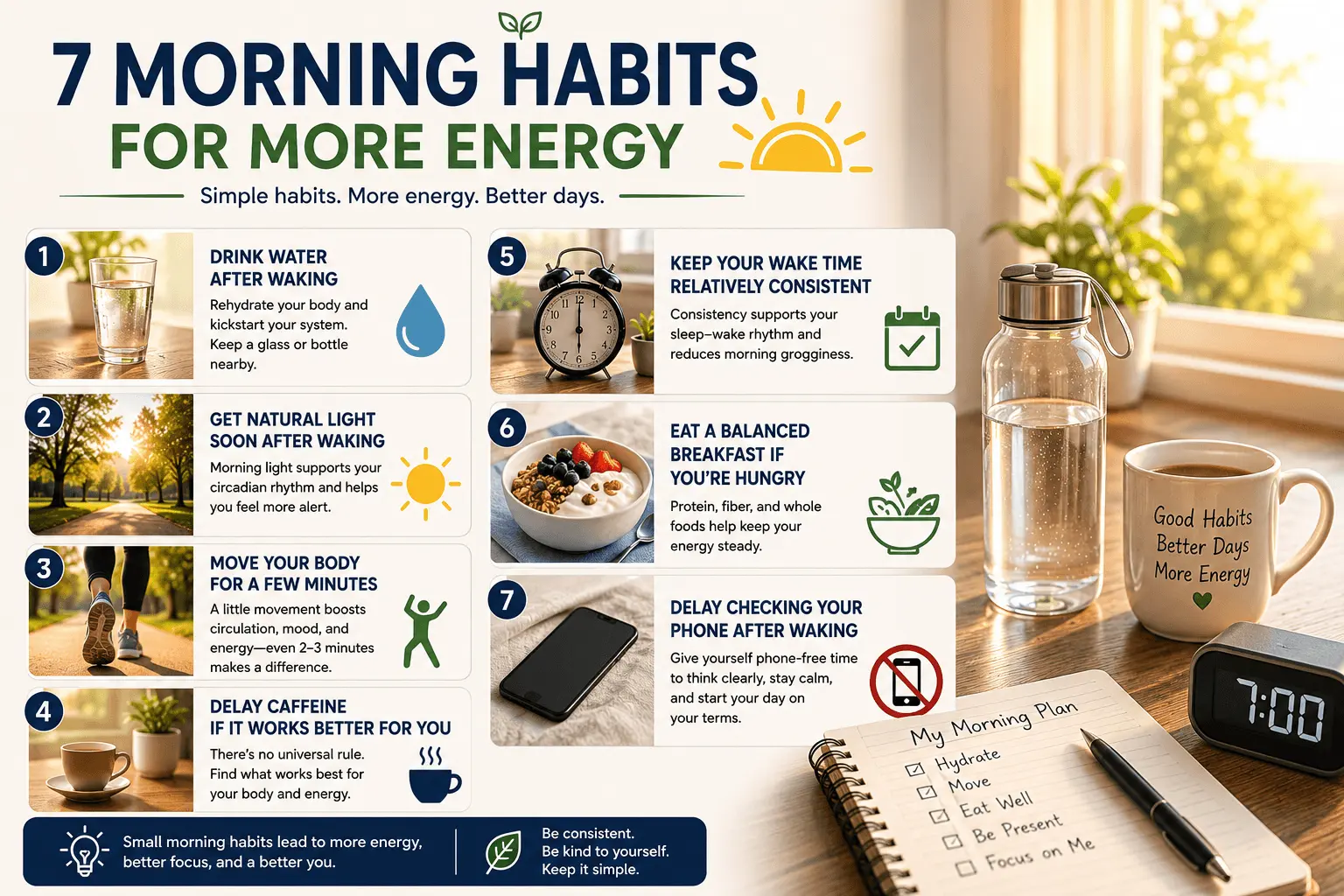
These seven habits form a simple morning routine for energy that you can adapt to your schedule. After years of trial and error, these are the habits I found easiest to keep—and the ones that made my mornings feel noticeably better. None of them are complicated. None of them require special equipment or extreme discipline.
1. Drink some water after waking. If you’re thirsty when you wake up, water is a simple place to start. Keep a glass or bottle nearby so it’s easy to reach for. You don’t need to force a large amount of water immediately after waking. If you enjoy coffee in the morning, that can come whenever it works best for you.
2. Get natural light soon after waking. Morning light provides an important timing cue for your circadian system and can help reinforce a regular sleep-wake schedule. It may also help you feel more alert, although the effects depend on the timing, intensity, and your individual circumstances. Getting outdoor light soon after waking can provide a stronger light signal than typical indoor lighting. If you can’t get outside, spending time in a bright indoor environment can still provide more light exposure than remaining in a dim room. If it’s still dark when you wake up, turn on bright indoor lights. If you regularly wake before sunrise, a properly designed light-therapy device may be an option for some people, particularly when used for a specific sleep or seasonal-lighting purpose. Follow the device instructions and consider professional advice if you have an eye condition or take medication that increases light sensitivity.
If you have a medical condition, take medication that affects sleep or light sensitivity, or regularly experience severe morning fatigue, talk with a qualified healthcare professional rather than relying on a routine alone.
3. Move your body for a few minutes. Not a workout. Just movement. Stretching. Walking around the block. A few pushups. Dancing in the kitchen. The goal is simply to get your body moving and help you transition into the day. Even two or three minutes of movement can be a practical way to get started.
4. Delay caffeine if it works better for you. There’s no strong evidence that everyone needs to wait 30 to 60 minutes before having coffee to prevent an energy crash. Caffeine blocks adenosine receptors and can improve alertness. Research has also found caffeine can reduce some effects of sleep inertia, although the evidence doesn’t support a universal rule about when everyone should drink coffee. Some people feel better delaying caffeine. Others don’t notice a difference. If you enjoy coffee soon after waking and it doesn’t interfere with your sleep or cause unwanted effects, there’s no established scientific requirement to delay it. The bigger consideration is whether caffeine affects your sleep later in the day; if it does, adjusting the amount or timing may help. Experimenting with both approaches, I found that waiting a bit worked better for me personally, but that’s not a universal rule.
5. Keep your wake time relatively consistent. Keeping your wake time relatively consistent can help support a more stable sleep-wake schedule. When your wake time varies substantially from day to day, it can make your sleep-wake schedule less consistent and may contribute to morning grogginess. Consistency matters more than forcing yourself to wake at an extremely early hour.
6. Eat a balanced breakfast if you’re hungry. Some people feel better eating breakfast. Some don’t. There’s no universal rule. If breakfast is part of your routine, meals that include protein, fiber, and minimally processed foods may help with fullness and overall nutritional quality. How you respond to different breakfasts varies, so there’s no single breakfast that guarantees steady energy for everyone. If you’re not hungry in the morning, don’t force it.
7. Delay checking your phone after waking. I found that keeping my phone away for the first 30 minutes made my mornings feel calmer and less reactive. My attention felt sharper. My mood was better. There’s nothing magical about 30 minutes, though. The useful principle is creating some phone-free time before messages, notifications, and social feeds take over your attention. Charge your phone in another room if you need to. Buy a separate alarm clock if that helps.
For more on how these habits fit into a broader morning plan, see our guide to building a healthy daily routine.
How to Build a Morning Routine for Energy
The mistake I made for years was trying to change everything at once.
I’d decide to drink water, exercise, meditate, get sunlight, delay caffeine, and eat a healthy breakfast, all starting Monday. By Wednesday I’d be exhausted from the effort of maintaining six new habits simultaneously. By Friday I’d have abandoned everything.
The approach that lasted was much simpler: one habit at a time.
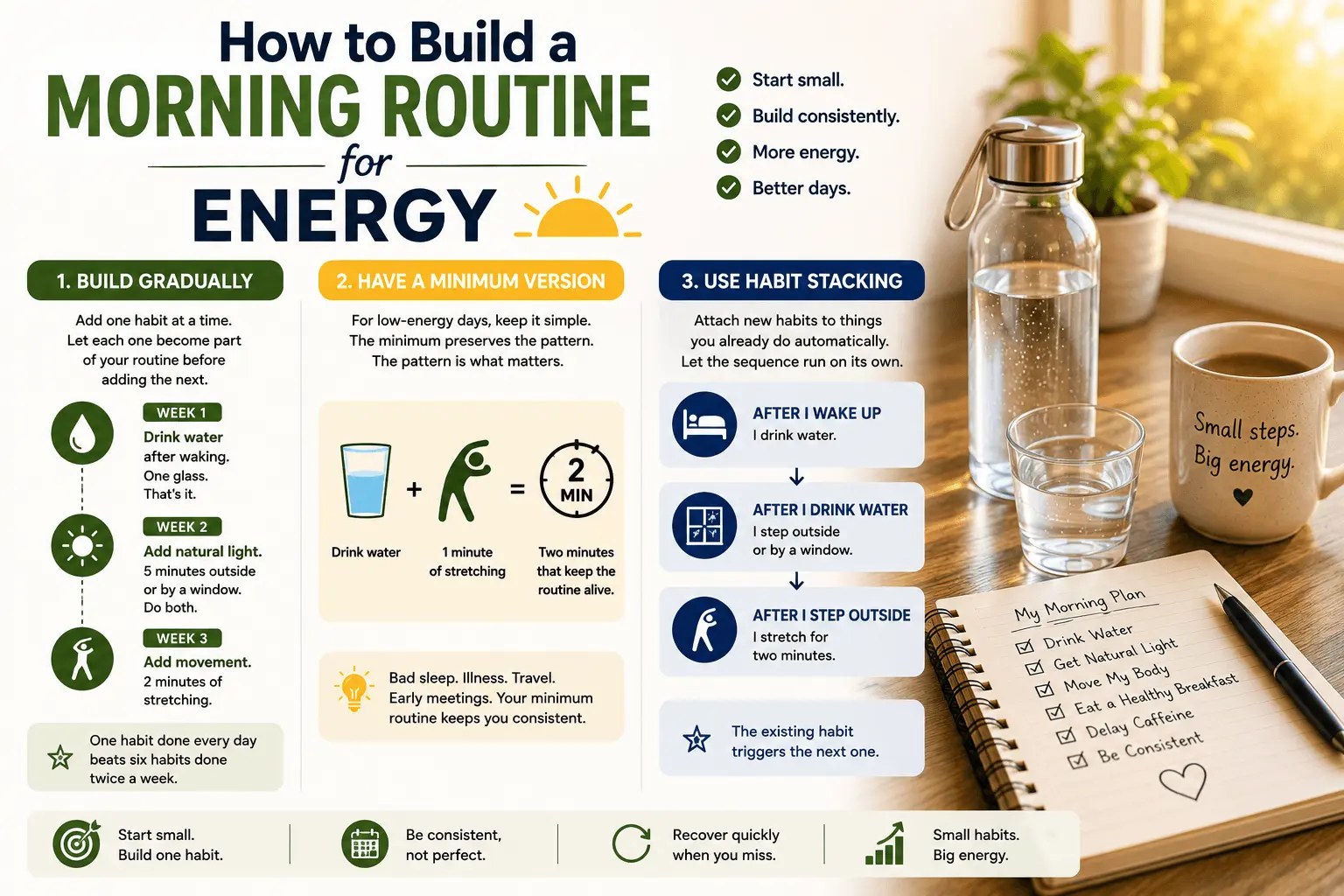
Start with water. One glass. Right after waking. Do that for a week. Then add natural light. Five minutes outside or by a window. Do both for another week. Then add movement. Two minutes of stretching. One thing at a time. Each habit gets time to stabilize before the next one begins.
For a detailed breakdown of this gradual approach, see how to build good habits that actually stick. The short version is that consistency matters more than completeness. One habit done every day beats six habits done twice a week.
Have a minimum version of your routine for low-energy mornings. Bad sleep. Illness. Travel. Early meetings. The minimum version might be water and one minute of stretching. Two minutes total. The minimum preserves the pattern. The pattern is what matters.
Learn how habits are formed and why context matters. When the context changes, the habit weakens. A minimum version bridges the gap.
Habit stacking makes an energy-boosting morning even easier. We’ve explained the method in detail in what is habit stacking. The short version is that you attach each new habit to something you already do automatically. After I wake up, I drink water. After I drink water, I step outside. After I step outside, I stretch for two minutes. The existing habit triggers the new one. The sequence runs on its own.
What Can Make Mornings Feel More Difficult
Some morning behaviors may not directly cause fatigue, but they can add friction, distraction, or grogginess to an already slow transition into the day. Adding good habits helps. Removing unnecessary friction can help too.
Checking your phone immediately. Within minutes, your attention gets scattered across messages, news, and notifications before you’ve decided what you want from the morning. Charge your phone in another room. Buy a separate alarm clock if you need one.
Hitting snooze repeatedly. If repeated snoozing leaves you feeling groggy, experiment with using one alarm and getting up when it goes off. The goal isn’t to follow a universal anti-snooze rule; it’s to find out whether repeated interruptions are making your mornings feel worse.
Staying in a dark room after waking. Light provides an important signal to your body that it’s time to be awake and alert. Staying in a dark room may make it harder to transition into full alertness. Open the blinds immediately. Step outside if you can. Turn on bright lights if it’s still dark out.
Choosing a breakfast that doesn’t keep you satisfied. If breakfast is part of your routine, meals that include protein, fiber, and minimally processed foods may help with fullness and overall nutritional quality. How you respond to different breakfasts varies considerably.
Making too many decisions early. A complicated morning can create unnecessary friction before your day has really started. If you spend your first hour deciding what to wear, what to eat, and what to work on first, simplifying those choices may make the morning feel easier. Lay out clothes the night before. Know what you’re eating. Know what your first task is.
For more on protecting your focus and energy during the first hours of the day, see building a morning routine for productivity.
How to Maintain Your Routine When Energy Is Low
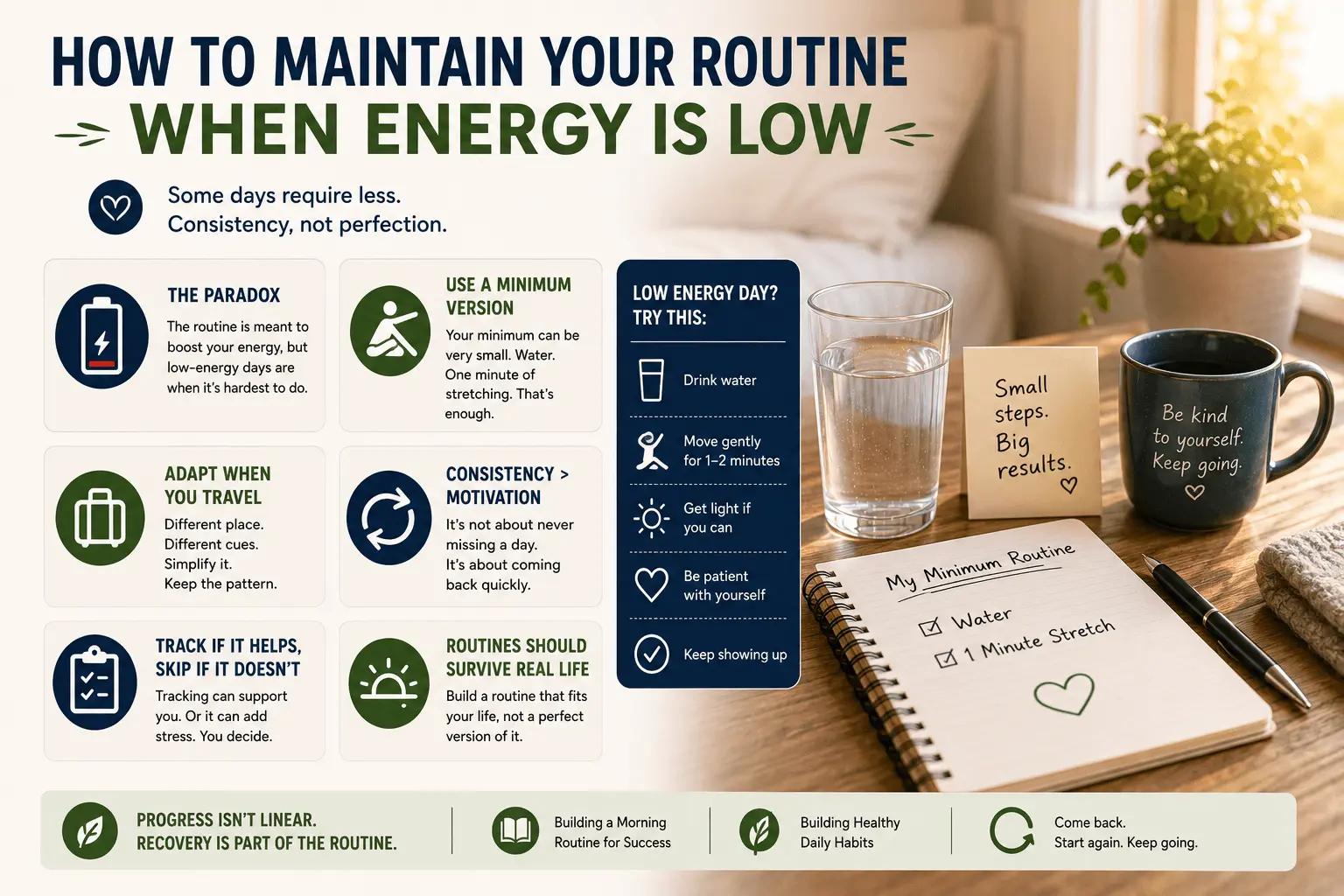
The paradox of an energy-boosting morning routine is that you need energy to do it.
On days when you’ve slept poorly or you’re sick or you’re just depleted, the routine can feel harder than skipping it. These are the days when having a smaller, flexible routine can make the habit easier to maintain.
What saved me was having a minimum version. Water. One minute of stretching. That’s it. Two minutes total. Enough to preserve the pattern without requiring energy I didn’t have.
Travel disrupts everything. Different bed. Different time zone. Different cues. My travel version is even simpler. Water. Stand by the window for thirty seconds. The routine adapts to the context. The pattern survives.
The broader principle is covered in why consistency matters more than motivation. Consistency isn’t about never missing a day. It’s about missing and coming back quickly. The people who maintain routines long-term aren’t the ones with perfect streaks. They’re the ones who recover fast after disruption.
Whether tracking helps during low-energy periods depends on the person. We’ve covered this in how to track habits. For some people, a simple tracker provides enough accountability to stay consistent. For others, it adds stress. Use it if it helps. Skip it if it doesn’t.
For more on creating routines that survive real life, see building a morning routine for success. For a broader picture, see our guide to building healthy daily habits.
Frequently Asked Questions
What should I do first in the morning for energy?
Start with something simple: drink some water if you’re thirsty, get into brighter light, and move for a few minutes. You don’t need to complete a complicated routine to start feeling more alert.
What is the best morning routine for energy?
The best routine is the one you’ll actually do consistently. For most people, that means drinking water first thing, getting natural light soon after waking, moving for a few minutes, and delaying or having caffeine based on personal preference. A basic version can take around ten minutes. Start there. Adjust based on what works for you.
How long does it take to feel more energetic in the morning?
Some people notice changes in alertness quickly, while other benefits become clearer after maintaining the routine consistently. Some people find that drinking water, getting into brighter light, and moving soon after waking helps them feel more alert. Other changes, such as keeping a more consistent sleep and wake schedule, may take longer before you notice a difference. The key is consistency.
Do I need to exercise in the morning to have more energy?
No. A full workout is great if you enjoy it, but a few minutes of light movement—such as stretching, walking, or simple bodyweight exercises—can be a practical way to get your body moving and may help you feel more alert. The goal is to break out of the low-energy feeling that follows sleep. Intense exercise isn’t required.
What if I can’t get natural light in the morning?
If you wake up before sunrise or live in a place with limited daylight, use bright indoor lights. A light therapy lamp may be an option, particularly if you experience seasonal affective symptoms. Follow the device instructions and consult a professional if you have an eye condition or take medication that affects light sensitivity.
Can I still drink coffee in the morning?
Yes. Caffeine can improve alertness, including during sleep inertia. Some people prefer to delay caffeine by 30 to 60 minutes, but there’s no strong evidence that everyone needs to do this to prevent an energy crash. If you enjoy coffee soon after waking and it doesn’t interfere with your sleep or cause unwanted effects, there’s no established scientific requirement to delay it. The bigger consideration is whether caffeine affects your sleep later in the day; if it does, adjusting the amount or timing may help.
How do I wake up earlier if I’m not a morning person?
If you consistently want to wake earlier, you’ll generally need to give yourself enough time for adequate sleep by shifting bedtime earlier. Try shifting your wake time gradually rather than making a sudden two-hour change. Consistent sleep and wake times matter more than the specific hour on the clock.
Is persistent morning fatigue a sign that something is wrong?
Occasional morning grogginess is normal. But if you’re regularly exhausted despite allowing enough time for sleep, or if fatigue is accompanied by symptoms such as loud snoring, gasping during sleep, persistent headaches, or significant daytime sleepiness, consider talking with a healthcare professional. A morning routine can help with alertness, but it isn’t a treatment for underlying sleep or health conditions.
Final Thoughts
A morning routine for energy isn’t about doing more. It’s about doing a few specific things that support the transition from sleep to wakefulness and stopping the things that keep you groggy.
Drink some water after waking if you’re thirsty. Get natural light soon after waking. Move for a few minutes. Have caffeine when it works best for you. Keep your wake time relatively consistent. Create some phone-free time before the day’s demands take over. That’s pretty much it. The starter routine takes about ten minutes.
Start with one habit. Water. Do it tomorrow. Add more when the first habit feels automatic. Have a minimum version for days when you’re exhausted. Let the routine bend when life gets messy.
The goal isn’t a perfect morning. It’s a morning where you feel awake enough to show up for the day. That’s enough.