I was a terrible morning person in school.
Not because I was lazy. Because my mornings were chaos. I’d wake up late, skip breakfast, grab whatever was nearby, and rush out the door feeling scattered. Then I’d sit through first period trying to focus while my brain was still booting up.
What eventually changed wasn’t a dramatic overhaul. It was a handful of small adjustments. Water before anything else. Backpack packed the night before. Phone away for the first twenty minutes. Nothing impressive. Just repeatable.
A morning routine for students doesn’t require waking up at 5 AM or meditating for an hour. It’s about removing the friction that makes school mornings stressful and adding a few small habits that support focus, energy, and organization once class starts.
This is what actually worked for me. Not the perfect routine. The realistic one.
Why Students Struggle With Mornings
Most morning routine advice isn’t written for students.
It’s written for adults with control over their schedules. People who can wake up whenever they want, exercise for an hour, and ease into their day without a bell schedule dictating when they need to be somewhere.
Students don’t have that luxury. School starts at a specific time. Buses don’t wait. First period doesn’t care if you slept badly. The routine needs to fit around fixed schedules, early mornings, homework from the night before, and the general chaos of student life.
The other problem is that most student routines are too ambitious. Wake up at 5 AM. Exercise. Meditate. Journal. Read. Eat a full breakfast. The whole thing takes two hours and falls apart the first time you have a late night studying or an early practice.
The guide on why habit building fails covers this pattern in detail. Most habits don’t fail because people are lazy. They fail because the habits are too big and too rigid to survive real life.
A good student morning routine is flexible. It has a full version for normal days and a minimum version for chaotic ones. It survives late nights, early exams, and days when everything goes wrong.
What a Good Morning Routine for Students Actually Looks Like
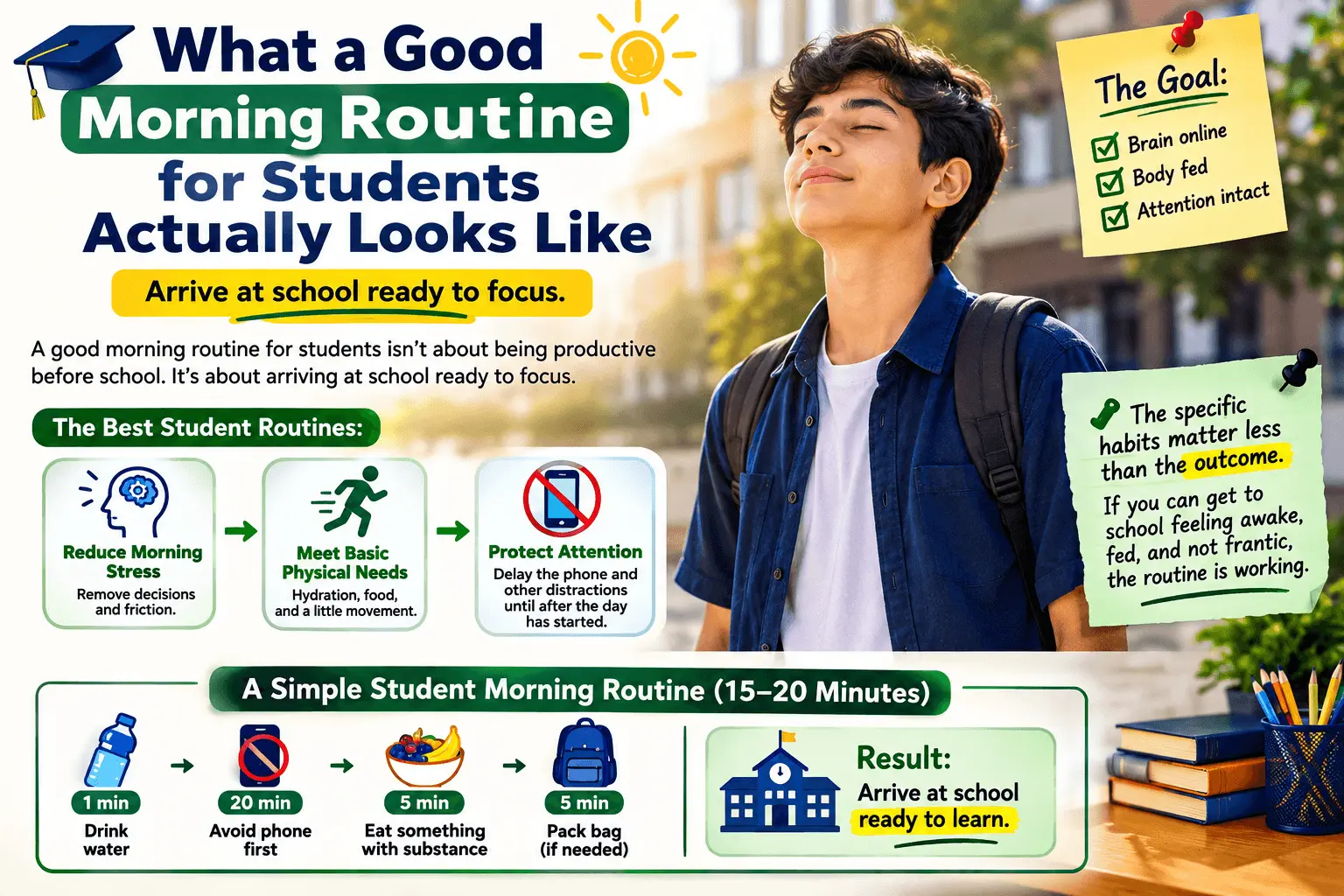
A good morning routine for students isn’t about being productive before school. It’s about arriving at school ready to focus.
That’s the whole point. Not checking off a list of impressive habits. Just getting to first period with your brain online, your body fed, and your attention intact.
At least in my experience, the best student routines do three things. They reduce morning stress by removing decisions and friction. They provide basic physical needs like hydration, food, and a little movement. And they protect attention by delaying the phone and other distractions until after the day has started.
The specific habits matter less than the outcome. If you can get to school feeling awake, fed, and not frantic, the routine is working.
For many students, a simple routine can fit into 15–20 minutes, depending on their schedule. The goal isn’t to accomplish things before school. It’s to arrive at school in the right state to accomplish things there.
A Simple 10-Minute Morning Routine for Students
Here’s a simple 10-minute starting point—not a complete checklist of all seven habits. Think of it as a quick version you can use on normal school mornings.
| Time | Habit | Purpose |
|---|---|---|
| 0–1 min | Drink some water | Address thirst and hydration needs |
| 1–3 min | Get natural light | Support wakefulness and signal the start of the day |
| 3–6 min | Move your body | Get moving and support alertness |
| 6–8 min | Wash up and get dressed | Transition into the day |
| 8–10 min | Grab your packed bag | Reduce morning scrambling |
Because every step is short, you can scale it down when the morning gets messy—on exam days, after poor sleep, or when you’re running late.
7 Morning Habits for Students
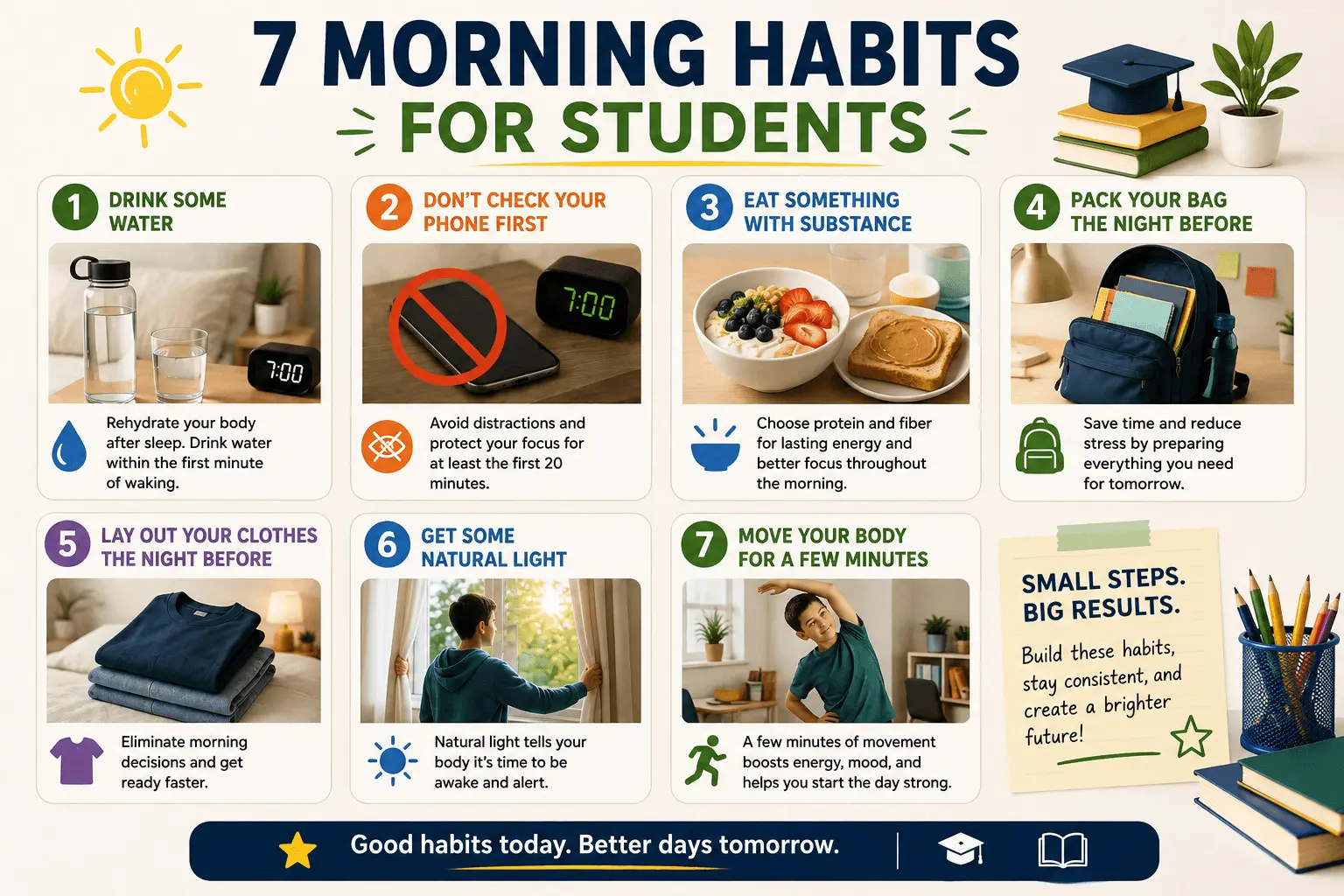
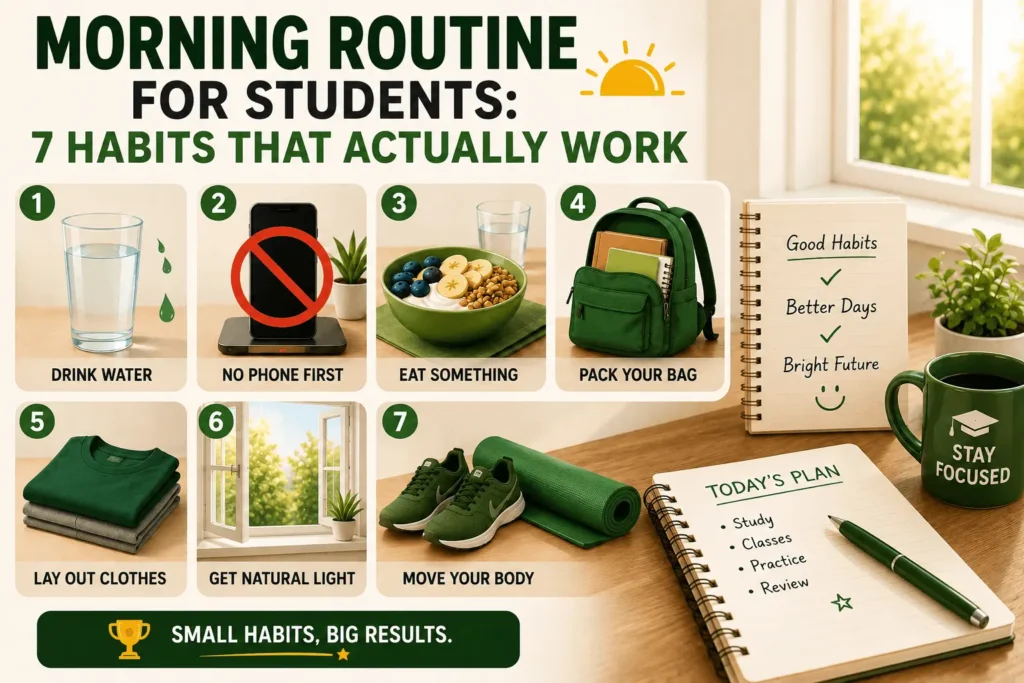
These seven habits form a simple morning routine for students that you can adapt to your schedule. After years of trial and error, these are the habits I found easiest to keep because they didn’t require me to completely redesign my mornings.
1. Drink some water after waking. You’ve gone several hours without fluids while sleeping. Keep a water bottle on your nightstand. Drink some water within the first minute of waking. It gives you an easy way to address thirst after waking. If you enjoy coffee or tea in the morning, that can come whenever it works best for you.
2. Don’t check your phone for the first twenty minutes. This one was hard for me. The phone is right there. The notifications are right there. But checking messages and social media first thing fragments your attention before the day has even started. You start school reacting to other people’s stuff instead of focusing on your own. Charge your phone across the room. Use a separate alarm clock if you need to.
3. Eat something with some substance. Some people aren’t hungry in the morning. That’s fine. But if you can manage something, prioritize protein and fiber over pure sugar. A breakfast that’s mostly added sugar may be less filling than one that also includes protein and fiber. Eggs, yogurt, peanut butter on toast, leftovers from dinner. These foods can provide longer-lasting fullness and may help make breakfast more satisfying. If you’re not hungry, at least drink the water.
4. Pack your bag the night before. This single habit eliminated more morning stress than anything else I tried. Homework. Books. Laptop. Charger. Permission slip. Whatever you need for the next day, pack it before bed. The morning version of you is tired and rushed and will forget things. The night-before version of you has time to think clearly.
5. Lay out your clothes the night before. Same principle as packing your bag. The morning version of you doesn’t want to make decisions about what to wear. The night-before version of you can pick something in thirty seconds. This removes one more decision from the morning and makes getting ready faster.
6. Get some natural light. Light provides an important signal to your body that it’s time to be awake and alert. Open the blinds. Step outside for a minute. Even standing near a bright window helps. If it’s still dark when you wake up, turn on bright indoor lights. In practical terms, getting into brighter light shortly after waking gives your body a clear signal that the day has started.
7. Move your body for a few minutes. Not a workout. Just movement. Stretching. Walking around your room. A few jumping jacks. Something that gets your body moving and makes the transition into the day feel easier. Even two or three minutes can be enough to make getting started feel easier.
For more on how these habits fit into a broader approach, see our guide to building healthy daily habits.
How to Build a Morning Routine That Survives School Life
Building a morning routine that lasts through the school year requires a different approach than building one that looks good on paper.
Start with one habit. Not seven. One thing you’ll do tomorrow morning. Maybe it’s drinking water. Maybe it’s packing your bag the night before. Pick the easiest one. Do it for a week before adding anything else.
This is where people usually struggle. The impulse to fix everything at once is strong. You want to wake up tomorrow as a completely different student. That impulse is normal. It’s also why most routines don’t survive their first disruption.
For a detailed breakdown of this gradual approach, see how to build good habits that actually stick. The short version is that consistency matters more than completeness. One habit done every day beats seven habits done once.
Have a minimum version of your routine for chaotic mornings. Overslept. Late for the bus. Big exam. The minimum version might be water and grabbing your packed bag. Two minutes total. The minimum preserves the pattern. The pattern is what matters.
Learn how habits are formed and why context matters. When the context changes, the habit weakens. A minimum version bridges the gap.
Habit stacking makes a school morning routine even easier. We’ve explained the method in detail in what is habit stacking. The short version is that you attach each new habit to something you already do automatically. After I wake up, I drink water. After I drink water, I open the blinds. After I open the blinds, I stretch for two minutes. The existing habit triggers the new one. The sequence runs on its own.
What Students Should Avoid in the Morning
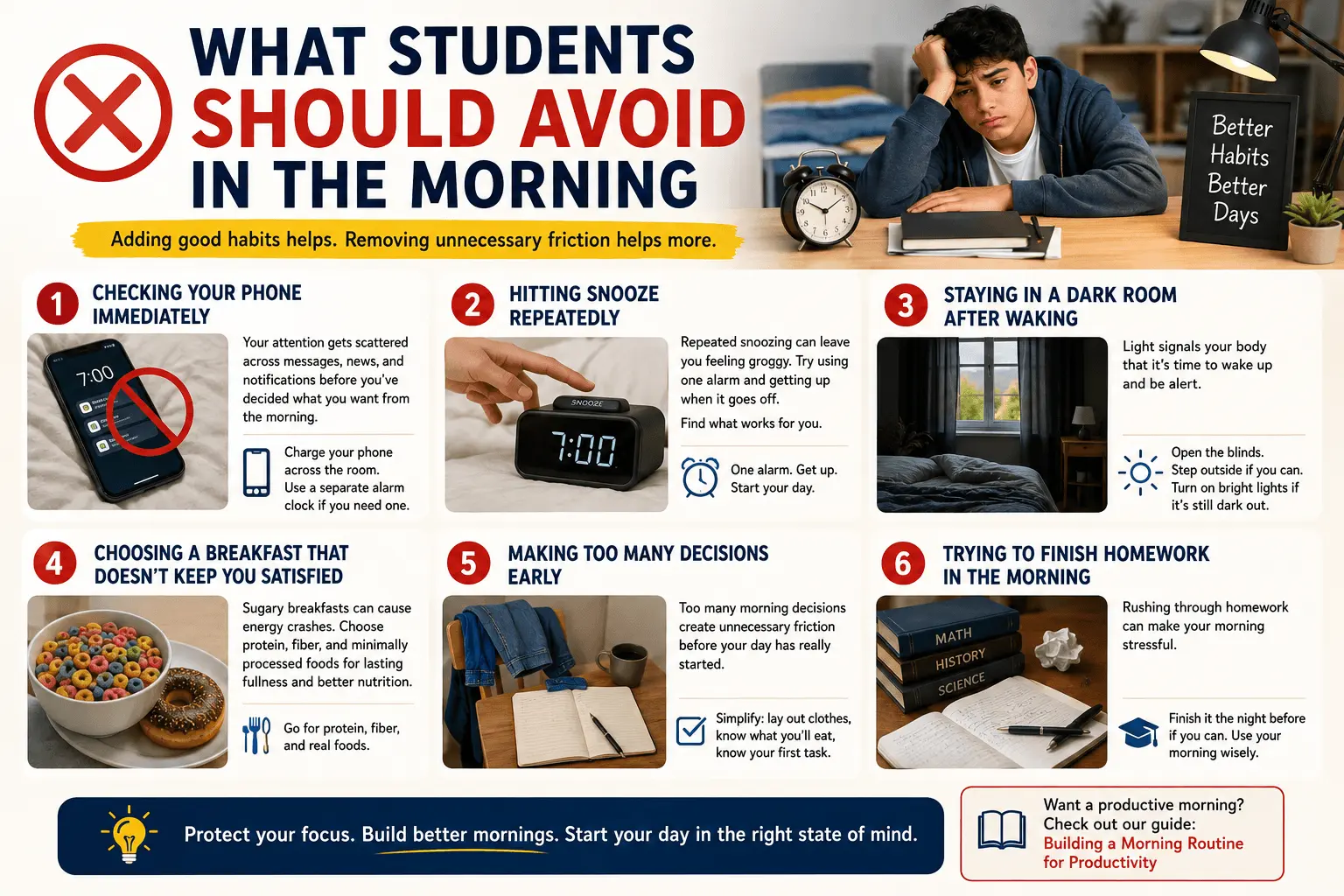
Adding good habits helps. Removing unnecessary friction helps more.
Checking your phone immediately. Within minutes, your attention gets scattered across messages, news, and notifications before you’ve decided what you want from the morning. Charge your phone across the room. Use a separate alarm clock if you need one.
Hitting snooze repeatedly. If repeated snoozing leaves you feeling groggy, experiment with using one alarm and getting up when it goes off. The goal isn’t to follow a universal anti-snooze rule; it’s to find out whether repeated interruptions are making your mornings feel worse.
Staying in a dark room after waking. Light provides an important signal to your body that it’s time to be awake and alert. Getting into brighter light can provide a useful wake-time cue and may help support alertness. Open the blinds immediately. Step outside if you can. Turn on bright lights if it’s still dark out.
Choosing a breakfast that doesn’t keep you satisfied. A breakfast that’s mostly added sugar may be less filling than one that also includes protein and fiber. If breakfast is part of your routine, meals that include protein, fiber, and minimally processed foods may help with fullness and overall nutritional quality.
Making too many decisions early. A complicated morning can create unnecessary friction before your day has really started. If you spend your first hour deciding what to wear, what to eat, and what to work on first, simplifying those choices may make the morning feel easier. Lay out clothes the night before. Know what you’re eating. Know what your first task is.
Trying to finish homework in the morning. If rushing through unfinished homework makes your morning stressful, try completing it the night before. But if you’re naturally more focused in the morning and have enough time, there’s nothing inherently wrong with doing some schoolwork then. The goal is to avoid turning your morning into a last-minute scramble.
For more on protecting your focus during the first hours of the day, see building a morning routine for productivity.
How to Maintain Your Routine During Exams and Busy Periods
Exam periods are when a morning routine matters most. They’re also when it’s hardest to maintain.
Late nights studying. Early morning revision. Stress. Anxiety. The routine you built during normal school days might not survive exam season. That’s okay. The goal during busy periods isn’t the full routine. It’s the minimum version.
What saved me during exams was having a stripped-down routine. Water. Pack bag. Go. Three minutes total. Enough to preserve the pattern and arrive at the exam feeling slightly more human than I would have otherwise.
Travel and holidays disrupt routines too. Different schedule. Different space. Different cues. The routine bends. The pattern survives.
Whether tracking helps during busy periods depends on the person. We’ve covered this in how to track habits. For some students, a simple tracker provides enough accountability to stay consistent. For others, it adds stress during already stressful periods. Use it if it helps. Skip it if it doesn’t.
For more on creating routines that survive real life, see building a morning routine for success. The mindset you bring to your routine matters. See the most powerful mindset for success for more on the mental frameworks that make routines stick.
Morning Routine for Students Who Wake Up Late
Not everyone is a morning person. Some students wake up with just enough time to get dressed and leave.
If that’s you, the strategy is different. Instead of trying to cram habits into fifteen minutes, move the important stuff to the night before.
Pack your bag. Lay out your clothes. Prep breakfast. Put your water bottle on your nightstand. The morning then becomes simple: wake up, drink water, get dressed, grab your bag, leave. Five minutes total.
A short morning routine still counts. The goal isn’t to be impressive. It’s to get to school without feeling frantic. If you consistently want to wake earlier, try shifting your wake time gradually rather than making a sudden change. Consistent sleep and wake times matter more than the specific hour on the clock.
Frequently Asked Questions
What is the best morning routine for students?
The best routine is the one you’ll actually do consistently. For most students, that means drinking water first thing, avoiding the phone for the first twenty minutes, eating something with substance, and packing your bag the night before. The whole thing takes fifteen to twenty minutes. Start there. Adjust based on what works for you.
What should a student do the night before for a better morning?
Pack your school bag, choose your clothes, prepare anything you need for breakfast, check your schedule, and put your phone or alarm where you won’t automatically start scrolling. Preparing these things at night removes decisions from your morning and can make getting ready feel less rushed.
How much sleep do students need?
Sleep needs vary by age and individual. Teenagers generally need more sleep than adults, often around eight to ten hours per night, while younger students may need more. A morning routine works best when it’s built around a regular sleep schedule rather than fighting against sleep deprivation.
Do students need to wake up early to have a good morning routine?
No. The quality of your morning routine depends on what you do with the time you have, not on what time you wake up. If you need to be at school by 8 AM, waking up at 6:30 gives you plenty of time for a simple routine. You don’t need to wake up at 5 AM to start the day well.
What should students eat in the morning?
If you’re hungry, prioritize protein and fiber over pure sugar. Eggs, yogurt, peanut butter on toast, leftovers from dinner. These foods can provide longer-lasting fullness and may help make breakfast more satisfying. If you’re not hungry, don’t force it. At least drink water.
How can I stop checking my phone first thing in the morning?
Charge your phone across the room. Use a separate alarm clock if you need one. The physical distance creates friction that makes checking the phone less automatic. If you must check it, set a specific time limit and stick to it.
How do I stick to a morning routine during exam season?
Have a minimum version that takes three minutes or less. Water. Pack bag. Go. The minimum preserves the pattern when time is tight and stress is high. You can always do the full version on calmer days.
What if I’m not a morning person?
You don’t need to become a morning person to have a good morning routine. The routine starts whenever you wake up, whatever time that is. The principle is the same. Start the day with a few intentional habits that support focus and reduce stress. The clock doesn’t matter.
Final Thoughts
A morning routine for students isn’t about becoming a completely different person before school. It’s about arriving at school ready to focus instead of frantic and scattered.
Drink some water. Avoid your phone for the first twenty minutes. Eat something with substance if you’re hungry. Pack your bag the night before. Lay out your clothes. Get some light. Move for a few minutes. That’s pretty much it. The whole thing takes fifteen to twenty minutes.
Start with one habit. Water. Do it tomorrow. Add more when the first habit feels automatic. Have a minimum version for chaotic mornings. Let the routine bend during exams and holidays.
The goal isn’t a perfect morning. It’s a morning where you get to school feeling ready instead of rushed. That’s enough.